Why Your AI Static Ads Underperform Without Brand Consistency
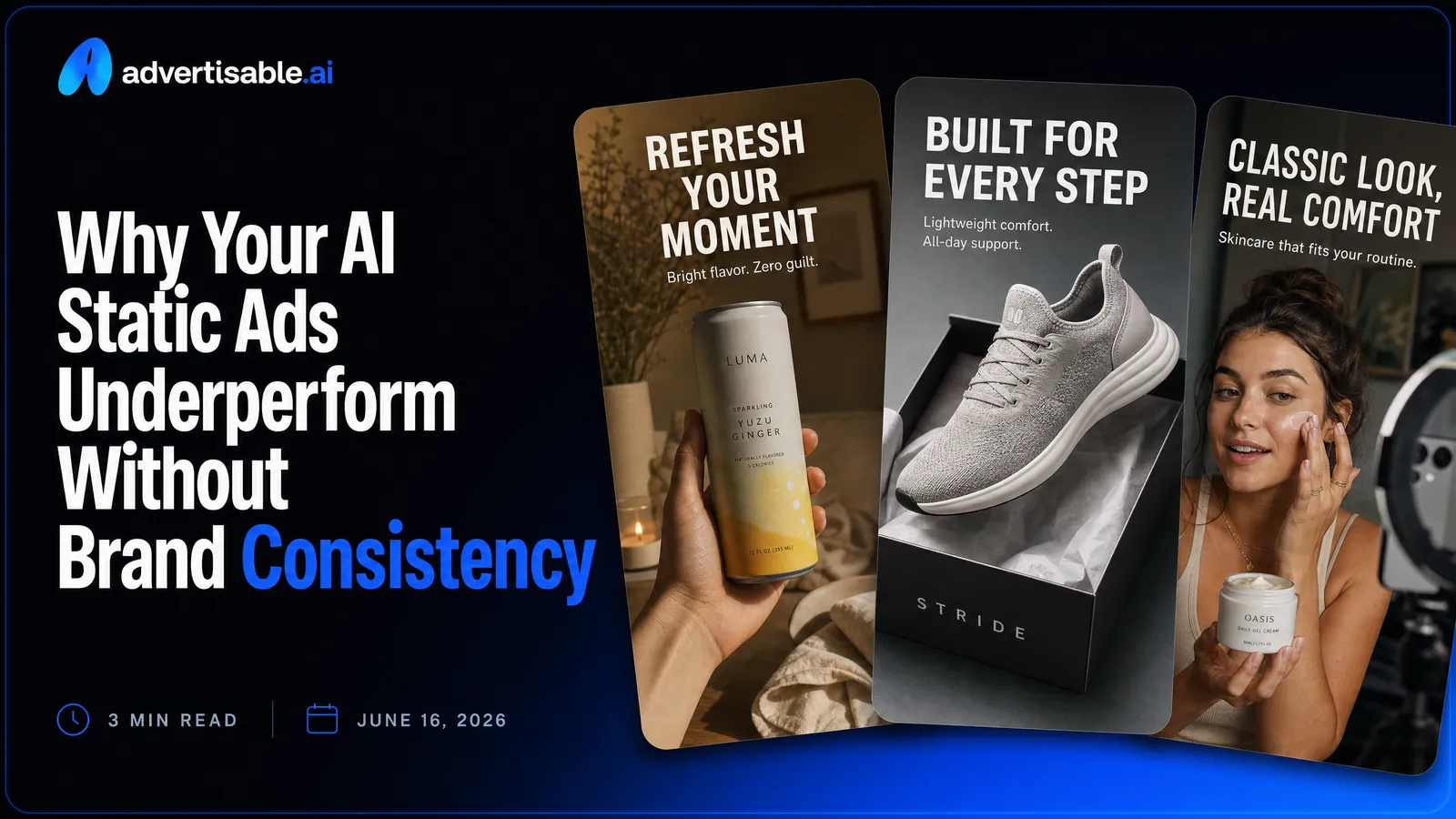
To generate AI static ads that actually perform today, lock your Brand DNA first and then use AI for controlled volume: produce multiple brand-accurate statics fast, regenerate only the elements that miss, and test winners on Meta and TikTok.
AI static creatives are single-frame, non-moving static image ads generated in seconds, built to be production-ready across placements and aspect ratios. When they underperform, it is usually not because the model cannot design. It is because your ads drift off-brand, your product loses contrast and clarity, or you are iterating blindly and burning credits on full re-rolls instead of targeted fixes.
In this guide, you will see how to:
- Keep brand consistency tight so trust and click intent do not leak
- Regenerate parts of a static without resetting everything
- Turn one proven angle into 5-8 variations in 48 hours, test for 2-3 days, then scale the winner
- Stay in control of what you still own: angle, offer, and message
- Choose tools based on iteration speed and control, not one-off aesthetics
We built Advertisable AI because we kept seeing performance teams stuck with slow creative cycles and uncontrolled AI outputs. With Create Statics, we generate production-ready static creatives from a prompt or product link, using our Brand DNA layer to enforce brand-accurate statics and our frame-by-frame editor to regenerate specific elements without wasting credits.
Once you treat AI statics as a testing engine, not a design contest, the advantage becomes obvious: velocity beats taste in most ad accounts. Let’s start by resetting the question and showing how fast you can realistically test without sacrificing brand consistency.
Stop asking if AI can design, start asking how fast you can test
Velocity beats taste in ad accounts
In ad accounts, “best-looking” loses to “most-tested” more often than people want to admit. Your job is not to win a design award, it is to find a message-market fit that holds CPA.
We see teams stall because they debate taste: fonts, shadows, whether the layout feels premium. Meanwhile, the account needs data. The fastest way to get it is controlled volume: ship more net-new angles, keep what performs, and move on without emotional attachment to any one creative.
Treat AI statics as a testing engine, not a replacement for judgment. You still own the strategy, but you stop letting production pace decide what gets tested.
- Velocity is a system metric: how many net-new ad variants you can launch per week without breaking brand rules
- Taste is a personal metric: whether the team “likes” the ad before the market votes
- Winning accounts build pipelines that make creative refresh routine, not a fire drill
Why statics still scale on Meta
Static ads still scale because they are fast to consume, easy to iterate, and they fit the way Meta optimizes around repeated patterns. You can test more hooks per dollar when the format is simple and the message is clear.
This is not theory. A recent Meta algorithm analysis notes that static images still drive approximately 60% to 70% of conversions on Meta, which is why statics remain a workhorse even as the platform evolves.
The catch is that Meta is increasingly sensitive to creative sameness. If your “new” statics are only tiny text-overlay tweaks, the system can treat them as near-duplicates, and you lose the practical benefit of fresh inventory.
- Statics let you rotate angles quickly to reduce creative fatigue
- They keep the product and promise legible in crowded feeds
- They make structured iteration realistic: new concept, then variations on the winner
What AI static ads are in practice
AI static ads are single-frame image ads generated in seconds, then shaped into production-ready variants you can actually test. In practice, the output is only as strong as the constraints and direction you give it.
A usable workflow is simple: start with a proven angle, generate multiple brand-accurate statics around that angle, then regenerate only the elements that miss (product clarity, contrast, headline legibility) instead of starting from scratch each time.
When you do this well, AI is filling the canvas at speed while you keep ownership of what matters: the hook, the offer, and the decision about what gets tested next.
- Inputs: product details, brand assets, and a specific hook or promise you want to test
- Outputs: multiple static creatives in the right aspect ratios for placements
- Iteration: targeted regeneration of problem areas (background, product position, headline treatment) while keeping the core concept intact
Why AI static ads lose when they drift off-brand
Brand drift costs you the click
Off-brand AI static creatives underperform because the reader has to re-verify who you are before they even process the offer. That hesitation shows up as lower click intent and weaker downstream conversion quality.
In performance accounts, you are not only competing on price or product. You are competing against attention filters. When your typography shifts, your color system changes, or your logo behaves differently from ad to ad, you stop feeling like a familiar brand and start feeling like a new, untrusted advertiser every time.
- Recognition breaks: the ad does not instantly register as your brand in-feed
- Credibility drops: the visual cues that signal legitimacy (consistent layout, marks, styling) are missing
- Message gets discounted: even a strong hook reads like it came from someone else
- Testing gets noisy: you cannot tell if the concept failed or the presentation lost trust
Brand DNA is your non-negotiable guardrail
You do not solve drift by writing better prompts. You solve it by locking the brand system AI is allowed to use, then generating inside those constraints.
In practice, that means treating Brand DNA as production rules, not inspiration. Your statics should have the same visual signature every time, even when you are testing new angles.
- Fonts: typeface choices, hierarchy, and how headlines and CTAs are styled
- Colors: your primary palette, background rules, and contrast standards so the product stays clear
- Logo: correct file, placement, padding, and when it should or should not appear
When those three are locked, variation becomes a performance tool instead of a brand risk.
Regenerate what missed, not the whole ad
The fastest way to waste AI speed is restarting from zero every time one element is wrong. You want iteration that preserves what is already working and only replaces the piece that missed brand.
This is where controlled regeneration matters. With our frame-by-frame editor in Advertisable AI, you can keep the structure and regenerate specific elements until the creative is brand-accurate and readable, without rewriting the entire concept.
- Swap a background that clashes with your palette while keeping the product and headline
- Fix typography or CTA styling without changing the image composition
- Correct logo sizing or placement without losing the layout that tested well
A repeatable workflow: angle to variations to winners
Start with a proven angle and offer
Speed only helps if you are multiplying something that already converts. Start from your proven angle and offer, then use AI static creatives to express that same promise with tighter brand consistency and clearer product presentation.
In our experience, teams lose time when they test “new ideas” that are really new words on a weak offer. Pull one concept that has already earned spend in your account: the hook, the value prop, and the exact offer mechanics. Your job here is not creativity.
It is controlled repetition with better execution.
Keep the test clean by holding the structure constant. Change the surface expression, not the strategy, so you can tell whether performance moved because of the creative, not because you quietly changed the deal.
- Angle: pick the message that already drove your lowest CPA or best CTR (problem-solution, price-led, founder story, before-after, etc.)
- Offer: keep the same discount, bundle, shipping, and guarantee language so performance comparisons stay valid
- One “truth” per ad: a single promise, one supporting proof point, and one clear call to action
- Brand guardrails: lock fonts, colors, and product depiction so “new” does not mean off-brand
Generate 5-8 variations in 48 hours
You are not trying to create eight different ads. You are generating 5-8 variations of the same concept so the market can pick the best execution fast.
Use a fixed template and rotate only a few variables. With Advertisable AI Create Statics, you can start from a product URL, enforce Brand DNA, then regenerate specific elements instead of rebuilding the whole ad every time.
The fastest path is to decide your variation map first, then generate in one batch. You should be able to look at the set and immediately see what changed and what did not.
- Hook line: curiosity-led vs benefit-led vs objection-handling
- Visual hierarchy: product large vs lifestyle-supporting vs ingredient-feature callout
- Background and contrast: light vs dark, clean negative space vs textured, avoiding product-on-same-color backgrounds
- Proof cue: review snippet, metric, or “as seen in” style badge (only if you can substantiate it)
- CTA treatment: button-style vs text CTA, urgency vs neutral
- Format: 1:1 feed, 4:5, 9:16 with identical messaging
Test 2-3 days, scale one winner
Run the set for 2-3 days with consistent targeting and conversion events, then pick one winner to scale. The goal is a clear signal, not a perfectly “fair” test.
Keep budgets controlled so you do not overpay for noise. Watch for the combination of stable CPA (or cost per purchase), improving CTR, and clean conversion-rate direction. Kill obvious losers quickly, but do not overreact to the first few hours.
When you have a winner, scale it by expanding variations around that same concept lineage. Meta's creative velocity testing ties better outcomes to more net-new creatives per unit time, with 30-50% ROAS improvements and up to 8% higher conversion rates in teams that master it.
- Scale: duplicate the winning concept into 5-8 new variants (new hooks and layouts, same offer) rather than “starting over”
- Protect consistency: keep Brand DNA locked so your scaled set stays recognizably yours
- Refresh cadence: plan weekly variant drops to blunt fatigue before performance decays
What you still own: angle, offer, and message
AI can help you ship more brand-accurate statics faster, but it cannot decide what you are trying to make the market believe, or what trade you are offering in return. Those are still your levers.
Angles come from the market, not the model
Your best angle is not a prompt trick. It is a specific market truth your audience already feels, and you can prove in one glance with a static creative.
Models are pattern matchers. If your inputs are vague, you will get familiar-looking outputs that do not connect to a real objection, desire, or moment of intent. The fix is upstream: decide the angle before you generate variants, then use AI to explore execution options inside that angle without breaking brand consistency.
In practice, you want angles that are testable as headlines and visual hierarchy, not essays.
- Start from a real constraint: time, cost, uncertainty, complexity, status, or risk of getting the wrong outcome
- Phrase the angle as a one-sentence claim you can show, not explain (benefit + proof cue)
- Generate 5-8 variants that keep the angle constant while changing only hook phrasing and layout
Offers set the conversion math
Your offer determines whether a click is worth anything. Creative can lift CTR, but offer quality decides conversion rate, payback window, and how much you can afford to spend to find a winner.
When AI statics underperform, we often find the “angle” is fine but the offer is undefined, inconsistent across variants, or too hard to evaluate in a fast scroll. Tighten the offer first, then let AI generate production-ready static creatives that present it clearly and repeatedly without drifting off-brand.
You do not need a complicated promo. You need an offer the buyer can understand instantly and the account can scale.
- What you are selling (SKU or bundle) and who it is for
- The value exchange (price, trial, guarantee, shipping, bonus) stated in plain language
- The primary proof cue (rating snippet, key spec, before-after claim you can substantiate)
- The single action you want (shop, get the offer, check availability)
Message clarity beats visual novelty
Novel visuals do not save a confusing message. A static ad wins when the buyer understands the product, the outcome, and the next step in under a second.
This is where brand consistency matters: the more your statics look and read like you, the less cognitive work the customer has to do. Use your Brand DNA to keep typography, color, and product treatment stable, then push variation in the copy and hierarchy so tests stay comparable.
Run a simple clarity check before you scale any variant.
- Can you name the product in one glance?
- Is the primary benefit readable at mobile thumb distance?
- Is the offer unmissable and not competing with five other messages?
- Is the CTA explicit and aligned with the landing page?
How to choose AI static ad tools by iteration speed
Iteration speed is the real feature
Pick your AI static ad tool based on how fast you can ship testable variants, not how impressive one image looks in a preview.
In performance work, the advantage is throughput: you want to turn a proven angle into dozens of on-brand static creatives, launch them, and learn quickly. That is how you stay ahead of creative fatigue without turning every new concept into a mini production cycle.
Speed is also about feedback loops. You need a workflow where you can generate, review, tweak, and export in minutes, then get results back fast enough to inform the next batch.
- Time-to-first-usable creative: how quickly you can get a production-ready static from a prompt or product link
- Time-to-20 variants: whether batch generation is smooth or feels like babysitting
- Iteration loop time: how long it takes to correct one issue (logo placement, background, offer text) and regenerate
- Operational friction: reviews, approvals, and exports that slow teams down even when generation is fast
- Test cadence fit: tools that support three to five day cycles align with performance marketing velocity metrics
Controls that prevent wasted generations
Your credits disappear on preventable mistakes: off-brand colors, unreadable typography, and product shots that do not match what you sell. The best tools reduce rework by letting you lock what must stay consistent and only regenerate what is wrong.
Look for controls that enforce your brand rules by default, then give you precise edits instead of forcing full reruns. In our experience, element-level regeneration is the difference between fast iteration and random output.
- Brand guardrails (a Brand DNA layer) to keep fonts, colors, and visual identity consistent across every output
- Selective regeneration so you can fix one element without re-rolling the entire static
- Clear input structure: hook, promise, product moment, and layout guidance that the model can follow reliably
- Variation controls: the ability to create true angle variants versus minor cosmetic changes
Outputs built for Meta and TikTok
Iteration speed only matters if you can export creatives that are ready for the placements you actually buy on Meta and TikTok. Platform-ready outputs save you from post-processing, resizing, and last-minute text fixes that erase the time you thought you saved.
Prioritize tools that export multiple aspect ratios cleanly, keep the product high-contrast, and preserve legibility on mobile. You should be able to generate a set for feed and story-style placements without rebuilding the creative from scratch.
Advertisable AI Create Statics is designed around this workflow: generate brand-accurate statics quickly, regenerate specific elements when something misses, and export in the formats you need for testing.
- Multiple platform formats and aspect ratios (Meta placements, TikTok-friendly sizes) available at export
- Readable layouts that survive mobile compression: strong hierarchy, clear product, and high contrast
- Consistent brand treatment across a batch so your test isolates the message, not a changing visual system
- Fast creative swapping so you can refresh weekly without breaking your account’s look and feel
Turn brand-consistent AI static ads into predictable winners
If your AI static creatives keep drifting off-brand, the fix is not another prompt. It is a tighter system for consistency and faster iteration. You need more controlled variations in market, with fewer wasted cycles.
That is exactly how we built Advertisable AI Create Statics. You bring the angle, offer, and message. We help you generate production-ready static image ads in seconds, with a Brand DNA layer that keeps colors, fonts, and visual identity aligned so your testing volume does not turn into brand drift.
Start by importing your product link, generate a first batch of brand-accurate statics, then use the frame-by-frame editor to regenerate only what is not working. Ship the next set of variants this week and let performance, not opinion, pick your winners.
Frequently Asked Questions
Q: How does Brand DNA keep my ads on-brand?
A: Brand DNA is our system for enforcing your brand guidelines across every static creative you generate. It keeps key elements like colors, fonts, and visual identity consistent so your ads look like they came from the same brand, even when you are producing variations at speed. It also helps reduce brand drift that can quietly lower trust and click intent.
The result is faster testing without sacrificing consistency.
Q: Can I turn a static ad into a video?
A: Yes. With Animate, you can convert a winning static into motion while keeping brand accuracy intact. This is useful when you want to keep the same message and composition but expand into placements that favor movement.
Many teams start with statics for rapid angle testing, then animate the winners to extend performance and fight fatigue.
Q: How are AI Static Ads different from AI UGC Ads?
A: AI static ads are single-frame image ads generated for fast deployment and high-velocity testing. AI UGC ads are a separate format that uses AI avatars performing on camera in video, which can be better suited to certain hooks or social-native storytelling. In practice, statics are your fastest path to testing many angles and variations, while UGC-style video can complement that once you know what message is winning.
The key is choosing the format based on your goal, not novelty.