How to Make TikTok Ads Without Filming in 2026
You can make TikTok ads without filming any video yourself by using AI UGC, where an AI avatar delivers your script inside a storyboard you can edit scene by scene.
Here is what you are going to walk away with in this 2026-ready workflow:
- A no-filming, step-by-step method that starts with your product link, builds a storyboard, and ships production-ready creative fast.
- A decision guide for what to use today: AI UGC when you need a voice, Recreate Video when structure matters, and motion statics when the offer is simple.
- A quality control system: brand-consistency guardrails to keep visuals accurate, plus scene regeneration so you can fix one bad segment without rebuilding the entire ad.
- A testing mindset built for TikTok: more hooks, more variations, less guesswork when creative fatigue hits.
Skipping filming is not cutting corners. It is removing the slowest step so you can spend your energy where TikTok decides winners: the hook.
Next, we will break down why the first two seconds beat any camera setup, and how higher hook volume is what actually outruns creative fatigue.
Why is skipping filming the fastest path to better hooks?
Filming feels productive, but it pushes you to commit to one execution too early. When you skip the shoot, you buy back the one thing TikTok rewards most: fast iteration on the first seconds that decide whether anyone keeps watching.
Hooks beat cameras in the first second
In the scroll, your camera quality is invisible until you earn attention. Your hook is the only real asset in the first second, because it answers the viewer’s silent question: “Why should I care right now?”
Skipping filming forces the right order of operations: you write the hook first, then build everything else to support that promise. That is how you avoid spending hours producing an ad that starts slow, explains too much, or hides the product until the viewer is gone.
We anchor this in a simple reality from TikTok's official creative research: 90% of ad recall impact is captured within the first six seconds. The “no filming” advantage is that you can keep rewriting and swapping those first seconds without treating every change like a reshoot.
- Lead with one clear promise, not context
- Make the product visible early so the hook has a subject
- Design the opening to earn the next second, not to introduce the brand
Fatigue punishes sameness, not simplicity
Creative fatigue is not your audience getting tired of simple ads. It is your audience getting tired of seeing the same idea, told the same way, with the same pacing and first line.
Filming makes sameness more likely because you reuse the same setup: same background, same delivery, same shot, same cadence. No-filming workflows let you keep the message simple while rotating the wrapper, so you stay “new” without rebuilding everything.
The practical shift is separating the promise from the execution. You keep the value proposition stable, then change what causes the thumb to stop: the opening line, the pattern interrupt, the first visual, and the first two seconds of pacing.
- Same offer, different hook angles (speed, results, objection, surprise)
- Same script, different first sentence and first visual
- Same structure, different AI avatar delivery and scene sequence
Volume creates winners you can scale
Better hooks are found, not brainstormed. Skipping filming is the fastest route to better hooks because it makes volume operationally realistic, and volume is what produces statistically meaningful winners.
A filmed workflow turns every test into a high-effort bet. A no-filming workflow turns tests into small, cheap swings: you can generate multiple hook variants, keep the rest of the ad consistent, and learn what the market responds to.
This is where scale actually comes from: once you have a winning hook, you do not protect it like a masterpiece. You replicate its structure, re-skin it for new angles, and keep feeding the account fresh openers before performance decays.
- You build a library of proven hooks you can reuse across products and offers
- You standardize what stays fixed (product moment, core promise) so your tests are clean
- You increase your “hit rate” over time because each test teaches you what to write next
How do you make a TikTok ad without filming, step by step?
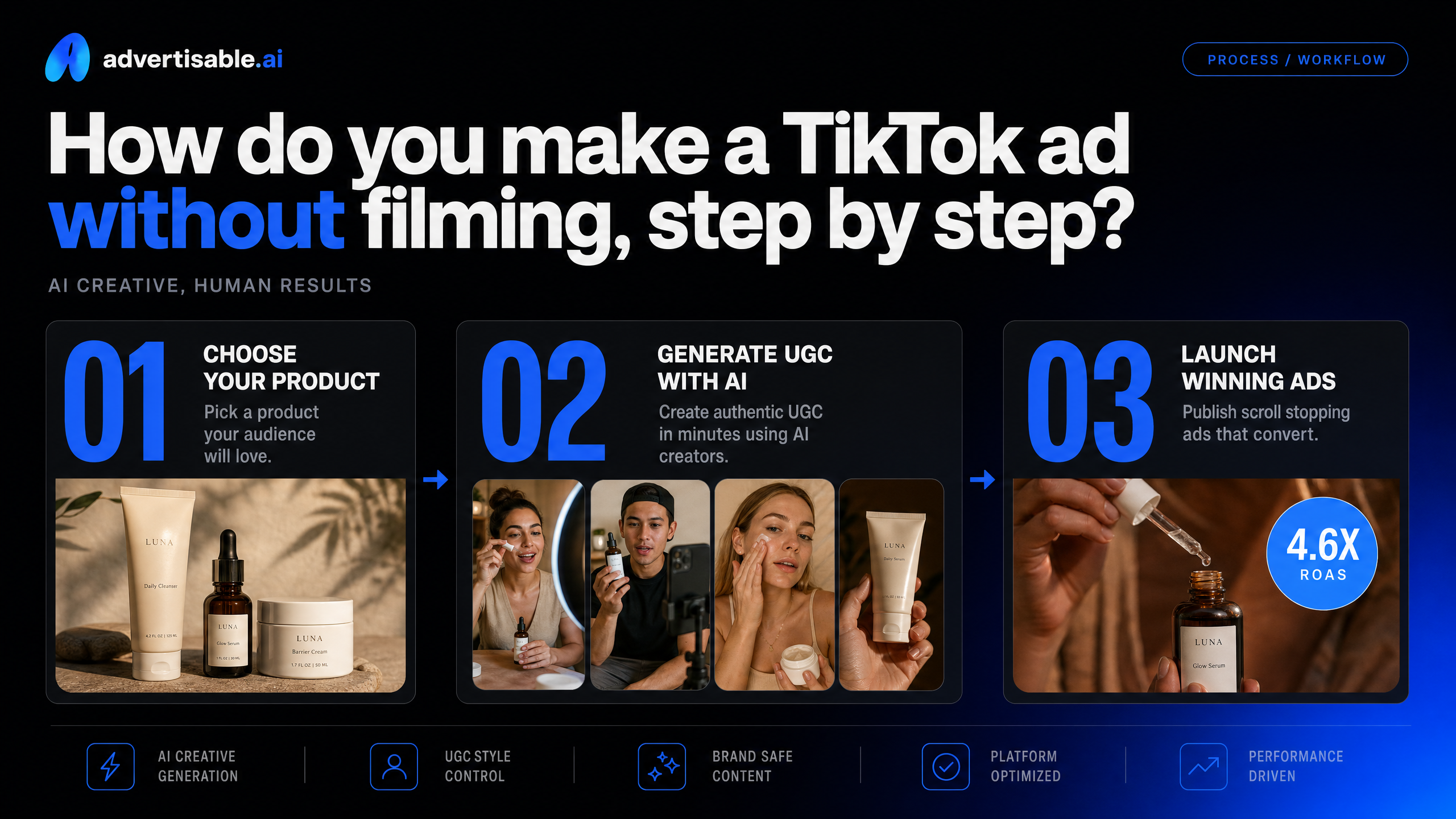
Start With a Product Link and One Clear Promise
You make a no-film TikTok ad faster when you begin with a product link and a single, testable promise, not a blank script. The link forces accuracy around what the product is, what it includes, and what you can responsibly claim.
From there, your job is to choose one promise the viewer can understand in one breath. In performance creative, we see ads fail most often because they try to sell the entire product page in 20 seconds, which makes the hook and the narrative blurry.
In an AI UGC workflow, the product link can be used to auto-generate a storyboard and scenes, but the promise is still your responsibility. Pick the one outcome you want the ad to be about, then build every scene to support that outcome and show the product early so the viewer is never confused about what they are watching.
- Pull 3 raw inputs from the product page: primary use case, proof element (review snippet, ingredient, feature), and a specific constraint (who it is for or not for)
- Write one promise in plain language: outcome + timeframe or moment of use (only if you can support it)
- Decide your “product moment”: the earliest point the product should be visible or named (aim for the opening beats, not the midpoint)
That single promise becomes your north star for the hook, the storyboard, and the variants you will test.
Lock the First Two Seconds on Paper
The fastest way to waste ad spend is to “generate a video” before you have a first-two-seconds hook written down. Nobody scrolls past because you did not film, they scroll past because the opening did not earn attention.
Write the hook like a headline and commit to it before you touch scenes, avatars, or edits. Your hook should make one promise and signal the product category immediately, so the right viewers self-select and keep watching.
Then turn that hook into two elements you can control: the on-screen text and the first spoken line. If those two disagree, the ad feels uncertain. If they align, the rest of the storyboard has a chance to do its job.
TikTok's official creative research notes that 90% of ad recall impact is captured within the first six seconds, so treating the first two seconds as a draftable asset is the practical move, not a creative philosophy.
- Hook formula you can draft in 60 seconds: “Stop doing X if you want Y” or “I tried X so you don’t have to” or “The fastest way to get Y without Z”
- Two-second checklist: one promise, one product cue, one reason to keep watching (curiosity, contrast, or concrete result)
- Write 5 hooks at once and keep the body identical, so you learn from the hook instead of changing everything
Export Clean 9:16 Versions for Ads Manager
When you are not filming, your “production” is the export. You want TikTok-native 9:16 outputs that preserve readability, keep the product moment visible, and give you versions you can test without rebuilding the ad.
Export multiple 9:16 cuts from the same storyboard: different hook scenes, different first lines, and tight length options. In our experience, most teams lose hours by exporting one version, uploading it, then realizing the safe-area text is blocked or the opening is too slow.
- Create 9:16 exports in multiple lengths (for example: 15s, 30s, 60s) so you can match placements without re-editing
- Keep captions and key on-screen text inside the safe area so UI elements do not cover your claim or product name
- Name files by hook and version (Hook-01, Hook-02) so you can connect Ads Manager results back to the exact first two seconds
- Export a “control” and 3-5 hook variants from the same base creative to make testing clean
If you can trace each export back to a specific hook, you can scale what works instead of guessing.
Which no-film TikTok ad format should you choose today?
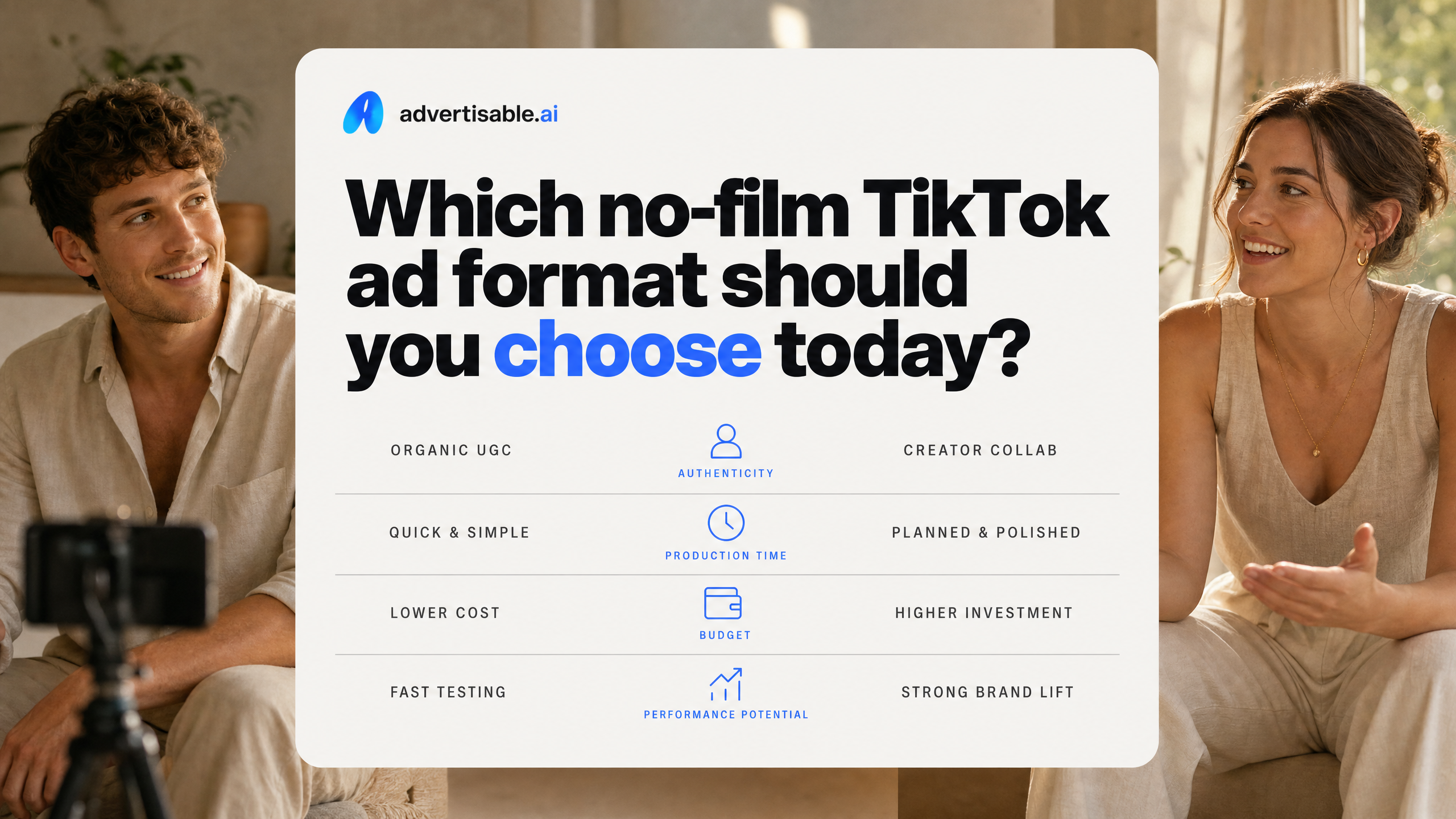
Pick the format that solves your current bottleneck: you either need a believable voice, you need to preserve a proven structure, or you just need to communicate a simple offer fast. The wrong choice is usually obvious in performance: weak hooks, muddled product moments, or a message that never lands.
Choose AI UGC when you need a voice
AI UGC is the right move when the ad needs someone to speak, explain, or persuade on camera, and you do not have a creator pipeline. A strong voiceover plus a creator-style avatar can carry nuance that text-on-screen cannot.
This format is most useful when your product has an invisible benefit (software, supplements, services) or when objections are the real conversion blocker. In our experience, it also helps when you need fast iterations on the first two seconds, because you can regenerate just the hook scene without rebuilding the whole ad.
Two execution details decide whether AI UGC feels native: keep the product moment early and keep the script narrowly focused on one promise. The moment you stack three claims, it stops sounding like a real creator and starts sounding like an ad read.
- Best for: explaining benefits, handling objections, “before/after” narratives, and any offer that needs trust-building in the first 6 to 15 seconds
- Watch-outs: enforce Brand DNA guardrails so colors, logo usage, and claim language stay consistent; regenerate any scene where the product representation drifts
- Fast test idea: run 5 hook variants that keep the same body script, so you isolate what actually drives thumb-stopping
You choose AI UGC when the voice is the creative asset, and the visuals exist to support it.
Recreate winners when structure matters
Recreate a winner when you already know the sequence works and you want to keep that pacing intact while swapping in your product. Structure beats novelty more often than people admit, especially when the original ad has a tight hook-to-payoff flow.
This is where template-based rebuilding shines: you are not brainstorming from scratch, you are transferring a proven blueprint. The goal is not to copy someone else’s vibe, it is to keep the same information order and retention mechanics while making the product moment and claims accurate for your offer.
Use Recreate Video when you have a reference ad that consistently holds attention, but you cannot film your own version quickly. In Advertisable, that means rebuilding the ad with AI avatars while keeping scene-level control, so you can adjust only what needs to change.
- Pick this format when: the winning ad has clear scene beats (hook, problem, proof, payoff, CTA) and you want to preserve them
- Avoid this format when: the “winner” depends on a specific human story you cannot credibly replicate
- Quality check: verify every scene still makes sense after the product swap, especially the first product moment and the proof segment
Use motion statics for simple offers
Motion statics work when the message is simple enough to understand from a headline, a price, and one visual. You are not asking the viewer to believe a story, you are asking them to notice an offer.
This format is ideal for straightforward ecommerce promos, feature callouts, or list-style benefits where voice is optional. The win condition is clarity: a clean first frame, readable text, and a single action.
Treat motion statics as a hook-testing tool: you can ship more variations with different promises, prices, and angles without rewriting a full script.
- Best for: discounts, bundles, new arrivals, “one feature, one benefit” messages
- Keep it tight: one headline, one supporting line, one CTA
- Common failure: trying to cram an explainer into a format that is built for scanning
How do you stop AI ads from looking off-brand?
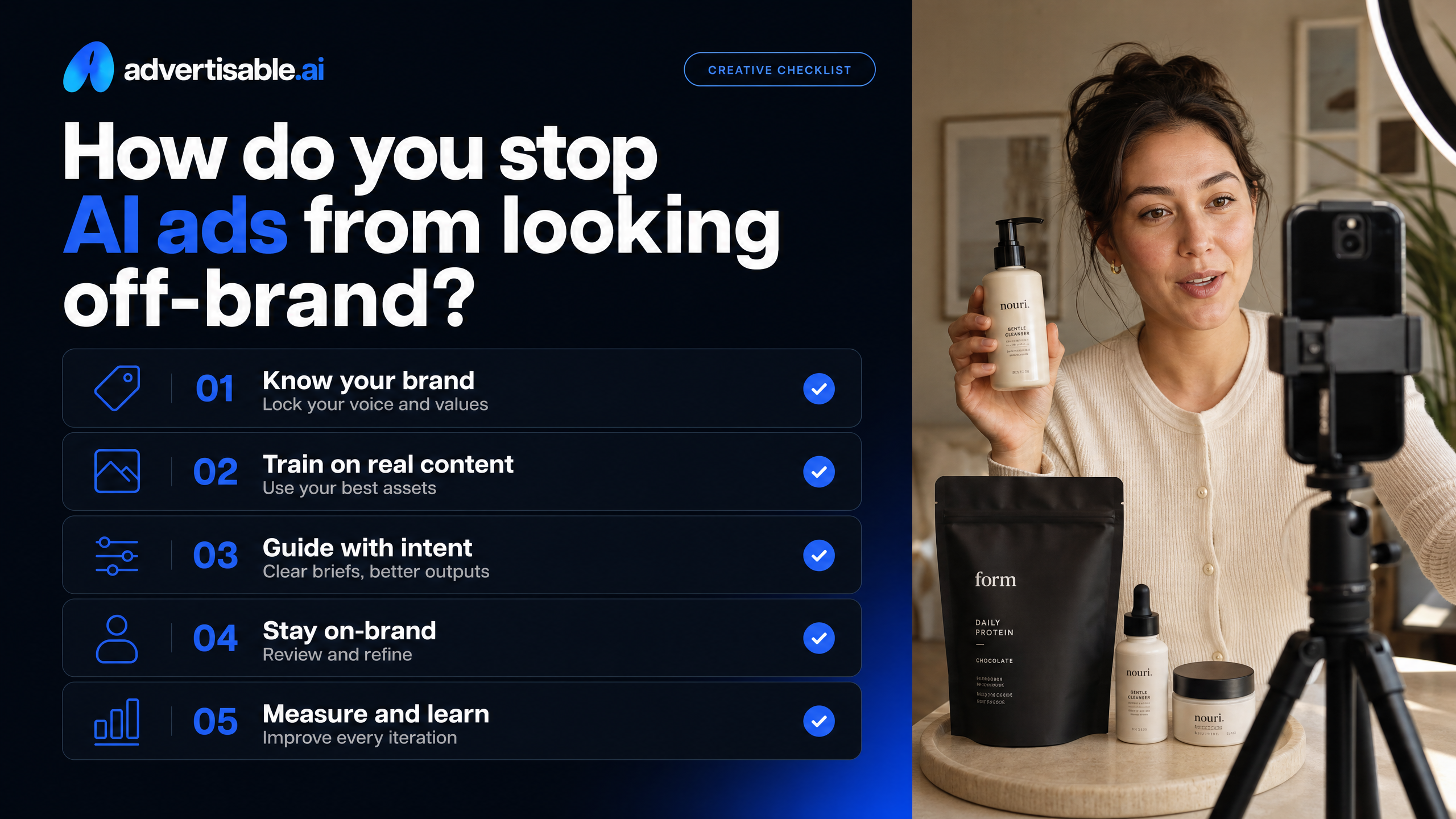
AI UGC can scale your TikTok output fast, but speed is exactly what makes brand drift expensive. You keep AI ads on-brand by locking in guardrails, editing at the scene level (not nuking whole videos), and making the product unmistakable early.
Use brand guardrails to prevent product mistakes
The fastest way for an AI ad to go off-brand is a product mistake: the wrong color, the wrong name, the wrong claim, or visuals that conflict with how your product is actually used. Guardrails exist to stop those errors before they ship.
In practice, you want your generation workflow to behave like a brand-safe template. Your brand inputs should be persistent, not re-explained from scratch every time you write a prompt.
What we use in Advertisable AI is Brand DNA, so the storyboard and every scene is generated with consistent tone, palette, and constraints. It keeps you from “winning” a hook that can never be approved because it violates your own rules.
- Lock in your non-negotiables: logo usage, colors, typography, and any prohibited visual elements
- Define claim boundaries: what you can say, what you cannot imply, and any required disclaimers your team enforces
- List product truths the model must not contradict: how it looks, how it’s used, what it includes, and what it does not do
- Decide your “voice box”: the creator-style tone you want (calm, direct, playful) and the tone you do not want
Regenerate the hook scene, not the whole ad
When an AI ad looks off-brand, it is usually one or two scenes causing the damage, and the hook is the top suspect. Fixing that by regenerating the entire video is how you accidentally break the scenes that were already working.
Scene-level control is the practical unlock here. You keep the product moment, pacing, and CTA structure intact, and you only iterate on the opening seconds until it sounds and looks like your brand.
A clean workflow is: generate a storyboard, approve the middle and end first, then run hook variations as scene swaps. You move faster, and your results are easier to interpret because you are not changing five variables at once.
- Freeze the scenes that are correct (product, offer, proof, CTA)
- Regenerate only the hook scene with a single, clear promise
- Keep the avatar, framing, and on-screen text rules consistent while you test hook angles
- Export multiple hook variants against the same back half so performance differences map to the hook
Show the product early and make it unmistakable
Off-brand often means “unclear.” If the viewer cannot tell what you sell in the first seconds, the rest of the ad has to work too hard, and the AI will tend to fill gaps with assumptions.
Keep the product moment early and concrete. That means the actual product on screen, named correctly, with the visual details your customers recognize, not a vague lifestyle stand-in.
Use your hook to earn attention, then anchor that attention with a fast product reveal. TikTok's official creative research notes that 90% of ad recall impact is captured within the first six seconds, so clarity is not optional.
- Put the product on screen in the opening: packaging, UI, or the core object, depending on what you sell
- Match on-screen text to the exact product name and primary benefit you can support
- Avoid “mystery” openings that delay what the product is
- Keep the product moment consistent across hook variants so you do not confuse the audience or the algorithm
Ready to make TikTok ads without filming, and still win the scroll?
If you take one thing from this guide, make it this: the shoot was never the bottleneck. The hook is. When you can generate and test more opening angles, you stop guessing and start building repeatable winners before creative fatigue catches up.
That is exactly where we fit. With Advertisable AI, you can paste in a product link, get a storyboard, and produce AI UGC that looks creator-native without hiring creators or picking up a camera. Then you use scene-level control to regenerate only the hook scene until it earns attention, while Brand DNA keeps everything consistent.
Start with the $5 trial, generate five hook variations, and export your 9:16 winners for Ads Manager.
Frequently Asked Questions
Q: How is AI UGC different from real UGC?
A: AI UGC is generated entirely by AI, using AI avatars to deliver your script in a creator-style format, so you can produce ads without filming or coordinating creators. Real UGC is filmed by humans, which can bring natural variation but also adds scheduling, iteration cycles, and inconsistency between creators. If your goal is to test hooks fast and refresh creative on a schedule, AI UGC gives you speed and control without sacrificing a TikTok-native structure.
You still stay accountable for accuracy and brand fit, which is why guardrails and review matter.
Q: What is scene-level control?
A: Scene-level control lets you edit and regenerate specific scenes inside an ad without redoing the entire video. Practically, that means you can iterate on the first two seconds, the product moment, or a single line that feels off, while keeping everything else stable. This is how you test hooks efficiently, because you isolate the variable that drives performance instead of starting over every time.
It is also how you reduce brand risk, since you can fix the exact moment that misrepresents your product or tone.
Q: Do I need to know how to film or edit to create AI UGC ads?
A: No. You can start from a product URL or a clear description of your offer, and the platform generates a storyboard and production-ready creative for you. Your job becomes decision-making, not video production: approve the structure, tighten the hook, and keep the product moment early and clear.
If something is not working, you use scene-level control to adjust that specific scene rather than learning a full editing workflow. The fastest path is simple: write the promise first, then iterate the first two seconds until it holds attention.