Winning Ad Creatives: What They Share & How to Find Yours

A winning video ad creative looks like a tight, repeatable sequence: a specific two-second hook that makes one clear promise, an early product moment that stays accurate, one believable proof element, and a single CTA that tells you exactly what to do next.
If you are shipping ads under pressure and fatigue is already creeping in, you need two things at the same time: a clean creative anatomy you can storyboard quickly, and a controlled testing system that does not dilute results.
- What the strongest hooks share when you only have two seconds to earn the thumb stop
- How to show the product early without drifting into inaccurate claims or vague visuals
- Which proof elements land as believable without stacking risky, hard-to-defend statements
- How to pace scenes and keep sound-off readability so the message survives different placements
- How to test 10 to 20 one-variable variations, read performance in 48 to 72 hours, and iterate without chaos
Before you chase new concepts, get the foundation right. Start by locking in the anatomy every winning video creative shares, beat by beat, so your next batch of variations has a structure the ad account can actually reward.
The anatomy every winning video creative shares
Winning ad creatives are built on a tight, repeatable sequence. When you get the first 5 to 10 seconds right, you earn the right to sell.
The two-second hook with one promise
Your hook has about two seconds to earn attention, and it needs one clear promise. Not a vibe, not a teaser, not three benefits stacked together.
In performance creative, clarity beats cleverness because the viewer is deciding fast: “Is this for me?” Make the promise concrete enough that someone could repeat it back after one watch.
- Lead with the outcome: “Get X without Y.”
- Name the moment of pain: “Still doing X every morning?”
- Call out the audience: “If you sell X, stop doing Y.”
The early product moment that stays accurate
Show the product early, and keep it accurate. The fastest way to kill a potential winner is a hook that implies something the product cannot actually deliver.
The product moment is not a beauty shot. It is a quick, unmissable “what it is and what it does” beat, ideally tied to the hook’s promise. If the viewer only watches the first few seconds, they should still understand the offer.
Accuracy matters because it protects conversion quality. When the first impression matches reality, you get fewer misclicks and more buyers who stick.
One proof element that feels believable
You need one proof element, not a wall of claims. The goal is believability, so the viewer can relax and keep watching.
The proof should be simple and specific, and it should match what you can actually show or substantiate in an ad.
- A quick demo that makes the benefit visible in one shot
- A concrete detail that signals legitimacy (what is included, how it works, what changes)
- A short testimonial line with a real constraint (who it is for and what result they got)
Pacing and clarity that survive Meta and TikTok
A visual change every 1 to 2 seconds
On Meta and TikTok, you earn attention in micro-beats. Plan a visual change every 1 to 2 seconds so the viewer’s brain gets a new reason to stay.
A “visual change” does not mean random motion. It means the next piece of information arrives as a new shot, crop, overlay, or on-screen demo step that advances the claim you made in the hook.
- Cut to a new camera angle or tighter crop on the product
- Swap the background or move from talking head to hands-on demo
- Introduce a new on-screen headline that updates the promise (not the same line restyled)
- Show the next step in a process: open, pour, apply, compare, result
- Use quick UI-style callouts (arrows, circles) to redirect the eye to the proof
Sound-off readability that still sells
Assume most people will watch with no audio, then make the ad persuasive anyway. Verizon and Publicis Media research found 92% of mobile users and 83% of desktop users report viewing video with the sound off.
Treat captions as sales copy, not transcription: short lines, strong nouns, and one idea per frame. The viewer should understand the offer, the proof, and the next step without relying on voiceover.
Prioritize contrast and placement so text survives thumbs and UI. If your message only works when someone listens closely, it will not scale on these feeds.
- Keep on-screen lines to roughly 5 to 8 words when possible
- Put the product name and primary benefit on-screen by second 2 to 3
- Caption the proof, not just the dialogue: what changed, for who, and why it’s believable
One CTA with platform-native wording
Use one CTA per creative, and write it the way the platform expects. Multiple actions create hesitation and muddy what the algorithm should optimize for.
Match the CTA to the behavior people already do in-feed, and make it frictionless. You are not writing a slogan, you are issuing a single instruction.
- Meta: “Shop now” or “Get offer” when the intent is purchase-ready
- TikTok: “Tap to see how it works” or “Tap to get yours” when you need one more step of curiosity
- Retargeting: “Finish your order” when the viewer already knows the product
Best winning video creative patterns you can storyboard fast
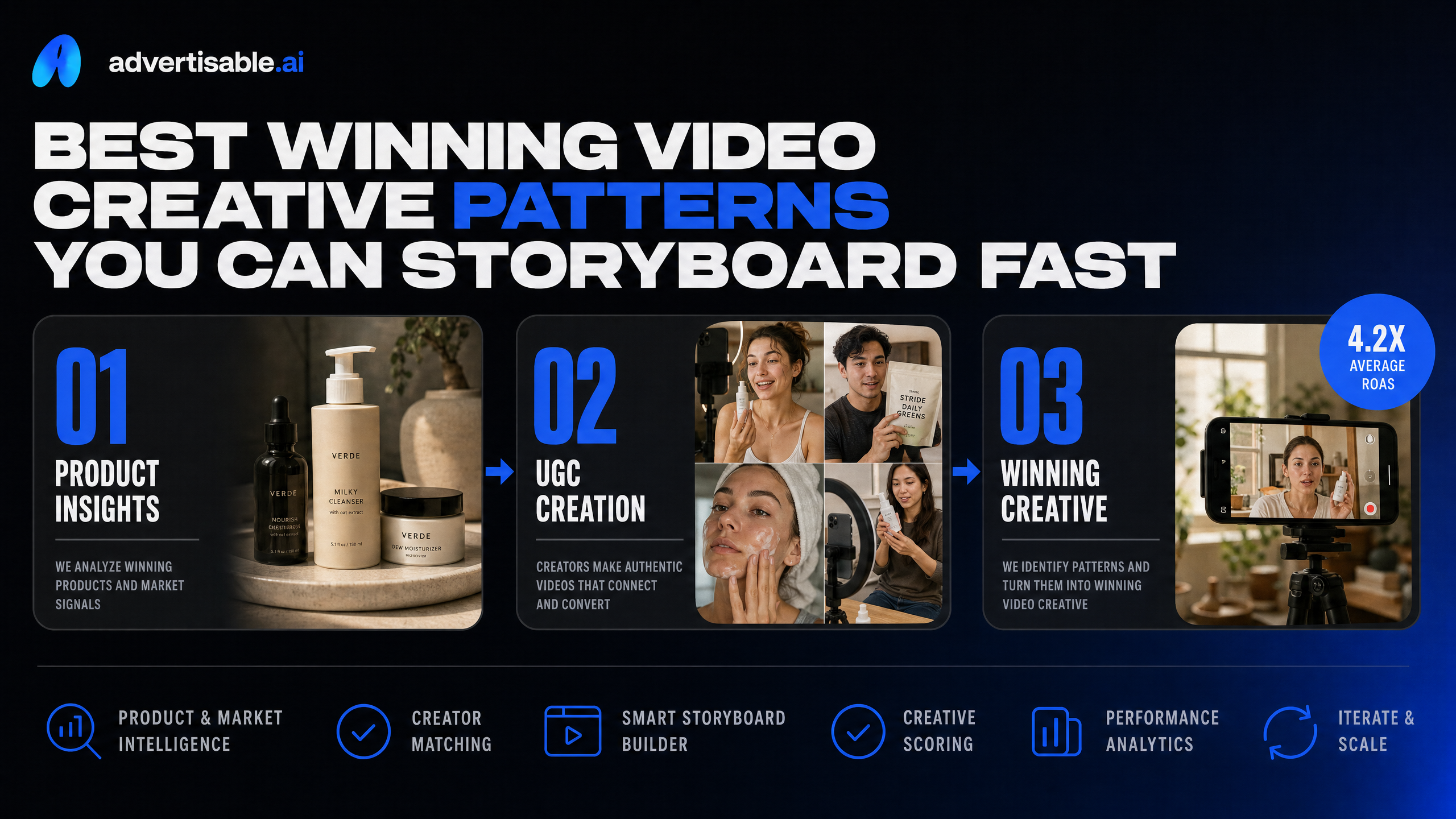
Problem to solution in six scenes
The fastest “winner-shaped” storyboard is a six-scene arc that moves from a specific pain to a visible outcome, without detours. You get clarity, pacing, and a clean structure for one-variable hook testing.
Keep each scene to one job and one on-screen sentence max, so you can swap hooks or proof without rebuilding the whole ad.
- Scene 1 (0-2s): Call out the problem in the viewer’s words
- Scene 2: Agitate with one real consequence, not a rant
- Scene 3: Introduce the product early and accurately (show it, name it)
- Scene 4: Show “how it works” in one step (demo, setup, or mechanism)
- Scene 5: Show the outcome (before/after, speed, ease, or result)
- Scene 6: Single CTA that matches intent (shop, learn, get quote, etc.)
Social proof with one concrete detail
Social proof works best when it is one believable detail, not a pile of claims. Your job is to make the proof verifiable in spirit: specific enough that it feels earned.
Use proof that can be shown on screen in a single beat, then move on. That keeps the ad from turning into a testimonial montage that dilutes the product moment.
- A screenshot-style review with one quoted line plus a timestamp (for example: “Day 3: finally stopped slipping”)
- A single UGC-style clip with a defined context (role + timeframe + outcome)
- One concrete operational detail (delivery time, setup time, size/fit note) that reduces purchase risk
Lifestyle plus demo with a clear payoff
Lifestyle only performs when it earns its keep by making the demo feel inevitable. You show the moment the product fits into their day, then immediately prove it works.
Storyboard it as “context, friction, use, payoff” so the viewer can picture themselves getting the benefit, not just admiring the vibe.
This is where scene-level control matters: you can lock the lifestyle setting while swapping the demo angle or payoff line inside the same creative sequence.
- Lifestyle: 1-2 seconds of the real use environment (kitchen counter, gym bag, commute)
- Demo: one clear action shown close-up (apply, click, pour, plug in, compare)
- Payoff: the visible win tied to a metric the viewer cares about (time saved, less mess, better finish, fewer steps)
Why you cannot design a winner upfront
Small hook changes swing the outcome
You cannot “design the winner” because tiny changes in the first seconds can completely reshuffle performance. The hook is the throttle on attention, and attention decides whether your proof and CTA even get seen.
In practice, changing one concrete detail often beats rewriting the whole ad: a different promise, a different problem statement, or a different first visual can shift who self-selects into watching. That is why we treat hooks as controlled variables, not a one-time brainstorm.
- Swap the first line from outcome to problem (or vice versa) while keeping the rest identical
- Change the first on-screen visual from “talking head” to “product-in-use”
- Replace vague language with one specific claim the viewer can verify in their head
Creative hit rate is not predictable
Even experienced teams are not reliably good at picking winners before they run. Your preferences are not the algorithm’s preferences, and they are definitely not your customer’s preferences.
Marpipe's study of 750+ marketers found the average marketing professional can only predict winning digital ad creative 52% of the time. That is basically a coin flip, which is why disciplined iteration beats “perfecting” one concept in a vacuum.
Fatigue punishes accounts that stall
When you stop shipping new creatives, performance does not just plateau. It decays as the same audience gets repeated exposures and stops responding.
Meta's own research points to a refresh cadence of every 2 to 4 weeks on Meta for cold prospecting. If you do not have new variants ready, you get forced into reactive changes like budget cuts or audience tinkering instead of controlled creative testing.
This is where scene-level control and brand-consistency guardrails matter: you can keep the structure that worked, refresh the hook and early product moment, and avoid drifting off-brand while you move fast.
A controlled testing system that finds winners fast
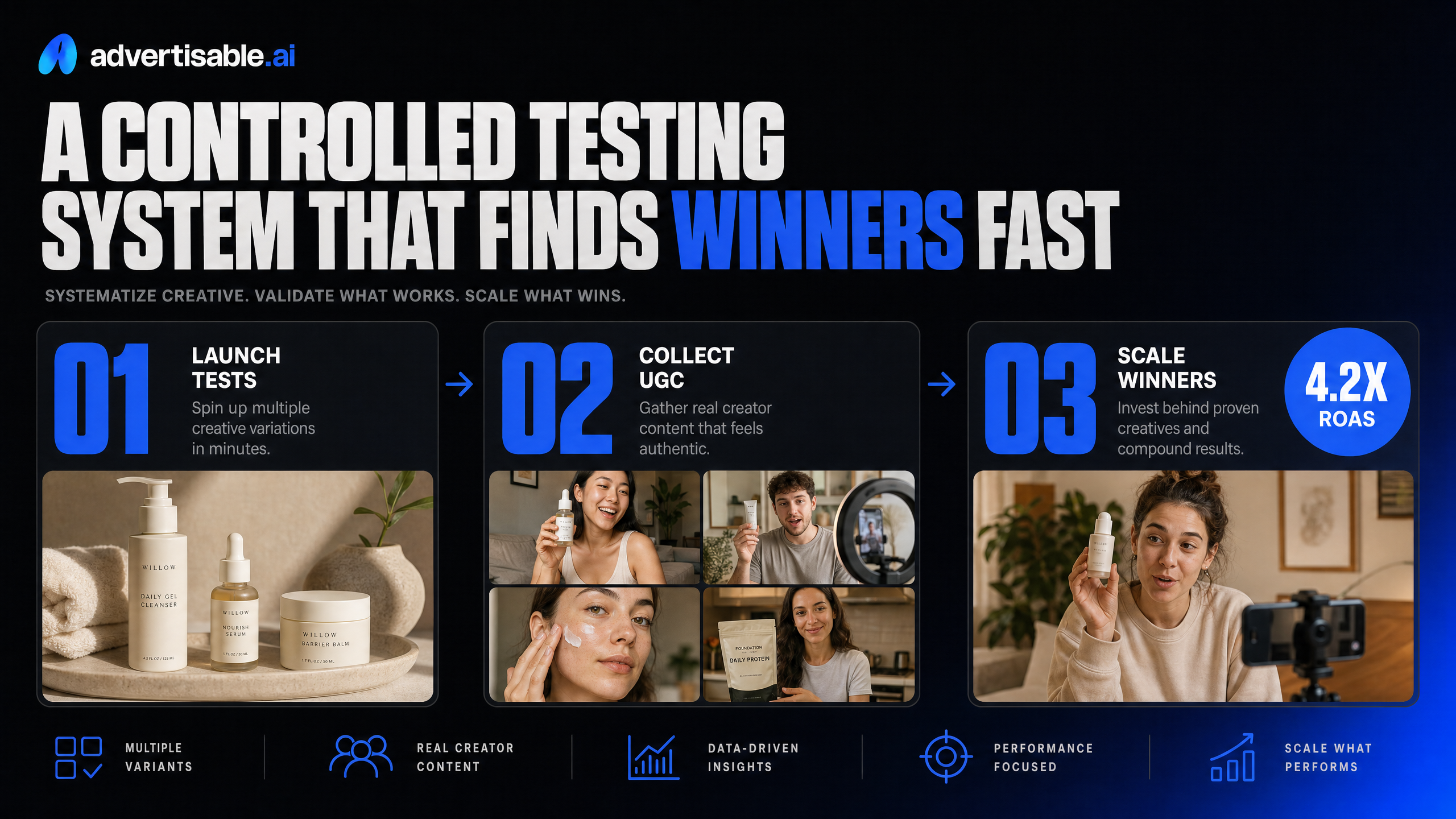
Fast creative testing only works when you control inputs. The goal is not more videos, it is cleaner learnings that compound into winners.
Start with one approved storyboard
Anchor every test on a single, approved storyboard so your variations stay comparable and on-brand.
Pick one creative sequence you are willing to scale: the same hook slot, the same early product moment, the same proof slot, and the same CTA slot. Lock that sequence before you generate volume.
In our experience, this is where teams either move quickly or waste weeks: approvals happen once at the sequence level, then you iterate inside a controlled box.
- Confirm the product moment is accurate and appears early
- Confirm the proof element is believable and not stacked with extra claims
- Confirm the CTA is singular and unambiguous
- Get final sign-off on the full sequence before you branch variants
Change one variable per test batch
One-variable batches are how you find real winners, not noise. When you change the hook, the proof, and the CTA at the same time, you cannot credit the lift to any one decision.
Define the variable and keep everything else fixed. Run enough variations to cover meaningful differences, not cosmetic edits.
Advertisable AI makes this practical because you can keep the storyboard constant while making scene-level control edits to only the element you are testing.
- Hook-only batch: 10 to 20 hook lines with the same scenes underneath
- Proof-only batch: swap demo vs concrete detail while keeping the hook and CTA fixed
- CTA-only batch: one action phrase per version, no extra offers or second asks
Read 48 to 72 hours, then iterate
Give a batch 48 to 72 hours before you declare a winner and move to the next variable. You are looking for directional signal, not a perfect read.
mobile advertising research notes that feed algorithms on Meta and TikTok burn through creative inventory in 48-72 hours, which is why short test windows often surface the first clear separation.
Promote the top performers into the next round, pause the clear losers, and build the next batch by changing only the next variable you care about. This is how you turn creative testing into a repeatable loop instead of a string of one-off experiments.
How to keep high-volume creative on-brand
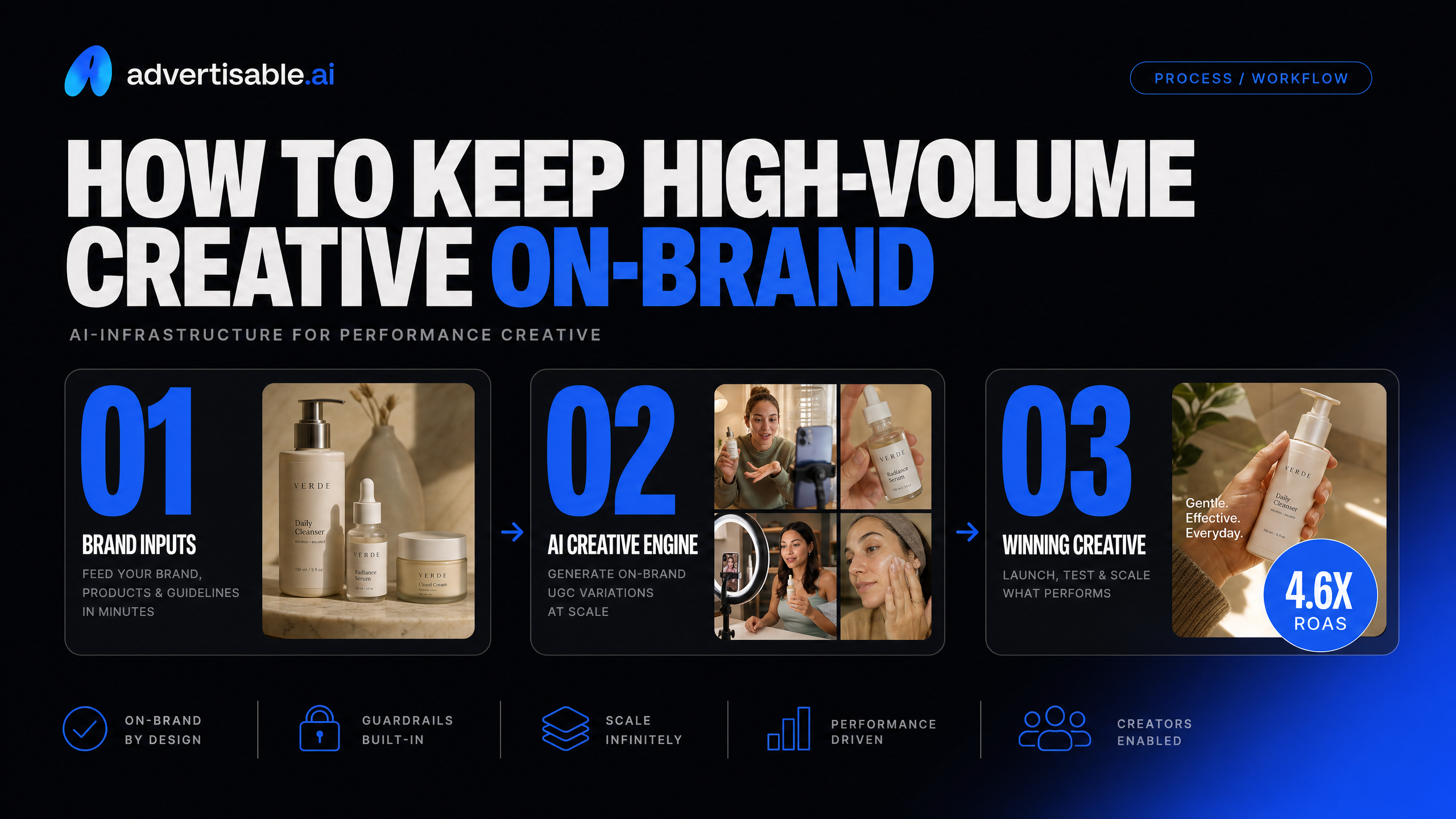
High-volume output only helps if it stays recognizably yours. The fix is a tighter workflow: lock rules early, approve structure once, and edit at the scene level.
Lock brand rules before generation
Your fastest path to on-brand volume is to decide the rules before the first frame exists. Once you are generating, every missing rule becomes rework and wasted review cycles.
Use a single source of truth for brand-consistency guardrails, then enforce it across every batch so variations stay creative, not chaotic.
- Upload your brand guidelines: colors, logos, fonts, and tone of voice
- Lock brand identity so the system applies those rules automatically
- Run a small test generation to confirm the guardrails are actually being applied
Approve the sequence before frames
Treat the creative sequence as the asset, not the rendered video. When the hook, product moment, proof, and CTA order is approved first, you stop debating edits that are really structural problems.
A Creative Sequence Approval Workflow lets you align on the story logic once, then generate multiple executions without reopening the same argument on every variation.
Fix scenes instead of restarting
Restarting from scratch is the most expensive way to get back on-brand. When one moment is wrong, you want the ability to correct that exact scene without touching the rest of the ad.
In our experience, scene-level fixes also protect test integrity. You keep the same sequence and change one variable, instead of accidentally changing five things by regenerating the whole spot.
- Swap a single shot that drifted off-brand while keeping the approved sequence intact
- Adjust one line of on-screen text or one proof element without rewriting the entire ad
- Regenerate only the affected scene, then re-export the same variant
Questions we hear before you scale variations
What makes an ad creative a winner?
A winner is the creative that reliably earns you the next action at your target CPA or ROAS, not the one your team “likes.” You only know it is a winner when it repeats across spend and audiences.
In performance video, the structure matters more than polish: a clear 2-second hook, a product moment early enough to prevent confusion, one believable proof element, and a single CTA. When any of those are missing, you usually see it in the data first as weak hold, low click intent, or post-click drop-off.
- Hook: one concrete promise in the first 2 seconds
- Early product truth: show what it is and what it does, fast
- Proof: one strong demo, comparison, or specific detail (not stacked claims)
- Pacing: a visual change every 1-2 seconds, readable on sound-off
- CTA: one action, phrased the way people actually talk on that platform
How many creatives should you test?
Plan for volume. In our experience, most teams find winners by testing 10 to 20 disciplined, one-variable variations, not by betting on one “perfect” edit.
Treat it like a hit-rate problem: you are buying learnings. Change one thing per batch (usually hooks first), run a short read, keep what clears your bar, and iterate the next variable.
- Minimum useful batch: 10 variations off one approved storyboard
- Healthy pace: 20 variations when you are trying to unlock a new angle
- Rule: one variable at a time (hook OR proof OR CTA), or you will not know what worked
Can AI generate winning creatives?
Yes, but only when AI is constrained by a performance-creative workflow. Uncontrolled generation tends to drift off-brand, invent details, or miss the sequence that makes ads convert.
What works is AI that starts from real product inputs and gives you scene-level control, so you can test hooks and proof cleanly without rewriting the whole ad. That is why we built Advertisable AI around a Product URL Pipeline plus brand-consistency guardrails and a Scene-Level Control Editor.
- Use AI for speed: produce high-velocity variations you would not manually edit
- Use controls for trust: lock brand identity and verify product claims before scaling spend
- Use humans for judgment: pick the angles, approve the sequence, and set the pass-fail bar
Turn winning ad creatives into a repeatable testing system
You already know what winning ad creatives share: a sharp two-second hook, an early and accurate product moment, one believable proof, and a single clear CTA. The variable is not your taste. It is your testing discipline.
We built Advertisable AI for teams who need high-velocity testing without sacrificing control. Start from your product URL, let our Product URL Pipeline pull real product details, then lock your brand upfront with the Brand Identity Locking Module. From there, use the Scene-Level Control Editor to spin 10 to 20 one-variable variations and keep your tests clean.
Generate your first batch, run a 48 to 72 hour read, and let the ad account pick the winner.
Frequently Asked Questions
Q: How is this different from general AI video generators?
A: General AI video generators are built for content creation, not performance advertising, so they often miss the requirements that make paid social and YouTube creatives work. Advertisable AI is an ad generation platform designed around performance creative: structured creative pipelines, brand-consistency guardrails, and scene-level control so you can test variations without drifting off-brand. You are not just generating videos, you are running controlled creative testing at scale.
Q: Can I control specific elements of generated ads?
A: Yes. You can adjust individual scenes using the Scene-Level Control Editor, which is critical when you are testing one variable at a time, like the hook, proof, or CTA. You also lock your brand before any frame is generated with the Brand Identity Locking Module, reducing brand risk during high-volume output.
And the Creative Sequence Approval Workflow gives you a checkpoint to confirm the full sequence before generation starts.
Q: How does product URL input work?
A: The Product URL Pipeline extracts real product details directly from your ecommerce URL, so your ads start from accurate inputs instead of manual copy and guesswork. That helps keep the early product moment truthful and consistent across variations, which matters when you are reading results from small creative changes. It also speeds up production so you can focus on testing volume and clean iteration, not re-entering product information.