Why Some Ads Convert and Others Don't
You can do everything “right” and still watch your ads die on day 4 with zero warning. You were getting clicks, CTR looked fine, then CVR stalls and you start cycling hooks, swapping thumbnails, and touching three variables at once just to feel in control.
Here’s what matters most when an ad gets clicks but won’t convert:
- Start by diagnosing, not rewriting: hook rate, then hold rate, then CTR, then CVR.
- If hook rate drops first, your opening scene is not earning attention.
- If hold rate drops, your body is losing belief before the proof lands.
- If CTR is fine but CVR fails, the promise and landing outcome do not match.
- Vague superlatives reduce believability; specific promises are easier to accept and act on.
- Test fast with one variable per batch, then read results over 48-72 hours.
We built Advertisable AI Studio for this exact problem: you need to ship controlled batches fast without losing brand accuracy. You paste a product URL to lock Brand DNA, approve the storyboard before render, then generate 5 to 10 hook variants while holding the body, proof element, and CTA constant. When one scene is weak, you regenerate that scene instead of redoing the whole ad, then export channel-ready formats for Meta, TikTok, and YouTube.
Once you treat conversion like objection removal, the work gets simpler: match your hook, proof, and landing outcome to how people actually decide.
Ads convert by matching how people decide
Most “creative fatigue” isn’t mysterious. Your results drop because the ad stops clearing the same objections fast enough, for the same kind of person, in the same context. Conversion is objection removal, not a creativity contest.
That is why polish rarely fixes a misfit. A sharper edit or nicer lighting can help attention, but it does not repair a promise that feels unlikely, a proof moment that does not support it, or an outcome on the page that is different from what the ad implied.
Treat this as mechanics, not platform myths. Meta, TikTok, and YouTube have different delivery behaviors, but the decision process you are selling into is consistent: fast judgment, low trust, and a tight focus on “what do I get?”
Fast, sceptical, self-interested
People decide on ads with System 1: quick pattern-matching under distraction. You typically have 3-5 seconds to earn attention and reduce friction before they scroll, skip, or click with weak intent.
That speed creates default distrust. Broad claims (“best”, “works for everyone”) read like ads, so viewers assume exaggeration and look for a reason to dismiss you. Under cognitive load, attention is measurably lower, as shown in cognitive load research (M=6.09 vs 6.93; F(1,174)=8.78, p=.003), which is why extra complexity or “clever” setups often underperform.
Then the personal payoff filter kicks in: the viewer is silently asking, “What changes for me, and how soon?” If your first beat does not name a concrete outcome or removes a specific worry, any later proof or offer arrives too late to matter.
- System 1 shortcut: they infer product category and likely value from the first scene and on-screen text, not your full narrative
- Distrust check: they scan for specificity (what, for whom, under what conditions) and penalize vague superlatives
- Payoff check: they prioritize relevance to their situation over production quality
Alignment beats cleverness
High-converting ads feel “obvious” because the promise, the proof, and the outcome match. When performance drops on day 4, the usual cause is not that you ran out of ideas. It is that your chain stopped lining up, so the viewer’s fastest interpretation is “this won’t deliver what it hints at.”
Alignment has a simple acceptance test: the hook names one specific result, the middle shows evidence that directly supports that result, and the landing experience makes that same result easy to purchase or act on. The four beats matter because they are how you earn belief in sequence, not how you entertain.
Consistency across steps is where most campaigns leak. A hook that implies one job, a product moment that demonstrates a different job, and a CTA or landing message that asks for a bigger commitment than the ad earned creates a trust gap.
Uncontrolled variation makes this look unpredictable. When you change the hook, proof, offer framing, and CTA language at once, you cannot tell what broke. Worse, the audience sees multiple versions that do not agree, and that inconsistency itself becomes a reason not to convert.
- Promise-proof-outcome match: one claim, one supporting proof element, one matching landing headline/outcome
- Message consistency: keep the core outcome language stable from first seconds through click
- Variation control: change one variable per batch so you can attribute any lift or drop to a single difference
Relevance is the first conversion gate
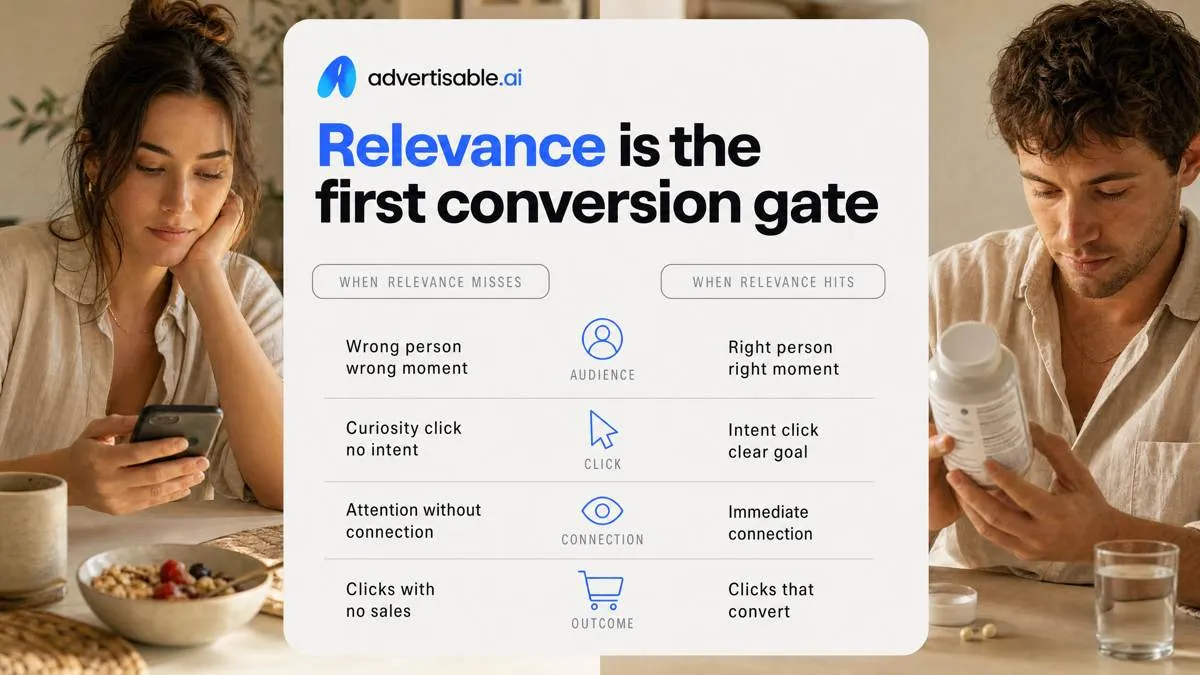
Clicks with no sales usually means you won attention from the wrong person or at the wrong moment. Even a great creative underperforms when the viewer cannot immediately connect it to a current goal, so the click is curiosity, not intent.
This is why we treat relevance as the first gate before you reach for “tweaks.” The same hook mechanics we break down in our hooks piece can look “broken” when the audience context is wrong, even if the hook itself is clean.
Selective attention rewards relevance
Your ads do not compete with other ads. They compete with whatever goal the viewer is actively pursuing, and the brain filters aggressively. selective attention studies describe this as enhancing relevant signals and suppressing irrelevant input, which is why “good” creative can still get ignored.
In practice, people pattern-match: they scan for cues that this message is for their situation right now. If the opening scene cannot be classified in 1 to 2 seconds, you will either lose the scroll or attract low-intent clicks from people trying to figure out what you are selling.
Category cues and context do most of the work. A skincare buyer reads “before/after” and ingredient proof differently than a finance buyer reads “rates” and “terms.” The cue is not just the product, it is the situation: problem state, urgency, and what “a credible solution” looks like in that category.
- Goal-driven perception: your first frames have to match the viewer’s active job-to-be-done (fix, save, compare, decide).
- Pattern matching to needs: the hook should name a recognizable symptom, outcome, or use-case, not a generic benefit.
- Category cues and context: visuals, language, and proof types must look native to the category the viewer thinks they are in.
Cold, warm, hot need different meaning
Cold, warm, and hot traffic can see the exact same words and take completely different meaning from them. Cold audiences are usually problem-aware (or not aware at all), while warm and hot audiences are often product-aware, already comparing options, and looking for justification to act.
Motivation and friction are not constant across stages. Cold requires clarity and credibility fast because the viewer is lending you attention. Hot requires reduced friction because the viewer is lending you intent.
If you run a bottom-funnel “buy now” format at cold traffic, you can drive CTR without creating the mental bridge to purchase, so CVR stalls and budget burns daily.
Mismatch is the fastest path to cheap clicks. The ad answers a question the viewer is not asking yet, so the click is either curiosity or disagreement, and your landing page has to do all the persuasion work in one step.
- Cold: make the problem legible and specific; avoid assuming they already want your product category.
- Warm: connect the problem to your product moment and one proof element that reduces doubt.
- Hot: confirm fit (price, offer, outcomes, constraints) and remove friction so the decision can complete.
When CTR is “fine” but purchases are flat, the first thing we suspect is not a weak ad, it is a meaning mismatch between funnel temperature and what the hook is asking the viewer to do.
Specific promises convert because they are believable
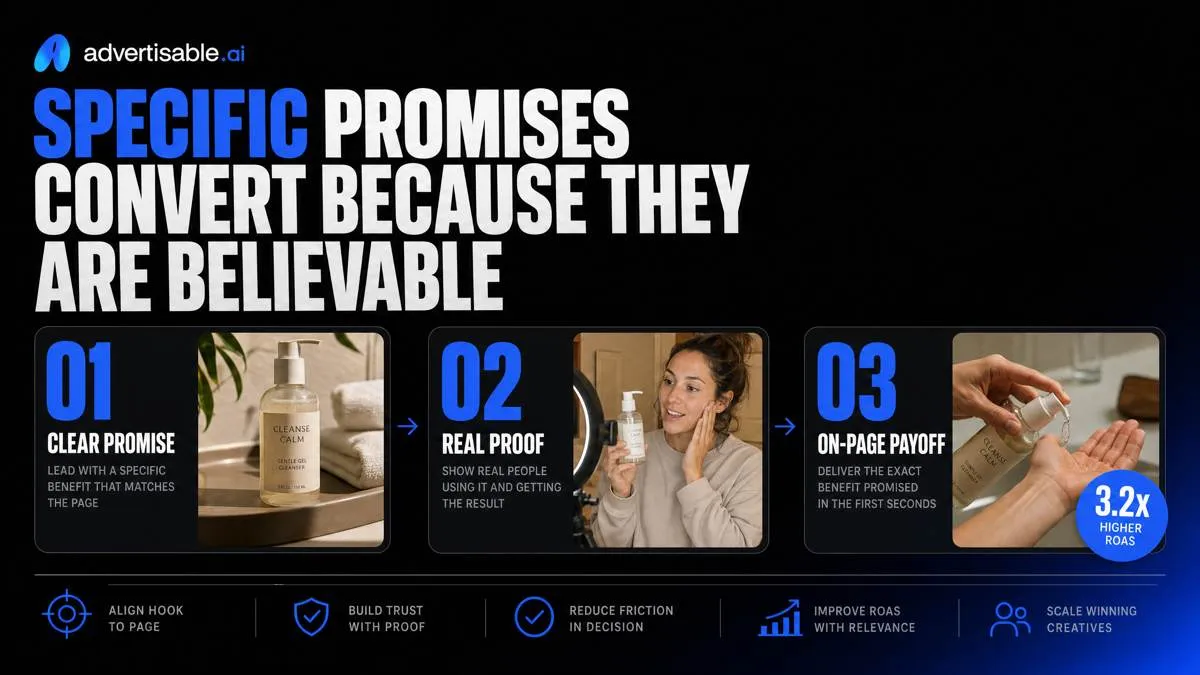
Vague superlatives create work for the buyer. “Best quality” forces them to guess what you mean, and guessing lowers trust fast.
Your claim also has to match the landing page word-for-word in outcome and scope. If the hook promises speed but the page sells “premium,” you manufactured doubt that no amount of retargeting fixes.
We map this alignment in our winning creatives piece: the promise in the first seconds, the proof in the middle, and the on-page payoff should all point to the same specific outcome.
Specificity creates cognitive ease
Specific promises convert because you can evaluate them in seconds. When you name a concrete outcome and a clear boundary, your buyer spends less time interpreting and more time deciding.
Operationally, specificity is a production constraint. It tells your team what must stay constant across variants, and it gives you a clean pass/fail check in a 48-72 hour readout because the audience is reacting to the same claim, not five different implied promises.
- Concrete outcomes: replace “better results” with an outcome you can observe on a page or in product use, like “sets up in under 10 minutes” or “includes 3 templates and 12 variations.”
- Verifiable details: include numbers, limits, and conditions you can QA against the landing page (time, quantity, compatibility, before/after state).
- Less interpretation effort: remove adjectives that require subjective judgment (“premium,” “high-end”) unless you immediately define what that means in measurable terms.
When the promise is specific, your creative tests become readable, because you know what the viewer is agreeing with.
Proof reduces uncertainty
Proof is not decoration. It is doubt reduction, and it works best when it demonstrates the claim instead of describing it.
In practice, we treat proof as a scene with acceptance criteria: the viewer should be able to point to what happened on screen and connect it to the promise without narration. That is why we separate hook, product moment, proof element, and CTA as distinct beats and only change one variable at a time.
You can stack proof types without bloating the ad by choosing one primary proof and one supporting signal.
- Demonstration over description: show the setup, the output, the interface state change, the unboxing contents, or the before/after screen so the claim is visually checkable.
- Mechanism evidence: show the “how,” not just the “what” (what inputs you use, what steps happen, what constraint makes the outcome possible).
- Social proof as signal: use specific, attributable signals like client logos, review counts, or short quotes with the outcome and timeframe, not generic “people love it.”
People hesitate when the downside feels bigger than the upside
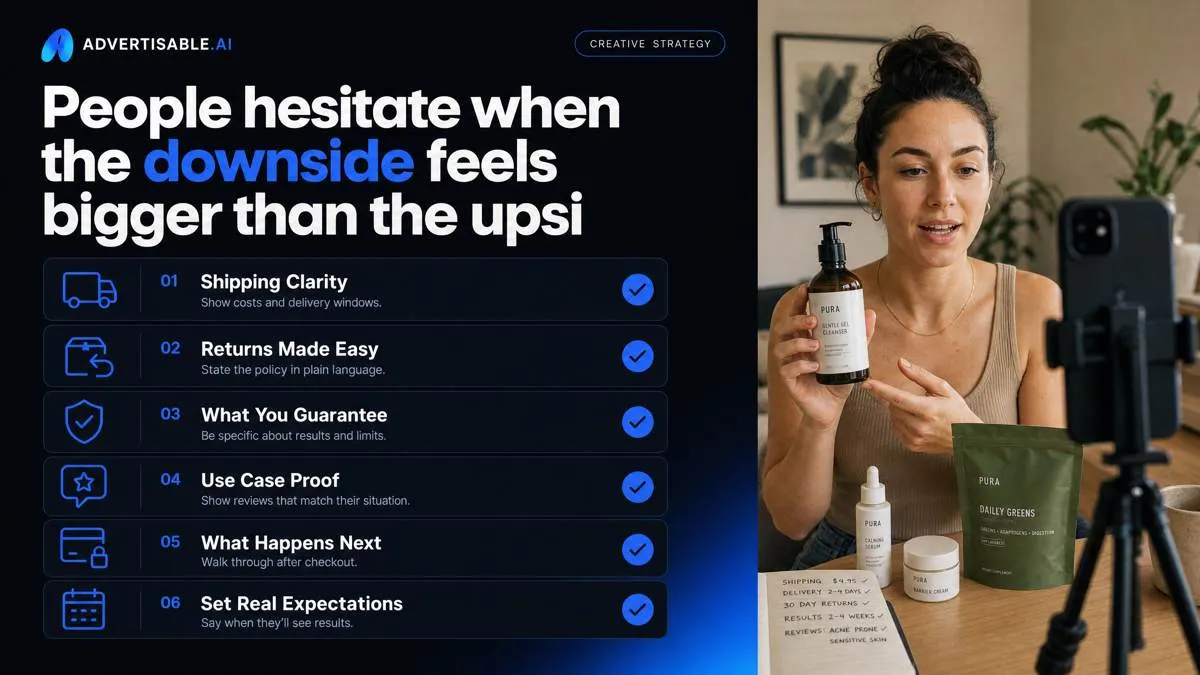
Clicks with no sales often means the risk signal on the page is louder than the value signal. The fix is not “more trust,” it is more specific risk cues: what happens after checkout, what you ship, when it arrives, and what the buyer can do if it disappoints.
Overpromising backfires because it increases perceived downside: “This works for everyone” reads as “I might be the exception.” And with social proof, ten detailed reviews that mention the exact use case beat 1,000 vague five-star ratings every time.
Loss aversion dominates action
When you are burning budget daily, the user is running the same math: one bad purchase feels worse than one good purchase feels good. That loss-aversion bias is strong enough that research on loss aversion found measurable real-world decision impacts (N = 2,158).
Money risk shows up as “Will I waste $X?” Time and hassle risk is “Will I have to chase support, repackage, ship, wait?” Fear of being wrong is social and personal: “If this doesn’t work, I look foolish for believing the ad.” In practice, any ambiguity in your promise becomes an imagined worst case, and the user does nothing.
- Money risk cue you are accidentally sending: totals, shipping cost, and renewal terms are harder to see than the benefits
- Time and hassle risk cue: the return path is unclear (steps, timeline, who pays shipping)
- Fear of being wrong cue: claims feel broad, so the buyer cannot map them to their exact situation
Risk reducers that feel real
Risk reduction converts only when it is concrete and testable, not motivational. Your goal is to replace ambiguity with operating details a buyer can verify in 10 seconds.
Set clear expectations that narrow the promise: what the product does, who it is for, and the constraints (compatibility, setup time, results timeline). This lowers “fear of being wrong” because the buyer can self-qualify.
Returns and guarantees work when they read like a process, not a slogan. Credible third-party signals work when they are specific to the decision, not generic badges.
- Clear expectations: 3-bullet “What you get / What it solves / What it does not solve” block near price and CTA
- Returns and guarantees: a plain-language policy snippet that includes timeframe, condition, and how refunds are issued
- Credible third-party signals: named publications, certifications, or verified reviews that reference the exact product model and outcome
Clarity wins because confusion creates friction
When you get clicks but not conversions, the failure is often simple: the ad promise, the landing headline, and the page’s next step are not saying the same thing. That mismatch shows up as measurable drop-offs, usually at CTR-to-CVR, because attention moved but intent could not complete.
Assume most of your traffic is reading on a phone, in a feed, with sound off. If your offer and next action are not readable in seconds, you are adding work at the exact moment you need momentum.
This is where “slop” and distinctiveness matter: generic, interchangeable language forces the viewer to interpret, and interpretation is friction.
One clear next step
A converting flow gives you one obvious next action, and it is the same action the ad is pre-framing. When you ask for multiple different actions, you split intent and you make results harder to read.
Operationally, we treat this as a control variable. In a 48-72 hour readout, you want the CTA to be constant across a batch so a CVR change can be attributed to the hook or proof, not to different asks or different destinations.
- Single primary action: one button, one verb, one destination (for example, “Shop” to the product page, not shop plus subscribe plus download).
- CTA matches intent: cold traffic needs a low-friction continuation of the promise; warm traffic can tolerate a stronger purchase ask, but only if the page immediately confirms the same promise.
- No competing asks: remove secondary CTAs in the first screen (newsletter popups, quizzes, “follow us”), or delay them until after the core action is completed.
A clean next step is not just UX polish; it is how you keep your tests interpretable and your CVR signal trustworthy.
Cognitive load kills intent
Your buyer does not stop converting because they changed their mind; they stop because the page asks them to think too hard, too soon. cognitive load research shows attention ratings drop under load (M=6.09) versus no load (M=6.93), which matches what we see in real funnels: every extra decision point reduces follow-through.
Three failure modes cause this most often: too many messages, unclear offer structure, and an ad-to-page mismatch. Each one forces the user to re-parse what they are buying and why now, and that is where intent bleeds out.
- Too many messages: multiple angles, multiple promises, and long above-the-fold copy that competes with the primary decision.
- Unclear offer structure: the user cannot tell in 5 seconds what they get, what it costs, and what happens after they click.
- Mismatched ad and page: the hook promises outcome A, but the landing leads with outcome B, different terminology, or different product framing, so the click feels like a bait-and-switch even when it is not.
Diagnose the break with hook rate, hold rate, CTR, then CVR
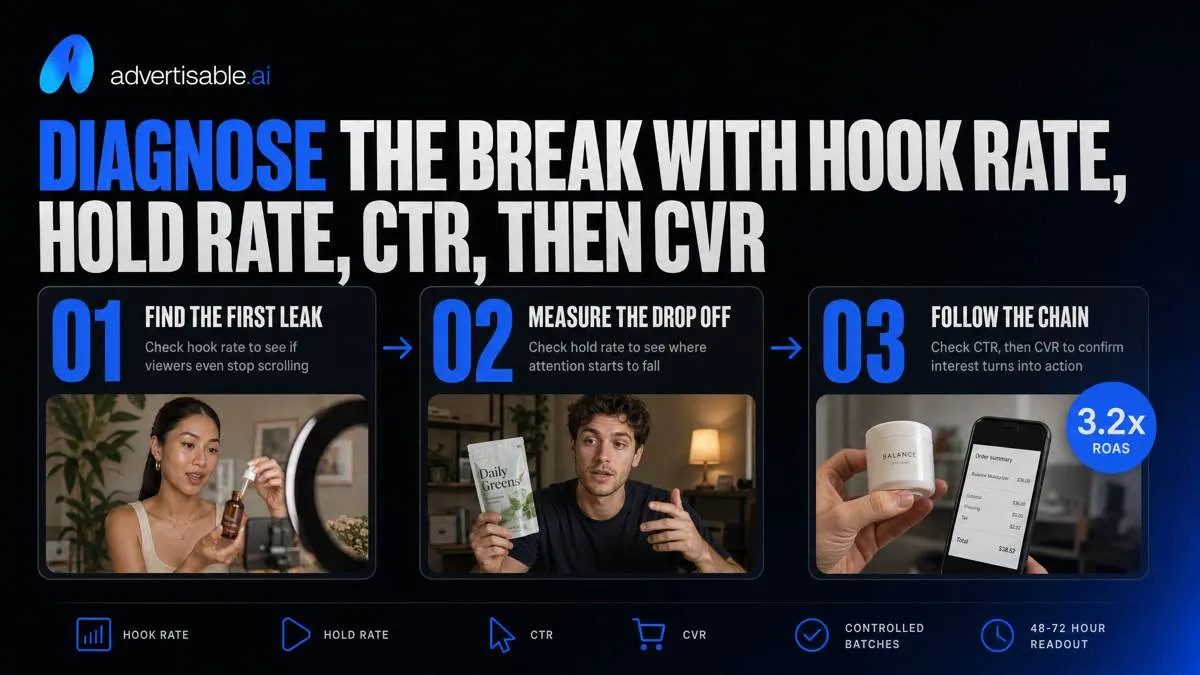
When results drop on day 4, treat your metrics like a chain: hook rate, then hold rate, then CTR, then CVR. Random full rewrites feel productive but erase causality and make “fatigue” indistinguishable from message drift. Run controlled batches on a 48-72 hour readout so you only change the weak scene, not the whole ad.
Hook rate tests relevance fast
Hook rate is your thumb stop fit signal: do people pause long enough to even enter your message. If hook rate breaks while the rest of the funnel is stable, you usually have relevance decay, not a landing page problem.
Good implies your opening promise matches the audience and placement. Broken implies your first 3-5 seconds look skippable or generic for that feed.
- First test: generate 5-10 hook variants while holding body, proof, and CTA constant
- Acceptance criteria: first frame is unmistakable at center-crop; on-screen text is readable in under 1 second
- Next decision: if hook rate lifts but CTR does not, the hook is stopping thumbs but not setting intent
Hold rate tests believability
Hold rate tells you if the body earns belief after the hook. When viewers drop right after the opening, your middle beats are usually incoherent or missing proof.
Drop-offs map confusion: the product moment is unclear, the claim feels unsupported, or the sequence jumps.
- First test: keep the hook and CTA fixed, swap one proof element (demo, before-after, spec, testimonial-style line) per variant
- QA check: each scene answers one question only (what it is, why it works, what changes, what to do next)
CTR and CVR locate friction
CTR is intent clarity: did the ad make the next step obvious enough to click. CVR is risk and match: once clicked, did the landing outcome deliver the same promise with low doubt.
High hook and hold with low CTR points to a vague CTA or mismatched angle. High CTR with low CVR points to mismatch or risk on page: price, shipping, claims, or the offer not matching the ad.
- Alignment check: hook promise = product moment = first screen of the landing page
- Production fix: in Advertisable AI Studio, lock Brand DNA from your product URL, approve the storyboard, then regenerate only the scene tied to the weak metric
- Next decision: if CTR improves but CVR stays flat, hold creative constant and reconcile landing outcomes before shipping more variants
Turn your diagnosis into a controlled hook test batch
If your CTR is fine but CVR stalls, stop cycling random variations. You need clean readouts where the promise in the first 2 seconds, the proof in the middle, and the landing page outcome stay aligned.
Open Advertisable AI Studio and paste your product URL first. We use the Brand DNA Extractor to lock the non negotiables so every variation stays on brand and claim accurate. Then generate a batch of 5 to 10 one variable hook variants while you hold the body, proof element, and CTA constant.
Run them for 48 to 72 hours, then make a single decision: regenerate only the weak scene using the Scene-Level Regenerator, or move to a new concept. Export channel-ready versions for Meta, TikTok, and YouTube, and keep your testing readable.
Frequently Asked Questions
### Why am I getting clicks but no conversions?
Most often your ad wins the click but loses the sale because the hook promise, the proof, and the landing page outcome do not match. Diagnose in order: hook rate, hold rate, CTR, then CVR, then run a one-variable hook batch so you can see what actually changed.
### How do I calculate hook rate?
On Meta, calculate it as 3-second video views divided by impressions. Use it as an attention check, then confirm with hold rate and CVR before you change anything.
### Why does my AI-generated ad look generic?
It usually means your hook and proof could fit any product, and your brand details are not being held constant across variations. Lock Brand DNA from your product URL, then tighten specificity in the hook and proof while you keep the rest of the four beats consistent.
### What is a good conversion rate for ads?
There is no universal number that travels across channels, offers, and landing pages, so focus on direction and stability instead. Use CVR alongside hook rate, hold rate, and CTR to identify whether the constraint is attention, belief, click intent, or post-click friction.