What Is Performance Creative? Made to Act, Not Admired

Performance creative is paid-social ad creative built as a measurable system: each ad follows a repeatable four-beat anatomy and is tested with one controlled change so you can attribute results to a specific decision.
Here’s what matters most right now:
- Performance creative uses a four-beat creative anatomy: hook, early product moment, proof element, CTA.
- Each beat has a job and a metric chain: thumb stop, then CTR, then CVR.
- You run one-variable batch testing so outcomes map to one specific creative change.
- Start with hook tests first because the first 2 seconds determine everything downstream.
- Hold three beats constant, change one variable, then read results after 48-72 hours.
- Use clear naming and tracking so learnings compound instead of resetting every launch.
We built Advertisable AI Studio for this exact bottleneck: teams need controlled variations without off-brand drift or claims creep. Our workflow imports a product URL to set Brand DNA guardrails, keeps you storyboard-first in the four beats, and supports scene-level regeneration so you can replace the weakest beat without re-rendering the whole ad.
Before you touch templates or debate concepts, you need to name the real problem performance creative was invented to solve: admired ads that cannot be held accountable, and a production loop that generates volume without attributable learning.
The problem performance creative was invented to solve
Admired Ads vs. Accountable Ads
Admired ads win internal approval. Accountable ads win measurable outcomes, and you can point to the specific creative decision that drove the change.
In practice, “admired” usually means you optimized for taste: the edit feels premium, the copy reads well, the concept gets compliments. None of that tells you which element earned attention, generated the click, or converted the session. When results are flat, the post-mortem becomes subjective because the ad was never built to isolate cause and effect.
Accountable creative is built for attribution. You lock what must stay consistent, then vary one thing at a time so the readout is interpretable within a single test window.
- Admired ad acceptance criteria: stakeholder approval, brand look-and-feel, narrative cohesion, “would we be proud to run this?”
- Accountable ad acceptance criteria: one named objective metric (thumb stop, CTR, or CVR), one hypothesis, one variable changed, and a 48-72 hour readout with a clear next-test decision
- QA checks that keep it accountable: the offer is identical across variants, the CTA language is identical, and the proof element is not changed when you are testing the hook
Measurable Channels Changed the Job
Once your primary channels became measurable, your job stopped being “ship one great ad” and became “run a reliable feedback loop.” You are no longer debating whether an ad is good. You are diagnosing why it performed the way it did.
Paid social and other measurable placements expose performance at the asset level, and they punish mixed-variable production. If you change the hook, the product moment, and the CTA in the same batch, you might get a winner, but you will not get a usable learning.
Operationally, that shifts your creative work into a testing discipline: storyboard-first planning, controlled variant batches, and readouts on a fixed cadence.
The teams that progress fastest treat measurement as a production constraint: hold the anatomy constant, change one variable, wait 48-72 hours, then decide to kill, iterate, or scale based on the metric chain you are targeting.
- Hold constant: offer, audience, spend range, four-beat structure, and proof type
- Change: one hook angle at a time until thumb stop stabilizes, then move downstream to CTR and CVR
- Decide: document the learning in a naming convention that maps the variant back to the exact scene-level change
A plain definition you can operationalise
What do we mean by performance creative?
Performance creative is short-form paid-social ad creative built as a measurement system: every ad follows the same structured anatomy so you can test one controlled change and attribute movement in outcomes to that change.
Operationally, it is not “make more ads.” It is “ship comparable ads.” You lock the structure, define the dependent metric you are trying to move, run a one-variable batch (often hooks first), and read results on a 48-72 hour window so you are not making day-to-day toggles that blur signal.
A useful acceptance criterion is simple: you should be able to point at one beat, name what changed, and show what moved (thumb stop, then CTR, then CVR). If you cannot do that, you produced variations, but you did not produce learnings.
The four beats that stay constant
For this system to work, the ad’s spine stays the same. These four beats are the control layer you protect across variants so results map to a specific creative decision, not taste.
- Hook (first 2 seconds): one clear promise designed to earn thumb stop. Acceptance check: you can state the promise in a single sentence, and it matches the audience being targeted.
- Early product moment: fast “what it is and what it does” tied directly to the hook. QA check: it is accurate to the product and avoids filler beauty shots that do not advance the claim.
- Proof element: one proof type per ad (for example, a single stat, a demo result, or a testimonial), not a stack of claims.
QA check: it is believable, specific, and aligned to the hook promise.
CTA: one explicit directive telling the viewer what to do next. Acceptance check: a viewer can repeat the action in 3 seconds without guessing.
When you hold these beats constant, you earn clean readouts and you can iterate at the scene level instead of rebuilding the whole asset.
The five traits that make it performance creative
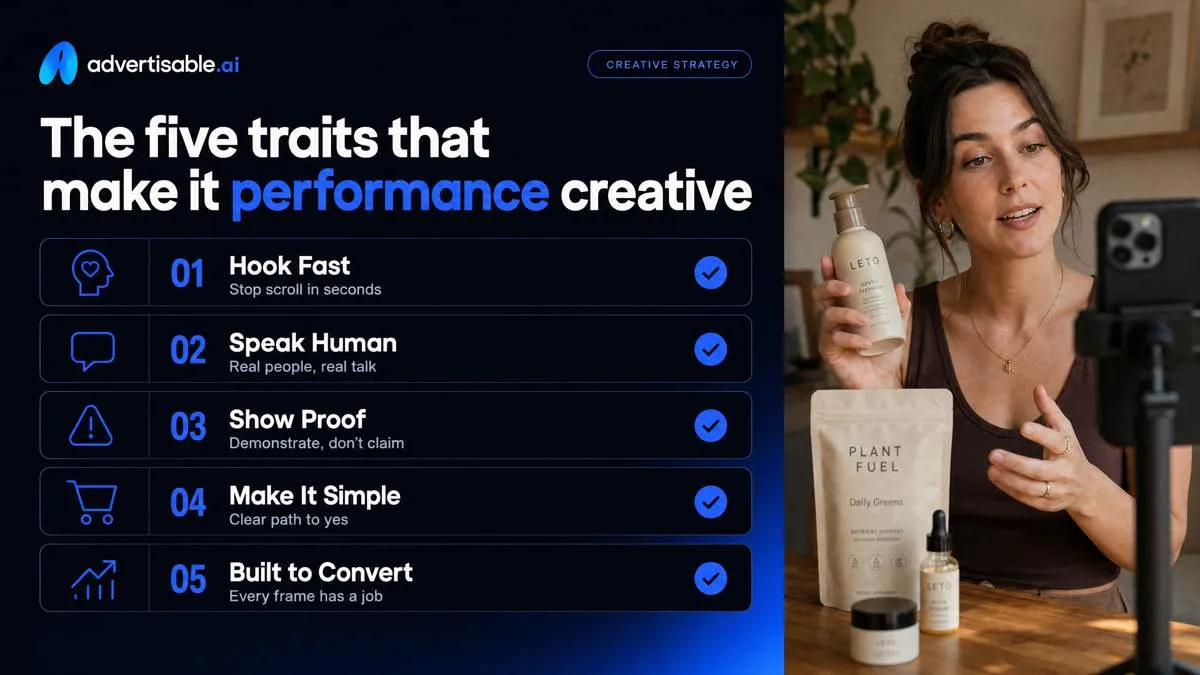
It Targets One Measurable Action
Performance creative is built to cause one observable behavior, not to “cover the funnel.” You pick the action first, then design the four beats to earn it in sequence.
Operationally, we tie each ad to one primary metric and one readout window. Most teams get cleaner learning when they commit to a 48-72 hour run and avoid day-to-day toggling that muddies attribution.
- Choose one primary action: 2-second thumb stop, click (CTR), or purchase (CVR)
- Lock what stays constant: offer, landing page, audience, and the non-tested beats in the hook-product moment-proof-CTA sequence
- Define acceptance criteria before spend: a kill rule (what “bad” looks like) and a scale rule (what “good” looks like)
It Is Judged by Results, Not Taste
You do not evaluate performance creative with internal reviews or “looks premium” opinions. You judge it by the metric you chose, using the platform readout, because that is the only standard that scales across stakeholders.
In practice, you read signals in order: thumb stop first, then CTR, then CVR. A hook can be cleanly produced and still fail if it does not earn the first 2 seconds, and a strong hook can still be disqualified if it drives clicks that do not convert.
One guardrail we use is claims and accuracy QA at the storyboard stage, so you do not “win” a test by drifting off-brand or implying unapproved outcomes.
- Pass: the primary metric improves versus your baseline creative within the same 48-72 hour window
- Fail: the primary metric drops, or improves while downstream quality degrades (for example, CTR up but CVR down)
- Next-test decision: keep the winning beat, and move the single-variable test to the next highest leverage beat
It Is Built in Variations You Can Attribute
Performance creative is not one ad, it is a controlled batch. Variations are designed so you can point to the specific change that caused the lift.
We see teams waste weeks with mixed batches where the hook, proof, and CTA all change at once. You get volume, but you do not get a learning you can reuse.
A practical cadence is 10-20 hook variants in one batch, with everything else held constant, then a second batch that tests a proof element type. In our workflows inside Advertisable AI Studio, that is why we generate storyboard-first and regenerate at the scene level instead of re-rendering the whole asset.
- Single-variable rule: change one thing per batch (usually hook first)
- Naming and tracking: encode the variable in the asset name so analysis is not guesswork later
- Production control: regenerate only the weakest scene, keep the other three beats identical
A short truce between brand and performance
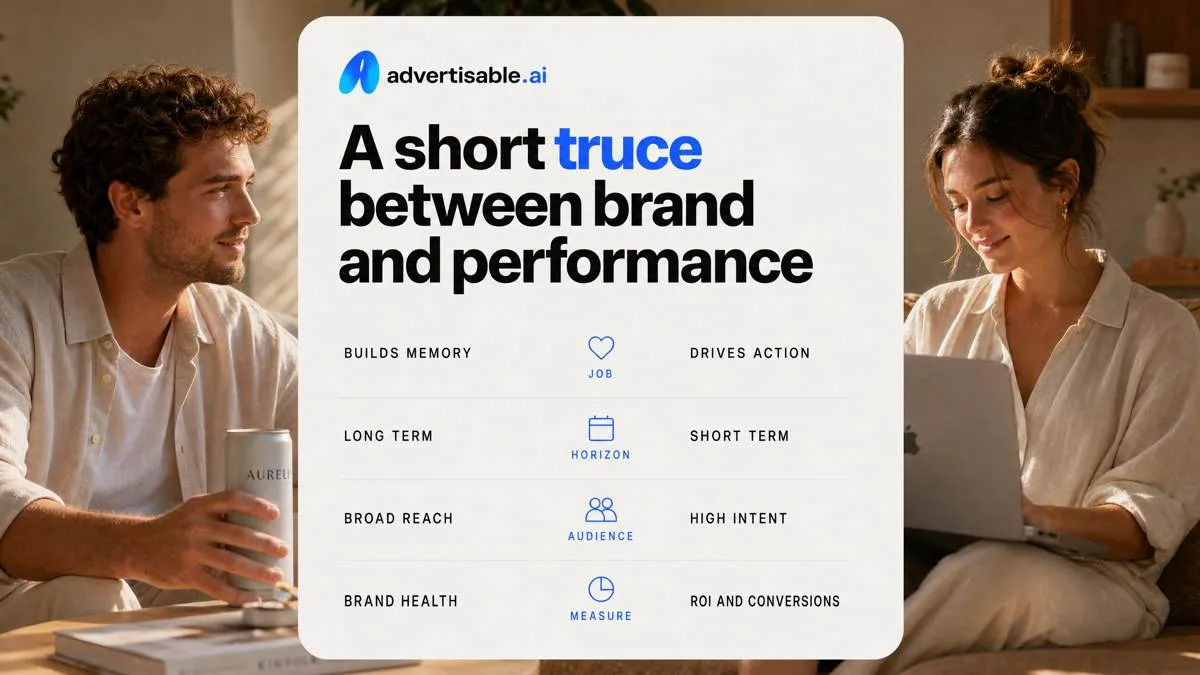
Brand and performance are not enemies. They are two disciplines with different jobs, and most conflict comes from scoring them on the wrong scoreboard.
Different jobs, different scorecards
Performance creative exists to create attributable lift now, while brand work exists to make future conversions cheaper and more likely. When you ask one to do the other’s job, you get noisy tests, subjective debates, and a lot of “winning” ads that do not scale.
Your operational fix is to separate the scorecards before you separate the teams. In practice, that means you define one primary metric per asset before production starts, and you do not move the goalposts after spend lands. For performance creative, we keep the metric chain tight: thumb stop in the first 2 seconds, then CTR, then CVR.
For brand, you are judging consistency and recognition, not whether a single hook moved CTR in 48 hours.
This is where a truce becomes practical: you can enforce brand guardrails without turning every ad into a logo bumper. The Multiplier Effect frames the risk of going performance-only as a measurable penalty: over-reliance on performance advertising reduces revenue returns by 20% to 50%. That is not a creative critique. It is a signal that short-term optimization works better when the brand is already doing some of the trust-building.
- Write two briefs, not one: a performance brief with one dependent metric and one variable to test, and a brand brief with non-negotiable guardrails (fonts, tone, approved claims).
- QA pass before launch: four-beat anatomy present, claims match approved facts, and only one variable changed across the batch.
- Decision rule at 48 to 72 hours: keep the winning variable, regenerate only the failing beat, and leave the rest locked.
Why performance creative matters more in 2026
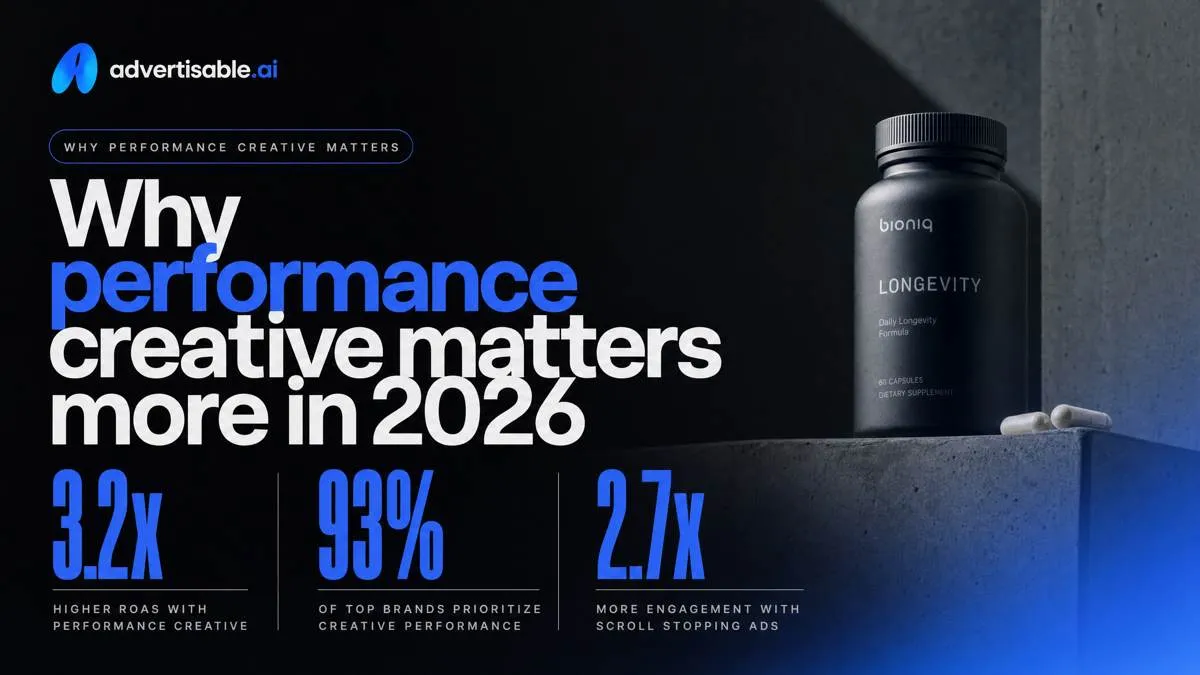
Automation moved the battleground
In 2026, automation neutralized a lot of the old optimizations. When bidding, targeting, and budget allocation get standardized by the platforms, the variable you still control at scale is what the audience sees.
This is why performance creative now decides whether your spend turns into learnings or noise. The “best” media setup cannot rescue an ad that fails in the first 2 seconds, because the platform will either throttle it or push it into higher costs as engagement signals soften.
2026 AI advertising data also reflects the production shift: teams report a 10x increase in creative output volume without additional headcount. That changes the baseline expectation from “ship a few polished ads” to “ship controlled batches that tell you what to do next.”
- Hold constant: offer, audience, landing page, four-beat anatomy, and format (for example, vertical 9:16) so the readout is attributable
- Change one variable per batch: start with hook variants, then product moment, then proof, then CTA
- Set a fixed readout window: 48 to 72 hours with no day-to-day toggling
- Acceptance criteria: each variation passes Brand DNA guardrails and claims QA before it gets spend
In practice, automation makes velocity easy; discipline is what makes velocity useful.
Creative is now the feedback system
Your ads are no longer just outputs; they are your measurement layer. Each variation is an instrument that tells you which beat moved thumb stop, which beat lifted CTR, and which beat protected CVR.
To make that feedback real, you need scene-level control and clean attribution. We run storyboard-first so the four beats are locked before rendering, then we name assets by the single variable being tested and read results in order: thumb stop, then CTR, then CVR.
The operational payoff is faster, cheaper iteration. When the hook fails, you regenerate only the hook scene and keep the product moment, proof, and CTA identical, so the next test is a true comparison.
- QA check before launch: the product moment matches the product page facts, and the proof element is a single, auditable claim type
- Decision rule after readout: if thumb stop is weak, do not change proof or CTA yet; replace the hook and rerun the 48 to 72 hour window
- Scale rule: only promote a concept after it holds across at least 2 hook variants with the same downstream CVR
Where Advertisable AI Studio fits in this discipline
How do you get controlled variations from a product URL?
Controlled variation starts with a single source of truth: the product page. In Advertisable AI Studio, you import a product URL so our Brand DNA Module can extract the brand and product constraints up front, then you generate a batch where only one scene-level variable changes.
Operationally, that matters because you can run a 48 to 72 hour readout and trust that any movement in thumb stop, CTR, or CVR is tied to the variable you intentionally changed, not drift in claims, visuals, or structure.
- Hold constant: four-beat anatomy (hook, early product moment, proof element, CTA) and the same offer
- Change one variable per batch: usually 10 to 20 hook variants from the same storyboard
- QA before export: check product facts match the page, claims stay within approved language, and the early product moment shows the product accurately (no implied features)
- Acceptance criteria: every variant is platform-ready (Meta, TikTok, YouTube) with consistent brand rules and clear scene boundaries for later edits
Fix the weakest beat, not all
You do not need a full re-render to improve an underperforming ad. You diagnose which beat is failing based on the metric sequence, then regenerate only that scene while keeping the other three beats locked.
Use a simple decision rule: if thumb stop is weak, fix the hook; if thumb stop holds but CTR lags, fix the product moment or proof element; if CTR is fine but CVR is weak, fix the proof element or CTA clarity. That keeps your next test attributable.
In Advertisable AI Studio, our Scene Regenerator is built for this exact loop: swap a single scene, export again, and re-run the same 48 to 72 hour window against the prior baseline. You preserve the working parts of the ad and avoid introducing three new variables at once.
- Weak thumb stop: regenerate hook only
- Weak CTR with stable thumb stop: regenerate proof element or tighten the early product moment
- Weak CVR with stable CTR: regenerate proof or CTA specificity, keep the hook untouched
Turn your creative into a measurable system this week
If you are shipping volume but cannot name which hook or proof element moved thumb stop, CTR, then CVR, your loop is still broken. We built Advertisable AI Studio for operators who need attributable learnings, not more opinions.
Start with control. Import your product URL to generate Brand DNA guardrails, then lock your four beats in a storyboard: hook, early product moment, proof element, CTA. Produce a single-variable batch by changing only the hook, keep everything else constant, and run it for 48 to 72 hours.
Your acceptance criteria is simple: one documented learning tied to one metric readout, plus a next-test decision. Then regenerate only the weakest beat and ship the next batch with platform-ready exports for Meta or TikTok.
Frequently Asked Questions
### What's the difference between creative fatigue and underperformance?
Underperformance shows up immediately: your thumb stop and CTR are weak from the first run. Creative fatigue is decay over time: frequency rises, then thumb stop and CTR slide, and CVR often softens later. The fix differs, so diagnose before you rebuild.
### Why should I test hooks before the rest of the ad?
If your first two seconds do not earn thumb stop, the rest of the ad cannot contribute to CTR or CVR. Hook tests also read cleanly in one-variable batches because the hook is isolated early in the sequence. We recommend you test hooks first, then move to product moment, proof, and CTA.
### What counts as AI UGC vs traditional UGC edited with AI tools?
AI UGC means the creator footage itself is generated, not just trimmed or enhanced. Traditional UGC edited with AI starts from real human-shot footage and uses AI for cleanup, cuts, or overlays. The distinction matters because it changes how you manage production control and iteration speed.