What Is a Hook in Advertising?
A hook in advertising is the first 2-3 seconds of an ad that stops scroll by making one specific, relevant promise. Its job is to answer “Is this for me?” fast, before your headline, offer details, and CTA ever get a chance to work.
Here’s what matters most right now:
- A hook is a first-beat promise, not a summary of the whole ad.
- Use a single promise format: get X without Y, stated in plain language.
- Clarity in two seconds beats clever phrasing every time.
- Hook types should match awareness: cold scroll, aware-but-skeptical, ready-to-buy.
- Clickbaity openings spike scroll-stop, then fail when the body cannot hold attention.
- Test hooks as one-variable variations: hold the body and CTA constant for clean learnings.
We built Advertisable AI for this exact iteration bottleneck: you need volume and control. Our Brand DNA locking keeps your claims and brand rules consistent while you generate hook variations, and our Frame-by-Frame Scene Control lets you regenerate only the hook opening and export platform-ready 9:16 variants for Meta, TikTok, and YouTube.
Start by treating the hook as the opening promise that earns attention, because that first beat determines whether the rest of your ad even gets seen.
A hook is the opening promise that earns attention
A hook is the opening promise, not the whole ad. The cleanest way to frame it is a single exchange in one line: get X without Y.
That promise is meant to set up the rest, not explain everything. In 2-3 seconds you earn attention; you do not deliver proof, terms, and nuance all at once.
The two-second job
The hook’s job is two-part: stop the scroll and earn the next few seconds. In most feeds, you have roughly 2-3 seconds to create a clear reason to keep watching.
The hook can be copy, a visual, or a beat in the edit. What matters is that the first-beat promise lands before your viewer decides to swipe away.
Operationally, we judge the opening on one question: does it answer “Is this for me?” fast enough that a cold viewer can self-qualify without effort?
- First line: one outcome or pain point stated plainly (not a stack of benefits)
- Image: show the before/after contrast or the core object immediately, not a logo animation
- Beat: a hard pattern interrupt (cut, sound, or motion) that supports the promise rather than distracts from it
If the viewer cannot tell who it is for by the end of the opening beat, you do not have a hook yet, you have an intro.
Hook vs headline, offer, CTA
A hook is not your headline, your offer, or your CTA. Mixing these components is how teams end up “testing hooks” while changing the entire ad and learning nothing.
The headline supports the hook by reinforcing the same promise in a different form factor (on-screen text, caption, or static overlay). It can clarify, but it cannot replace the opening beat, because it is not guaranteed to be seen or processed before the swipe.
The offer is the full value exchange: what the buyer gets, what they give up (price, time, effort), and any constraints. That belongs after attention is earned, because it takes more than two seconds to understand.
The CTA is the end-of-ad action. It converts attention into a next step, but it does not stop scroll by itself.
- Hook: 0-2 (up to 3) seconds, one promise that earns attention
- Headline: supports the same promise with a tighter restatement or qualifier
- Offer: the complete “what you get for what you pay” trade
- CTA: the final instruction (shop, sign up, learn more) once you have interest
Why the hook outweighs everything that follows
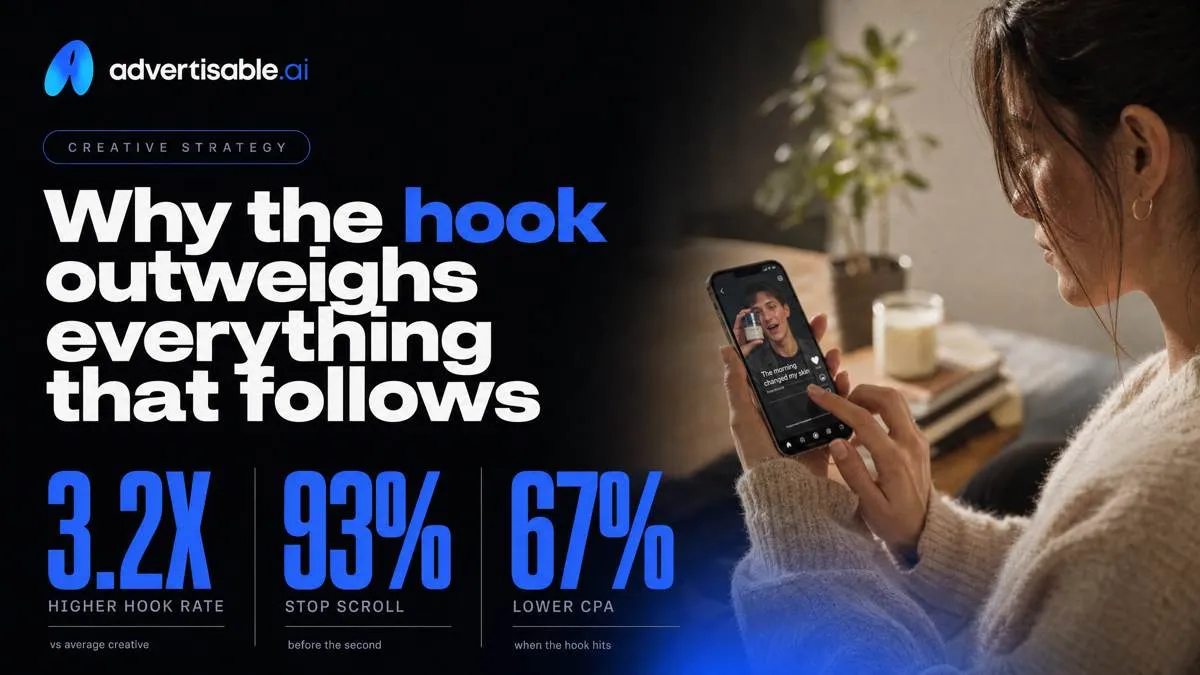
If you keep wasting spend on ads that do not stop scroll, treat the opening as the highest-leverage part of the asset, not a creative flourish. You can have strong proof, tight benefits, and a clean CTA, but none of it matters when the first beat fails to earn attention.
This is why hook rate exists as a metric: it gives you an objective read on whether your opening sequence is buying you seconds of attention. We cover the definition and how to interpret it in our hook rate guide (internal link).
Attention is the gate
The viewer makes a keep-watching decision fast, typically inside the first 2-3 seconds. Your hook is not competing with other ads. It is competing with the thumb.
When that decision is “no,” the rest of your ad is never seen. Your product moment, proof element, and CTA do not fail, they simply do not get a chance to run.
Operationally, this is where wasted spend shows up: you pay for impressions that produce no learnable signal about your message because the audience never reaches it. That is why we isolate the opening sequence in one-variable hook A/B tests and hold everything after second 3 constant for a 48-72 hour readout.
- Acceptance criteria: you can identify the promise in one sentence after a single watch, and it is stated or shown by the 2-second mark
- QA check before launch: the first frame contains either the outcome, the pain moment, or the audience qualifier, not a logo, montage, or slow setup
- Next-test decision: if hook rate is weak, change only the first beat and re-run; do not touch proof or CTA until the opening earns attention
Clarity beats cleverness
In a two-second window, clarity wins because it creates instant relevance. Wordplay and “smart” openings cost time your viewer will not give you.
You want a specific outcome, not a mood. The opening should make a single, testable promise the viewer can self-select into, so you can tell which message actually earns attention.
Write the hook in simple language built for speed: short words, concrete nouns, and one claim. If you need a second sentence to explain what the first meant, the opening is too clever for the medium.
- Prefer: “Get X without Y” over any line that requires context to understand
- Name a measurable change (time saved, steps removed, result achieved) instead of a broad “better” or “premium” claim
- Use one idea per hook variation so hook rate changes map cleanly to a single message
What makes a hook work: one relevant promise, delivered fast
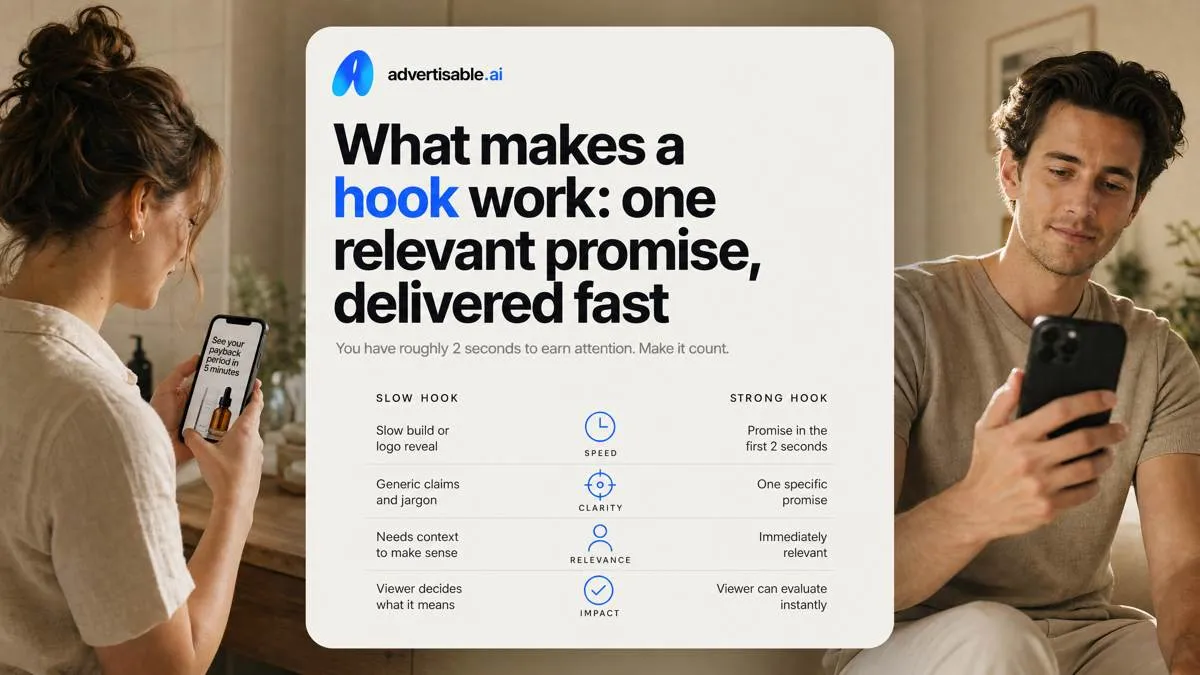
You have roughly 2 seconds to earn attention, so a hook cannot rely on a slow build, a logo reveal, or context that only lands after the viewer has already scrolled.
In that window, specific language beats generic claims. “Faster reporting” is fog; “See your payback period in 5 minutes” is a promise your viewer can evaluate instantly.
One clear promise
A working hook makes one promise to one audience. One outcome, stated so cleanly that a stranger can repeat it back after a single watch.
We see performance drop when the opening stacks benefits, audiences, and features at once. The fix is usually subtractive: pick the primary result you can credibly deliver, then write it in concrete terms before you add any style.
Concrete before creative means you lead with the measurable change, then let the visual, pacing, and wording make it feel human. You are not trying to be clever in the first beat; you are trying to be understood.
- Get X without Y: “Get compliant UGC-style ads without filming new content.”
- Get X without Y: “Get 20 hook variations without rewriting the whole script.”
- Get X without Y: “Get a cleaner close shave without razor burn.”
Relevance beats reach
The best hook is not the one that could apply to everyone. It is the one that clearly calls out the right viewer and gives everyone else permission to ignore it.
Callouts work best when they reference a situation the viewer recognizes, not a demographic label. “For busy moms” is broad; “If you are rebuilding ads every time hook rate dips” is specific and self-identifying.
Relevance also means matching category buying intent. A category-intent hook helps the viewer decide fast if you solve the job they are already shopping for, instead of forcing them to decode what you sell.
- Specific viewer: “If your Meta 3-second views are flat, your first beat is the variable.”
- Situation over demographics: “If your team is stuck waiting on reshoots, you need scene-level swaps.”
- Intent match: “Need a stroller that fits airline overhead bins?” versus “Meet the next-level stroller.”
The hook must connect
A hook works only if it sets up what the ad will prove and what the product is, fast. In short-form, you do not get credit for attention unless the next seconds validate the promise.
Connection is an alignment check: the opening claim, the product moment (around seconds 3 to 5), and the first proof element (roughly seconds 5 to 10) should all point at the same outcome. If the hook promises speed, the next beat should show speed, not a different benefit.
Avoid bait-and-switch openings. When the first beat is exaggerated or unrelated, you might see a temporary bump in hook rate, but hold rate usually pays the price because viewers feel misled.
Operational QA: before you ship, we like to run a simple consistency pass. Can you underline the exact words in the hook that the next scene demonstrates, and the next scene proves? If not, the opening is disconnected.
- Proof setup: Hook promises “20 ads from one prompt” and the next scene shows the storyboard output, not a brand montage.
- Product setup: Hook says “Regenerate only the opening scene” and the next scene is the storyboard editor selecting the hook frame.
- No bait: Hook claims “without filming” and the next scenes avoid footage that implies a real shoot happened.
Common hook types, chosen by awareness level
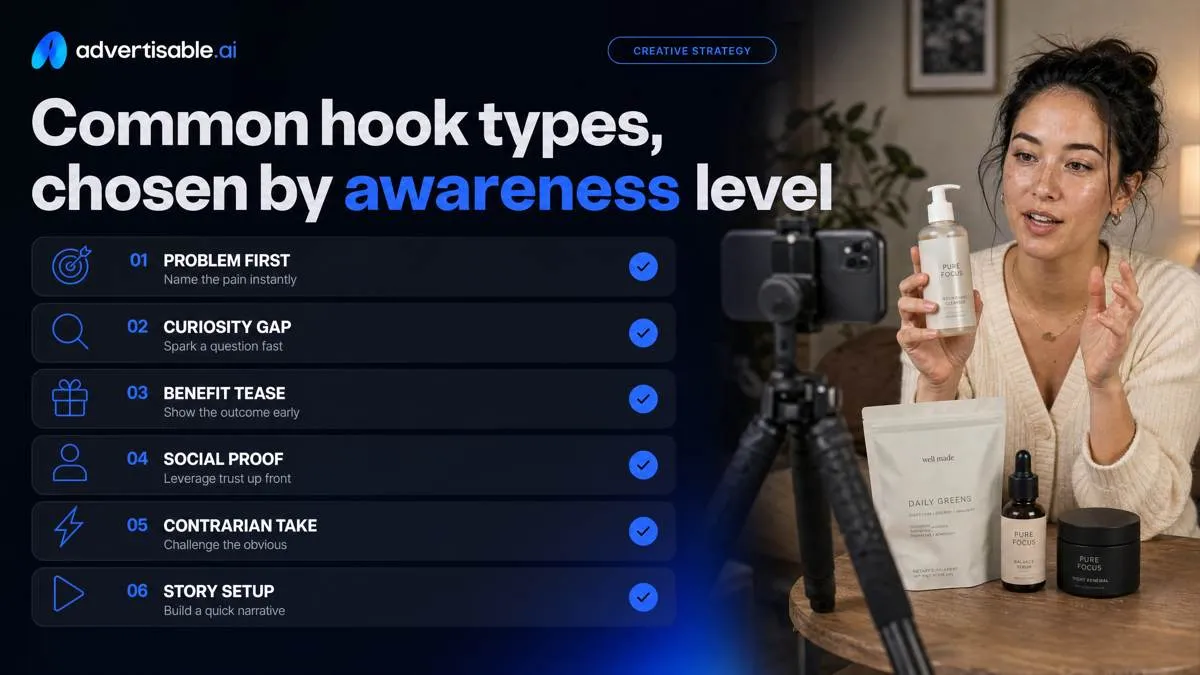
Pick your opening sequence based on where the viewer starts mentally, not based on what template feels clever. The examples below are intentionally punchy and incomplete, so you can choose a category fast and then generate variations without drifting into random, untestable lines.
Cold scroll hooks
Cold-scroll hooks win by naming a familiar problem moment in the first 2 seconds, then showing a visual that makes you pause. Your goal is recognition, not persuasion: get the viewer to think, “that is me,” before they know who you are.
Keep the language concrete and timed to a real moment in someone’s day. Then pair it with a pattern interrupt visual that communicates the promise without needing explanation. (Internally, this is the same “first-beat promise + scroll-stop moment” concept we cover in the visual hook section.)
Close the hook with a quick mirror scene: a relatable shot that confirms you understand the context, not just the claim.
- Problem moment callouts: “Still reconciling this by hand every Monday?” “Why does your first report take 45 minutes?” “You shipped the ad, but the first 3 seconds are blank.”
- Pattern interrupts: hard cut from messy screen recording to a single clean before/after frame; on-screen timer counting down from 02:00; oversized text overlay that matches the spoken promise
- Relatable mirrors: laptop at kitchen table at 6:30am; Slack pings stacking; creator re-exporting the same cut for the third time
Aware but skeptical hooks
Aware-but-skeptical hooks work when you challenge a belief, tease one specific proof point, and flip a common objection into a risk of doing nothing. You are not trying to win with hype; you are trying to earn a hearing from someone who has seen this pitch before.
Lead with a contrarian claim that is testable. Then tease proof without dumping it all in the hook, because the next beats (product moment and proof element) should carry the weight.
- Myth-bust lines: “Your problem isn’t ‘creative fatigue’. It’s that your promise is unclear.” “A better edit won’t fix a weak first beat.”
- Proof tease (not full proof): “We’ll show the same body cut with only the opening swapped.” “Watch what happens after 72 hours when the promise is the only variable.”
- Objection flips: “Without one-variable hook tests, you will keep blaming the offer.” “Without a single promise, your proof never gets watched.”
Ready to buy hooks
Ready-to-buy hooks should state the outcome and cue the offer immediately, then qualify who it is for and how fast or easy the first result is. At this awareness level, ambiguity costs you conversions because the viewer is already shopping for fit.
Make the promise operational and bounded. Pair it with a clear “for you” filter so you do not attract the wrong clicks.
- Outcome + offer cue: “Generate 20 ad variations from one prompt, starting with 10 hook variations.” “Regenerate only the first 2 seconds, keep the rest locked.”
- Who it is for: “For paid social teams shipping weekly tests.” “For agencies that need on-brand variants across clients.”
- Time-to-result or ease: “Run a 48 to 72 hour readout before changing anything else.” “Single-scene swaps instead of rebuilding the full video.”
How hooks fail: vague, slow, clickbaity, or disconnected
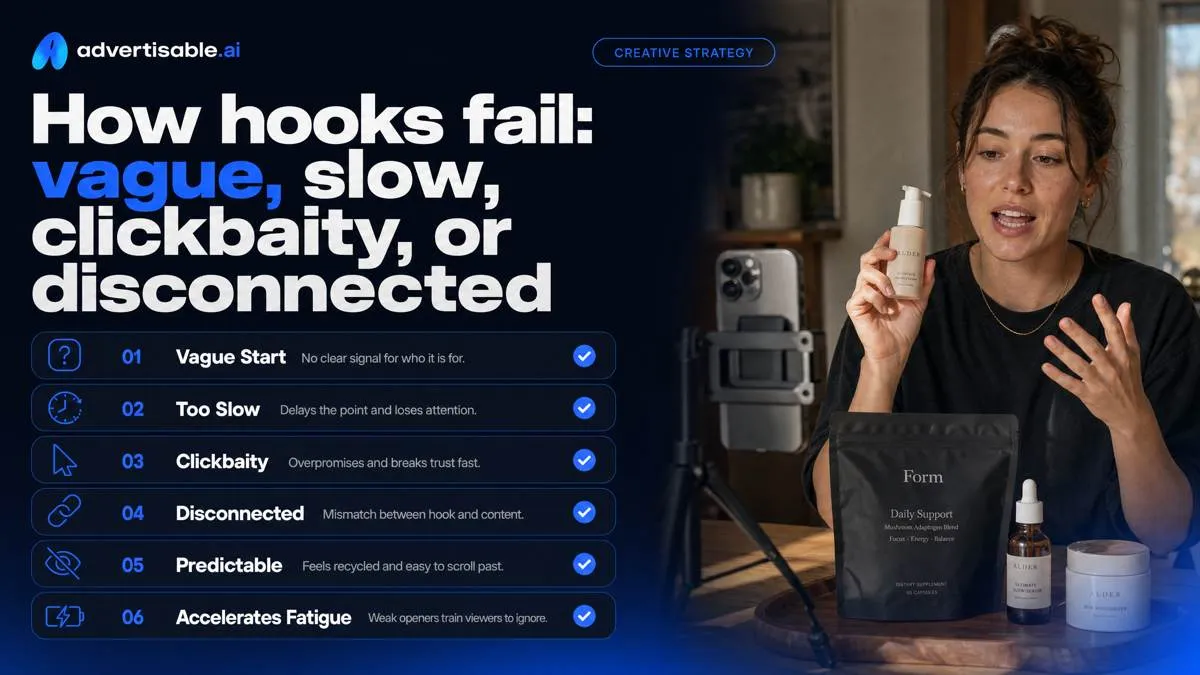
A hook fails when it does not do its job in the first 2-3 seconds: clearly signal “this is for you” and earn attention for the next beat. Most failure modes also accelerate creative fatigue because you are buying impressions for an opening that viewers learn to ignore.
Vague and generic openings
Generic openings usually underperform because they burn your two-second window on hype instead of a testable promise. Viewers cannot tell if the ad is relevant, so they keep scrolling and your hook rate tells you nothing actionable.
Operationally, these are expensive because you cannot isolate what to change. When the opening sounds like every other ad, you are competing in the worst possible way: louder words, same meaning.
- Empty superlatives: “best,” “ultimate,” “next level,” with no concrete outcome
- No defined viewer or outcome: you never name who it is for or what changes for them
- Same template as everyone else: interchangeable copy that could sit on any product
Clickbait and over-promising
Clickbait is not “a strong hook.” It is an implied promise the rest of the ad cannot deliver, and the viewer feels the gap within seconds 3-10.
That mismatch shows up as a drop in hold rate after a strong opening, plus downstream trust loss: the next time they see your brand, they scroll faster.
The antidote is honest specificity: make a narrow promise you can prove immediately with a demo, a constraint, or a clear before-after.
- Fail pattern: “You will never believe…” with no verifiable outcome
- Fix pattern: “Get X in Y minutes without Z,” then show the product moment by seconds 3-5
- Acceptance check: the proof you planned is visible before second 10 and directly supports the opening claim
Mismatch with product reality
A hook can be clear and still fail if it points at the wrong thing. When the opening promise does not match the demo, the proof feels unrelated and the CTA reads like a hard pivot.
We see this when teams test hooks in batches but let the body drift. You lose one-variable learnings, and you also teach viewers that your openings are unreliable.
Keep the promise-category aligned: the first-beat claim should be the same claim your visuals, proof element, and CTA can support without explanation.
- Hook-demo mismatch: you promise speed, then show aesthetics; you promise simplicity, then show complexity
- Proof and CTA disconnect: the proof supports a different benefit than the opening, and the CTA asks for action on an unstated offer
- Wrong promise for category: you lead with a claim your category is not trusted to deliver, so skepticism is the default
Turning the definition into controlled hook variations
Once you have a clear first-beat promise, operationalize it by exporting 9:16 variants for Meta, TikTok, and YouTube so each platform gets the same opening test in the native format.
If you want a fast way to generate those variants without bloating your production queue, Advertisable AI offers a $5 3-day trial.
One-variable hook testing logic
The cleanest way to improve your opening sequence is one-variable testing: change only the hook and hold the rest of the ad constant. Same product moment, same proof beat, same CTA, same length.
We read these tests on a 48-72 hour window. One day is usually noise, and changing multiple scenes at once makes it impossible to attribute movement to the first-beat promise.
Acceptance criteria stays simple: you are looking for a hook rate lift first, then checking that hold rate does not collapse right after the opening. If your hook rate drops, treat it as an opening problem until you have evidence the body is the constraint.
- Lock the body: identical scenes from second 3 onward across all variants
- Ship 8-12 hook variations in one batch, not one-by-one
- Wait 48-72 hours before calling a winner or killing a concept
- Use the same hook rate definition you already track from our hook rate piece so comparisons stay apples-to-apples
Generate variations without rebuilds
Variation volume breaks when every new hook forces a rebuild. The goal is controlled regeneration of the first 2-3 seconds while everything downstream stays fixed.
In Advertisable AI, you start by importing your product URL so the platform pulls the product facts and core assets into the workspace. Then you lock Brand DNA so voice, visuals, and positioning do not drift while you test different first-beat promises.
Frame-by-frame control is the practical enabler: you regenerate only the hook scene, QA it against your Brand DNA constraints, and export platform-ready 9:16 files without touching the rest of the timeline.
- QA check: hook claim matches what the product page can support
- QA check: logo/color/voice rules stay consistent under Brand DNA lock
- Next-test decision: keep the winning body, rotate only the hook when hook rate softens
Turn your hook into a controlled test, not a guess
If your opening promise is real, you should be able to move hook rate by changing only the first 2 seconds and holding everything else constant. That is the fastest path to signal.
In Advertisable AI, you paste your product URL, lock Brand DNA, then regenerate only the hook opening as a scene-level edit. Produce 10 hook variations in a single-variable batch while keeping the product moment, proof element, and CTA identical.
Export platform-ready 9:16 variants for Meta, TikTok, and YouTube. Let the test run 48 to 72 hours. Use hook rate as your first readout, then check hold rate to confirm the body earns the attention the hook creates.
When performance slips, rotate the hook, not the whole ad.
Frequently Asked Questions
### What is a good hook example?
A good hook is one specific promise delivered immediately, like “Get X without Y” or a direct pain callout the viewer recognizes in under 2 seconds. If you cannot isolate it and see hook rate change, it is not a hook, it is a hypothesis.
### Can you give me an example of a video hook?
Example: On screen text and VO in the first beat, “If you sell online, stop rewriting ads every week, ship 10 new hook variations today.” The key is that the promise is concrete and the product moment lands right after so the viewer understands what is being shown.
### What's the difference between a hook and a hook rate?
The hook is the opening sequence itself, the first-beat promise. Hook rate is the metric that tells you whether that opening earned attention, for example 3-second views divided by impressions on Meta.
### Can I test just the hook without changing the entire ad?
Yes. Use one-variable hook A/B testing: change only the hook opening and hold the product moment, proof element, and CTA constant. In Advertisable AI, scene-level control lets you regenerate only that hook scene while Brand DNA keeps everything else consistent.
### How long does it take to see if a hook is working?
Plan for 48 to 72 hours to get a read you can trust. One day is usually noise, so wait for enough delivery to compare hook rate and hold rate before making the next change.