Video Ads vs Static Ads: Which Should You Make?
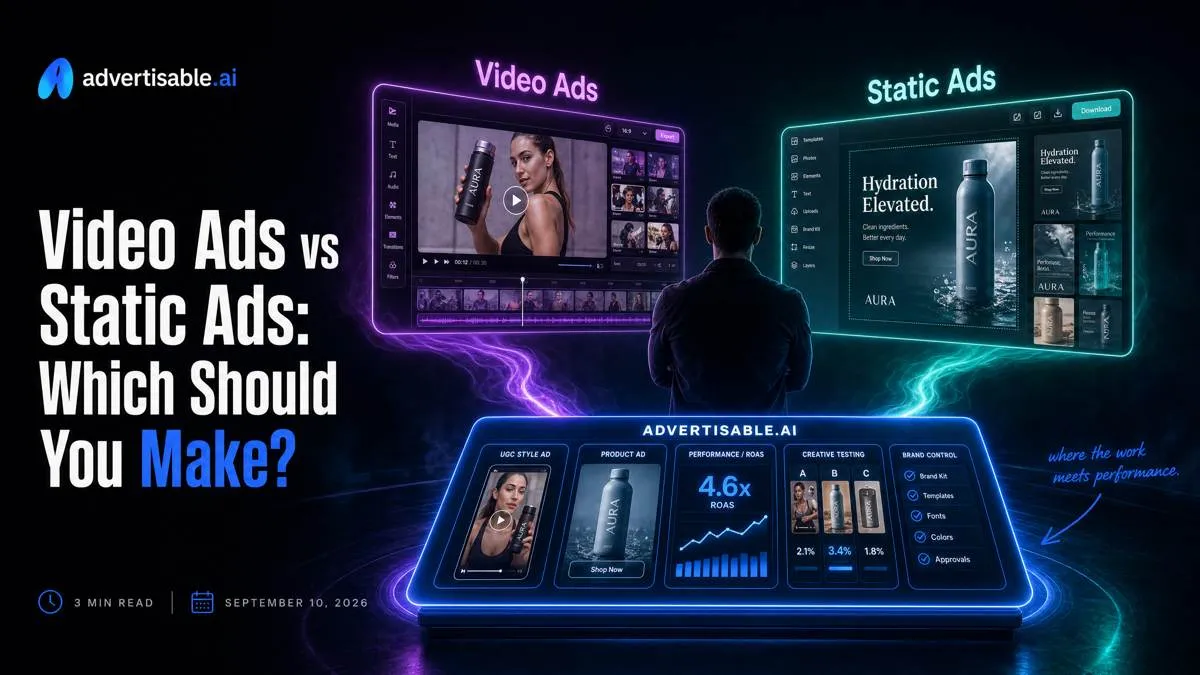
Use video ads when you can ship and test enough variations fast, and use static ads when you need the fastest, most controlled iteration per dollar.
Here’s what matters most when you are choosing what to make this week:
- Pick the format that matches your throughput, not your preferences or platform myths.
- If you cannot ship 50 to 100 variations weekly, favor static for consistent testing speed.
- Use video when you can iterate the opening seconds and CTAs in tight, single-variable batches.
- Run a matched 72-hour test and change only one variable per batch.
- Lock QA before launch: naming, sizing, captions, landing page match, and offer accuracy.
- Scale with brand guardrails so variants stay on-brand while you swap hooks and scenes.
We built Advertisable AI for this exact bottleneck: you need volume and control at the same time. Our URL-to-ad workflow pulls Brand DNA from your product page, generates scripts and storyboards, and lets you regenerate scene by scene so you can keep what works and replace only what does not. You can also export platform-ready versions for Meta, TikTok, and YouTube without reformatting by hand.
Before you argue about which format is “better,” start with the real difference that drives CPA: iteration speed and information density per test cycle.
Start with the real difference: iteration speed and information density
Choose format based on constraints, not preference. The real difference is how quickly you can ship a clean test and how much information the unit can deliver per second. Neither format is universally better; each wins in the situations it is built for.
What static communicates at a glance
Static works when you need one claim and one proof point to land instantly, with zero dependency on pacing. In a feed, you often have under a second to be understood, and a good image can do that without asking for any extra attention.
Operationally, static is the highest-clarity format for offer and legibility. You can make the price, discount, bundle, or guarantee readable at small sizes, and you can QA it quickly before spend goes out the door.
Static also lowers coordination cost. You can iterate from existing product assets and a clear template without scheduling a shoot, wrangling creators, or re-editing a timeline just to swap a headline.
- Single claim: one promise you want remembered (not three competing angles)
- Single proof point: one concrete reason to believe (result screenshot, rating count, feature spec, or a single strong testimonial line)
- Offer clarity: the deal is readable on a phone screen at arm’s length
- Production control: swap headline, proof element, or CTA as single-variable changes without touching the rest of the layout
- Coordination footprint: one designer and one reviewer can ship a batch in hours, not days
What video communicates in two seconds
Video earns its keep when you can use motion to stop the scroll and communicate a setup immediately. The first 2 seconds are the ad; if the hook is weak, the rest of the edit does not matter.
Your advantage is pattern interrupt: movement, cuts, and on-screen actions create motion cues that telegraph “something is happening” before the viewer even processes the words. That is why video can carry higher information density, but only when the opening is engineered.
Video is also the fastest path to demonstration: showing the product in-use, a workflow, or a before-after sequence. The tradeoff is hook dependency and pacing. You are managing timing, rhythm, and comprehension across frames, which means small changes can require re-cuts unless your process supports scene-level swaps.
In practice, treat video as a system of modular parts you can replace within 48-72 hours based on early signals, not as a single finished film you protect.
- Pattern interrupt options: first-frame movement, hard cut, sudden zoom, text pop-in synced to action
- Demonstration structures: problem shown in 1-2 beats, product action, outcome shot (before-after, time-lapse, side-by-side)
- Hook requirements: the offer and the “why now” must be clear by second 2, not buried in the mid-roll
- Pacing QA: captions readable, key action not obscured, and each scene has one job so you can swap only the failing scene
Where static wins in paid social right now
Static is often the smarter default when you cannot afford to guess on production. The tradeoff is real: it is weaker at cold interruption, and it cannot deliver a true product demo the way motion, sequencing, and audio can.
Warm audiences and retargeting clarity
Static wins most reliably when you are speaking to people who already know the product. In retargeting, your job is clarity and friction removal, not storytelling, and a single frame can do that faster than a 15-second edit.
Treat these as reminder and decision ads: the user has context, you provide the nudge. We typically judge these on 48 to 72-hour readouts using CPA and click-through rate, because the intent is already there and the signal shows up quickly.
- Reminder creative for a known product: one hero image, one headline, one reason to come back (for example: restock, new color, back in stock).
- Offer-led conversion pushes: discount, bundle, free shipping, or limited-time add-on where the offer is visually dominant and the CTA is unambiguous.
- Catalog and price anchoring: grid or carousel-style layouts that show multiple SKUs with prices to set expectations before the click.
Fast testing of many messages
Static is the fastest way to test many angles without turning your cycle into a video production project. When you need to find the winning hook or offer this week, you can ship a larger batch of images, learn, and only then invest in motion for what is already validated.
Operationally, you want clean single-variable swaps: change one thing, hold the rest constant, and read results in 48 to 72 hours. That is difficult with video because edits tend to bundle multiple changes at once (opening, pacing, voiceover, on-screen text), which muddies the lesson.
- Batching angles and offers: build 10 to 20 statics that each test one angle (pain point, outcome, objection) paired with one offer.
- Clean single-variable swaps: keep layout, brand cues, and CTA placement fixed; rotate only the headline, primary claim, or offer badge.
- Cheap rework and approvals: updating one line of copy or swapping one image is usually a same-day iteration, which keeps stakeholders aligned and reduces wasted spend.
Your acceptance criteria is simple: if you cannot explain what changed between variants in one sentence, you are not running a controlled test.
Where video wins when you can ship variations
Video only earns its CPM when you can iterate fast enough to find the right hook and the first 2 seconds. Without tools and a tight workflow, cycles slow down into reshoots, re-edits, and approvals, and you run out of budget before you learn anything.
It is also overkill for simple reminder creative. When the job is “stay present” or “point to a known offer,” a clean static can ship faster with less QA risk.
Cold traffic needs a stronger hook
On cold traffic, video wins when your opener can stop the scroll inside the first 2 seconds and you can ship enough variations to find it. In our experience, the difference is rarely the full concept; it is the first line, first visual, and first on-screen claim.
Short-form placements train users to expect motion, pattern interrupts, and immediate context. That gives you more “surface area” to earn attention than a single frame, but only if you treat hooks as a testable unit and keep everything else stable.
- Scroll-stopping openers to batch-test: hard cut to outcome, fast before/after, objection-first line (“No extra steps”), or a single bold claim on screen with motion behind it
- Problem framing in motion: show the problem happening (the mess, the delay, the friction) while the voiceover names it, instead of describing it after the fact
- Native short-form expectations: captions are readable on mobile, cuts land every 0.5 to 1.5 seconds, and the first scene makes sense with sound off
Demonstration and objection removal
Video is strongest when the buyer’s question is “Does it actually work for me?” because you can demonstrate use and remove objections in the same 10 to 20 seconds. This is where static usually loses: it can show the promise, but it struggles to prove the process.
Your goal is not cinematic production; it is proof density. Each scene should answer one objection, and you should be able to swap only that scene in the next batch while holding the hook, offer, and CTA constant for a clean readout within 48 to 72 hours.
- Product-in-use proof: hands using it, the moment the problem resolves, and a clear “what changed” shot
- Setup, texture, fit, results: unboxing to setup, close-ups that show material/texture, fit or sizing cues, then the result in a single frame that reads instantly
- Social proof clips and quotes: 6 to 10 word on-screen quotes paired with attribution context (role or use case), plus quick UGC-style reaction shots to reduce “this is staged” skepticism
When you can change one scene at a time instead of redoing the whole edit, demonstration becomes a repeatable testing asset instead of a one-off production expense.
Run a 72-hour matched test on Meta and TikTok
Before you compare formats, run pre-flight QA so the test is measuring creative, not breakage. Confirm tracking fires on the landing page, UTMs are consistent, the destination loads fast on mobile, and each ad points to the correct SKU and price.
Export correctly for each platform so delivery is not biased by cropping or compression. Ship 9:16 for TikTok, plus 1:1 and 4:5 variants for Meta feeds, and verify safe zones so your hook, headline text, and CTA are readable in the first 2 seconds.
Match variables so results mean something
A matched test only works if you hold everything constant except format, for the same 72-hour window. Otherwise you end up comparing audiences, offers, and delivery quirks instead of video versus static.
Lock the offer and the landing page first. Same price, same promo, same product page, same post-click path. If your video points to a collection page and your static points to a PDP, your CPA readout is not comparable.
Then align your audience and placement rules across Meta and TikTok. Use the same geo, age, exclusions, and optimization event, and avoid “one ad set broad, one ad set stacked” setups. Match placements as tightly as each platform allows so performance differences reflect the creative, not inventory.
- Offer parity: identical discount, shipping terms, and call to action
- Destination parity: one landing page URL for all variants
- Audience parity: same targeting rules and exclusions
- Placement parity: same placement set per platform, not “auto” for one and “manual” for the other
- Budget parity: same daily spend per variant
- Timing parity: launch within the same hour and read results at +72 hours
Change one thing per batch
To learn fast, you need single-variable batches. We aim for one intentional change per iteration, so when performance moves you know why.
For video, treat the hook as the variable. Keep the body structure, scenes, offer callout, and end card consistent, and swap only the first 1 to 2 seconds. This is where most of the variance shows up early, and it keeps editing cheap.
For static, isolate the headline. Hold the image, layout, and CTA button treatment constant and rotate only the top-line claim. One headline change gives you clear signal without redesigning the entire asset.
Run one objection per iteration across both formats. Pick a single friction point (price, time to results, trust, complexity) and build the next batch to answer only that, rather than mixing three messages and losing interpretability.
- Video batch: 5 to 10 hook-only swaps using the same storyboard
- Static batch: 5 to 10 headline-only swaps on the same base design
- Objection rule: choose one objection, express it once, and keep every other element fixed
72-hour readout and next decision
At 72 hours, you are not declaring a lifetime winner. You are deciding what to make next based on directionality in CPA and CTR, plus attention signals that explain why one unit is pulling.
Start with early CPA and CTR movement across matched sets. If one format is materially cheaper while also maintaining or improving CTR, you have a clear next build direction. If CTR is high but CPA is flat or worse, your issue is usually message-to-landing alignment, not “format.”
Then check thumbstop and hold. Thumbstop is the first-second stop rate, and hold is whether the viewer stays through the first key proof beat. For video, that means your hook and first scene are doing work.
For static, it maps to scroll-stop and click intent, which shows up as CTR quality and downstream conversion rate.
Make an operator call: kill, iterate, or scale. If you can generate controlled variants quickly, Advertisable AI helps you regenerate only the failing scene or headline and export the same batch in Meta and TikTok sizes without rebuilding from scratch.
- Kill: CPA is clearly worse and CTR is not improving after the first day
- Iterate: CTR is promising but CPA lags, so you adjust hook or headline against one objection
- Scale: CPA leads and attention signals are stable, so you increase spend while keeping the winning structure fixed
Scale to 50-100 variations weekly without losing brand control
Split test lanes when you need clean answers: one lane for hook tests (first 2 seconds), one for offer or CTA tests, and one for format (static vs short-form) so you do not mix signals. Run each lane in 48-72 hour batches with a single variable change.
Consolidate winners when the direction is clear: once a concept repeatedly beats your control, stop making micro-variants and roll the winning hook into new angles. Your goal is fewer, cleaner decisions, not more assets.
A variation system you can govern
You get to 50-100 variations weekly by turning creative into components, not one-off videos. The system is simple: govern inputs, standardize what stays fixed, and rotate only the parts you are testing.
Start with an angle library (the why) and a hook taxonomy (the first line and first 2 seconds). We typically define 8-12 angles per product and 5-8 hook types (problem, proof, contrast, objection, outcome) so you can build batches that are comparable instead of random.
Hold constants so performance readouts mean something: brand claims, product facts, tone, CTA placement, offer terms, and a stable edit template. Swap components one at a time: hook line, opening shot, proof asset, or CTA wording.
Naming discipline is what keeps you sane at scale. Without it, you cannot QA, you cannot learn, and you cannot avoid rerunning the same idea under a different filename.
- Angle ID: A03 (e.g., "time-saver") + Hook type: H02 ("contrast")
- Format: VID or STA + Aspect: 9x16, 1x1, 16x9
- Variable under test: V1=HookLine, V2=OpenShot, V3=CTA
- Version: v01, v02 (only increments when the tested variable changes)
Bottlenecks that kill performance
Most teams do not fail on ideas. They fail on throughput and governance: edits take too long, feedback loops blur the test variable, and approvals drift the ad off-brand.
Slow edit queues usually come from passing full timelines around. Your acceptance criteria should be scene-level: the hook line matches the script, the first frame communicates the angle, and the CTA is readable on a phone. When you can regenerate or swap a single scene, you keep the batch intact and still ship within 48-72 hours.
Reshoots for minor changes are a symptom of not separating “facts” from “packaging.” Lock product facts and brand rules, then treat visuals, pacing, and hook language as modular. This is where a storyboard-first workflow helps, and why we built Advertisable AI around Brand DNA guardrails plus scene-by-scene regeneration instead of forcing full re-edits.
Off-brand iterations happen when approvals are subjective. Put brand control into a checklist that reviewers must mark pass or fail, then only comment on the variable under test.
- Feedback rule: one reviewer, one round, within 24 hours, comments limited to the test variable and factual accuracy
- QA checks before export: claim accuracy, logo/typography compliance, captions safe-area, audio levels, CTA legibility
- Approval gate: brand checklist pass + export readiness for Meta/TikTok/YouTube sizes, no “taste” rewrites
Make both from one URL, then iterate scene by scene
The practical way to run video and static together is to generate both from the same product page, then export platform-ready versions for Meta, TikTok, and YouTube without reformatting by hand.
If you want to validate the workflow before committing, Advertisable AI offers a low-risk $5 3-day trial so you can ship a real batch and see if iteration speed improves.
URL import to on-brand outputs
Start from a single product URL so your statics and short-form clips are anchored to the same facts, claims, and visual source material. This reduces the most common failure mode we see in high-volume production: variations that drift off product reality after a few rounds of edits.
In Advertisable AI, the URL import is paired with Brand DNA guardrails. In practice, that means the system extracts what it can from the page and uses it as constraints while generating scripts, storyboards, and final assets, so you are not re-briefing the same basics every time.
- UGC Ads: generate creator-style scripts and storyboarded scenes from the imported page content, then produce production-ready short-form variations
- Create Statics: generate image-based ad sets from the same URL inputs, keeping product naming and positioning consistent with what is on the page
- Brand DNA QA check: verify product name, offer terms, and any required disclaimers match the source page before you export
Frame-by-frame control for fast reruns
Fast iteration comes from scene-level control: you should be able to swap the first 2 seconds without rebuilding the full ad. Your objective is a rerun cycle that fits a 48 to 72 hour readout, where you change one variable and keep the rest stable.
When a concept is directionally right but the hook is weak, regenerate only the hook scene. When the middle drags, rerender that single section and leave pacing, captions, and end card intact.
Hold the offer and CTA constant while you test hooks or structure. That keeps your early CTR and CPA signals attributable to the creative change, not to moving terms.
- Swap hook without rebuild: replace only the opening scene and keep the remaining storyboard unchanged
- Regenerate a single scene: rerender the underperforming segment without touching the scenes that are already stable
- Lock offer + CTA: reuse the same end card and CTA language across the batch until you have a clear winner
Acceptance criteria is operational: you can make one targeted change and export a new version the same day, without introducing a new claim, a new offer, or a new CTA.
Run the matched test before you scale production
If you want video to beat static this cycle, you need a system that ships volume without losing control. We built Advertisable AI for exactly that. You start from a product URL, let Brand DNA set your guardrails, then generate two short-form video concepts plus a static set you can launch immediately.
Next, run a single-variable batch: create 10 hook variations while holding offer, audience, and landing page constant. Export platform-ready versions for Meta and TikTok, launch, and read results at 48 to 72 hours using early CPA and CTR signals.
Your acceptance criteria is simple: keep only the concepts that clear your CPA threshold and earn attention in the first 2 seconds. Then iterate scene by scene. No re-shoots.
No full rebuilds. Just the next controlled test.
Frequently Asked Questions
### Which is better, image ads or video ads?
Neither wins by default. Video tends to outperform when you can produce and test enough controlled variations to quickly find the winning hook and first 2 seconds, while static usually wins when you need faster, cheaper iteration with tighter control.
### What are some examples of static ads?
Common examples include a single product image with a headline and price, a before and after graphic, a testimonial quote card, and a simple offer tile optimized for mobile readability. The best static ads communicate one idea at a glance with minimal visual noise.
### Do static ads work?
Yes, especially when you need consistent, repeatable testing and fast production cycles. Static is often the most reliable format for isolating message and offer variables without introducing editing and pacing variables that can blur the readout.