How to Turn Reviews Into Ads Despite Policy Risk
You can turn customer reviews into high-performing ads fast by treating each review as raw material for controlled, compliant variations.
Here’s the workflow that keeps speed, performance, and compliance under control:
- Pick 10 reviews by pain point and outcome, not by star rating alone.
- Exclude competitor names, price comparisons, and unsupported claims from your source set.
- Convert each review into hook, proof line, and CTA, then map to each placement.
- Follow the accuracy rule: trim the review, but do not invent or upgrade claims.
- Batch variations around one change at a time to isolate what moved CPA.
- Set rotation triggers so you refresh before fatigue, not after performance collapses.
- Plan capacity so 10 reviews can feed 50 to 100 weekly variants.
We built Advertisable AI for this exact production problem: you need volume without losing control. Our URL-to-ad workflow pulls Brand DNA guardrails from a product page, then generates scripts and storyboards you can edit and regenerate at the scene level before exporting platform-ready variations for Meta, TikTok, and YouTube.
Before you touch templates or editing, you need the right input, because credibility is the one thing generic AI copy cannot simulate, and your best ads usually start as customer language you did not write.
Why reviews beat generic AI copy as ad scripts
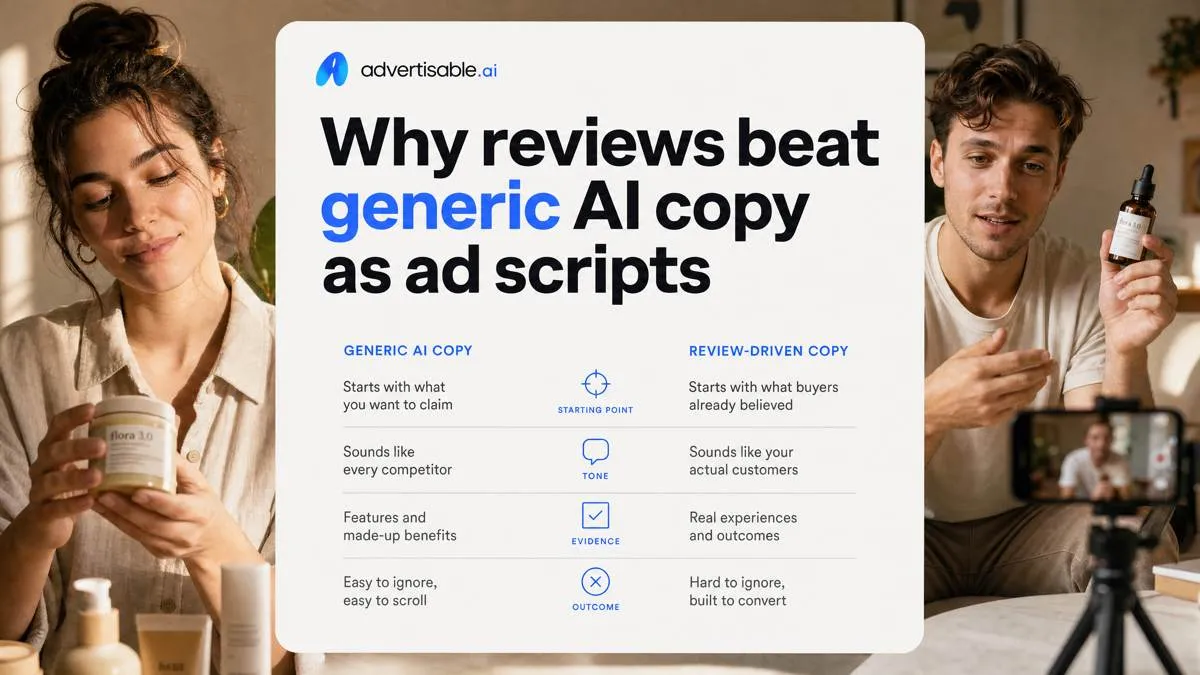
Bland review creative does waste spend, but the root cause is usually the input, not the format. Generic AI copy starts from what you want to claim; reviews start from what buyers already believed enough to pay for, then explain in their own words why it was worth it.
Credibility you cannot simulate
Reviews beat generic AI ad scripts because they carry credibility signals you cannot write into existence: a real voice, real context, and real tradeoffs. You are not asking the market to trust your phrasing, you are borrowing the customer’s framing.
A good review does three jobs at once. It sounds like a human, it anchors the claim to a situation, and it handles the objection the buyer had before purchase. Example: “I run a small warehouse team, and after the first week the picking errors dropped because labels stopped smearing” is stronger than “improves accuracy” because it includes the role, the timeframe, and the mechanism.
The performance impact is not subtle when social proof is present. Northwestern's Spiegel Research Center found the conversion rate increased 190% for lower-priced products when reviews were displayed, and the conversion rate increased 380% for higher-priced products when reviews were displayed.
From an operator lens, the best part is objection handling. Customers already write the disclaimers your compliance and support teams wish marketing would say: shipping expectations, sizing nuance, setup time, who it is not for, and what changed after day 3 versus day 30. That plain language is what keeps you from overselling and getting low-quality clicks.
- Real customer voice: contractions, imperfect grammar, and personal priorities that do not read like brand copy
- Specific outcomes and context: who it worked for, when it showed up, and what “better” looked like in their day
- Objection-handling in plain language: the caveat, the comparison they made in their head, and why they still bought
Specificity that writes the storyboard
Generic AI scripts force you to invent scenes. Reviews hand you the storyboard because they already contain moments: what triggered the search, what they tried first, what failed, and what finally clicked with your product.
When you mine reviews for problem and trigger moments, you get hooks that are naturally segmented: “I bought this after my third failed attempt at…” targets a different viewer than “I needed something before a trip next week…”. That specificity reduces wasted impressions because the first 2 seconds qualify the audience.
Reviews also give you product moment cues: the first unboxing reaction, the setup step that surprised them, the feature they keep mentioning, or the moment the result became obvious. Those cues translate into shot lists without guesswork, so you can keep brand guardrails consistent while changing only the scene that carries the message.
Most importantly, your proof lines are already phrased the way people talk. You are not polishing for style; you are tightening for clarity while preserving the customer’s nouns, numbers, and before-after contrast.
- Problem and trigger moments: the “why now” that becomes your hook scene
- Product moment cues: the exact beat to show on screen (install, first use, first visible result)
- Proof lines already phrased: quotable sentences with built-in specificity (timeframe, use case, outcome)
Pick 10 reviews that can scale into variations
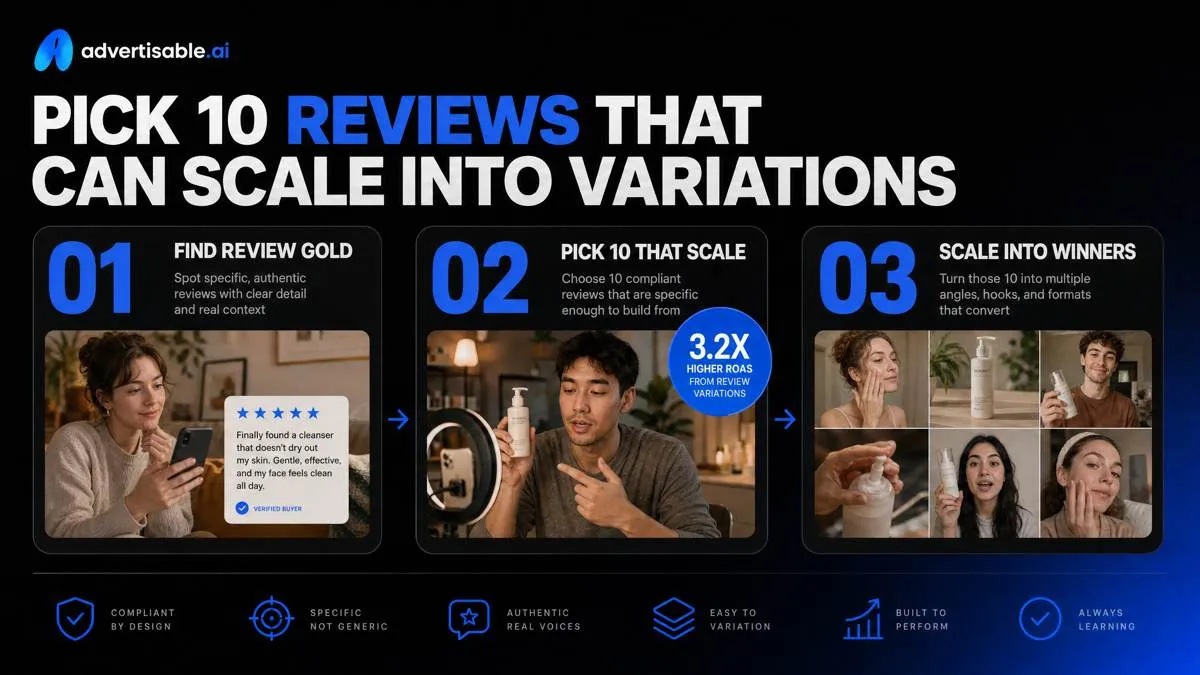
Your fastest path to compliant testimonial creative is picking 10 reviews that are specific enough to scale, and clean enough to run without rewriting claims. The workflow breaks the moment you choose reviews that imply outcomes you cannot substantiate or that platforms treat as prohibited.
Ad-ready review selection rubric
Select 10 reviews that each contain a named problem and a concrete result, plus at least one “before vs after” detail you can lift into a hook and a proof line. We treat this as a policy control step, not a creative preference step, because vague praise forces you to add claims and that is where FTC and platform risk shows up.
Use a simple acceptance threshold: if you cannot turn the review into 3 angles (hook, proof, CTA) without inventing words, it is not a source review. In our ops reviews, the strongest inputs usually include rich, scannable specifics; research published in Frontiers in Psychology notes reviews often contain semantic detail like product features and user sentiment, and those are the details that survive editing without turning into unsupported marketing copy.
- Named problem plus result: “I had [problem], and after [timeframe], I got [outcome].” Example: “After week 2, my razor bumps stopped flaring up after workouts.”
- Clear before-after details: baseline state (what was happening), intervention (what you did), and observable change (what is different now). Keep at least one measurable element: time to notice, frequency drop, or a clear situation change (morning routine, commute, meetings).
- Matches top buyer objection: choose reviews that directly answer one objection you repeatedly hear (skepticism, sensitivity, complexity, durability, fit). Example: “I thought setup would be a pain, but it took 5 minutes and it stayed stable for 3 months.”
Tricky reviews you must filter
Filter aggressively. Three review types create most policy risk: competitor callouts, price comparisons, and claims you cannot support with your own evidence. Your goal is to preserve the customer’s voice while removing the parts that create implied deception or platform disapprovals.
We run a compliance QA pass before a review ever enters creative production. Anything that forces you to “clean up” meaning (instead of removing a risky fragment) is usually a sign to discard the review and pick a different one.
- Competitor names removed: delete brand and product names and keep the underlying objection. “Better than X” becomes “I switched after repeated issues and the new one held up.” Do not imply the competitor’s performance if you cannot substantiate it.
- Price comparisons avoided: remove “half the price,” “cheaper than,” “saved me $120,” or “worth every penny” framing. You can keep value language tied to experience: “I stopped replacing it every month.”
- Unsupported claims excluded: cut medical, safety, or performance absolutes (“cured,” “no side effects,” “works for everyone,” “permanent,” “FDA-approved” unless you can document it). If the result is real but unprovable, rewrite to an observed experience: “I noticed fewer breakouts after 10 days,” not a universal promise.
Convert each review into hook, proof line, and CTA
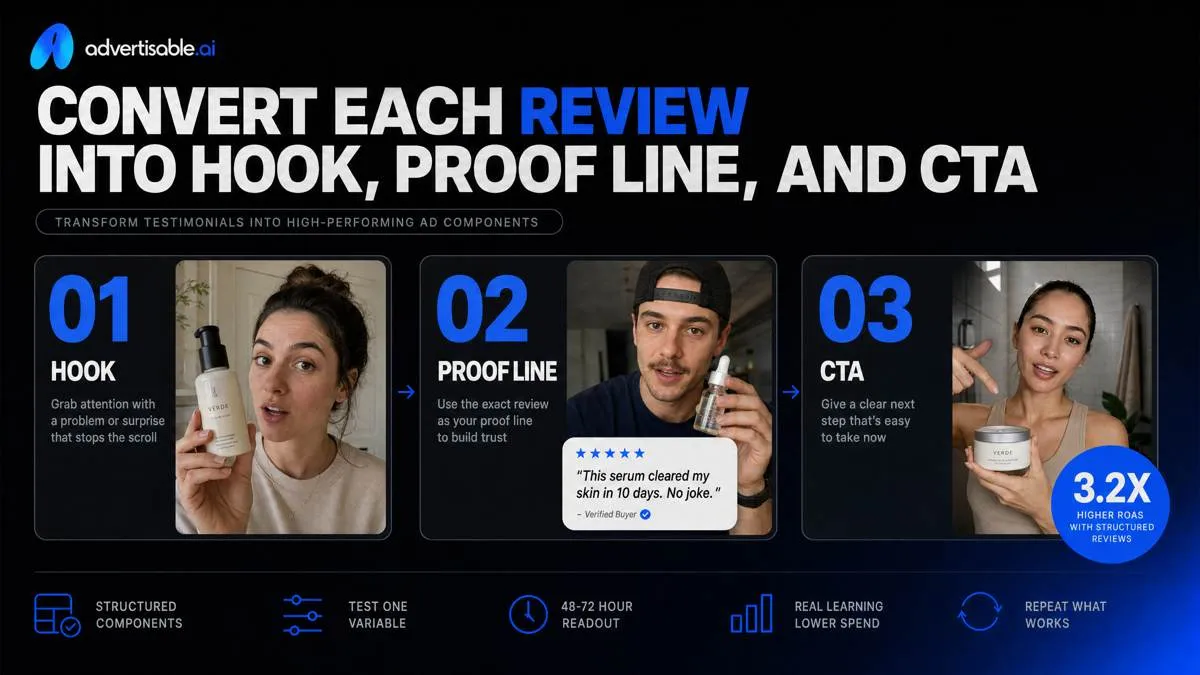
Bland review creative wastes spend because it treats testimonials like copy, not like structured ad components. The control move is to split every review into three fixed parts you can vary safely: a hook (attention), a proof line (the exact claim), and a CTA (the next step). When you keep the proof line stable and only test one variable at a time, you get real learning within a 48-72 hour readout instead of a pile of “new” ads that all say the same thing.
Hook options that stay truthful
Your hook should be a faithful entry point into the review, not a stronger claim than the reviewer made. In practice, we ship 3 hook variants per review, then hold the proof line constant so you can attribute changes in CTR and thumbstop to the opening only.
Use two hook angles and a compliance check: problem-first, strongest line first, and a hard ban on absolute superlatives that you cannot substantiate from the review text. This prevents the common failure mode where the hook over-promises, your proof line under-delivers, and conversion rate drops even when scroll-stop looks fine.
- Problem-first opening (pull the pain point the reviewer named): “Dry patches by noon?” or “Tired of products that sting?” Only use problems that appear in the review.
- Strongest line first (verbatim pull-quote as the opening): “I stopped waking up with a tight jaw.” Keep it word-for-word and on-screen for 1.0-1.5 seconds before adding context.
- Avoid absolute superlatives: replace “best ever” with the reviewer’s specific comparator or timeframe: “my favorite this month,” “the first week I noticed…,” or “better than my previous one.”
- Acceptance criteria before you export: the hook must be traceable to a phrase or implication in the original review, and it must not introduce a new outcome, speed, or certainty level.
When hooks are constrained this way, you can test for attention without turning your creative iteration into policy risk.
Proof lines that keep meaning intact
A proof line is the testimonial claim you refuse to distort, because it is doing the trust work. Edit for length, not for persuasion: you are allowed to cut words, not change what happened, how fast it happened, or who it happened to.
The safest workflow is to lock the proof line as a single sentence (or two short clauses) and treat everything else as optional packaging. If you need 2 to 3 versions, they should be trims of the same sentence, not paraphrases with stronger implications.
- Trim for length only: remove hedges and filler that do not change meaning (for example, “honestly,” “literally,” “I think”), and keep the parts that define scope: timeframe, usage context, and outcome.
- No paraphrase that shifts claims: “helped my redness” is not “cleared my redness.” “By week two” is not “immediately.” If the review is subjective, keep it subjective.
- Pair with a product moment: show the exact action that makes the claim plausible. Example mapping: proof line about texture paired with a close-up application; proof line about ease paired with a one-step demo; proof line about fit paired with a mirror check.
- QA check: can you underline every claim word in the proof line and point to the original review text that supports it? If not, revert to the reviewer’s wording.
Meta and TikTok placement mapping
The same hook and proof line will not perform the same way across placements because pacing and safe text area change what viewers can actually process. Map each review into at least 3 placement scripts so you are not forcing a Feed cut into Stories or a TikTok cut into Reels.
For short-form vertical (Reels, Stories, TikTok), your first 2 seconds must carry either the problem or the pull-quote, and your proof line should land by second 4-6. For Feed, you can earn attention with the thumbnail and headline, but you need a text-safe frame that does not get cropped or covered by UI.
- Reels and Stories pacing: 6-9 shots total, 0.7-1.2 seconds per shot early, then slow slightly during the proof line; keep the CTA as a final 1.0-1.5 second beat.
- Feed text-safe framing: keep your pull-quote in the center safe zone, avoid placing key words on the bottom 15-20% of the frame, and ensure the first frame reads as a complete thought without audio.
- Caption and on-screen hierarchy: on-screen gets the hook and proof line; caption carries the context you trimmed out (who, when, usage). Use one primary line on-screen, one supporting line max, then let the product moment do the rest.
This mapping is what lets you produce controlled variations by placement without rewriting the testimonial into something it never claimed.
The accuracy rule that keeps testimonial ads safe
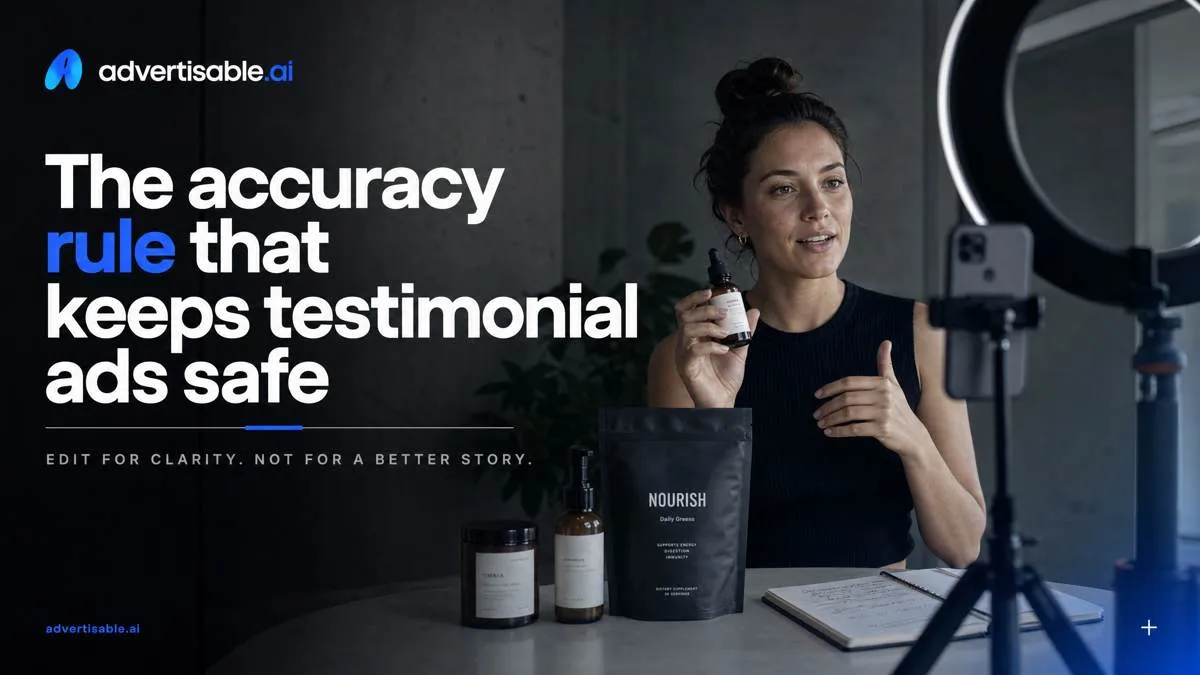
Policy risk in testimonial-led ads usually comes from one failure mode: you changed the meaning while “cleaning up” the customer voice. Your safest scaling rule is simple: edit for clarity and format, not for a better story.
Trim, do not invent
You can shorten testimonials aggressively, but you cannot upgrade them. If the customer said “helped,” you cannot edit it into “fixed,” and if the timeline was “after a month,” you cannot cut it down to “overnight.”
Our operational check is to keep a verbatim source record for every quote and make edits in one direction only: shorter. This matters most when you are producing 20 variations from one review, because small meaning shifts multiply across exports.
Composite testimonials are a hard no. Stitching together two customers into one “clean” narrative (even if both are true) creates a single endorsement that no real person actually gave.
- Acceptance criteria: the edited pull-quote must be traceable to a single original review with identical claim strength (same outcome, timeframe, and degree of certainty).
- QA check (30 seconds): highlight every adjective and time reference in the ad and confirm each one exists in the source review.
- Hold constant: keep the reviewer as one person and one experience. Change only length, punctuation, and removal of filler words.
Representative results and disclaimers
Do not build a creative batch around outliers only. A single “lost 18 lb in 14 days” style result might be real, but if you run it as your headline claim, you are implying that outcome is what a typical buyer should expect.
“Results may vary” language can help, but it is not a license to run non-representative claims. The higher-control move is to keep the qualifying context that makes the testimonial true instead of stripping it out for punch.
- Avoid: one-off extremes as the lead claim, especially when the testimonial includes unusual conditions (stacked routines, prior experience, atypical starting point).
- Use when needed: results-vary language alongside the claim, not buried, and without contradicting the main on-screen takeaway.
- Keep: the context that qualifies the outcome (who it worked for, how long it took, and what else was true at the time).
FTC guidance in plain language
Your testimonial ad must be truthful and not misleading, even by implication. That means the viewer should not walk away with a “typical result” takeaway that your customer story cannot support.
The endorsement must come from a real person and reflect their real experience. If you cannot show that the endorser exists and said the words you are running, treat the asset as unshippable.
This is the core of FTC's official guidance on ftc.gov: honest experiences only, and no testimonial that would be deceptive if you said it yourself.
- Evidence you should be able to produce on request: original review capture, date, platform/source, and the exact edited version used in creative.
- Decision rule: if you need a disclaimer to “fix” a misleading headline claim, rewrite the headline claim instead.
Build a refresh-cycle so review ads do not fatigue
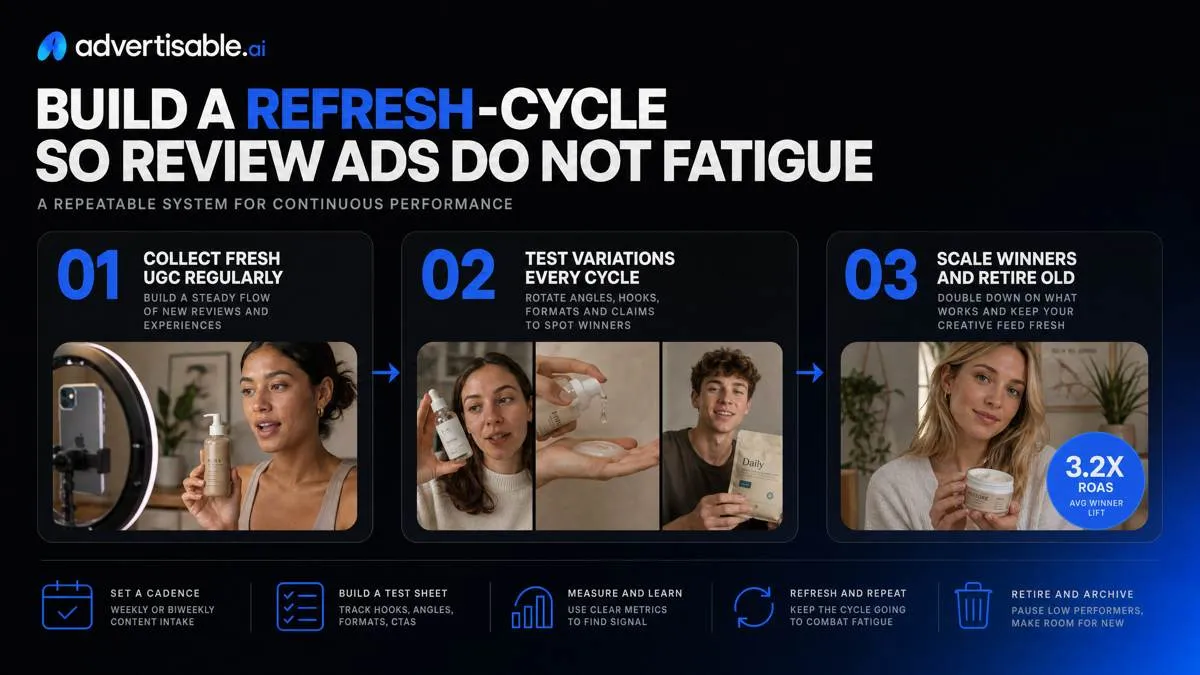
Rotation triggers and 72-hour readouts
Review creative goes stale faster than most teams plan for. At four repeated exposures to the same creative, the likelihood of a conversion drops by roughly 45% using Meta's internal analysis, so you need rotation triggers, not vibes.
Run 72-hour readouts on single-variable batches: hold your format, CTA, placement mix, and offer constant, then change one thing so the result is interpretable. In practice, you either swap the hook (first 2 seconds, headline, opening line) or swap the proof (the quoted line, star rating frame, before-after claim phrasing), never both at once.
- Hold constant: same base edit, length, captions style, and end card so delivery differences do not mask the test
- Swap only hook or proof: 3 to 5 variants per batch per audience segment
- Keep: stable or improving CPA plus flat frequency; Kill: CPA rising while frequency climbs, or CTR drops after day 2
Scaling math for 50-100 weekly variants
To ship 50 to 100 variants weekly without wasting spend, you need a predictable conversion from one review to many controlled outputs. Our baseline is 20 to 50 variations per review, created as scene swaps, not full re-edits.
Organize a review bank by pain point and outcome so each batch stays coherent: example buckets are "pain relief speed," "ease of setup," "durability," or "refund anxiety." Then set weekly production targets backwards from your refresh needs.
Example math: 3 reviews per week x 20 variants = 60 new assets; 5 reviews x 20 = 100. Tools like Advertisable AI help you storyboard once, then regenerate hook or proof scenes and export platform-ready files without breaking your guardrails.
- Minimum operating bank: 10 reviews mapped to 5 pain points (2 reviews each) so rotation does not collapse into one winner
- Weekly target setting: aim for 2 to 5 new reviews processed weekly, depending on whether your goal is 50 or 100 variants
- QA before export: proof line matches the source text, no unsupported outcomes, and the variable you changed is the only change
Execute the workflow fast in Advertisable AI Studio
URL import to storyboard output
The fastest way to operationalise review-led creative is to start from the product truth, then map a single review into a storyboard you can vary without rewriting the claim. In Advertisable AI Studio, you import a product URL, then build the ad as scenes so production and compliance checks happen before any rendering.
Treat the review as the proof script: one clean, verbatim “proof line” that anchors every variation. Your acceptance criteria is simple: the proof line matches the approved review text exactly (including qualifiers), and every other scene supports it rather than introducing new promises.
From that same review, you can generate a batch of controlled variations in minutes by changing only one variable at a time (hook, opening visual, CTA frame). We regularly plan 20 ads from one prompt as a first batch, then keep the winners and recycle the storyboard for the next review.
- URL import: pull product facts and on-page assets into the project before scripting
- Proof script review: lock one review line as the non-negotiable proof element
- Batch build: generate 20 starting variations, each with a single intended change
Brand DNA and frame-by-frame control
Brand guardrails are where most teams lose time, because they discover tone or claim issues after a video is already assembled. Brand DNA solves that by setting on-brand constraints upfront (product facts, terminology, and visual consistency) so your first drafts are closer to shippable.
When a scene is weak, you do not need to restart the whole ad. You regenerate or swap the specific frame that is failing the check, while holding constant the approved proof line so your test stays interpretable.
- On-brand guardrails: validate voice, product facts, and visual style before you scale output
- Scene QA: flag any frame with vague claims, missing qualifiers, or off-brand phrasing and regenerate only that scene
- Constant proof line: keep the testimonial line unchanged across variants so performance differences trace back to the variable you changed
Exports for Meta and TikTok tests
Export should be the least dramatic part of the workflow: format-ready files, consistent names, and a test plan that matches how platforms learn. We ship creative in batches sized for a 72-hour readout, because you need enough time for delivery and enough variants to avoid over-weighting a single execution.
Name for rotation, not aesthetics. Your file names should encode the review ID, concept, and single variable so you can pull clean learnings when you see a lift or a drop.
- Format-ready outputs: export variants sized and packaged for Meta and TikTok placements without manual resizing passes
- Naming convention: Review07_HookA_ProofLocked_CTA1 (or similar) so rotation and reporting stay clean
- 72-hour batch plan: 8 to 12 variants per concept, one variable changed per set, decisions made at 48-72 hours on what to keep, fix, or retire
Turn one review into a controlled test batch this week
You already have the raw material. The bottleneck is shipping compliant variations fast enough to stay ahead of fatigue. We built Advertisable AI for this exact workflow.
Start the $5 trial, import your best-selling product URL, and let our Brand DNA guardrails pull the product facts and brand rules you need to stay consistent. Then paste one winning review and convert it into a storyboard where the review is the proof line. Keep the offer and targeting constant.
Change one variable per batch, like hook, opening scene, or CTA. Export Meta and TikTok-ready variations, run a 72-hour readout, and promote the winner. Your acceptance criteria is simple: no new claims, clean subtitles, correct aspect ratios, and a clear next-test decision before you scale.
Frequently Asked Questions
### Are fake testimonials illegal?
Using fabricated testimonials is a high-risk compliance move because it misleads buyers and can violate advertising rules. Treat reviews as source material: trim for clarity, do not invent details, and keep any outcome statements representative and supportable.
### How much does a testimonial ad cost?
Your cost is driven by two variables: production cost per shippable variation and the media CPMs your account earns. A practical way to manage it is to set a fixed weekly variation quota, export batches, then let 48-72 hour readouts decide what you keep in rotation.
### How much does 1000 views cost on Facebook ads?
It varies by audience, placement mix, seasonality, and your creative quality, so there is no single benchmark you can rely on. Focus on what you can control: export placement-correct assets, test single-variable batches, and use 48-72 hour readouts to improve CPM efficiency over time.