Retargeting ad creative fatigue: 6 failure types
Retargeting ad creative fatigue is most often a diagnosis problem, not a frequency problem, and you fix it by locking a four-beat structure and running one-variable batch tests per segment over a 48-72 hour readout window.
Here’s what matters most:
- If you cannot name the failing beat, your “fatigue” fix is guesswork.
- Hold three signals constant: thumb stop first, then CTR, then CVR.
- Run one-variable batch testing for 48-72 hours, not day-to-day toggling.
- Keep one segment, one objection, and one metric per test to protect attribution.
- Hook fatigue often shows up as collapsing thumb stop before CTR and CVR move.
- Rotate by diagnosing the weak scene, not by rebuilding the entire ad.
We built Advertisable AI Studio for this exact workflow: import a product URL, lock Brand DNA guardrails, generate 10-20 on-brand hook variants for one retargeting segment, and keep the rest of the four-beat structure fixed. When one beat breaks, we use scene-level regeneration to replace the weak scene without restarting the whole storyboard.
Before you label an ad “fatigued,” you need to separate true creative decay from normal underperformance, because the signals and fixes are different. Start by learning which fatigue signals you can trust in retargeting and which ones are noise from unstable test windows.
What makes retargeting creative fatigue different from underperformance?
In retargeting, “underperformance” is a result. Creative fatigue is a diagnosable mechanism: the same audience sees the same creative elements too many times, so attention decays before intent does.
That distinction matters because fatigue is a measurement and control problem. If you treat it as generic poor performance, you end up changing multiple things at once, burning budget on warm users who are already primed but no longer paying attention.
Fatigue signals you can trust
The most reliable fatigue fingerprint is sequential: frequency rises while CTR falls, and the earliest damage shows up in attention, not conversion intent. Underperformance tends to show up as weak metrics from the first meaningful spend, without that “worn-out” progression.
In practice, thumb stop drops first because the hook is what your warm audience is re-encountering most often. When the first 2-3 seconds stop earning attention, the rest of the ad becomes irrelevant no matter how strong your proof element or CTA is.
CVR often holds for a window, then slides. You will see clicks get more expensive and less frequent before the people who do click stop converting, because the segment still contains high-intent users who will push through despite weaker creative.
The key is to read these in order, not as a single blended KPI: frequency pressure shows up, attention weakens, then click intent weakens, then purchase intent weakens.
- Frequency up + CTR down: audience saturation, not necessarily a broken offer
- Thumb stop drops first: hook repetition is usually the first point of failure
- CVR holds then slides: intent can persist after attention decays, then erodes as the ad keeps repeating
Mixed-batch noise looks like fatigue
Mixed-batch noise happens when you change multiple beats at once, then interpret the outcome as “fatigue” because performance moved. You did not isolate what failed, so you cannot control what you fix.
When hook, product moment, proof element, and CTA all vary across a batch, multiple beats change together and any readout is confounded. A drop in CTR could be a weaker hook, a less credible proof element, a slower product moment, or an inconsistent claim.
This is where creative conclusions stop being reproducible. You ship a high-performing variation, rebuild from scratch, and the next “similar” ad does not hold because the actual driver was never identified.
Repeatedly swapping variables also triggers platform learning reset repeatedly. Your system ends up paying tuition over and over, which looks like audience fatigue but is frequently self-inflicted instability.
Why 48-72 hours matters
A 48-72 hour readout window is the minimum unit of truth for diagnosing fatigue versus normal volatility: it is long enough to collect signal across thumb stop, CTR, and CVR, but short enough that you can cut losers before they compound spend waste.
Shorter windows push you into day-to-day overreaction, especially on retargeting where small shifts in audience mix can swing results. Longer windows lock you into funding weak hooks long after attention has already decayed.
This window also protects you from mislabeling platform ramp-up as fatigue. Meta can flag a new ad as Creative Limited within the first 48 hours, and platform stabilization research is explicit that 48-72 hours is the critical window for distinguishing genuine creative fatigue from normal stabilization.
The four-beat anatomy that keeps retargeting ads attributable
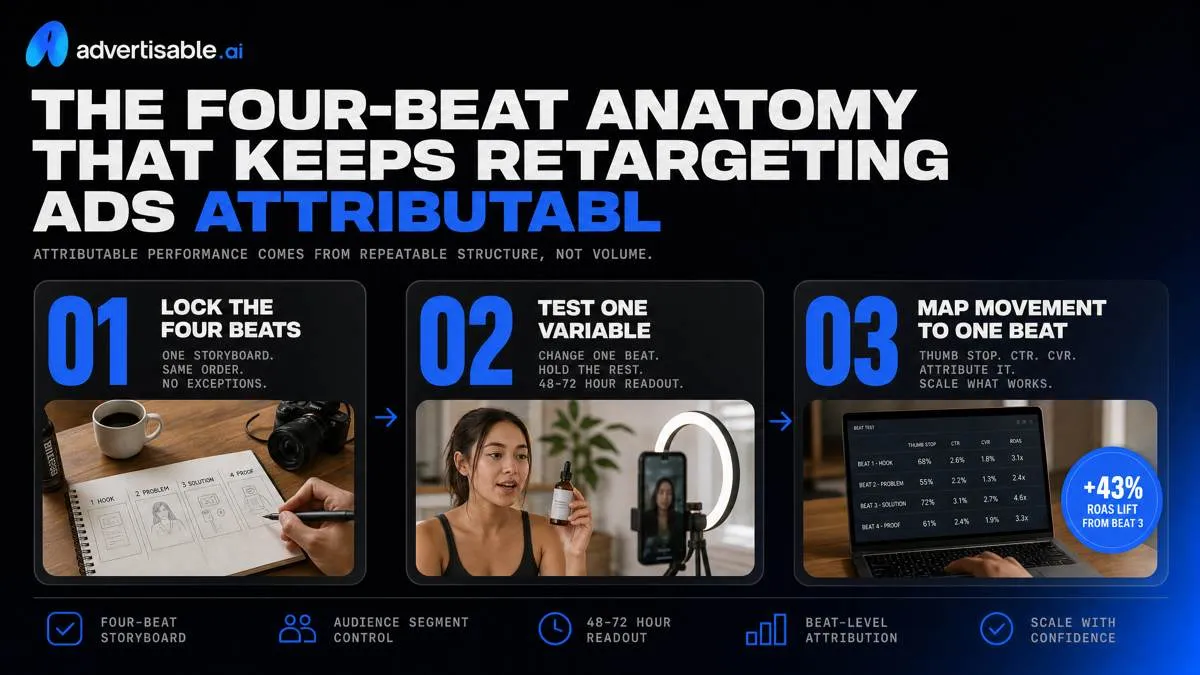
Attributable performance comes from repeatable structure, not volume. When every creative uses the same four beats in the same order, you can map movement in thumb stop, CTR, and CVR back to one beat and one controlled variable, instead of debating what “changed” in a mixed batch.
We treat the four beats as a locked storyboard, then run one-variable batch tests per audience segment over a fixed 48-72 hour readout window. That is the minimum unit where learnings stay clean enough to scale without brand drift or fatigue-driven noise.
Hook: the two-second promise
Your hook is a single promise delivered in the first 1-2 seconds, with no qualifiers and no stacking benefits. When you split attention across two outcomes, you lose thumb stop and you lose attribution because you cannot tell which claim pulled the click.
Match the promise to the segment’s intent level. A cart abandoner can process a friction-reducer, while a product viewer often needs a clearer “what this is for” promise before they will re-engage.
For controlled learning, change one hook variable per batch and keep the rest of the anatomy fixed for 48-72 hours. This is where creative teams usually contaminate results by changing voice, offer framing, and proof at the same time.
- Single promise examples (pick one): “Stop back pain from desk posture” vs “Assemble your desk in 10 minutes”
- Intent match examples: Browse segment = problem clarity; product-view segment = feature-to-outcome; cart segment = risk removal (shipping, returns, setup time)
- One-variable hook batch: 10-20 hook variants with identical product moment, proof element, and CTA
Product moment: accuracy first
Show the product early, before the viewer has to infer what you sell. In retargeting, ambiguity inflates clicks from curiosity and depresses downstream conversion, which looks like “fatigue” but is often a product moment failure.
Accuracy is the guardrail that keeps results attributable and compliant: every visual, label, price mention, and outcome claim must be defendable from the landing page. The fastest way to burn signal is to let creative imply capabilities you cannot prove.
Keep it to one feature proof per ad. When you demonstrate three features, you also create three competing reasons for conversion, and your readout no longer tells you what moved CVR.
- Early product reveal options: product-in-hand, UI walkthrough, unboxing, before-and-after of a measurable state (time saved, steps reduced)
- Undefendable claims to avoid: guaranteed results, “#1” leadership without substantiation, medical-grade outcomes without clearance
- One feature proof pattern: feature -> observable demo -> stated constraint (who it is for, what it does and does not do)
Proof and CTA as levers
Proof and CTA are the levers you pull after the hook and product moment are stable: they change believability and commitment, not basic comprehension. You select one proof type per ad so the conversion lift is attributable to a single evidence mechanism.
Use proof that matches the objection in the segment, then set a CTA that matches the required commitment level. Past purchasers may accept an upsell CTA; cart abandoners often need a lower-friction step that reduces perceived risk.
Urgency is acceptable when it is true and verifiable, and it becomes toxic when it is manufactured. False scarcity can spike short-term CTR while degrading trust, refund rates, and long-run LTV/CAC.
- Proof types: social (review snippet with source context), demo (screen capture, side-by-side, timed task), data (specific metric tied to use case)
- CTA by commitment level: “See how it works” (low) vs “Finish checkout” (high) vs “Add your refill” (repeat purchase)
- Truthful urgency: shipping cutoff times, real inventory constraints, end dates for an actual promo, onboarding windows for a genuine capacity limit
Retargeting ad creative fatigue: 6 failure types you can diagnose
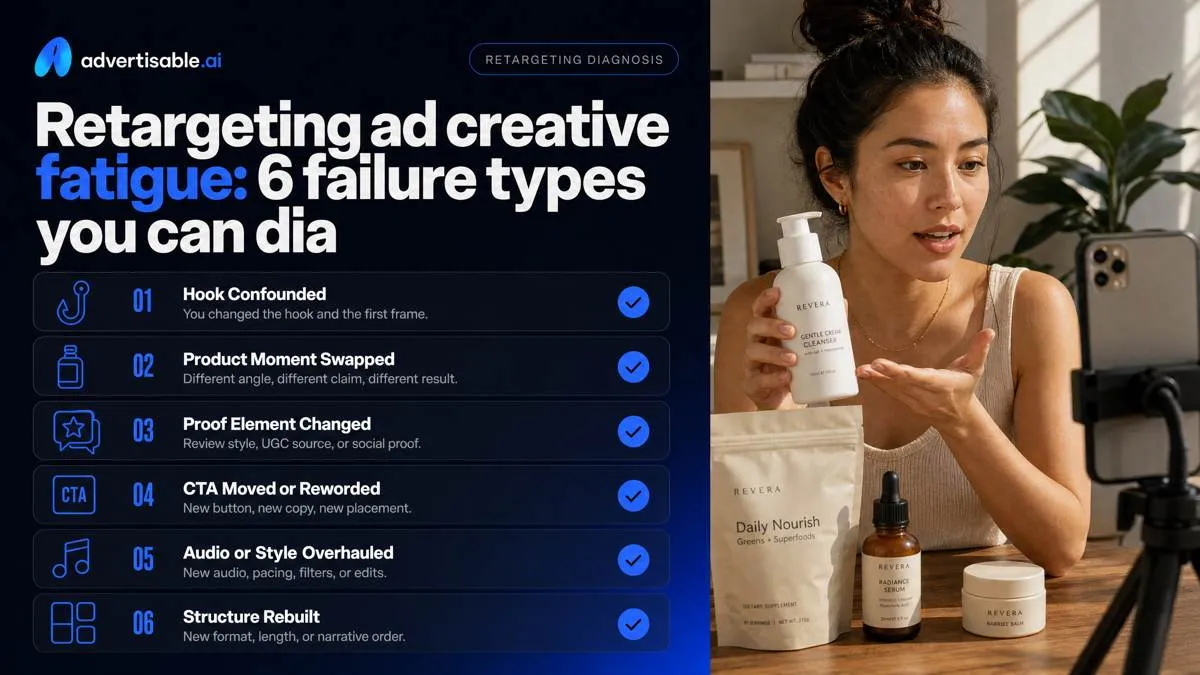
Most “fatigue” in retargeting is not that your audience is bored, it is that your variations are non-attributable. When you change multiple beats at once, you cannot tell whether the hook, product moment, proof element, or CTA caused the drop, so you iterate blind and compound the problem.
Hook fatigue
You have hook fatigue when every variant starts the same way and thumb stop deteriorates inside a 48-72 hour readout window, even though the rest of the ad is “new.” The audience learns your opening pattern and scrolls before you earn attention.
This shows up most often after teams generate volume but keep the first 1-2 seconds templated. In our experience, it is the fastest way to spend budget without learning because your downstream metrics become irrelevant when the opening collapses.
- Failure type: Same opening line, same first frame, same pacing across variants
- Signal to look for: Thumb stop erodes while CTR and CVR never get clean volume
- First beat to change: Run a hook-only batch of 10-20 variants while holding product moment, proof element, and CTA constant
- Execution note: Use a storyboard-first workflow so the body stays identical; in Advertisable AI Studio you can generate hook variants from a product URL and keep Brand DNA guardrails in place
Proof fatigue
You have proof fatigue when your claim is familiar but unsubstantiated, and the pattern is CTR stays stable while CVR falls over time. People click because the promise is attractive, then hesitate because nothing inside the ad resolves skepticism.
The root cause is repeating the same headline claim without rotating the “receipt” type. Retargeting audiences are already aware; they need corroboration, not another assertion.
- Failure type: Claims repeat without receipts (no demo, no concrete metric, no third-party validation)
- Signal to look for: CTR flat, CVR declines across successive flights
- First beat to change: Proof-type rotation while holding hook and product moment constant (eg, swap demo proof for customer outcome proof, then for expert/authority proof)
Product moment fatigue
You have product moment fatigue when the product shows up too late or too vaguely, so viewers cannot map the ad to what they saw on-site. Retargeting is a memory test, and delay creates doubt.
It is also common to blur features across variants, especially when you chase “new angles” and the visuals drift off the landing page reality. That mismatch can preserve thumb stop but depress qualified clicks and conversions.
- Failure type: Product shown after the audience has already decided to scroll
- Failure type: Feature blur or mismatch versus what the shopper evaluated on the PDP
- First beat to change: Move a specific demo earlier (first 3-5 seconds) and name the exact feature being shown
Offer and urgency fatigue
You have offer and urgency fatigue when the same incentive appears every time, and results only spike when you increase the discount. That is not performance stability, it is incentive dependency.
The long-term cost is audience training: people learn to wait, and your LTV/CAC math absorbs the margin hit.
- Failure type: Same incentive in every retargeting touch
- Signal to look for: CPA improves only when discount depth increases
- First beat to change: Non-price risk reversal (eg, extended returns, guarantee language, shipping certainty, pause or cancel terms) while holding creative anatomy constant
Audience mismatch fatigue
You have audience mismatch fatigue when the message is correct for someone else. The clearest version is browse traffic seeing a cart-close script, or purchasers seeing an acquisition offer.
This is where “more variations” increases noise: you are solving the wrong objection for the segment, so creative changes will not become durable learnings.
- Failure type: Browse segment receives cart-level urgency and assumes the brand is pushy
- Failure type: Purchasers receive first-time offers and ignore you because it is irrelevant
- First beat to change: Segment-specific objection in the hook and proof element (one objection per segment per batch), with product moment and CTA held stable
Format and placement fatigue
You have format and placement fatigue when the same aspect ratio and cut-down runs everywhere, and performance decays unevenly by placement. Feed-native expectations are different in Reels, Stories, in-feed, and YouTube placements, even for the same audience.
When you ignore that, you interpret a placement problem as a creative problem and iterate the wrong beat.
- Failure type: One master creative stretched across vertical, square, and horizontal without reframing
- Signal to look for: Strong results in one placement, rapid decay in another at similar frequency
- First beat to change: Placement-specific framing (first frame, captions density, pacing) while keeping the same four beats and one-variable discipline
How do you build retargeting ad creative by segment without rebuilding everything?
You avoid full rebuilds by keeping a fixed four-beat creative anatomy and swapping one variable per segment. In Advertisable AI Studio, the URL-to-ad workflow pulls product facts and core messaging into a consistent storyboard, then Brand DNA guardrails keep fonts, tone, and allowed claims from drifting as you generate variants. When performance drops, scene-level regeneration lets you replace the losing beat (often the hook or proof scene) without re-rendering the whole ad.
Browse and product-view segments
For browse and product-view audiences, the objection is rarely price. It is relevance and differentiation, so your first batch should hold product moment, proof, and CTA constant and test hook angle only across 10-20 variations for 48-72 hours.
Your hook needs to answer “why this, not the dozens like it” in the first 1-2 seconds, then earn belief fast with a tight proof beat. For this segment, proof that converts is usually low-friction: a 5-10 second demo snippet or a single, specific review line that reinforces the hook promise.
- Hook angles to test (one per variant): “the problem you did not realize you had,” “feature-to-outcome contrast,” “before/after expectation reset,” “expert shortcut,” “ingredient or spec callout that competitors cannot match”
- Proof options that stay lightweight: one-screen demo of the key mechanism, a 1-sentence review with the concrete outcome it mentions, a quick side-by-side showing the differentiator in use
Cart and checkout segments
Cart and checkout audiences stall on risk and friction, so you test proof or CTA before anything else. Keep the hook and product moment fixed, then run a 48-72 hour one-variable batch where each variant changes only the risk-reducer or the CTA wording.
Urgency here is operational, not hype. You are clarifying shipping, returns, and timing so the buyer can finish the decision without opening a new tab.
- Proof levers: returns policy callout, delivery window clarity, warranty guarantee, “what happens after you order” micro-steps
- CTA levers: “Complete checkout,” “Finish your order,” “Get it by [timing],” “Lock in free shipping,” “Start your return-free trial” (only if true on your site)
- Urgency angles that do not distort: shipping cutoff times, expected arrival ranges, limited-time shipping promos, restock timing, return window countdown
Past purchasers segment
Past purchasers are not asking whether the product works. They are asking why buy again, so your first test lever is a new use case, not a new discount, run in a controlled 48-72 hour batch.
Keep your four-beat structure intact and swap only the “reason to return” message, then support it with proof that fits existing customers: results, bundles, and refills that increase value without re-educating from scratch.
- New use case angles: seasonal need, complementary routine, travel or backup, upgraded workflow, “second unit” household logic
- Proof formats: post-purchase result snapshot, bundle math stated plainly, refill reminder tied to typical consumption timing (when you can back it with your own order data)
- Offer structures that preserve LTV/CAC: subscribe-and-save refills, accessories bundle, “complete the set” cross-sell anchored to what they already bought
Which creative tools fit each fatigue problem in 2026?
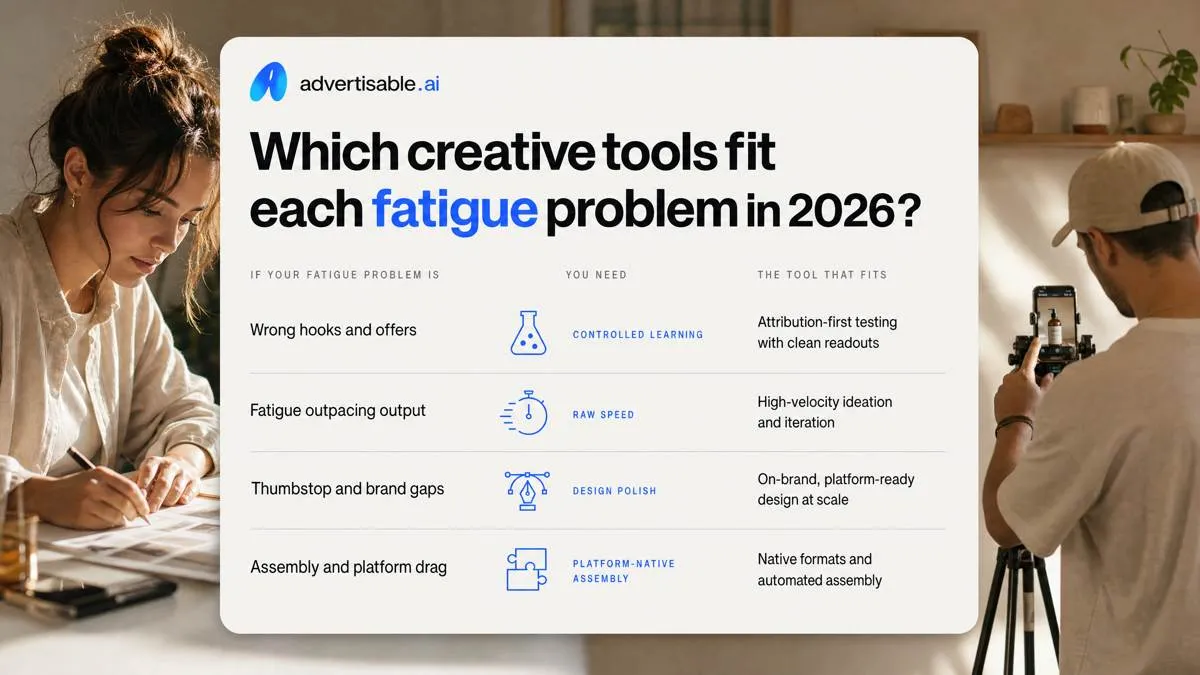
Tool choice is a constraint choice: do you need controlled learning (attributable readouts), raw speed, design polish, or platform-native assembly. The wrong stack produces mixed-batch noise, faster fatigue, and no repeatable path to lower CPA.
Advertisable AI Studio
Use Advertisable AI Studio when your bottleneck is attribution and brand control, not output volume. It is built to keep a fixed four-beat structure (hook, product moment, proof element, CTA) so each batch teaches you something you can repeat.
Storyboard-first four-beat control forces you to approve anatomy before rendering, which reduces off-brand drift and prevents “creative soup” where multiple beats change at once.
One-variable batch generation maps directly to a 48-72 hour readout window: generate 10-20 hook variants for one segment while holding the other three beats constant, then read thumb stop, CTR, and CVR without confounded variables.
Scene-level regeneration is the operational win: when the proof element is weak, you regenerate that scene without rebuilding the full ad, preserving your test integrity and QA trail.
Canva
Canva fits teams that need fast statics with strong brand kits, especially when your fatigue problem is “we cannot ship enough clean-looking assets.” Its collaboration, commenting, and template ecosystem can cut iteration cycles from days to hours.
Where it falls short is testing governance: you will still manage naming, change logs, and one-variable discipline outside the tool, which increases the odds of mixing variables in a retargeting batch.
Adobe Express
Adobe Express is a good match when design teams require tighter brand controls and you need quick resize and variants across placements. It is a practical layer for producing polished adaptations without reopening full production files.
It offers less structure for performance learnings: you can generate variants quickly, but you still need an external system to enforce a four-beat anatomy and keep variable changes attributable over a 48-72 hour readout.
CapCut
CapCut is optimized for rapid short-form editing when the fatigue problem is pacing and format, not brand drift. You get a creator-style effects library that accelerates UGC-like cuts, captions, and tempo changes.
Variant management is manual: unless you impose strict file conventions, you will lose track of which beat changed, which makes post-test readouts harder to trust.
Meta Advantage Plus Creative
Meta Advantage Plus Creative fits platform-native assembly when you need speed at scale inside Meta, with native auto-enhancements applied automatically. Since February 2026, all new Sales, Leads, and App Promotion campaigns launch with every Advantage+ Creative enhancement turned on by default, so you are opting out rather than opting in.
The tradeoff is limited creative learnings clarity: multiple enhancements can shift delivery and presentation, which blurs which creative element earned the lift or caused the fatigue signal.
Policy reality: Meta's 2026 disclosure requirements add operational risk if you cannot track which ads contain AI-generated or AI-modified elements.
Google Ads asset combinations
Google Ads asset combinations are built for multi-asset mixing at scale, where your fatigue problem is coverage: you need many headline, description, image, and video permutations to match auctions.
This is strong for reach and coverage, but attribution per creative element is harder because the system recombines assets dynamically; you often learn which bundle performed, not which beat (hook, proof element) drove the outcome.
A 48-72 hour retargeting creative test plan you can run this week
Budget waste in retargeting usually comes from rebuilding whole ads when only one scene is failing. In Advertisable AI Studio, regenerate the weak scene (often the hook or proof) while keeping the rest of the storyboard intact, so your next batch is still attributable.
Export the same locked four-beat asset set into Meta, TikTok, and YouTube formats so placement differences do not masquerade as creative learnings. One caution: retargeting ROI is frequently overstated when you treat view-through and last-click as incremental lift, so keep claims and internal expectations grounded in what your readout window can actually prove.
Batch setup and variable lock
Your cleanest 48-72 hour test uses one segment and one objective, otherwise you create mixed-batch noise that looks like fatigue. Pick a single retargeting segment (for example: product viewers) and one learning goal tied to one primary metric (hook efficiency, click intent, or purchase efficiency).
Lock three beats of the four-beat structure (product moment, proof element, CTA) and vary one beat only. In most accounts, the highest-leverage first test is hook-only, because it controls thumb stop and determines whether the rest of the ad is ever seen.
- Segment: choose one audience cut only (browse, product-view, cart, past purchasers), and keep it unchanged for the full 48-72 hours
- Objective: choose one intent step (stop, click, convert) and align optimization to it so you do not grade the batch on conflicting signals
- Variable lock: hold product moment, proof element type, and CTA constant; change only the hook or only the proof or only the CTA
- Variant count: generate 10-20 hook variants max so delivery does not fragment into under-sampled outliers
Readout metrics and decisions
Read results in this order: thumb stop first, then CTR, then CVR, because each metric gates the next. If the first 2-3 seconds do not earn attention, CTR and CVR are downstream noise; video hook retention data shows clips that hold 70 to 85% of viewers through the first three seconds earn about 2.2x more total views than weaker openers.
Pre-set kill and scale rules before spend lands. That removes the temptation to rationalize a weak batch because one ad “looked good” or because results bounced hour to hour.
Log the one thing you changed and the outcome, at batch level, so the next iteration is a controlled step forward rather than a fresh guess.
- Kill rules: pause variants that are bottom-tier on thumb stop by the midpoint of the 48-72 hour window, or that show clear CTR underperformance while holding thumb stop constant
- Scale rules: allocate incremental budget only to variants that clear your thumb stop floor and hold CTR without CVR degradation within the readout window
- Logging format: segment, objective metric, variable changed, variant count (10-20), readout window (48-72 hours), thumb stop, CTR, CVR, decision taken
Policy and disclosure checks
Run policy checks before launch, not after rejection, because rejected retargeting creative resets momentum and can distort your 48-72 hour readout. Keep a repeatable QA checklist aligned to Meta advertising policies and TikTok ad policies so your batch is judged on performance, not compliance errors.
Avoid prohibited personal attributes in both text and voiceover. Retargeting is where teams most often slip into “we know who you are” language that platforms flag.
- Meta advertising policies compliance: validate claims match the landing page, avoid misleading before-and-after implications, and ensure required labels are applied when content is AI-generated or AI-modified
- TikTok ad policies compliance: avoid shock tactics, unverifiable performance promises, and any creative that implies sensitive inference about the viewer
- Prohibited personal attributes: do not call out health status, financial status, ethnicity, or identity-based inferences (for example, avoid lines like “Still dealing with your acne?” or “As a new mom, you need…”)
Turn fatigue into attributable learning in your next retargeting batch
If your warm audiences are ignoring repetitive ads and your team is shipping endless minor variations, the issue is rarely volume. It is mixed-batch noise and a lack of control over what changed.
We built Advertisable AI Studio for performance teams that lock a fixed four-beat structure and test one variable per segment, so your readouts map to a specific beat. Start your workflow by importing a product URL to extract Brand DNA guardrails, then generate 10 to 20 on-brand hook variants for one retargeting segment while holding the product moment, proof element, and CTA constant.
Launch a single one-variable batch test for 48 to 72 hours, read thumb stop, CTR, and CVR, then use scene-level regeneration to fix the losing beat without rebuilding the full ad.
Frequently Asked Questions
### What is retargeting creatives?
Retargeting creatives are the video and static ads you run to people who already engaged, such as browsing, product-viewing, adding to cart, or purchasing. They work best when the message answers one segment-specific objection inside a fixed four-beat structure: hook, product moment, proof element, CTA.
### Can you give me an example of a retargeting ad?
For a product-view segment, a strong pattern is: hook that states a single promise in the first two seconds, an immediate product moment showing the exact product in use, one proof element like a testimonial line or quantified product fact from your site, then a direct CTA aligned to the next step. Keep all beats constant and rotate hook-only variants to diagnose whether the hook is the failure point.
### Is retargeting still effective?
Yes, but effectiveness depends on disciplined testing and attribution, not frequency alone. When you lock the four beats and run one-variable batch tests with a 48 to 72 hour readout, you reduce mixed signals and can lower CPA by understanding which beat moved thumb stop, CTR, or CVR.
### What is the difference between testing to pick winners vs. testing to learn?
Picking winners optimizes for the best-looking ad in a mixed set, but it rarely tells you what caused the lift. Testing to learn isolates one variable within a fixed four-beat anatomy, so you can attribute performance movement to a specific beat and carry that learning into the next segment and batch.
### What is Brand DNA and why does it matter for scaling retargeting ads?
Brand DNA is a locked set of guardrails for fonts, colors, tone, approved claims, and product facts that keeps variations from drifting off-brand. It matters because retargeting requires volume across segments, and without guardrails your variation engine produces inconsistent claims that inflate QA time and erode trust at the point of conversion.