AI Ad Automation Risks in 2026
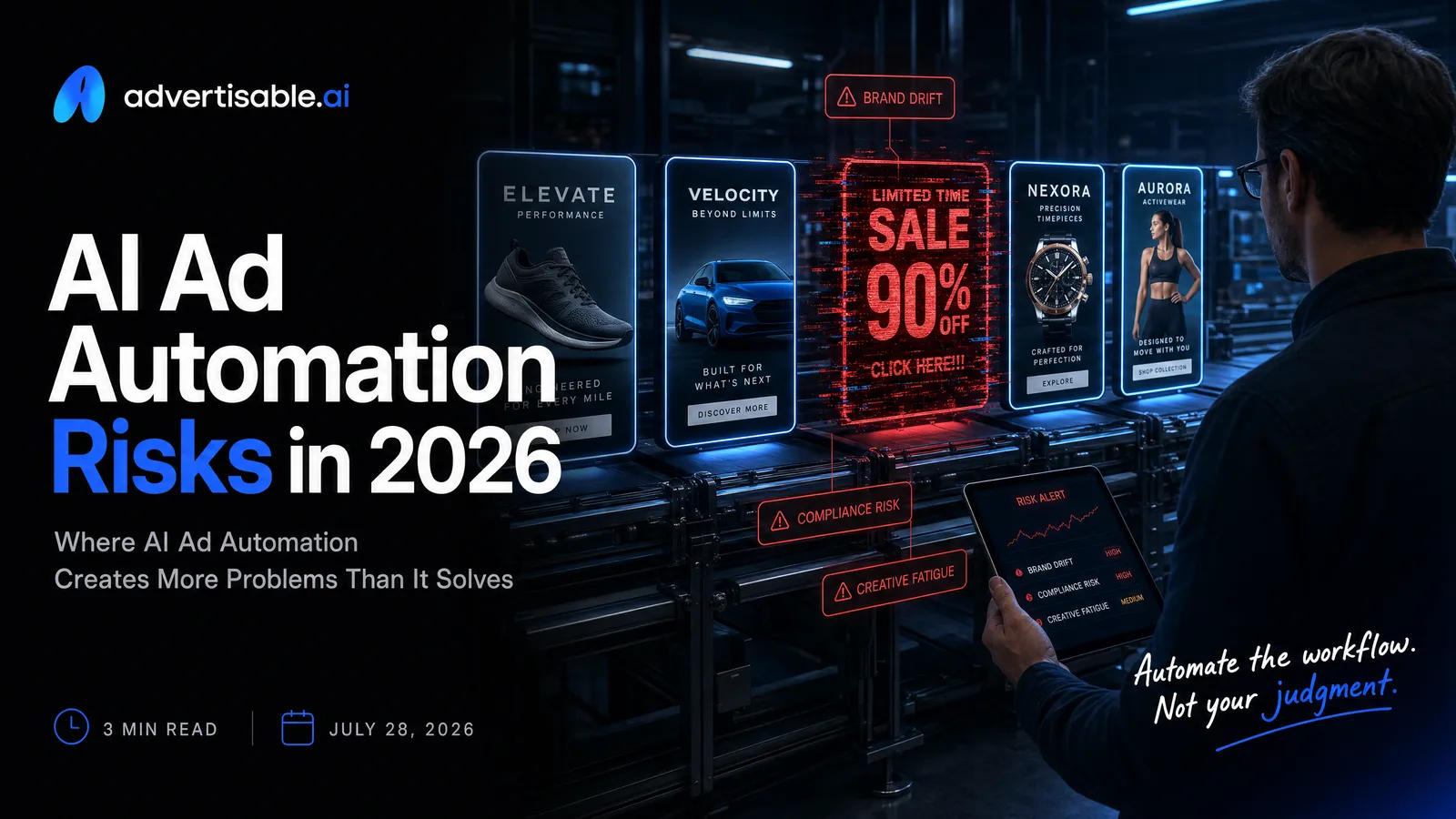
The biggest AI ad automation risks in 2026 are brand drift, unbackable claims that trigger policy or compliance issues, and high-volume sameness that wastes spend, because output scales faster than your review process.
Here’s what matters most right now:
- Brand drift happens when generation starts before your Brand DNA guardrails are locked.
- Claim risk spikes when “proof-by-vibes” language ships without an approved claims database.
- AI ad slop shows up as interchangeable hooks that depress CTR before you notice.
- Re-render loops waste budget when you cannot regenerate at the scene level.
- A safe workflow is storyboard-first, then single-variable batches with 48-72 hour readouts.
- Acceptance criteria must be explicit: on-brand voice, verifiable claims, and platform-ready exports.
We built Advertisable AI for this exact bottleneck: scaling AI-generated ad creative without letting speed erase accuracy and brand control. Our Brand DNA layer constrains generation up front, our Storyboard editor forces structure approval before you render, and our scene-level and frame-by-frame control lets you fix the risky parts without rebuilding the whole asset.
Next, we will get specific about where automation without review breaks inside real ad accounts, and how claims drift can ship quietly until it becomes a spend, trust, or policy problem.
Where automation without review breaks in real ad accounts
In 2026, automation fails less from bad models and more from missing checkpoints. When you ship before review, small errors scale faster than your team can notice, fix, or even explain.
How claims drift before anyone notices
Claims drift happens when variations quietly upgrade your promise over time, and you only catch it after spend has already gone to a version you cannot defend. It shows up fast because you are generating and launching in batches, not one-off ads.
In real accounts, drift usually starts with wording that is directionally true but not actually approved, then gets amplified by iteration. Your workflow needs a hard acceptance gate before launch, not a clean-up pass after performance data comes in.
Use the same 48 to 72 hour readout you use for CTR and CPA as a compliance readout too: any ad that changes the claim, the scope (who it is for), or the proof type should be treated as a new risk item, not a minor variant.
- Objective metric: count how many live creatives include non-approved benefit statements per batch (target: 0)
- Hold constant: approved claim library and required qualifiers; change only one variable per batch (hook or proof, not both)
- QA check: match each on-screen claim to a specific approved statement; reject if it introduces time-to-result, medical, or comparative language you do not have cleared
Product truth gets visually rewritten
Visual drift is when the creative shows a product you do not actually sell, a feature that is not real, or a use-case that is misleading, because the generator fills gaps with plausible imagery. You can lose product truth even when the copy is technically fine.
This breaks in the details: colorways, pack counts, included accessories, size cues, and before-after style implications. Once those frames ship, you are buying clicks on a promise your PDP cannot fulfill, which typically inflates refunds and support load even if CTR looks strong.
- Acceptance criteria: hero shot matches the current PDP imagery and exact SKU configuration (pack, pieces, included items)
- Scene-level QA: any frame that implies a result, a transformation, or a bundled feature must be traceable to the product page
- Next-test decision: if performance is good but truth is off, keep the hook and regenerate only the inaccurate scene, not the whole ad
Why brand voice collapses into sameness
Without review, your voice collapses into the same generic cadence every other advertiser is producing, and the account stops generating distinct learnings. The outcome is not just creative fatigue; it is measurement noise, because variants become near-duplicates.
The fix is operational: you need voice guardrails that are as explicit as your claim rules, and you need to enforce single-variable batches so you can attribute lift to a real change. Otherwise, you end up re-rendering volume and learning nothing.
- Objective metric: percentage of hooks that are interchangeable across your last 20 creatives (target: under 20%)
- Hold constant: brand lexicon, sentence length range, and banned phrases; change only hook angle or proof type per batch
- QA check: read the first 2 seconds of five ads side-by-side; if you cannot tell which is yours, the batch fails
Why AI ad automation risks are growing in 2026
How does volume outpace your QA bandwidth?
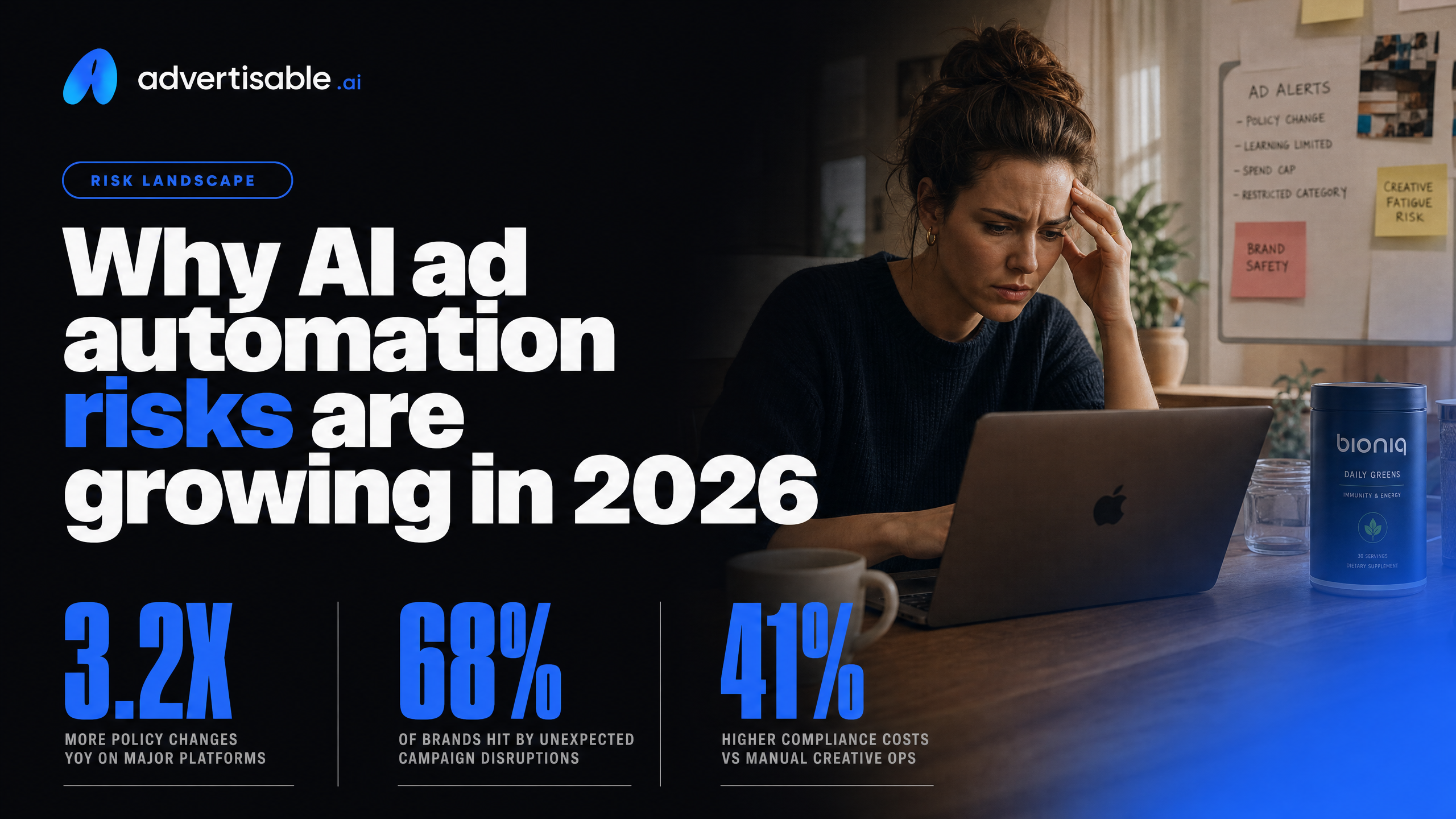
Risk grows because creative volume now scales faster than your ability to review it. When you can generate 10-20 variations in one sitting, the failure mode shifts from “we missed a detail” to “we shipped too many unreviewed details.”
In practice, QA is not just spelling and sizing. It is checking that the hook matches the product truth, that the visual context supports the claim, and that every variation stays inside your approved claim set. JumpCloud's Q3 2026 IT Trends Report shows organizations requiring human review before high-risk AI actions dropped from 40% to 25% in six months, while full AI autonomy without human review rose from 11% to 26%. That same drift shows up in creative teams when review becomes optional instead of required.
Operationally, your capacity constraint is simple: every extra variation is another chance to introduce a new claim, implication, or off-brand framing that your policy, legal, or brand owner never saw.
- Bandwidth math: if one reviewer can clear 30 assets/day and generation outputs 120/day, 75% of output either waits or ships without review
- QA scope expansion: more formats (9:16, 1:1, 16:9) multiplies review, even when the “idea” is the same
- Error propagation: one bad product fact or rule miss can replicate across an entire batch
If you do not cap output to what you can actually review, automation turns QA into a lottery.
Native generators compress the timeline
Risk is also growing because native generators inside ad platforms and creative tools compress the time between ideation and spend. The old buffer, a handoff to design or an editing queue, used to catch obvious brand and claim mistakes.
Now the workflow is closer to: generate, export, launch. When timelines compress, teams skip two controls that keep automation safe: (1) locking Brand DNA guardrails and approved claims before generation, and (2) approving the storyboard structure before any full video render.
We see the cleanest teams treat speed as a constraint, not a goal. They run single-variable batches, hold the offer and proof constant, and read results in 48-72 hours so performance signals stay interpretable.
Tools like our Video Ad Generator are built around this reality: storyboard-first review plus scene-level regeneration so you can fix the risky scene instead of re-rendering an entire ad under deadline pressure.
The real business costs: spend waste, trust loss, and policy exposure
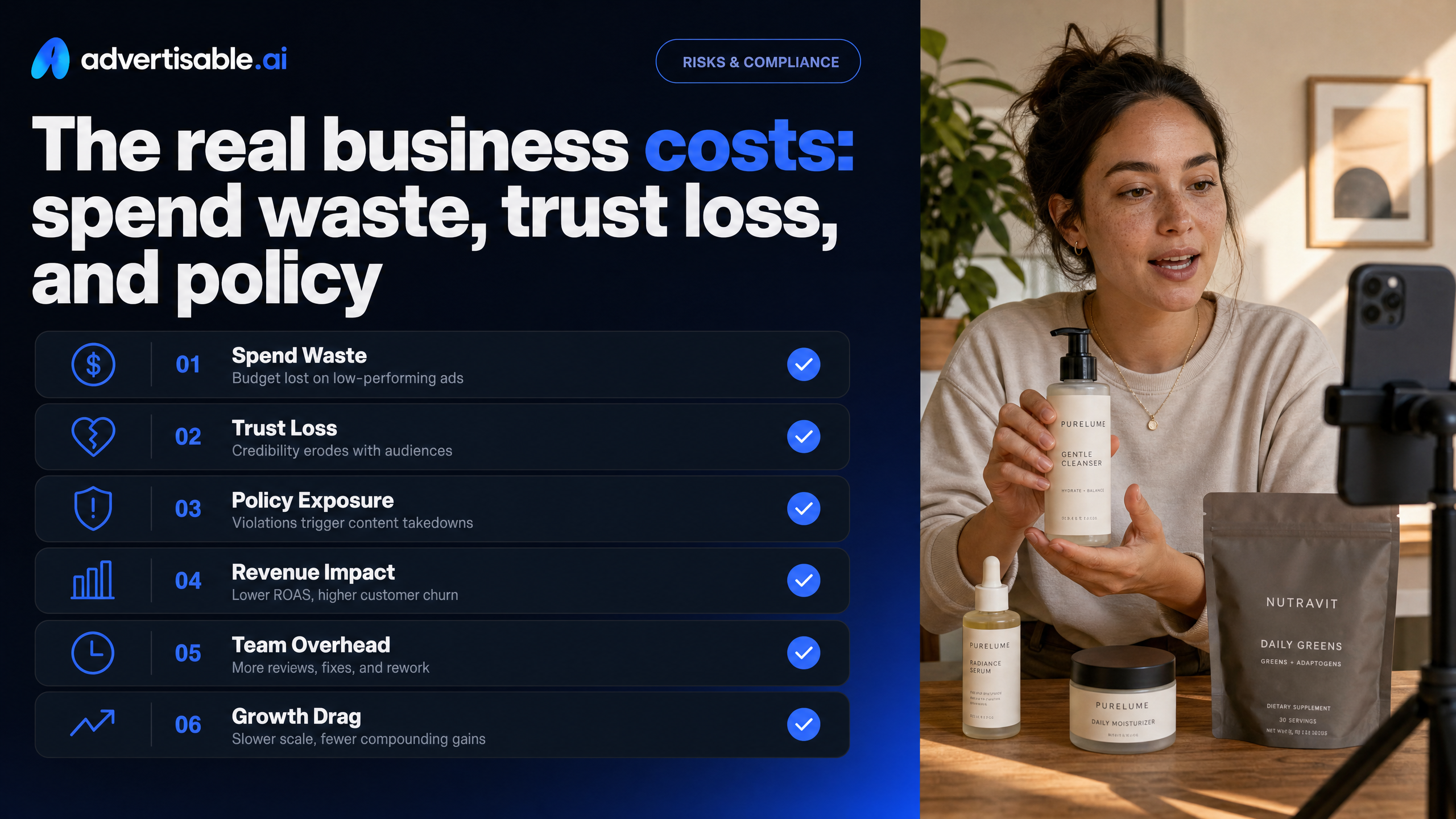
Wasted spend and rework loops
The most expensive failure mode is shipping high-volume creative that is directionally wrong, because you pay twice: once in media spend, then again in production time to rebuild and relaunch. You also lose the 48-72 hour readout window because the test never produced a clean signal.
We see rework loops when teams regenerate entire ads instead of isolating the failing variable. Keep the storyboard structure and offer constant, then change only one element per batch (hook, proof, or CTA) so you can attribute CPA or CTR movement to a real cause.
A practical acceptance gate before any spend: claims match your approved list, product shots match the SKU, and the hook is distinct enough that a reviewer can label the angle in 5 seconds.
- Objective metric for “waste”: ads that spend past your first 48-72 hours without a clear hypothesis (what changed) or a clear outcome (CTR or CPA moved)
- QA check that prevents full rebuilds: review the storyboard in text form first, then render only after claim and brand-rule approval
- Next-test decision rule: if one scene introduces risk (claim, disclaimer, or visual mismatch), regenerate that scene only; hold all other scenes constant
This turns creative output into readable experiments instead of expensive guesses.
How fast does trust damage compound?
Trust damage compounds in days, not quarters, because one off-brand or unbackable variation can get screenshotted, shared, and re-used as “what this brand is like.” You then pay a higher CPA to overcome skepticism you created yourself.
The operational fix is to treat trust as a production constraint, not a vibe check. Lock Brand DNA guardrails and an approved claims database before generation so you do not rely on reviewers to catch drift after 20 variations are already rendered.
Use an explicit pass-fail rule: any ad that cannot point to a specific, verifiable proof element (demo, mechanism, ingredient/spec, or documented policy-safe claim) does not ship.
- Measure trust erosion indirectly: rising refund rate, higher support ticket volume citing “misleading,” and comment sentiment spikes after new creative launches
- Reduce “AI ad slop” risk: require each variation to change one meaningful angle (not just synonyms) so your brand voice stays recognizable
Compliance and platform penalties
Compliance failures are not just legal risk; they are distribution risk. Platforms throttle, reject, or restrict accounts based on patterns, and AI-generated volume can create those patterns faster than your team can review them.
Your controls need to be pre-generation and scene-level. Approve the storyboard before rendering, then QA the specific scenes that contain claims, testimonials, or before-and-after implications. When something is risky, regenerate that scene only instead of re-cutting the entire ad.
ArentFox Schiff's 2026 compliance analysis is a useful reminder that civil penalties can reach up to $53,088 per occurrence under the Consumer Review Rule, so “we will fix it after launch” is a costly policy.
- Acceptance criteria before export: claim substantiation exists, required disclosures are present, and no visual implies results you cannot prove
- Platform-readiness check: verify aspect ratios and safe zones per placement so compliance text is not cropped in-feed
- Next-test decision: when an ad is rejected, isolate the rejection to the specific scene and claim, then re-test only that variable
A controlled workflow that reduces AI ad automation risks
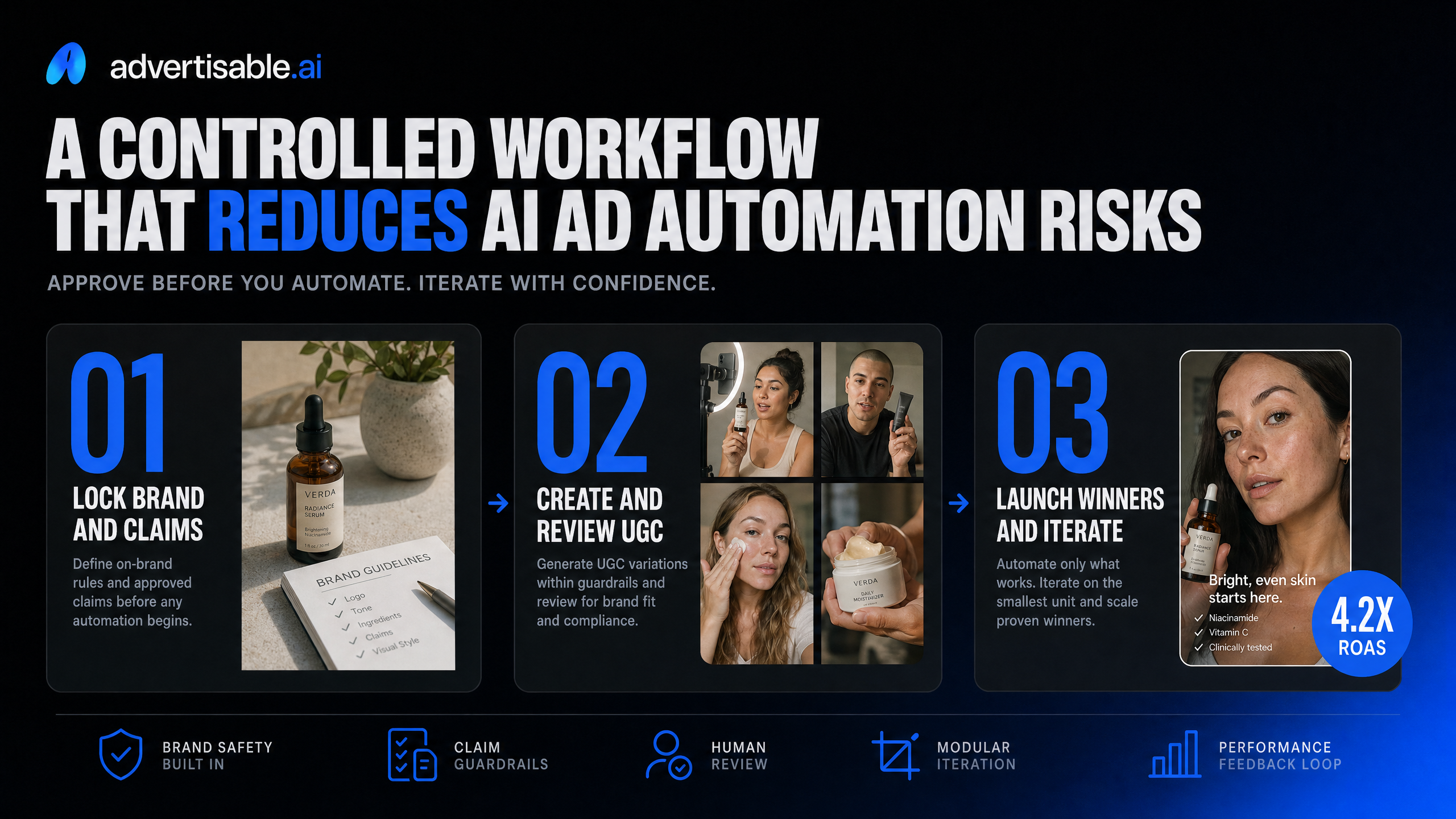
AI creative breaks when you generate at scale before you lock what “on-brand” and “allowed to claim” actually means. The fix is a workflow that forces approvals upstream and keeps iterations scoped to the smallest editable unit.
How do you lock Brand DNA and approved claims before generation?
You reduce risk by locking Brand DNA and an approved-claims list before you generate a single variation. That turns review from subjective taste into an objective pass-fail check.
In practice, we treat Brand DNA as a contract: what the product is, what you can prove, what you will not say, and what visual and voice constraints must hold constant across every output. The acceptance criteria is simple: every claim in the script must match your approved list, and every implied promise must be backed by sourceable product truth from your URL or internal documentation.
- Approved claims only: benefits, proof points, pricing, and offer terms you can substantiate
- Explicit disallowed language: medical, financial, or absolute outcome statements you cannot support
- Brand voice constraints: do-not-use phrases, required phrasing for product names, and tone rules
- Visual guardrails: logo use, color constraints, and “never show” elements
Approve the storyboard before rendering anything expensive
Approve the storyboard structure before full rendering so you catch brand and claim problems while changes are still cheap. The goal is to validate narrative and compliance at the text-and-scene level, not after you have 20 finished videos to unwind.
Hold constants steady (offer, approved claims, CTA placement) and vary one variable per batch (usually the hook). Generate 10 to 20 distinct variations, then run a 48 to 72 hour readout so CTR and CPA signals are interpretable instead of noisy.
Your storyboard approval should be a checklist, not a meeting.
- Scene-by-scene claim check: each line maps to an approved claim or is removed
- Proof placement: where the “why believe this” moment appears (and that it is specific, not proof-by-vibes)
- Brand fit: voice matches your guidelines and avoids generic “AI ad slop” phrasing
- Export readiness: aspect ratios and safe areas are correct for the placements you will run
Regenerate only the risky scene (not the whole ad)
When something fails review, regenerate only the risky scene instead of re-rendering the entire asset. That keeps learning intact and avoids introducing new errors into scenes that already passed.
We see the highest-risk scenes cluster in three places: the hook (overpromises), the proof moment (unverifiable claims), and the CTA/offer (terms drift). Scene-level control lets you fix those while holding everything else constant, so your next test is still a single-variable change.
In Advertisable AI, this is exactly what the Storyboard editor and scene-level regeneration are designed for: you edit the one scene, re-export, and preserve the rest of the approved sequence.
- Define the failure: policy risk, claim risk, brand voice drift, or visual mismatch
- Regenerate that single scene with tighter constraints (approved claim wording and required proof)
- Re-run only the affected QA checks, then ship the updated export
Audit checklist: find automation risk in your current process
Automation risk is usually process risk. You can find most of it by auditing two choke points: what the system is allowed to say, and what must be true before anything ships.
Brand and claim controls: what is your system allowed to generate?
Your highest-risk failure mode is generating creative that is on-template but off-truth: wrong product facts, unapproved claims, or a voice that drifts across variations. Audit whether your controls exist before generation starts, not as a cleanup step after outputs pile up.
We look for a single source of truth that production uses every time: brand rules, visual constraints, and an approved-claims list tied to the exact product URL or feed data you trust. If you cannot point to that artifact, you are relying on reviewer memory under time pressure, and drift is predictable.
- Approved claims registry exists (yes/no), with an owner, a last-updated date, and explicit “not allowed” claim examples
- Brand voice rules are explicit (do-say, do-not-say) and applied consistently across statics and video scripts
- Product-truth inputs are defined: the one URL or feed fields that are considered authoritative for facts, ingredients/specs, pricing, and offer terms
- Variation boundaries are documented: what can change per batch (hook, proof, CTA) and what must stay constant (brand promise language, disclaimers, offer constraints)
If any box is unchecked, treat automation output as draft-only until those constraints are locked.
Prelaunch QA gate: what must be true before anything ships?
A prelaunch QA gate is a short, repeatable checklist that blocks exports until the ad is brand-clean, claim-safe, and platform-ready. Keep it lightweight, but make it non-optional, because volume hides mistakes.
Run QA at the storyboard level for video, then again on the rendered export. In a storyboard-first workflow, you catch 80% of issues before you burn time or credits rendering scenes you will throw away.
- Claim check: every performance/health/superlative claim maps to an approved claim or gets removed
- Offer check: price, discount, guarantee/return language, and time limits match the landing page and current promo
- Brand check: logo placement, colors, typography, and voice match your Brand DNA guardrails
- Readability check: captions are legible on mobile; key message is visible within the first 2 seconds
- Export readiness: correct aspect ratios and safe zones for Meta, TikTok, and YouTube; audio levels are consistent; no truncated end frames
Where AI helps safely and where full automation is still risky
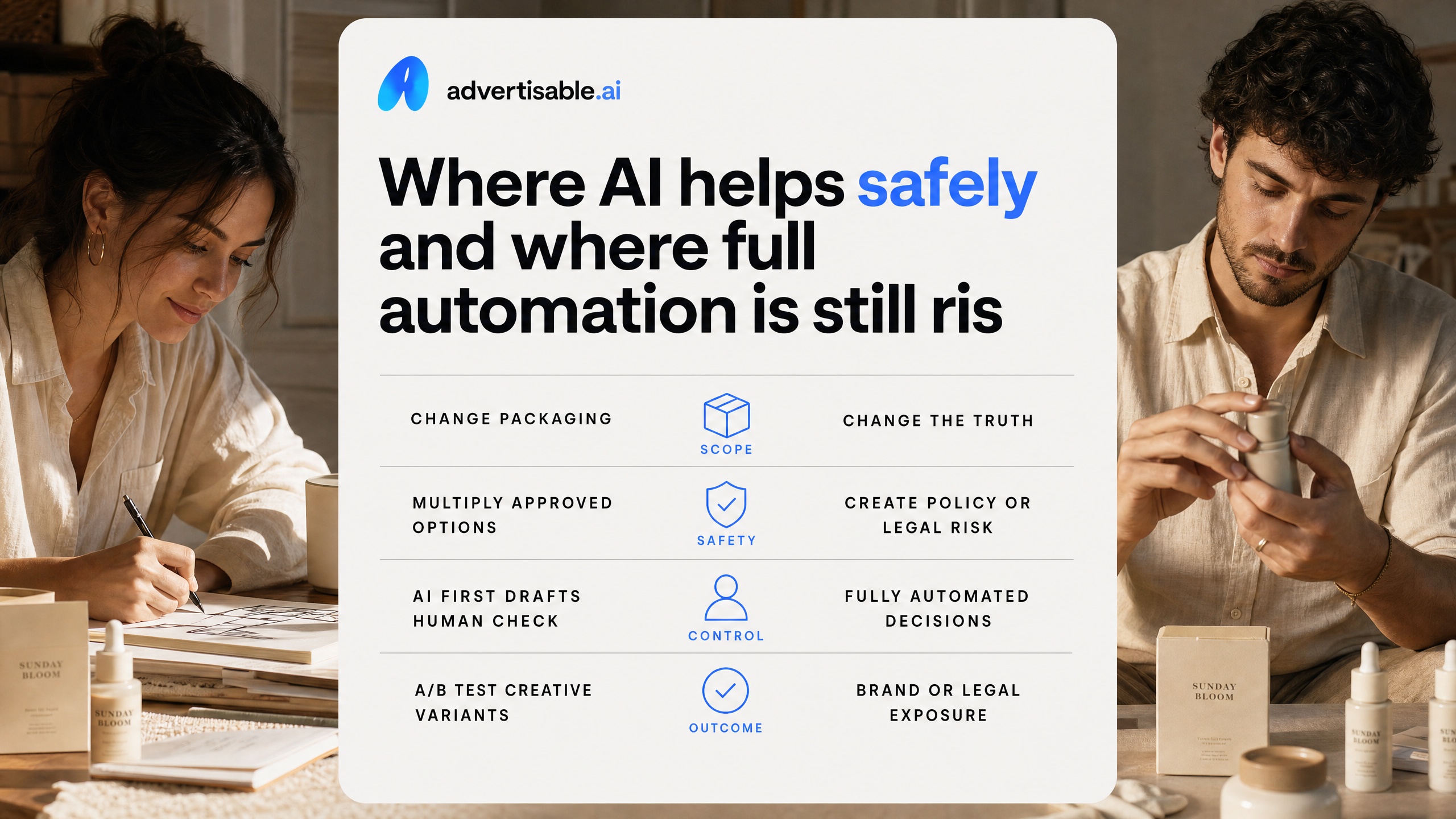
Automation is safest when it changes packaging, not truth. Use AI to multiply approved options, then keep a human checkpoint on anything that can create policy, legal, or brand exposure.
Safe: Hook and CTA variations (within locked guardrails)
Hook and CTA variations are a low-risk place to use AI because you are changing phrasing, not product reality. Treat these as single-variable batches so you can read results in a 48-72 hour window without confounding factors.
Hold the storyboard structure, offer, and proof constant. Only change the opening line or the last line. You want 10-20 genuinely distinct options, not 100 near-duplicates that create noise.
- Acceptance criteria before you generate: approved claim set, prohibited phrases list, and a defined CTA intent (buy now vs learn more)
- QA check before you ship: hook matches the first scene, CTA matches the destination action, and no new claims were introduced
- Next test decision after 48-72 hours: keep the winning hook angle, then test a new CTA verb or urgency line, not a full re-render
Safe: Format and aspect exports
Exporting to the right formats is safe to automate because it is mechanical output work, not messaging work. You should standardize this so every winning concept becomes deployable across placements in minutes, not days.
Use platform-ready aspect exports for Meta, TikTok, and YouTube, then run a quick visual QA on each cut. The key control is keeping safe zones and legibility consistent, even when crops change.
- QA checklist per export: no text cut off, subtitles readable on mobile, product stays in frame, audio does not clip
- Hold constant: timing, narration, and claims; only change: crop, layout, and caption placement
Risky: Unreviewed claims generation
Unreviewed claim generation is where automation becomes expensive fast, because one bad line can create policy issues or real-world customer harm. AI will confidently produce proof-by-vibes unless you constrain it to an approved claims database.
Your control point is simple: no claim ships unless you can point to a source of truth you already approved (product page, compliance notes, or internal substantiation). This is the part that needs a hard human gate, not a soft spot check.
- High-risk claim types to block by default: health outcomes, before/after promises, “best” or “#1” statements, fake social proof
- Acceptance criteria: claim is explicitly present in your approved set and matches the exact product variant being advertised
Risky: Auto-publishing creative changes
Auto-publishing creative changes is risky because the system can introduce brand drift while performance looks fine for a day or two. That is how you end up scaling an off-brand variant before anyone reviews it.
Keep automation on generation and export, but require a human approve step for anything that changes scenes, on-screen text, or voiceover. In our workflows with Advertisable AI, that means approving the storyboard before rendering and limiting regeneration to the specific scene that failed QA.
- Never auto-publish: new scenes, new claims, new offers, or any change to the first 3 seconds
- Safe to auto-apply: aspect exports, minor caption repositioning, and file naming conventions
- Owner checklist: creative ops signs off on brand rules; marketing signs off on hook/CTA intent; compliance signs off on claims
Run a controlled trial before you scale volume
If you want speed without brand drift, do not start by generating 100 ads and hoping QA catches it. Start by locking constraints, then letting automation operate inside them.
In Advertisable AI, paste one product URL and turn on Brand DNA to lock your brand rules and approved claims before anything is generated. Next, use our Video Ad Generator to approve the storyboard structure before you render. That is your first risk gate.
Then generate 10 to 20 hook variations as a single-variable batch. Hold the offer, proof, and CTA constant. Run a 48 to 72 hour readout on CTR and CPA.
Regenerate only the risky scene, then export the winners in Meta, TikTok, and YouTube-ready formats.
Frequently Asked Questions
### What's the difference between AI ad slop and AI ad automation risk?
Slop is a creative problem: interchangeable hooks and visuals that blend into the feed. Automation risk is a governance problem: ads shipping with unapproved claims or brand errors because no one reviewed them. Slop makes ads forgettable. Automation risk makes them a liability.
### How many ad variations should I generate and test?
Start with 10 to 20 distinct variations where each one changes a real variable like the hook, angle, or proof. Run a 48 to 72 hour readout so you can make a clean next decision instead of drowning in noisy results.
### Does using AI in ads hurt customer trust?
AI does not break trust, unreviewed outputs do. You protect trust by locking approved claims, keeping product truth consistent, and QA checking the scenes where drift and compliance risk usually show up.