5 AI Ad Myths That Are Costing You Performance
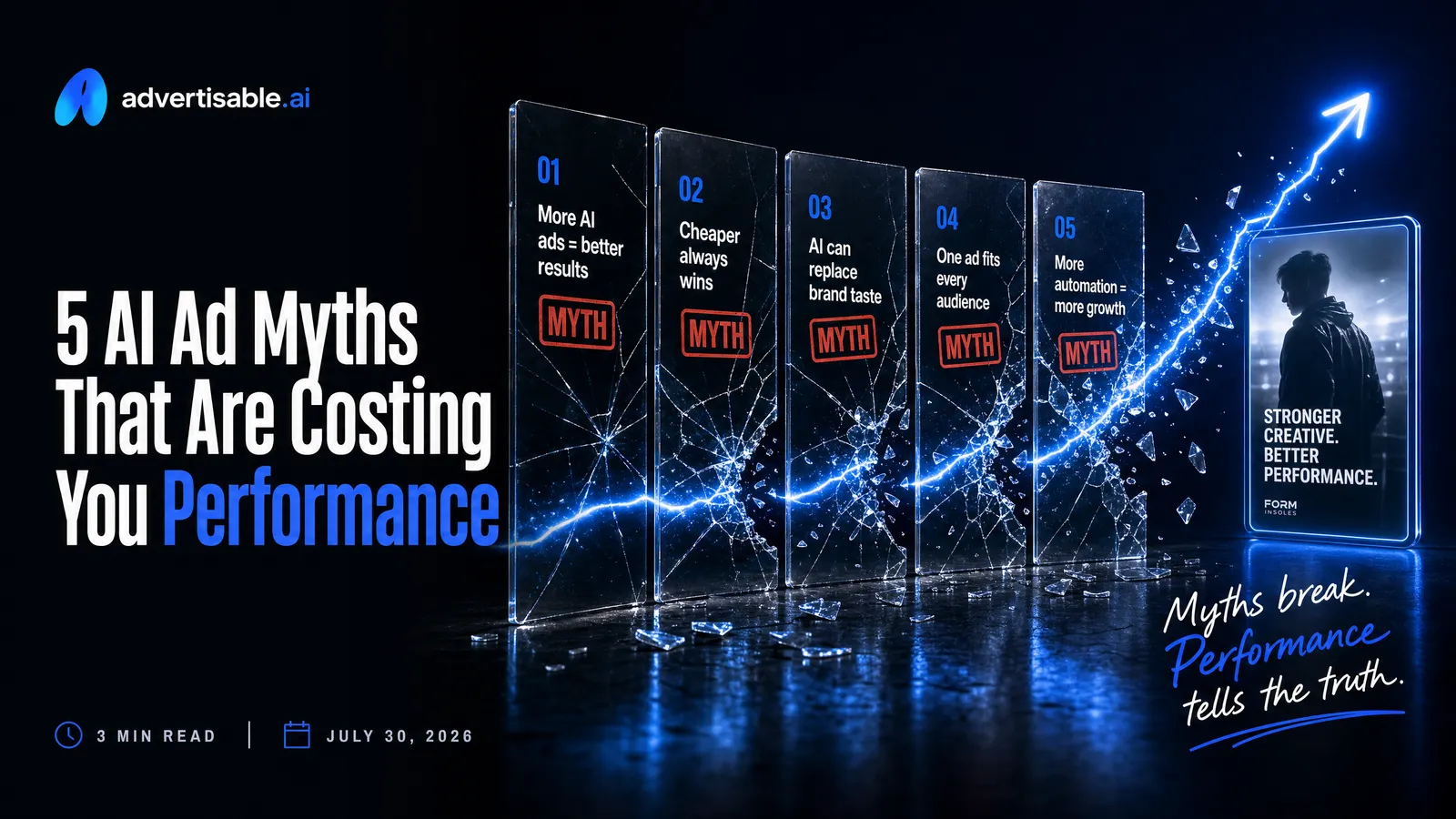
Most AI ad performance drops come from operational myths, not the model. If your AI-generated ad creative keeps coming out off-brand, triggers QA rework, or loses to your baseline, you are likely optimizing the wrong constraint. The fix is not better prompting.
Here’s what matters most right now:
- Volume does not beat focus when you are shipping uncontrolled variations.
- “Undetectable” is a bad KPI; specificity and proof signals earn attention.
- Cheap to generate can be expensive if your process creates review and rerender loops.
- AI will not fill brief gaps with judgment, so you need explicit constraints.
- A “dead” ad often needs a scene-level fix, not a full rebuild.
We built Advertisable AI for this exact bottleneck: you generate production-ready creative from a product link, keep outputs brand-locked with Brand DNA and claim verification, review the narrative in the Storyboard Editor before render, then use scene-level and frame-by-frame control to regenerate only what fails.
The first myth to retire is the one that causes the most wasted output: the belief that more variations always win, even when the inputs and constraints are drifting.
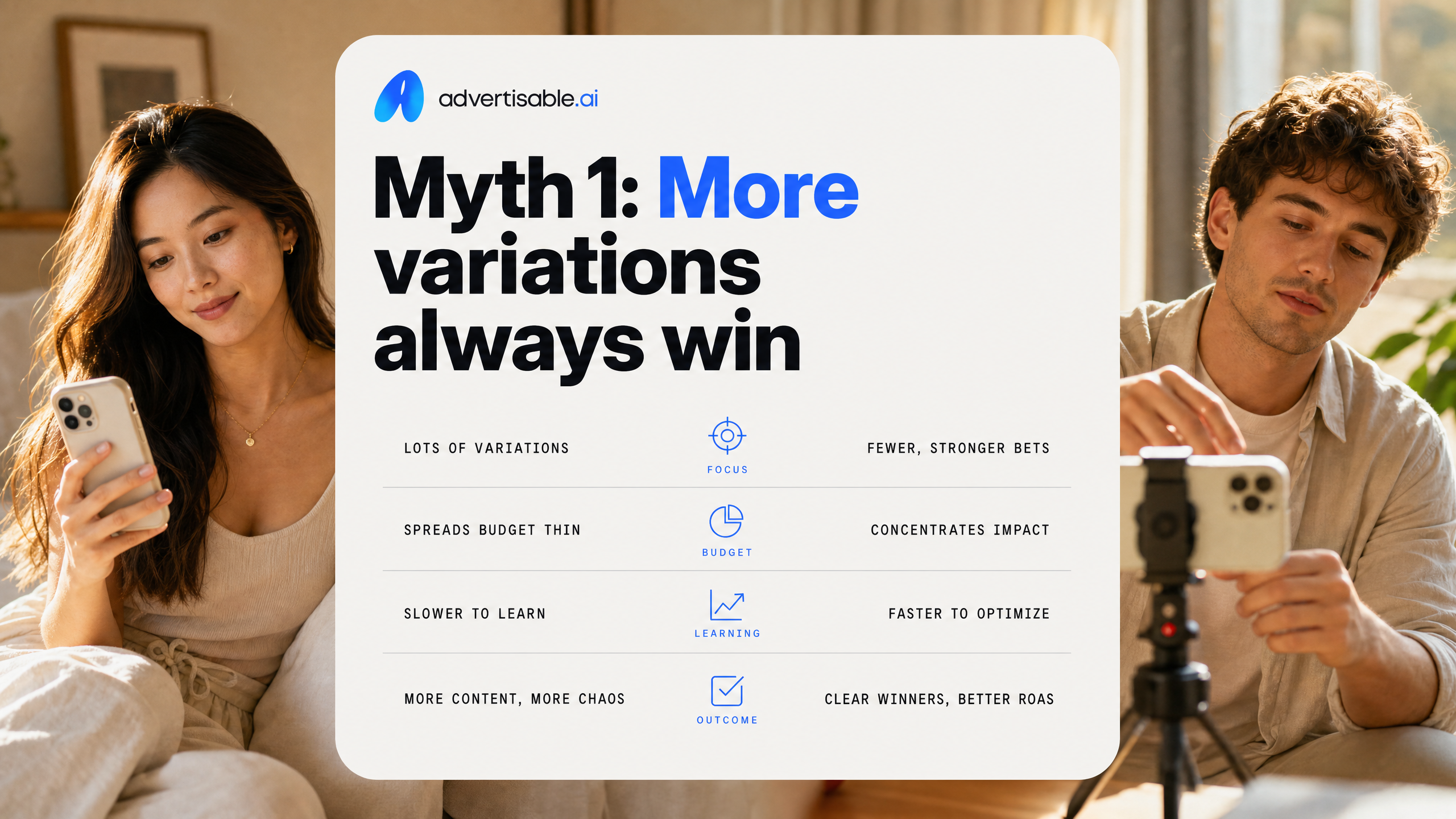
Myth 1: More variations always win
Why Teams Rush to Ship 30 Versions
The rush comes from a reasonable fear: you will burn budget while waiting for a “winner,” so you try to brute-force volume to get coverage fast.
In practice, most teams are really shipping multiples of the same concept: same hook, same pacing, same proof, same end card, with only headline or background swaps. That feels like diversification, but it is mostly insurance against creative fatigue, not a plan to create new demand.
The operational tell is that you cannot name what changed at the concept level. If you cannot describe the difference in one sentence, you are not producing meaningful variation, you are producing more files.
- Belief: more outputs increases the odds the platform finds “your audience”
- Constraint: creative reviews and QA are slow, so volume feels like the only lever
- Shortcut: prompts get reused, which collapses everything into prompt mimicry
Why “Same-but-Different” Loses in Auctions
Sameness loses because auctions reward attention and relevance, and repeated exposures decay quickly when the concept is interchangeable. Creative is what the algorithm has left to optimise once targeting is automated - and near-identical variants just teach it nothing while the audience tunes them out faster.
When you load an ad set with near-identical assets, you typically fragment learning and spend while feeding the same audience the same idea. You get more impressions, but not more new information.
If you are measuring within a 48-72 hour readout, this shows up as noisy results: small CTR swings, unstable CPA, and no clear “why” behind the outliers.
- Auction-level issue: you are not earning incremental attention, so CPM does not buy you incremental intent
- System-level issue: the algorithm has too many similar choices, so delivery spreads thin and signals get muddier
- Ops-level issue: your team cannot diagnose performance because the concepts are not separable
Reality: Distinctness Beats Count
You win more often with fewer, clearly distinct concepts than with a large pack of near-copies. Distinctness means each variation changes the reason-to-believe or the narrative structure, not the font or the cut.
Operationally, we treat “distinct” as a QA-able spec: one hypothesis per concept, one primary proof type, and one clear constraint you hold constant so the readout means something.
This is where a tool like Advertisable AI helps, because Brand DNA and storyboard-first generation let you produce brand-locked outputs while still varying the actual concept. Scene-level control matters because you can swap the weakest scene instead of rerendering an entire video when one moment is dragging results.
- Acceptance criteria for a “new concept”: the hook, proof, or offer framing changes, and you can name the new hypothesis in 10 words
- What to hold constant: product claim set and brand voice rules, so you are not testing accuracy drift
- What to change: one scene at a time (hook scene, proof scene, or CTA scene) to keep learnings attributable
Myth 2: The goal is AI ads people cannot detect
Why did “undetectable” become the KPI?
“Undetectable” became the KPI because teams confuse trust with camouflage. They have seen AI outputs trigger brand reviews, compliance escalations, and comment-section skepticism, so they optimize for hiding the tool instead of controlling the message.
That fear is understandable, but it is mis-aimed. Most people can't reliably tell a good AI ad from a filmed one anyway, so "undetectable" was never what separated ads that work from ads that don't. Your real risk is not being "caught." Your risk is shipping creative that feels evasive or ungrounded, which lowers trust even when nobody labels it AI.
- KPI drift: “looks human” replaces “communicates the offer clearly”
- Review bottlenecks: QA time goes to tone policing after generation instead of locking facts before generation
- Decision bias: teams keep the safest, most generic outputs because they are least likely to offend
Generic is the real giveaway
People do not need a detector to sense AI ad slop. Generic language and default visuals read as interchangeable, and interchangeability is what signals low effort and low truth.
In performance terms, the giveaway is “could sell anything” creative: vague benefits, missing constraints, and no concrete product view. Those are also the easiest failure modes of one-shot prompting, because the model fills gaps with defaults instead of brand specifics.
- Hooks that never name the product category or moment of use
- Proof-by-vibes claims with no mechanism, spec, or limitation
- Same pacing, same lighting, same UGC-style structure as every other ad in the feed
Reality: on-brand beats invisible
You do not win by making AI “invisible.” You win by making the creative unmistakably yours: brand-locked, claim-verified, and specific enough that a competitor cannot swap in their product and keep the ad intact.
Operationally, that means you set acceptance criteria before you generate. In our workflow, we lock Brand DNA and Claim Verification, approve the storyboard, then iterate scene-by-scene on a 48-72 hour readout so only the weakest scenes change and the rest stays constant.
Advertisable AI is built for this control loop: generate from a product URL, export 10 platform-ready variations for Meta and TikTok, and regenerate only the failing scenes instead of rebuilding the whole asset.
- Brand check: tone, color, and visual language match your existing paid winners
- Specificity check: clear product view plus one concrete promise and one constraint
- Truth check: every claim maps to an approved benefit, with no invented outcomes
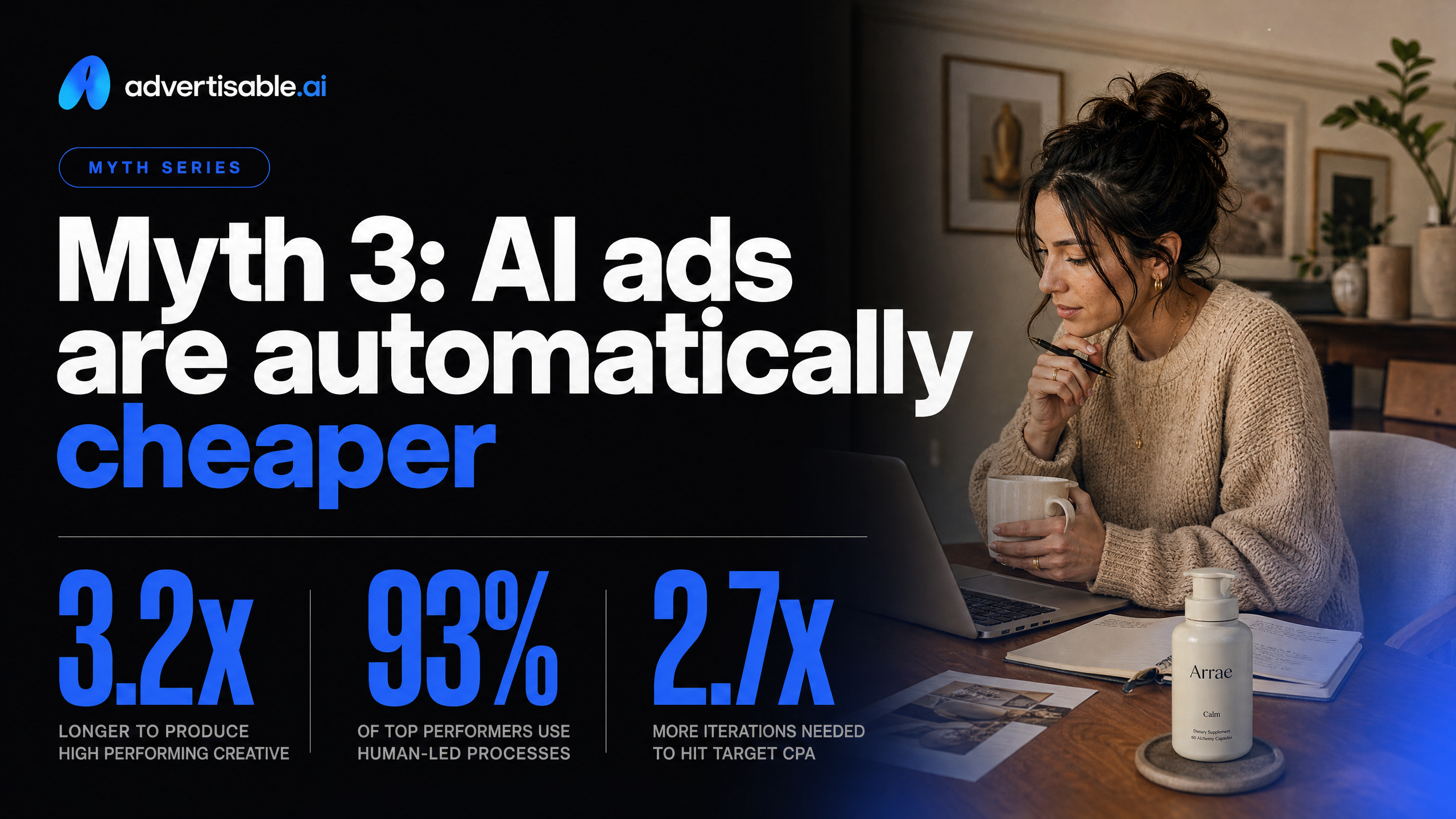
Myth 3: AI ads are automatically cheaper
Cheap to Make Is Not Cheap to Ship
Generation cost is not your real unit cost. Your real cost is cost per shippable, claim-verified, on-brand variation, and that number climbs fast when outputs need rework.
In practice, the “cheap” version of AI creative is the one-shot prompt that produces something almost-right: the hook is generic, the product details are off, or the offer language is unapproved. You then pay for human time fixing it, plus the opportunity cost of not testing while the asset is stuck in QA.
The generation is cheap; the waste isn't. A cheap ad that's off-brand or inaccurate still burns verification time, re-renders, and internal review before you kill it - and that's before you count the ad spend it wastes while live.
Where Costs Really Show Up
AI ad spend leaks in operations, not in the tool line item. The budget you feel is the hours and cycles burned when you cannot isolate what broke and fix it quickly.
Watch for these cost centers in your workflow:
- Claim cleanup: rewriting or removing unsupported benefits after the fact, then re-reviewing with legal or brand
- Brand drift fixes: correcting tone, visual rules, and product truth across multiple versions
- Full-asset rerenders: rebuilding an entire video because one scene is wrong
- Approval latency: extra review rounds when stakeholders cannot evaluate the narrative until after render
- Test waste: pushing “good enough” ads live, then learning nothing because multiple variables changed at once
Reality: Cheap Follows Control
AI creative gets cheaper when you control inputs and isolate edits. The operator move is to lock what must be true, then iterate scene-by-scene on what is actually underperforming over a 48-72 hour readout.
That is why we built Advertisable AI around Brand DNA, claim verification, a storyboard editor, and scene-level control. You review the narrative before rendering, export platform-ready variations, then swap only the weakest scene instead of rebuilding the whole ad.
Acceptance criteria stays simple: the product is shown clearly, the offer is explicit, claims are pre-approved, and each new batch changes one variable (hook, proof, or CTA) while everything else stays constant.
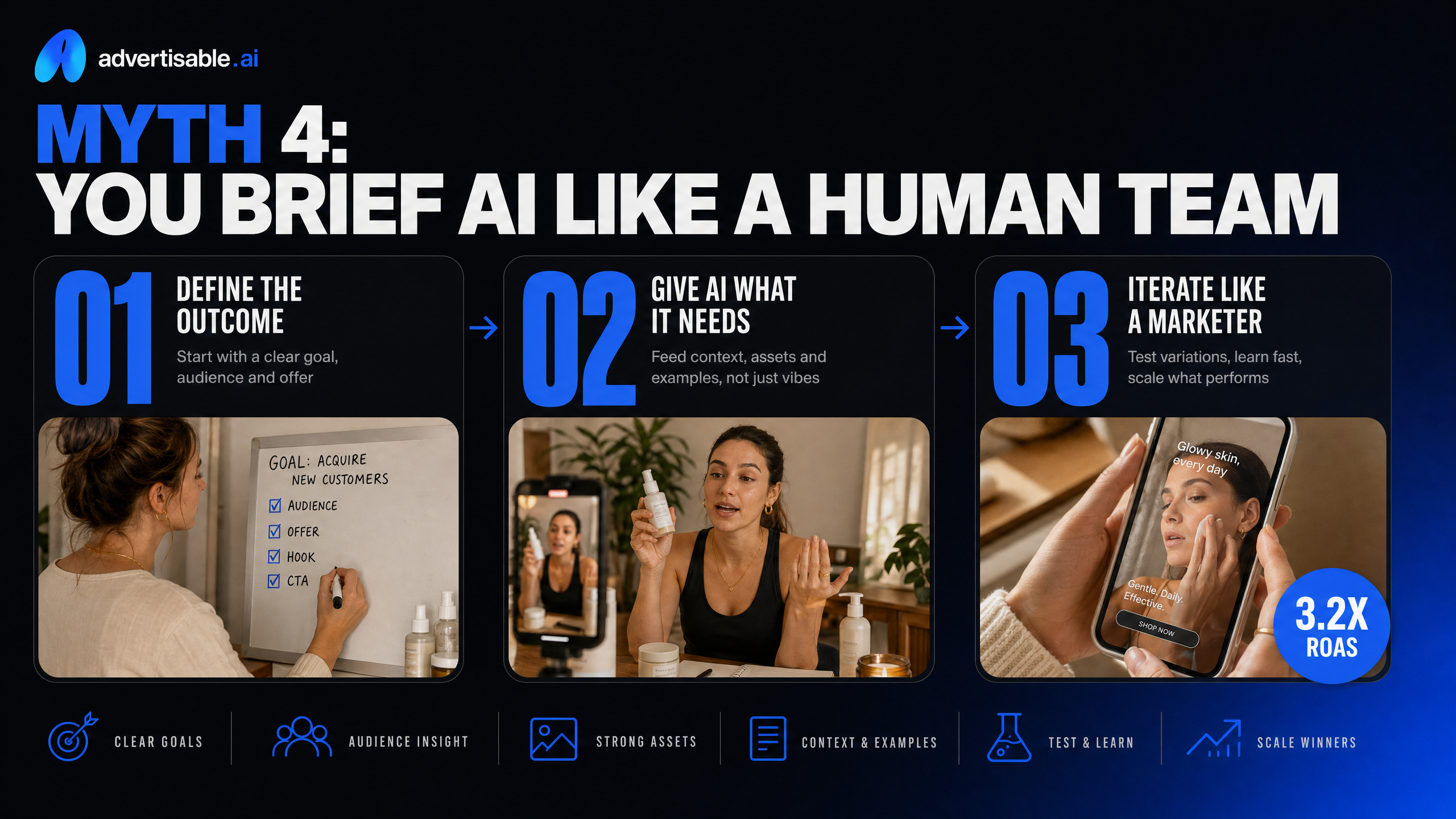
Myth 4: You brief AI like a human team
Humans Fill Gaps With Judgment
A human team can take an incomplete brief and still ship something usable because they infer intent from context. They know what “on-brand” sounds like, which claims are risky, and which visuals will get you flagged in QA.
In ops terms, humans add invisible inputs: taste, category norms, and your historical performance memory. That is why you can write “make it punchier” and still get a coherent revision back.
The risk is you start writing briefs that rely on mind-reading. That works with a senior creative who has seen 50 of your ads, not with a model that only has what you gave it in the prompt.
AI Fills Gaps With the Average
When your brief has holes, the model doesn’t “use judgment”, it completes the pattern with the most statistically common version. That’s how you get the same UGC-style pacing, interchangeable hooks, and vague benefit language that could sell anything.
This is where AI ad slop comes from operationally: you omitted constraints, so the model supplied defaults. It also tends to smooth edges that make a brand distinctive, because distinctive is rarely the average case.
Even audience trust is sensitive to this. Since most people can't reliably spot a good AI ad anyway, your bigger risk is not detection - it is generic output that feels uncommitted.
Reality: Constrain Inputs Upfront
The fix is not a longer prompt. The fix is locking what cannot drift before you generate anything, then iterating at the scene level.
In Advertisable AI, we do this by generating from a product link so Brand DNA and product facts are present from frame one, and by requiring claim verification before render.
Your upfront constraint checklist should be explicit:
- Non-negotiables: offer, price or promo terms, and one primary CTA
- Approved claims only: benefits you can stand behind, plus required disclaimers if relevant
- Brand rules: tone do-not-use list, visual identity constraints, and banned phrases
- Storyboard acceptance criteria: clear product view, concrete proof type, and a single hook angle per variation
- Iteration plan: export 10 variations, read results in 48-72 hours, then swap only the weakest scene while holding everything else constant
Myth 5: If an ad stops working, make a new one
Why did this ad stop working?
“Stopped working” is an outcome, not a diagnosis. The same CTR or CPA slide can come from totally different system changes, so reacting with a rebuild often fixes the wrong thing.
In our ops reviews, we see the usual suspects: audience saturation, auction pressure, targeting or placement mix shifts, delivery pacing changes, and platform learning resets. research on creative fatigue detection makes the same point: CTR trajectories alone do not tell you the underlying cause, and simple rules like “3 days down, kill it” trigger false positives because normal variance can look like deterioration.
Your first job is to separate a true creative problem (message no longer resonating) from a delivery problem (the system is showing it to different people, in different contexts, at different costs).
What does new creative actually fix (and what doesn’t it fix)?
New creative primarily addresses one cause: audience saturation and message wear-out. It does not automatically solve an auction that got more expensive, a placement shift, or a learning phase disruption.
When you swap the whole asset, you also reset the platform’s learned signals. Sometimes that “freshness bump” looks like a win for 24 to 72 hours, then performance returns to the same baseline problem because nothing upstream changed.
We treat a full rebuild as the most expensive option because it changes multiple variables at once: hook, proof, pacing, visuals, and offer framing. That makes it harder to learn what actually broke.
Reality: diagnose, then make targeted changes
Run a short diagnosis window, then change one lever at a time. Our default is a 48 to 72 hour readout with acceptance criteria set before you touch the creative.
Start with a simple split: hold the core story constant, then test targeted edits in small batches. With Advertisable AI, that means storyboard-first review, then using Scene-level Control or Frame-by-frame Control to swap only the weakest moment instead of rebuilding the whole video.
- Define the objective metric before testing (CPA, CTR, hook rate, or thumbstop) and the cutoff you will act on
- Check whether delivery changed: placement mix, audience expansion, budget jumps, or learning resets
- If it is saturation, keep the offer and proof type constant and rotate only the hook or first 2 seconds
- If it is trust decay, keep the hook and add specificity: clearer product view, tighter claim language, or Claim Verification to remove unbackable lines
- Export 10 platform-ready variations for Meta and TikTok, then retire only the variants that miss the threshold
What this mindset looks like in Advertisable
Import a product URL to lock the facts first
Your fastest path to accurate AI-generated ad creative is starting from a real product page, not a blank prompt. In Advertisable AI, you generate from a product link so the model has concrete inputs to pull from before it writes a script or builds a storyboard.
Operationally, this shifts your workflow from “write what sounds right” to “use what is already true.” You spend your time deciding what to emphasize, not cleaning up hallucinated features, mismatched pricing, or missing offer terms.
Acceptance criteria before you export anything: product name matches the page, core benefits match approved language, and the offer terms shown are the ones you can actually fulfill
Brand DNA keeps outputs on-brand and claim-verified
Brand DNA is the guardrail that stops drift. You lock your visual identity, tone, language rules, and approved claims up front, so the variations stay brand-locked instead of slowly turning into generic feed content.
In practice, we treat this like QA prevention: you decide what is allowed once, then generate volume without re-litigating the basics on every new cut.
- QA check: does the ad use approved claims only (Claim Verification), and avoid vague “proof-by-vibes” lines that cannot be substantiated?
- QA check: do visuals and wording feel like your brand across every variation in the pack, not just the best one?
Frame-by-frame control is how you iterate without redoing the ad
Iteration gets cheap when you can change only what is failing. Advertisable AI lets you edit at the scene level and down to frame-by-frame control, so you can swap one weak moment without rerendering the entire video.
Run your tests like an operator: keep 80% constant, change one variable, and give Meta or TikTok a clean 48-72 hour readout before your next decision.
- Hold constant: offer, product truth, and Brand DNA rules
- Change one thing per batch: first 2 seconds hook, proof scene, or CTA scene
- Decision rule: replace the lowest-retention scene first, then re-export the same structure
Try it on one product: $5 for 3 days
If you want to validate this workflow quickly, start with one key product URL and a$5 3-day trial. Your goal is a small, controlled output you can actually ship, not a giant library you cannot QA.
A practical first run is exporting 10 platform-ready variations for Meta and TikTok, then iterating by replacing only the weakest scenes while the rest of the ad stays brand-locked.
- Pick one hero product page with the cleanest, most complete on-page details
- Generate a variation pack, review the storyboard, and approve claims before render
- Export 10 cuts, then do one-variable swaps on the losing scenes
Turn the myths into a controlled creative test this week
If your AI-generated ad creative keeps drifting off-brand or underperforming, the fix is not a better prompt. It is a tighter workflow with clear acceptance criteria. We built Advertisable AI for exactly that.
Start the $5 trial using one key product URL. Lock your Brand DNA and run Claim Verification before you render anything. Build storyboard-first, then export 10 platform-ready variations sized for Meta and TikTok.
Hold constant your offer, CTA, and proof type. Change one variable per batch, typically the first two scenes. Read results after 48 to 72 hours, then use Scene-level Control to regenerate only the weakest scenes.
QA before launch: on-brand visuals, claim-verified lines, clear product view, and export readiness.
Frequently Asked Questions
### What's the difference between AI ad slop and quality AI creative?
AI ad slop is interchangeable creative that could sell anything because it lacks product truth, proof, and consistent brand cues. Quality AI-generated ad creative is brand-locked, claim-verified, and specific in what it shows and says so it earns trust and performs in auctions.
### How do I keep my AI ads from drifting off-brand?
Define and lock your Brand DNA before generation, then constrain outputs with approved claims and visual rules. Review in a storyboard-first pass and fix only the failing scenes using scene-level control instead of rebuilding the full ad.
### Why does every AI ad in my feed look the same?
Most teams accept default structures and vague language, so outputs converge on the same hooks, pacing, and generic proof. You break that by holding your Brand DNA constant, anchoring every scene to a concrete product truth, and iterating scene-by-scene with single-variable batches.
### What are common AI myths?
Common myths include thinking more variations always win, chasing ads that look “non-AI” as the main KPI, assuming AI is automatically cheaper, briefing AI like a human team, and replacing an ad instead of diagnosing which scenes are failing. The operational fix is always the same: lock inputs, storyboard-first, then iterate with controlled scene-level changes and 48 to 72 hour readouts.