AI Ad Feedback: How to Steer Almost-Right Output
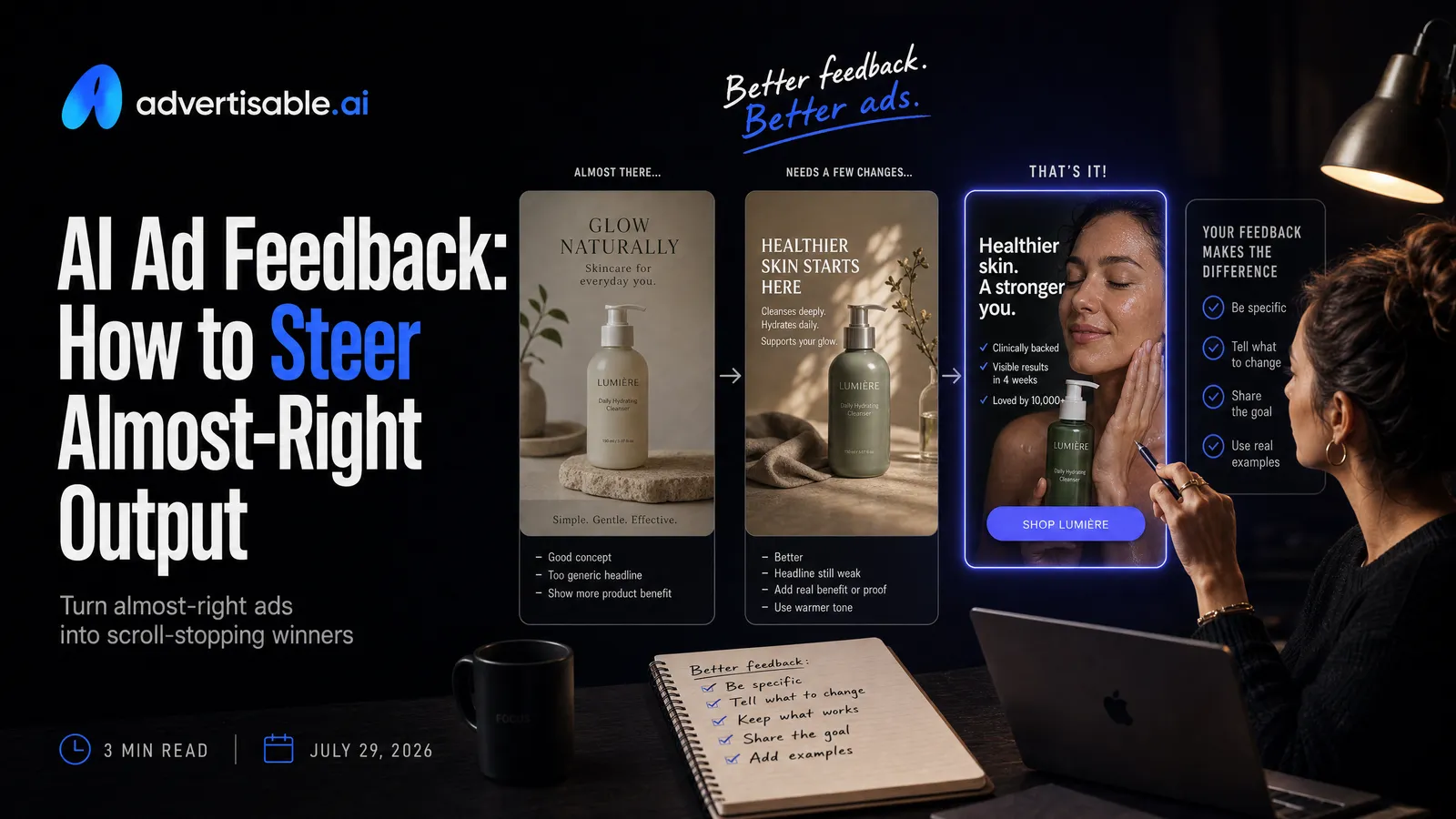
Advertisable AI gives actionable ad feedback because it ties every note to a controllable, scene-level edit while keeping outputs accurate with Brand DNA from your product URL.
Here’s what matters most when you need feedback you can actually ship:
- Actionable feedback names the failing beat, not an adjective like “more engaging.”
- Every note should map to one edit: hook, product moment, proof element, or CTA.
- Treat “80% finished” ads as dangerous until each beat passes a quick QA check.
- Run one-variable tests so CTR and CVR changes have an attributable cause.
- Use 48-72 hour readout windows to avoid overreacting to noise.
- Scale with batches designed for learning, not winner-picking.
We built Advertisable AI for the iteration bottleneck you are living in: shipping 50 to 100 variations a week without losing control. The workflow is simple and operational: paste a product URL to lock Brand DNA, generate a storyboarded video, request feedback focused on the hook and CTA, regenerate only the named scenes with Scene Regenerator, export platform-ready formats for Meta and TikTok, then launch a 72-hour one-variable test batch.
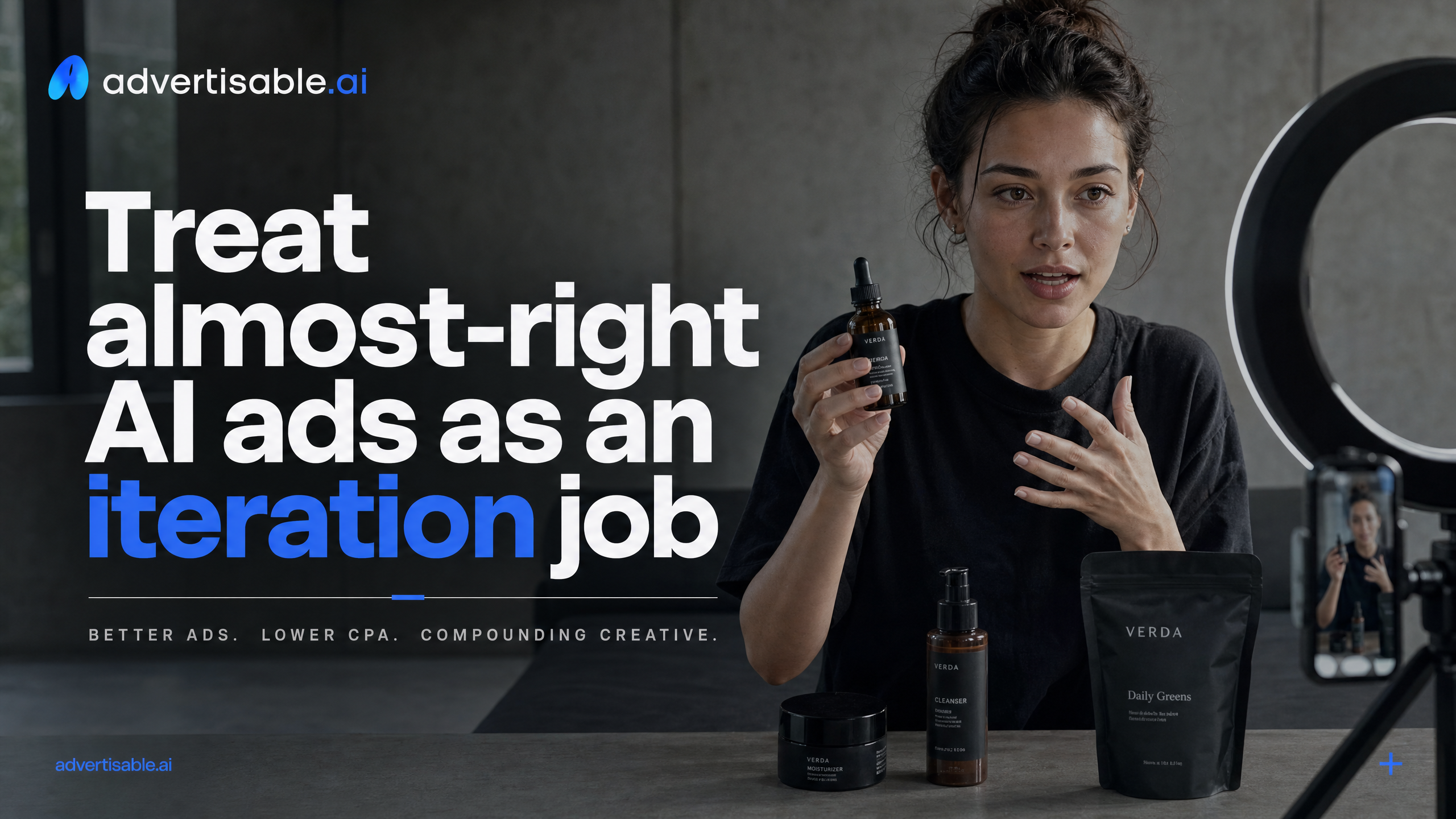
The fastest way to improve almost-right AI ads is to stop treating them like finished deliverables and start treating them like an iteration job with tight control over what changes and what stays constant.
Treat almost-right AI ads as an iteration job
Why “80% finished” is dangerous
An ad that is 80% correct is more risky than one that is clearly wrong, because it ships. The last 20% usually includes the highest-leverage beats: the two-second hook, the first clear product moment, the proof element, and the CTA.
In operations, “almost-right” creates false confidence. Teams stop asking what changed, ship mixed batches, and then read performance like it is a taste problem instead of a controllable variable problem.
Treat near-finished output as a draft with a scoped change list. What we see work is a storyboard-first pass where you hold three beats constant and only iterate one variable, then read results in a 48-72 hour window before you touch anything else.
- Common 80% traps that cost you learning: hook promises one outcome while the proof supports a different one
- Product moment shows up after 5-10 seconds, so thumb stop and CTR die before the offer is even understood
- CTA is present but not specific enough to drive an attributable action (click, sign-up, shop now)
- Brand drift slips in as unbackable claims because the script sounds plausible
What does actionable feedback look like?
Actionable feedback has a shape: it names one beat, one problem, one edit, and one acceptance criterion. If a note cannot be applied as a scene-level change, it is not feedback, it is a vibe.
We use feedback that maps cleanly to controllable edits because iteration is cheaper and more accurate than full regeneration: critique-then-refine - fix the specific weak part - beats rerolling the whole thing and hoping the good parts survive.
In Advertisable AI, this becomes practical: you lock Brand DNA from your product URL, generate a storyboarded ad, request feedback focused on one beat (usually hook or CTA), then use Scene Regenerator to fix only the weak scene while holding the rest constant.
Beat: Hook. Note: promise is unclear. Edit: rewrite first 2 seconds to state the outcome.
Accept when: outcome is stated in 7 words or fewer
Beat: Product moment. Note: product appears too late. Edit: move product shot into seconds 0-5.
Accept when: product is visible and named once
Beat: Proof. Note: claim is unbackable. Edit: replace with a sourced product fact from Brand DNA.
Accept when: no new claims are introduced
Beat: CTA. Note: action is vague. Edit: one verb + one destination.
Accept when: CTA matches the offer exactly
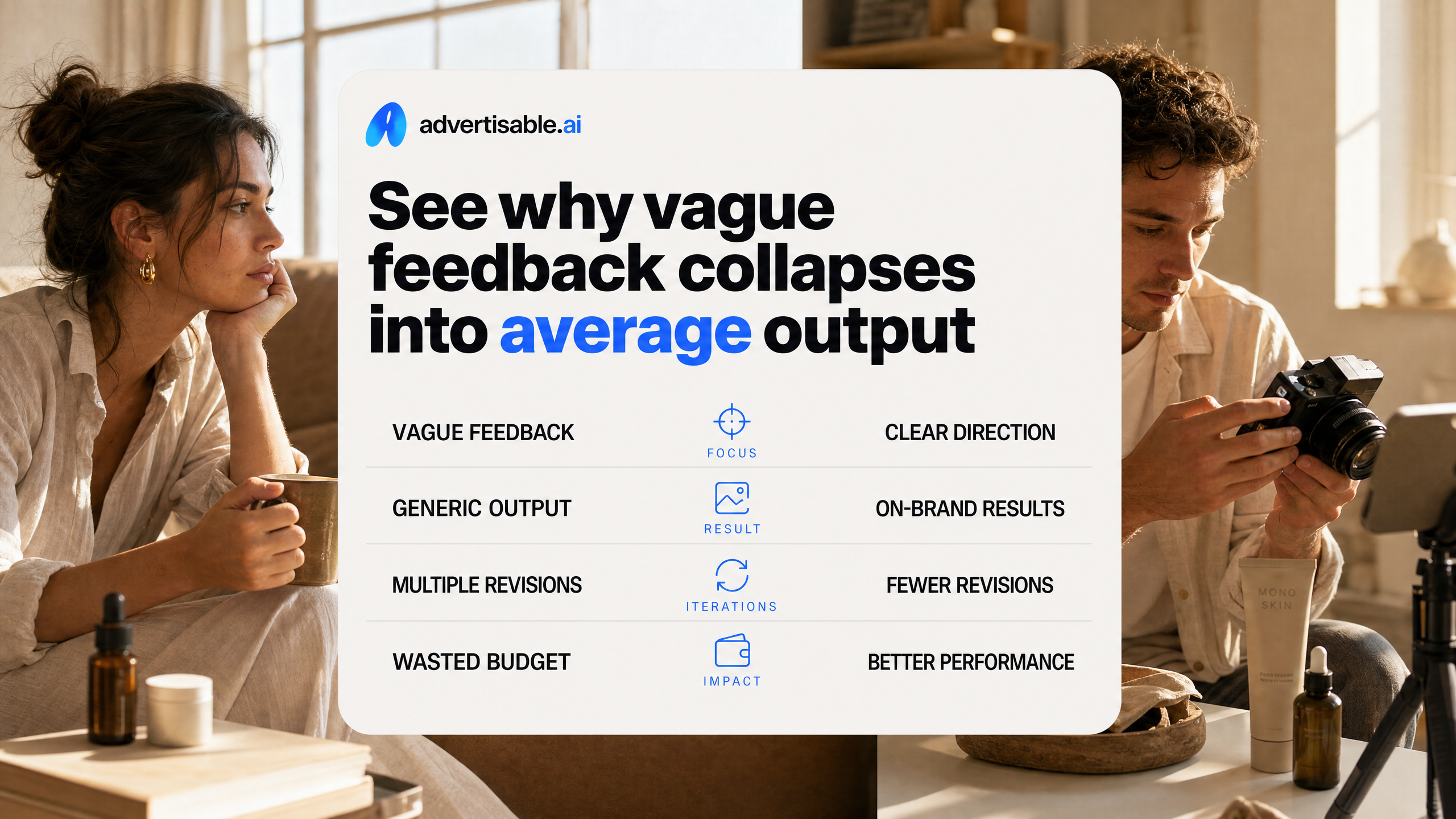
See why vague feedback collapses into average output
Why Adjectives Have No Target
Feedback like “make it punchier” or “more premium” fails because adjectives do not point to a controllable edit. You cannot ship an adjective. You can only ship a changed hook, a tighter product moment, a different proof element, or a clearer CTA.
In performance creative, every note has to map to a unit you can change without rewriting the whole ad. If the note does not specify which beat is weak and what you want it to do differently, your team ends up debating taste instead of making an attributable change you can test in a 48-72 hour readout.
Use acceptance criteria that forces specificity. Your feedback is actionable only when you can answer “what do we edit” and “what will we hold constant” in one pass.
- Bad: “More engaging.” Targeted: “Hook needs a clearer two-second promise. Replace the first line with the primary outcome and remove the brand intro.”
- Bad: “More trustworthy.” Targeted: “Add one proof element in the first 5-10 seconds: a quantified claim you can back, a demo moment, or a specific customer result.”
- Bad: “Stronger CTA.” Targeted: “CTA is late and vague. Move CTA to the final scene and use one verb plus one offer term.
Keep everything else identical.”
The Model Fills Gaps With Averages
When your direction is vague, the model has to infer your intent, and it usually lands on the safest, most generic version of the category. That is why outputs start to look the same across brands: the gaps get filled with average hooks, average pacing, and average claims.
Averages are not neutral. They flatten your positioning and increase the odds of brand drift, because the model will borrow familiar patterns that may not match your voice, your allowed claims, or your actual product facts.
This is why we anchor generation and feedback to Brand DNA in Advertisable AI. You give the system a product URL and guardrails up front, then your “improve the hook” note can become a scene-level change while the product moment, proof, and CTA stay fixed for a clean one-variable test.
- Missing metric target (CTR vs. CVR) becomes generic “attention” advice instead of a specific hook or offer change
- Missing claim boundaries becomes either cautious filler or unbackable claims that create compliance risk
- Missing creative constants becomes a mixed batch, so you cannot attribute the result to one edit
Use a feedback format the model can execute
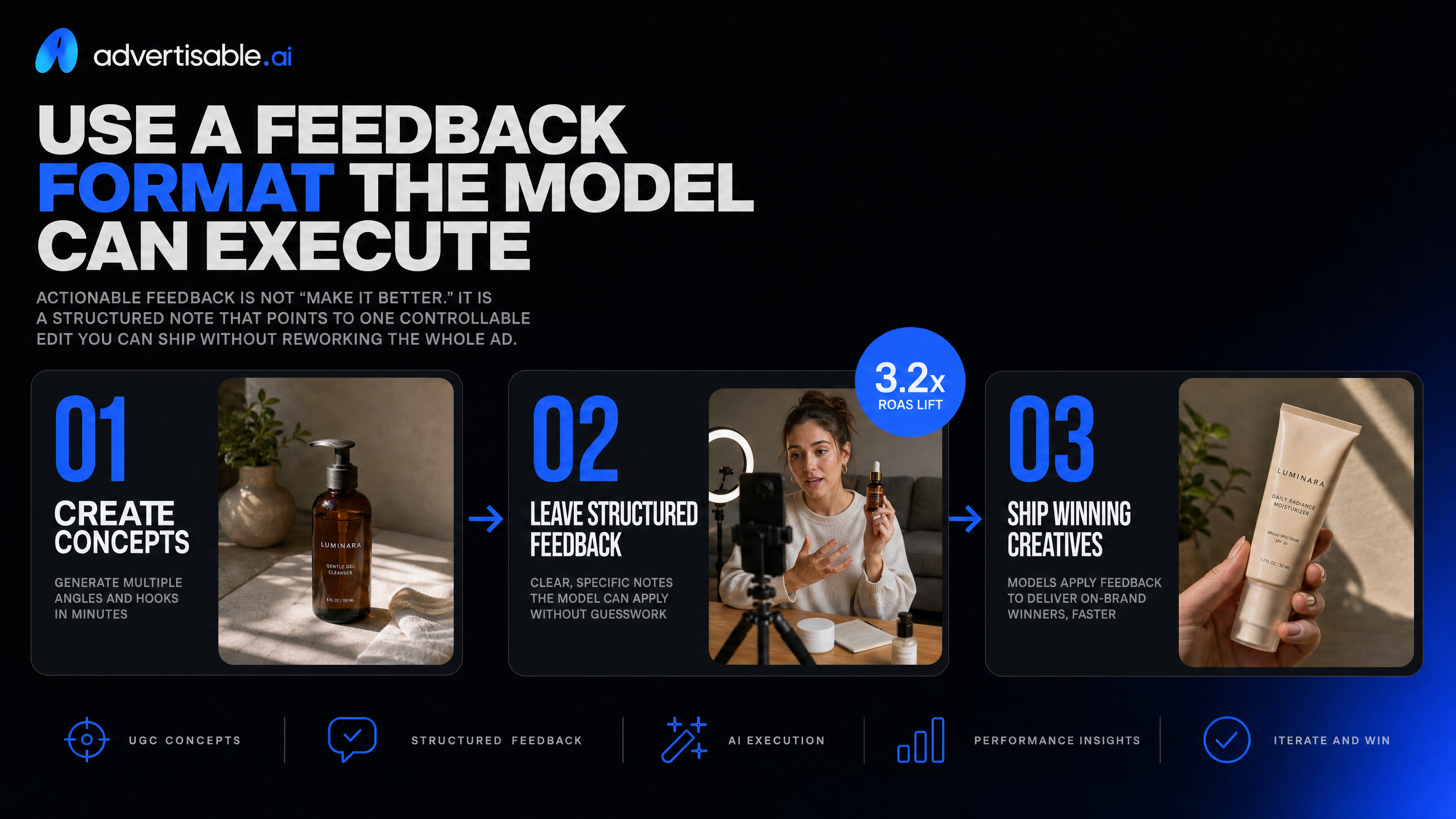
Actionable feedback is not “make it better.” It is a structured note that points to one controllable edit you can ship without reworking the whole ad.
Locate the exact failing beat
Start by forcing the feedback to name the single beat that is failing: hook (first 2 seconds), product moment (roughly 5-10 seconds in), proof, or CTA. If the model cannot point to a timestamp, scene number, or beat label, you cannot execute the note reliably.
In practice, you are asking for a scene-level diagnosis you can hand to an editor or run through a Scene Regenerator without touching the rest of the storyboard.
- Beat label: Hook / Product moment / Proof / CTA
- Pointer: Scene 2, 00:02-00:04 (or “the first on-screen line”)
- Observed symptom: low thumb stop, CTR drop, or CVR drop within a 48-72 hour readout window
- Constraint: keep Brand DNA guardrails and all product facts unchanged
State why it fails the job
Next, make the model explain the failure in job terms, not taste terms. “Feels boring” is unusable; “the hook promise is not specific enough to earn the next second” is executable because it maps to a controllable change.
Tie the why to one outcome in the thumb stop to CTR to CVR chain so you know what you are trying to move and what you are not diagnosing yet.
- Hook fails: the two-second promise is generic or mismatched to the offer, so you lose thumb stop
- Product moment fails: the product appears too late or unclear, so clicks do not qualify and CTR softens
- Proof fails: claims are unbacked or missing a concrete proof element, so CVR stalls or comments push back
- CTA fails: action is unclear or too late, so intent never gets captured
Define “right” in concrete terms
Finally, require a specific replacement spec the model can generate: exact words, exact on-screen structure, and what stays constant. This is where you prevent mixed batches and keep a one-variable test clean.
When we run this inside Advertisable AI, we treat “right” as acceptance criteria for a single scene swap, not a full rewrite.
- Hook “right”: 1 sentence promise + 1 qualifier, delivered within 2 seconds, no new claims outside Brand DNA
- Product moment “right”: show product by 5-10 seconds with one clear use-case and one visible benefit cue
- Proof “right”: 1 proof element (demo step, before/after framing, or specific fact from the URL) and remove unbackable claims
- CTA “right”: 1 action verb + 1 offer detail, spoken and on-screen, in the final scene
With “right” defined as a scene spec, you can regenerate only the failing beat, export, and keep the next 48-72 hour readout attributable.
Diagnose the failing beat before you regenerate
How do you map feedback to the four beats?
Map every note to one of four beats: hook (first 2 seconds), product moment (roughly seconds 5-10), proof element, or call-to-action (CTA). If a note cannot land on a beat, it is usually taste, not a shippable edit.
In practice, you are trying to protect a one-variable test. You hold three beats constant and change only the beat that is failing, then read results in a 48-72 hour window using the thumb stop to CTR to CVR chain.
- Hook: low thumb stop or weak early retention. Edit the two-second promise, opening visual, or first line only.
- Product moment: viewers stay but do not understand what it is. Tighten the what-it-does shot and name the product within 5-10 seconds.
- Proof element: CTR is fine but CVR lags.
Swap in a clearer demo, quantified claim you can back, or a more specific outcome statement.
CTA: good engagement, weak clicks. Change the ask, the offer framing, or the on-screen button timing, not the whole script.
Why full rerolls break what already works
A full reroll replaces multiple beats at once, which destroys attribution. You may improve one part and accidentally remove the only reason the ad was earning clicks.
Operationally, rerolls also introduce brand drift: claims, tone, and product facts shift because the model is re-solving the entire ad instead of editing a controlled segment. That is how you end up with unbackable claims or a mismatched offer.
Set acceptance criteria per beat before you touch anything. Example: keep the hook if it is already driving acceptable thumb stop and CTR, and only regenerate the proof scene that is failing to move CVR.
This is where Advertisable AI is built to keep you honest: lock Brand DNA from the product URL, use the Storyboard Editor to preserve the other beats, and use Scene Regenerator to change one scene while holding the rest constant.
- QA check before regenerating: identify the beat, name the single variable you will change, and list the three beats you will not touch.
- QA check after regenerating: verify claims and product facts match Brand DNA, then confirm only one scene materially changed.
- Next-test decision: ship 10-20 variants only when they differ in that one beat, then read results after 48-72 hours.
Run a repeatable iteration loop you can scale
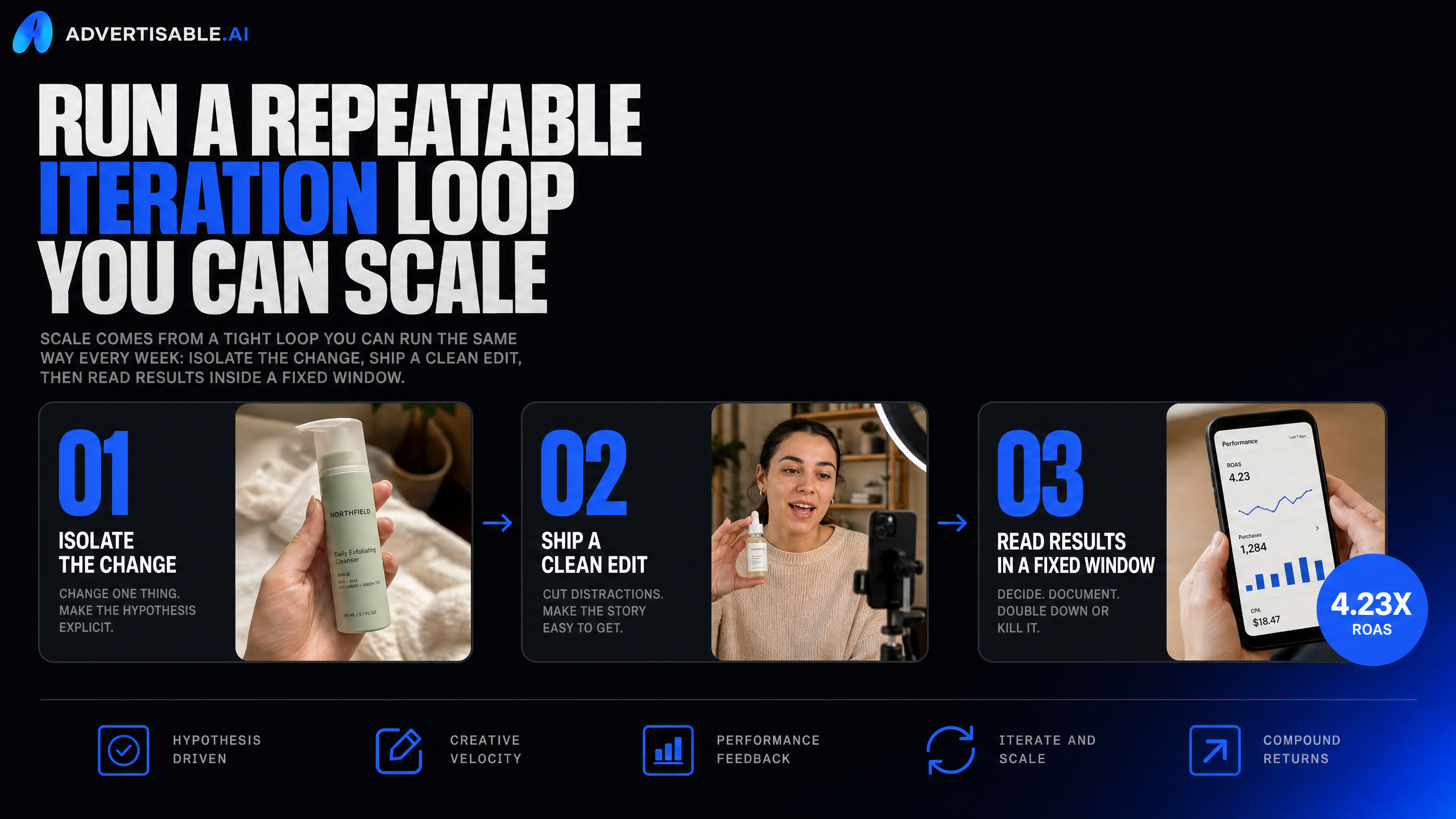
Scale comes from a tight loop you can run the same way every week: isolate the change, ship a clean edit, then read results inside a fixed window.
How do you keep iteration clean? One change per pass
Change one variable per pass, then hold everything else constant for 48-72 hours. That is how you get an attributable learning you can reuse, instead of a mixed signal you debate in Slack.
In practice, you freeze your creative anatomy beats and only swap one controllable piece: hook, product moment, proof element, or CTA. When multiple beats move at once, you cannot credibly say what caused a CTR lift or a CVR drop.
Operationally, this is where scene-level editing matters. In Advertisable AI, we lock Brand DNA and the storyboard structure, then use Scene Regenerator to replace only the weak scene while keeping the rest untouched.
- Lock constants for the batch: Brand DNA rules, offer, runtime, aspect ratio, product facts, and the three non-tested beats
- Pick one learning goal: for example, improve the two-second hook promise (only the hook changes)
- Generate 10-20 variations that only differ on that variable
- Run a 48-72 hour readout and decide the next single change based on thumb stop, then CTR, then CVR
QA gates for shippable edits
A scalable loop needs QA gates that stop non-shippable edits before they hit spend. Your goal is not more versions, it is more versions that are export-ready and policy-safe.
Treat QA as a checklist you can run in minutes per variant, tied to acceptance criteria. If an edit fails a gate, it does not enter the test batch, even if the idea is strong.
Keep the gates aligned to production control: brand accuracy (Brand DNA), scene continuity (Storyboard Editor), and platform exports sized for Meta and TikTok. This keeps your iteration speed high without letting brand drift creep in.
- Brand DNA compliance: claims match the product page, no unbackable language, no new medical or performance promises added during edits
- Creative anatomy integrity: the hook is a clear two-second promise, the product moment appears within 5-10 seconds, proof is specific, CTA is singular and visible
- Scene continuity: visuals match the script, product name and offer are consistent across scenes, audio levels are even
- Export readiness: correct aspect ratios, safe margins for UI overlays, captions readable on mobile, filenames and version tags match your test log
Fix only the named scene with Advertisable AI
Your fastest path from “almost-right” to shippable is to lock the source of truth once, then edit only the scene that is failing your metric.
How do you import from a product URL?
Paste your product page into Advertisable AI and let the Brand DNA Module extract the facts and guardrails you need before you generate anything. This reduces brand drift because claims, positioning, and product details come from the same canonical page every time.
Operationally, treat the URL import as a one-time setup step per product. Once Brand DNA is locked, you can generate new concepts without re-arguing basics like offer terms or what the product does.
- Acceptance criteria: key claims match the product page language, no new unbackable claims appear, and the offer and CTA are stated clearly once
- QA check: confirm the hook is a two-second promise and the early product moment lands within 5 to 10 seconds
Regenerate only the weak scene (not the whole ad)
When one beat fails, fix that beat only. Use the Scene Regenerator to swap a weak hook, unclear product moment, thin proof element, or soft CTA while holding the other scenes constant.
This is how you keep your test attributable: one-variable changes at the scene level, not a full rerender that quietly changes pacing, wording, and visuals everywhere.
Set the objective metric for the scene you are changing. Hooks are judged first by thumb stop, then CTR; later beats show up in CVR.
- Hold constant: the other three beats in the creative anatomy, the offer, and the CTA destination
- Change only: one scene and one intent, for example hook promise language or proof format
- Decision rule: if CTR moves but CVR does not, keep the new hook and iterate the proof or CTA scene next
Ship variant packs for a 72-hour readout
Package your edits into small variant packs and run them for 48 to 72 hours so you can read signal without overfitting to a single day. A clean pack is 10 to 20 versions where each version changes the same scene type, usually the hook first.
Export platform-ready formats and launch with naming that encodes the one variable, like Hook-A, Hook-B, Hook-C. Your job at 72 hours is not “pick a winner,” it is document what changed and what metric moved.
- Pack structure: 10 to 20 ads, single-variable, one scene changed per version
- Readout order: thumb stop, then CTR, then CVR
- Next test: iterate the next beat only after you have a directional hook signal
Turn feedback into shippable scene-level edits this week
You do not need more opinions. You need feedback that maps to a controllable change, then a clean 48 to 72 hour readout that tells you what to do next. That is the standard we built Advertisable AI around.
Start the $5 trial. Paste a product URL to lock your Brand DNA Module, generate one storyboarded video ad, then request feedback focused only on the two-second hook and the CTA. Regenerate just the weak scenes with Scene Regenerator while holding the product moment and proof element constant.
Acceptance criteria: every variant preserves approved claims, follows your creative anatomy, and exports cleanly. Export Meta and TikTok formats, launch a 72 hour one-variable test, and use thumb stop, CTR, then CVR to choose your next scene-level change.
Frequently Asked Questions
### What makes AI ad feedback actionable?
It names one beat, one problem, one edit — not an adjective. "Make it more engaging" gives the model nothing; "the hook doesn't state the outcome in the first two seconds - rewrite it to lead with the result" does. If a note can't become a single scene-level change, it's a reaction, not feedback.
### How many ad variations should I test at once?
Start with 10 to 20 one-variable variations per batch so each version creates a distinct performance signal. Scale volume only when your QA and readout process can keep constants locked and your learnings remain attributable.
### Why should I test one variable at a time instead of testing multiple changes?
Because you need a clean cause and effect between a scene-level edit and the outcome you read in thumb stop, CTR, and CVR. When multiple beats move at once, you cannot attribute the lift, so your next iteration becomes guesswork instead of a repeatable system.