How To Scale Ad Creative Without Losing Control
Scale ad creative without losing performance learnings by locking your constants (Brand DNA and a four-beat creative anatomy), then shipping one-variable batches with a fixed 48 to 72 hour readout. This keeps volume from turning into mixed packs where you cannot attribute why something won.
Here’s what matters most:
- Define one learning goal per batch, not a hunt for a single winner.
- Lock Brand DNA guardrails so claims and product facts stay consistent.
- Use a four-beat creative anatomy: hook, product moment, proof element, CTA.
- Change one independent variable at a time to keep learning attributable.
- Read thumb stop, CTR, and CVR in a fixed 48 to 72 hour window.
- Set kill rules before spend lands so you do not rationalize after the fact.
- Organize a Monday to Friday rhythm with an owner, reviewer, and launcher.
We built Advertisable AI Studio for this exact bottleneck: you can paste a product URL to extract Brand DNA, approve variants in a Storyboard Editor before rendering, then use Scene Regenerator to fix only the weak beat instead of remaking the whole ad. When you are ready to make volume safe, there is a $5 3-day trial.
Start by reframing “scale” as increasing your rate of attributable learning, because output without control just creates noise you cannot act on.
Reframe scaling ad creative as learning, not output
Before you try to “scale,” align on the objective: increase attributable learning per week, not raw asset count. Your worry is valid: shipping more ads can create mixed batches and unreadable signals when the variables are not controlled.
This section pairs well with our Quality vs Quantity piece and our Creative Testing guide, because both reinforce the same operating principle: you earn volume only after you can explain why something won.
The failure state you know
Most scaling attempts fail because you pay for output but you manage for learning. The tell is a calendar full of “deliverables,” yet you still cannot answer one question within 48 to 72 hours: which single change moved thumb stop, CTR, or CVR.
The agency model often produces low shippable volume because the real bottleneck is not design time. It is clarification, approvals, and rework. When the brief leaves gaps, humans infer intent and AI averages, so you spend cycles debating taste instead of diagnosing variables.
Mixed batches are where performance signals die. When a single drop changes hook, product moment, proof element, and CTA at once, the result is unattributable. You might see a winner, but you cannot replicate it because you do not know which beat drove the lift.
- Output looks “busy,” but usable throughput is low: lots of drafts, few exports that are ready to launch.
- Each batch combines multiple independent variables, so results are noisy and post-hoc explanations replace decisions.
- Re-briefing becomes the default: you rewrite the same constraints, fix the same missing product facts, and rebuild entire ads instead of editing one beat.
The fix is not more capacity. It is tighter control over what changes and what stays constant so every batch produces a clean readout.
Volume multiplies whatever is loose
Creative volume is an amplifier. When your guardrails are loose, shipping 20 variants does not create 20 learnings, it creates 20 ways for voice, product truth, and differentiation to degrade.
Voice drift is usually the first failure at scale. A small set of “close enough” tone choices turns into inconsistent phrasing, inconsistent promises, and inconsistent CTAs across ads, which makes performance comparisons unreliable. Lucidpress's brand consistency research found that 81 percent of organizations deal with off-brand content despite having style guides, which is exactly what happens when enforcement is manual.
Product detail decay follows. Over a few iterations, benefits get generalized, claims get softened or embellished, and the product moment stops matching the landing page. Then you are testing creative execution and factual accuracy at the same time.
Finally, samey variants creep in. Without a single intended variable, teams generate cosmetic differences: different backgrounds, similar hooks, identical proof. That creates the illusion of testing while your differentiation stays flat.
- Unchecked voice drift at scale: the same offer is framed five different ways, so you cannot compare like-for-like outcomes.
- Product detail decay over time: later variants lose specificity and introduce errors, so “learning” is contaminated by accuracy issues.
- Samey variants, weak differentiation: changes are aesthetic, not strategic, so you burn spend without expanding message coverage.
Diagnose what breaks first when you scale without guardrails
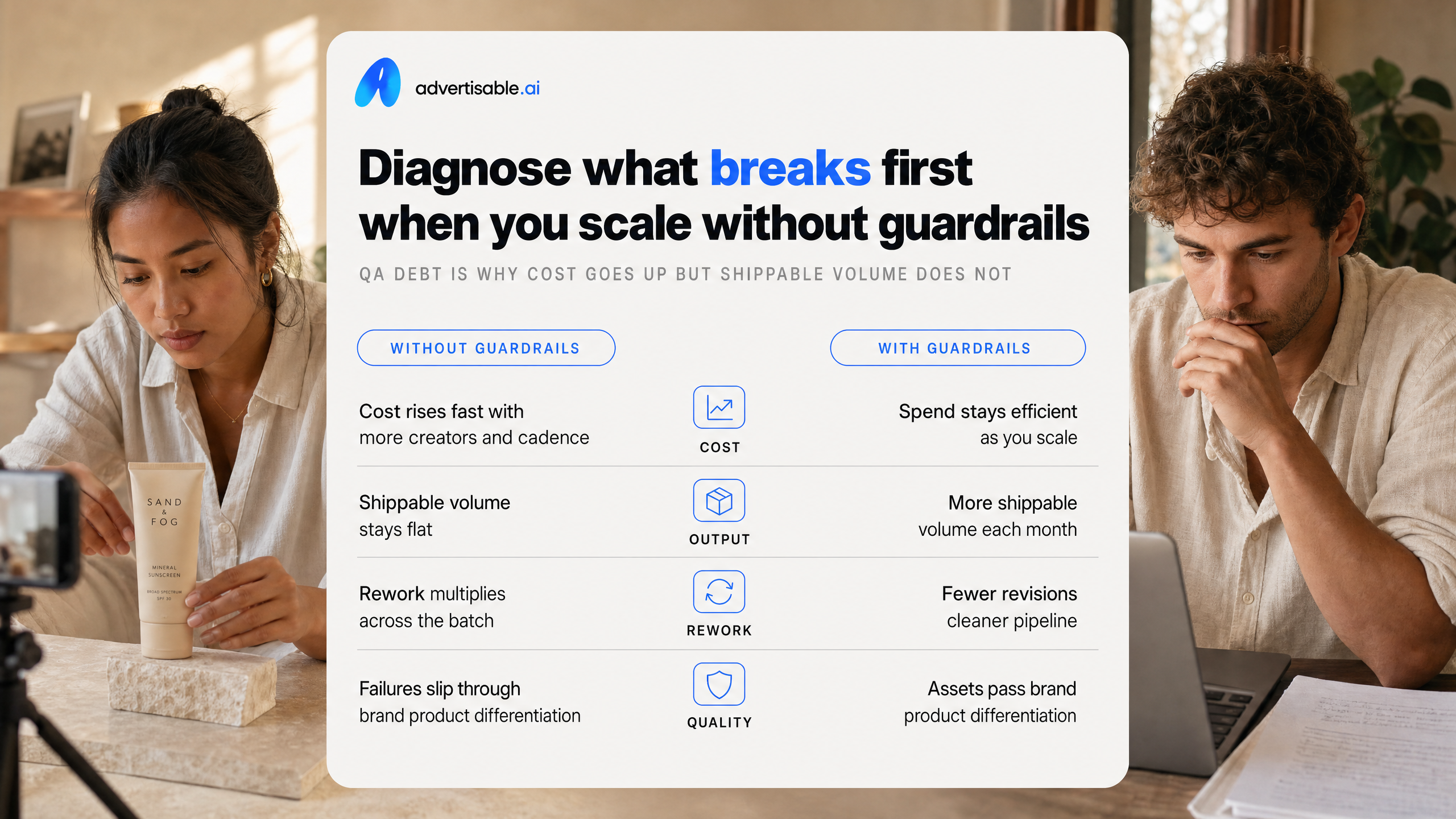
When you add creators and increase cadence, cost goes up fast, but shippable volume often does not. The reason is QA debt: you end up reworking assets that fail three lenses, brand (does it feel like you), product (is it true), and differentiation (does it teach you something new).
Triage has to be binary. Fixable issues are scene-level edits you can correct without changing the test variable. Killable issues are anything that contaminates the batch, like an off-brand voice, a claim you cannot defend, or a concept that is just a reskin of last week.
Brand drift through tiny decisions
Brand drift is usually the first breakpoint because it comes from tiny, local choices: one creator writes like support docs, another writes like a comedian, and a third goes full luxury tone. Even if each ad is “fine,” the set stops looking like one brand, and your costs spike in revisions.
The tell is batch inconsistency. You approve a storyboard on Monday, but by Friday the exported videos feel like three different companies because pacing, on-screen copy density, and even CTA phrasing changed across creators. This is how a single new ad ends up redefining the brand in the feed, not because it is better, but because it is louder and different.
This is a supervision problem, not a “make a style guide” problem. Lucidpress's brand consistency research found 81 percent of organizations deal with off-brand content despite having style guides.
- Acceptance criteria (brand): one approved tone profile (do-say, do-not-say), one CTA voice, and one proof posture (confident, careful, or technical) that every script must match
- Batch QA checks (visual): lock typefaces, color palette, logo treatment, and lower-third layout so “creator variety” shows up in the hook idea, not in the design system
- Kill rule: any concept that changes your implied positioning (budget vs premium, playful vs clinical) gets rejected even if you like the performance hypothesis
Product accuracy collapses at volume
Accuracy breaks next because high-volume production creates more chances to invent features, omit specs, or blur what the product actually does. One wrong line is not a small defect, it forces a full stop on the batch because you cannot safely run spend behind it.
At scale, the failure modes cluster: feature hallucinations, missing constraints (size, compatibility, ingredients, warranty), and usage instructions that imply the wrong outcome. The most expensive version is proof mismatch: you show a demo, stat, or testimonial-style claim that is not actually tied to the product on the page, so your “proof element” becomes liability instead of lift.
- Acceptance criteria (product): every hook promise must be satisfied by the product moment within the first 3-5 seconds, using only facts present on the product page
- QA checks: claim guardrails for disallowed absolutes (best, cures, permanent) and a spec checklist (what it is, who it is for, key constraint) embedded in the storyboard
- Kill rule: any ad where proof cannot be traced back to a defensible source or a real demo of the product in use
Sameness that kills learning
The third breakpoint is sameness: you ship “more ads,” but they are cosmetic edits that keep the same core message, so you learn nothing. This is where hiring more creators feels like pure cost, because you get volume without new attributable signal.
You see it when hooks differ only superficially, swapping a few words while keeping the same promise, same objection, same proof type, and same CTA. After 48-72 hours, the readout is noisy because the batch did not test a real independent variable.
Fatigue then gets disguised as iteration. Teams keep reskinning the prior winner instead of generating a true alternative hypothesis, so performance decays and nobody can explain why.
- Differentiation QA: every variant must declare the one thing that changed (hook promise, proof type, or objection) and hold the other beats constant
- Batch integrity rule: 10-20 hook-only variants means the product moment, proof element, and CTA stay fixed so the readout attributes to the hook
- Kill rule: any “new” creative that cannot be described as a single-variable test gets cut before production time is spent
Standardise the constants so every ad stays the same brand
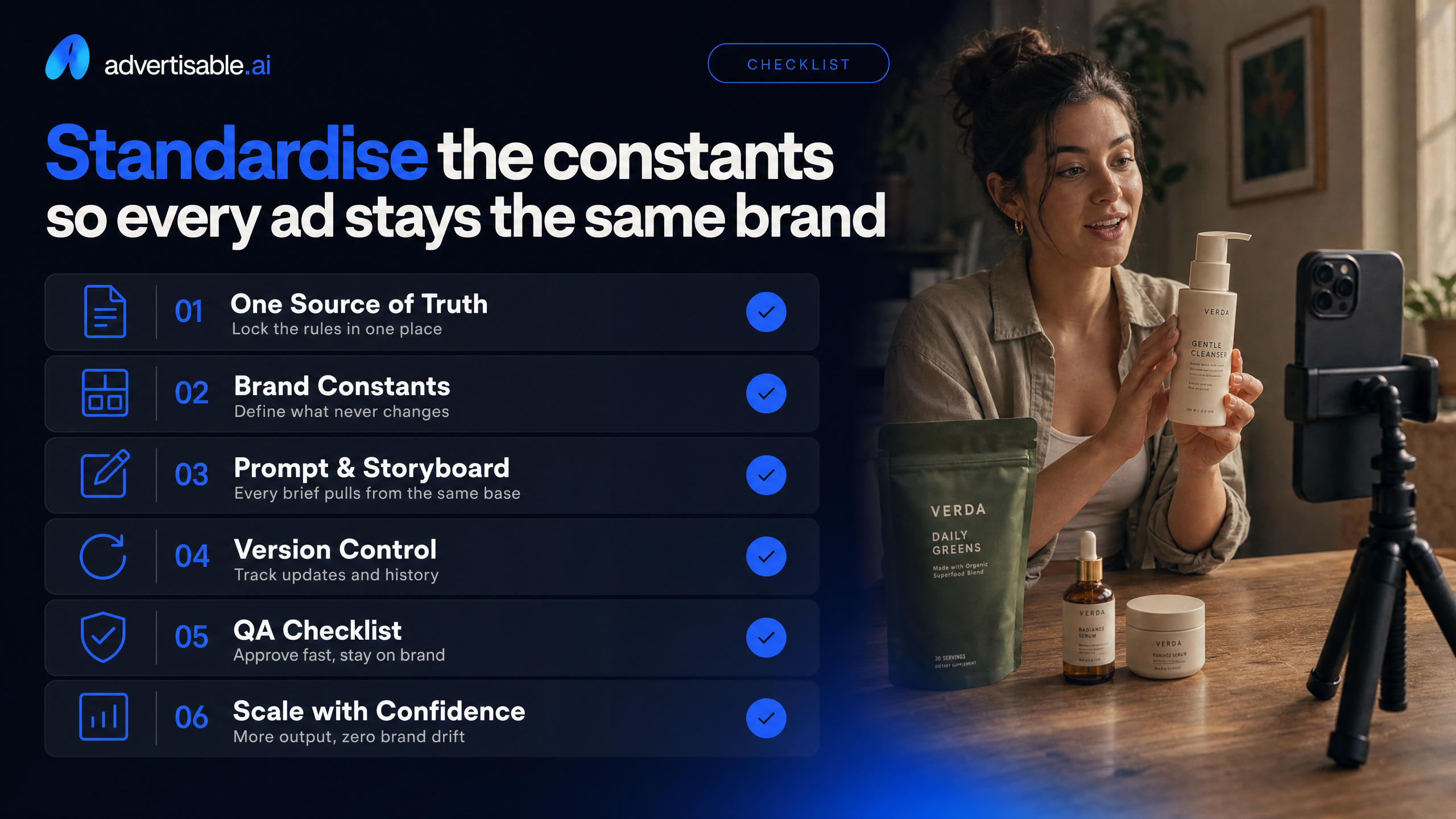
You scale output without brand drift by locking a single source of truth that every prompt, storyboard, and revision references. Keep it short, operational, and versioned: one page that defines what must stay constant across every variant.
Before any generation, run a QA checklist against that document. The goal is simple: you should be able to approve or reject a storyboard in under 3 minutes without re-debating fundamentals.
Brand voice and visual rules
Your brand stays coherent when you set hard boundaries for tone and visuals, then treat anything outside them as a failed output. Consistency is not subjective once the rules are written.
We keep this section as constraints, not inspiration. The rules should be tight enough that two different creators, or an AI model on two different days, still land in the same brand neighborhood.
- Tone boundaries: 3 adjectives you must match (for example: direct, calm, technical) plus 3 you must avoid (for example: snarky, sentimental, clinical).
- Banned phrases list: 10-20 phrases you never ship (common ones include empty superlatives, vague hype, and unqualified “best” language).
- Typography: primary font, backup font, and “never use” fonts; minimum on-screen font size for mobile; casing rules for headlines.
- Colour system: primary, secondary, and accent colours (with exact values); background rules (light vs dark); contrast requirement for captions.
- On-screen patterns: caption style, safe-area rules, logo placement, and how often you allow text callouts (for example: max 2 overlays per scene).
- Approved creator style constraints: framing (selfie vs tripod), pacing (cuts per 5 seconds), and delivery (no shouting, no sarcasm, no impersonations).
Product facts and claim guardrails
Claim drift is the fastest way to create rework and risk. You prevent it by defining a non-negotiable product truth set, then allowing only claims you can support with evidence you would be comfortable defending.
This is also where you protect learnings. If one ad implies a different promise than the next, your performance signal becomes uninterpretable because you changed the product story, not just the creative.
- Non-negotiable truth set: what the product is, who it is for, what it does (and does not do), key specs, and usage constraints pulled from your landing page.
- Approved claims list: 5-15 precise statements you allow, written in plain language (no implied outcomes).
- Required disclaimers: the exact lines that must appear when a claim is made (and where they appear on-screen or in VO).
- Proof types you can defend: demo footage, quantified spec from your product page, customer review excerpts you have permission to use, and validated guarantees or policies (shipping, returns) that are publicly stated.
Lock the four-beat anatomy
Every variant should keep the same four beats: hook, product moment, proof element, CTA. That structure is your control layer, so you can change one variable (usually the hook) without rewriting the whole ad each time.
Require early product visibility. If the viewer cannot see what it is within the first 1-2 seconds, you are asking them to commit attention before they have context, and your hook test is no longer a clean test of the hook.
- Hook (first 1-2 seconds): one promise only; no stacking outcomes or audience callouts plus outcomes in the same line.
- Product moment (immediately after hook): show the product and tie it directly to the hook promise, using the same naming conventions every time.
- Proof element (middle): choose one evidence type per ad (demo OR stat OR testimonial), not a collage of weak proofs.
- CTA (end): one next action and one destination (shop, learn more, get started), with consistent on-screen treatment.
Vary the variables on purpose so volume does not become sameness
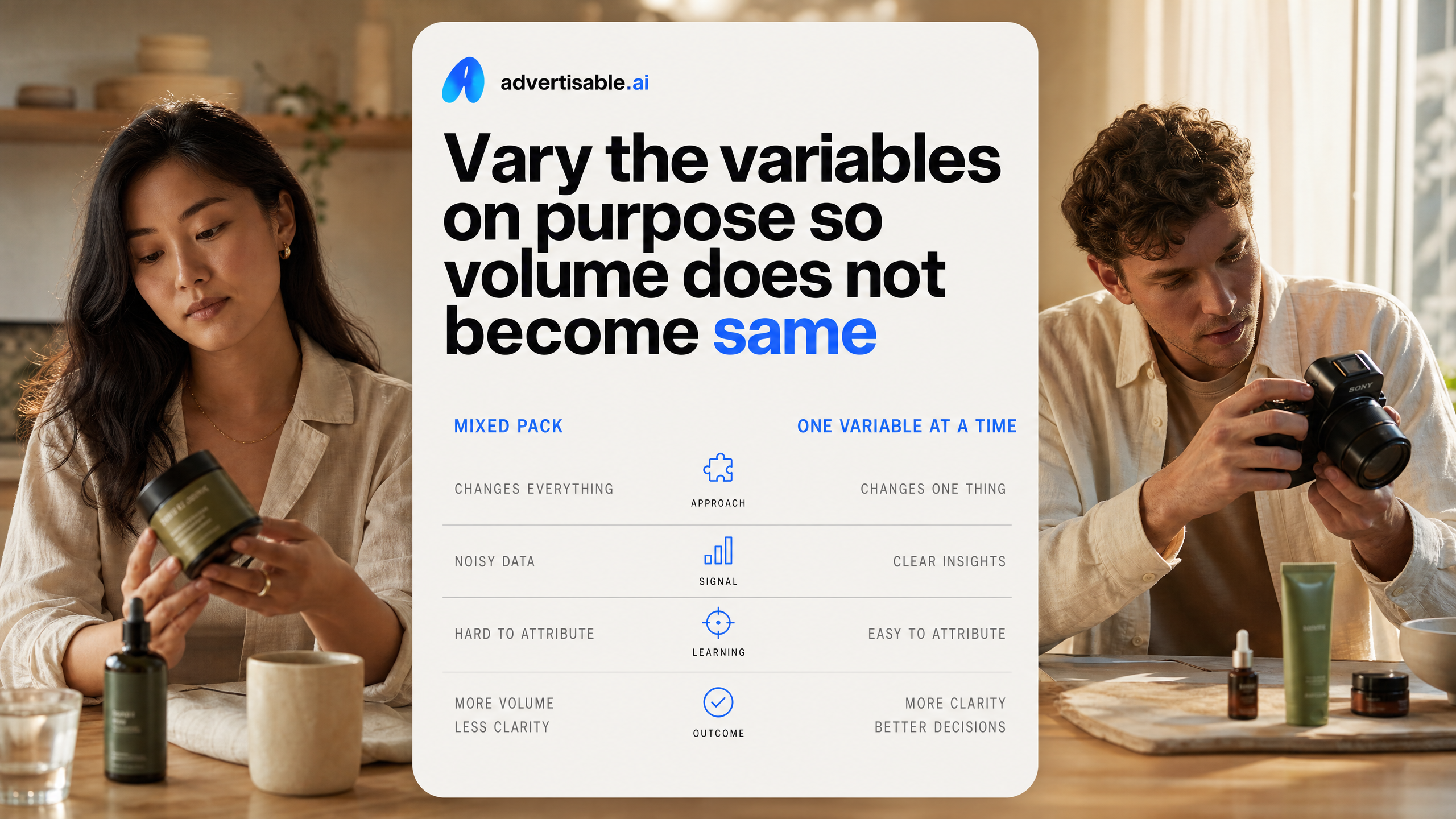
The fastest way to create noisy, unreadable performance signals is shipping “mixed packs” where each ad changes the hook, visuals, proof, CTA, and format at once. You want volume, but every variation should exist to answer one learning question so results stay attributable.
Hook-only batches that teach
Run hook-only batches to keep learning clean: one independent variable, 10 to 20 variants, and the same four-beat creative anatomy underneath. Your readout window stays fixed at 48 to 72 hours, and you judge the batch on thumb stop first, then CTR, then CVR.
The operator move is to vary promise type, not swap synonyms. Word swaps create near-identical ads that look different to you but behave like duplicates in delivery and measurement.
- Hold constant: product moment, proof element type, CTA line, pacing, and Brand DNA guardrails
- Change one variable: the hook promise type (pain-based, outcome-based, audience-callout, or “new mechanism”)
- Batch size: 10 to 20 hooks, each 1 to 2 seconds, all feeding the same storyboard structure
- Acceptance criteria before spend lands: every hook states one clear promise, fits in 2 seconds, and is still true on the landing page
Angles mapped to objections
Diversity that scales comes from mapping angles to real objections, not brainstorming random “new concepts.” Pick one objection per batch (price, efficacy, or convenience), then write hooks and story choices that address it directly.
Your story choices should be use-case specific so the angle is meaningfully different. “Morning routine,” “travel bag,” and “before a workout” are not cosmetic changes if they change what the viewer believes the product is for.
Match proof to the angle you picked. A price objection wants value math or durability logic, an efficacy objection wants a defensible demo or quantified claim you can stand behind, and a convenience objection wants time-to-result or steps-eliminated evidence.
- Price angle: anchor the cost to cost-per-use or replacement frequency, then use proof that supports value
- Efficacy angle: show the product working early, then use proof that reduces “does it actually work?” skepticism
- Convenience angle: show fewer steps, less time, or fewer tools, then use proof that makes the shortcut believable
Formats without identity changes
You can expand formats without changing identity by treating format as packaging, not strategy. Keep the same Brand DNA and the same creative anatomy, then re-wrap the exact message as UGC cadence or as a direct demo.
UGC cadence tends to be faster cuts and tighter first-person delivery; direct demo is clearer product visibility and step order. Either can be controlled as long as you do not change the underlying promise, proof claim, and CTA.
Lock aspect ratio and placement rules upfront so the “format test” stays a single variable. Export the same storyboard into 9:16 for TikTok and Shorts, 1:1 for Meta feed, and 16:9 when you need standard YouTube, but do not let reframing change what the viewer sees in the first 2 seconds.
- UGC cadence version: same script beats, tighter shot duration, first-person voice stays within Brand DNA tone rules
- Direct demo version: same beats, earlier product moment, clearer proof visibility
- Placement QA: safe margins for captions and UI, legible on mobile, and the hook is not cropped in any aspect ratio
Run a Monday to Friday rhythm that keeps output clean
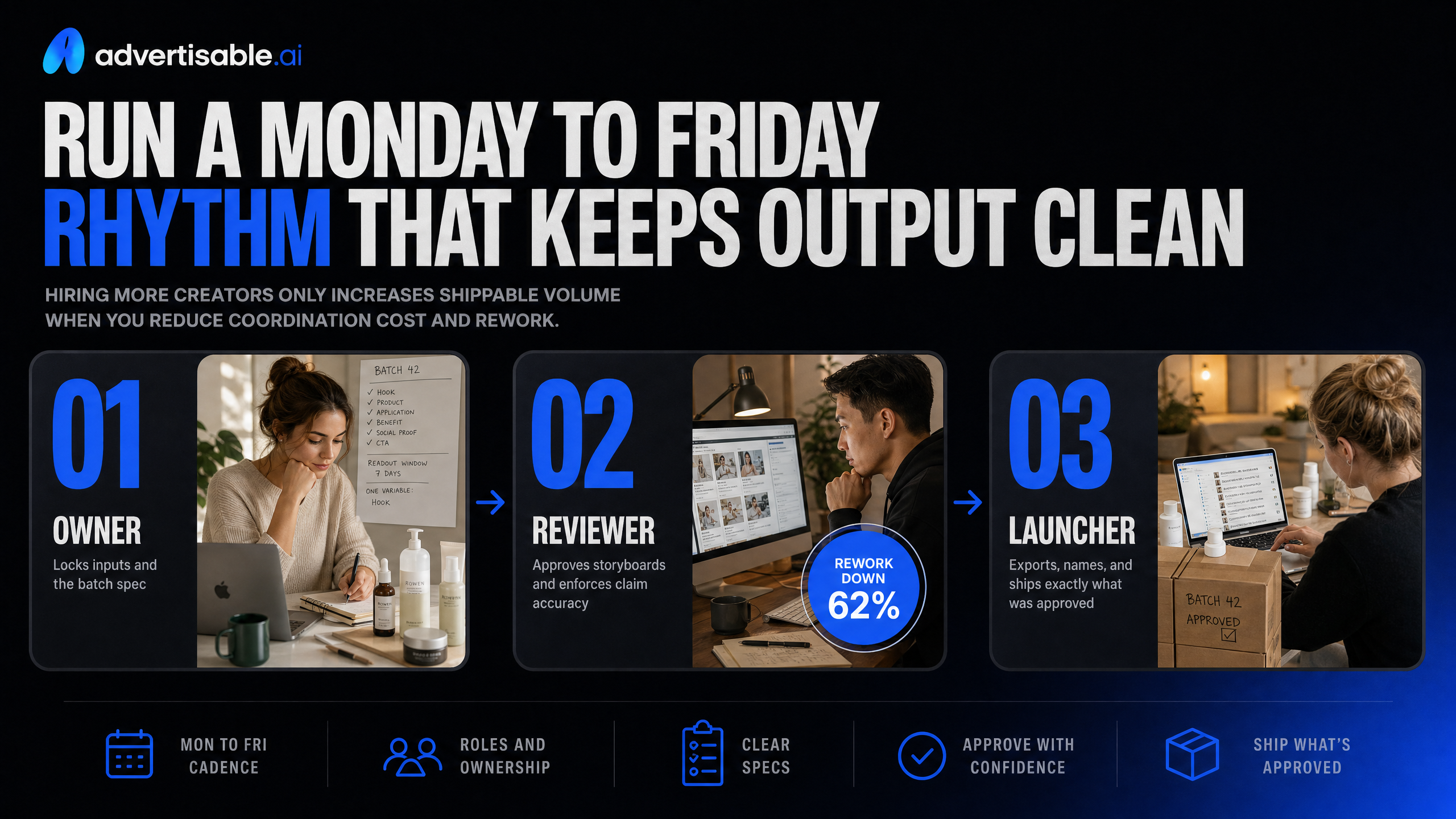
Hiring more creators only increases shippable volume when you reduce coordination cost and rework. Run three roles: an owner who locks inputs and the batch spec, a reviewer who approves storyboards and enforces claim accuracy, and a launcher who exports, names, and ships exactly what was approved.
This cadence assumes you already follow the one-variable batch method and fixed readout window from our Creative Testing guide.
Monday: plan and lock inputs
Monday is where you prevent mixed batches, which is the main reason added headcount raises cost without raising usable output. You lock one learning goal, one dependent metric, and one independent variable for the week, then you do not change them mid-flight.
Keep the learning goal specific and measurable: hook comprehension, objection fit, or proof believability. Tie it to a dependent metric you can read in 48 to 72 hours, typically thumb stop or CTR for hook tests, and CVR only when the landing page and offer are stable.
Your batch spec is a production contract, not a brainstorm. It defines what stays constant (Brand DNA, creative anatomy, product moment timing, proof type, CTA) and what varies (for example, hook promise wording).
- Batch size: 10 to 20 variants for a single variable
- Variable definition: written as a single sentence you can point to (example: hook line only, same visuals and beats)
- Naming format: YYYYMMDD_BatchGoal_VarName_V## (example: 20260731_HookThumbStop_PainHook_V03)
- Version rule: V## increments only when the independent variable changes; cosmetic fixes do not get a new version
Tuesday to Wednesday: produce and QA
Production moves faster when approval happens before rendering. Your approval gate is storyboard-first: the reviewer signs off the four beats and the exact variable change, then creators produce within that box.
You do not QA every ad frame-by-frame. Spot-check a sample that is large enough to catch drift, then tighten guardrails when you find failure modes.
- Approval gate: storyboard shows hook text, product moment shot, proof element type, CTA line for each variant
- Spot-check: review 3 to 5 variants per creator per batch, plus any variant that introduces a new claim or proof element
- Product moment check: product is shown early and matches what is on the landing page (name, form factor, key use)
- Claim check: no new features, outcomes, or numbers that are not supported by the product page
Advertisable AI Studio fits cleanly here because we can generate a storyboard-first controlled batch from a product URL using Brand DNA guardrails, then only render what the reviewer already approved.
Thursday to Friday: read and decide
Read results on a fixed 48 to 72 hour loop so decisions are comparable week to week. For hook batches, lead with thumb stop, then CTR, then CVR as a confirmatory signal once you have enough purchase volume to avoid noise.
Decide with three outcomes only: kill, iterate, or scale. Iteration should be scoped to the smallest edit that addresses the failing metric, otherwise you reintroduce multiple variables and lose attribution.
- Kill: thumb stop and CTR both materially lag the batch median after 48 to 72 hours
- Iterate: thumb stop is strong but CTR is weak (regenerate hook-to-product transition or proof scene), or CTR is strong but CVR is weak (regenerate proof element or tighten claim clarity)
- Scale: top performers hold thumb stop and CTR while CVR is directionally positive; keep the variable constant and increase spend
- Remake rule: regenerate at the scene level when one beat underperforms; only do a full remake when the storyboard was wrong (wrong promise, wrong proof type, wrong product moment)
Make volume safe with Advertisable AI Studio at the friction points
Advertisable AI Studio is where we’d plug the system in once your constants and readout window are defined. You can validate the workflow with the $5 3-day trial and ship one controlled hook batch before you commit to higher volume.
First hook batch launch checklist: (1) one learning goal, (2) 10-20 hook variants only, (3) lock Product Moment, Proof element, and CTA, (4) pre-set 48-72 hour readout metrics and kill rules, (5) QA for brand and claims before launch.
Lock constants with Brand DNA
Brand DNA is how you keep volume from turning into brand drift. You lock voice, visuals, and claim guardrails once, then reuse them across every one-variable batch so your performance movement stays attributable.
Operationally, this becomes your single source of truth: the same approved tone, colors/fonts, allowed claims, and disallowed language applied to every storyboard and render. That matters because your four beats still need enforcement at scale: Hook (1-2 seconds), Product Moment, Proof element, CTA.
Acceptance criteria before anything ships: the hook promise matches an allowed claim, the Product Moment shows the real product early, the Proof element is defensible, and the CTA is a single clear next action.
Keep facts accurate with product URL import
URL import reduces factual errors because your product details are pulled directly from the product page instead of being retyped from a doc. That cuts the time you spend copying specs and lowers the risk of “helpful” invented features slipping into scripts.
In practice, we use it as a QA gate: your variant pack should not introduce new ingredients, capabilities, compatibility claims, pricing, or guarantees that are not on-page. Any variance is a fail, even if the ad “sounds better,” because it contaminates both compliance and learnings.
- QA check: product name, core benefit statement, and key constraints match the page language
- QA check: any proof element (stat, demo, testimonial) stays within the approved claim guardrails
- Next-test decision: if performance lifts, you iterate the hook, not the underlying facts
Fix weak scenes frame-by-frame
Frame-by-frame edits are how you iterate without resetting the whole ad. You keep the winning beats intact, regenerate only the weak scene, and preserve your independent variable so the next 48-72 hour readout stays clean.
We typically hold the Hook constant once it clears your thumb stop threshold, then iterate either the Product Moment clarity or the Proof element format. With Advertisable AI Studio, that means you can swap a single scene in the Storyboard Editor and use the Scene Regenerator instead of re-rendering everything.
When the revised cut is approved, export platform-ready files for Meta, TikTok, and YouTube so you do not introduce formatting differences that act like accidental variables.
Start your first clean hook batch this week
If you want attributable learning, you need a repeatable system: lock the constants, change one variable, and read results inside a fixed 48 to 72 hour window.
Run your first weekly hook test in Advertisable AI Studio. You paste a product URL, then our Brand DNA Module extracts the product facts and guardrails you must hold constant. From there, you approve a storyboard-first batch of 10 to 20 hook variants built on the same four-beat creative anatomy.
After your 48 to 72 hour readout, you do not remake the whole ad. You use the Scene Regenerator to rebuild only the weakest scene, re-export Meta, TikTok, and YouTube-ready files, and launch the next controlled batch with clean signals.
Frequently Asked Questions
### What is scaling in advertising?
Scaling is increasing spend and reach while keeping your unit economics and performance stable. In practice, you scale safely when you can produce enough controlled creative variation to keep learning without introducing noisy, mixed changes.
### What is the four-beat creative anatomy?
It is a fixed structure you keep constant across variants: a two-second Hook, an early Product moment, one Proof element, and a single CTA. Locking this sequence prevents random edits from turning your tests into mixed batches.
### Why should I test one variable at a time instead of generating many random variations?
Because you need attributable learning. When you change multiple elements at once, you cannot tie movement in thumb stop, CTR, or CVR to a single independent variable, so you cannot reproduce wins or kill losers with confidence.
### How fast should I expect to test and iterate?
Use a fixed 48 to 72 hour readout window, then make a decision immediately: kill, iterate, or scale. Keep the iteration scoped to scene-level edits so you regenerate only the weak beat and preserve the rest of the control.