Pattern Interrupt Ads: How to Stop the Scroll
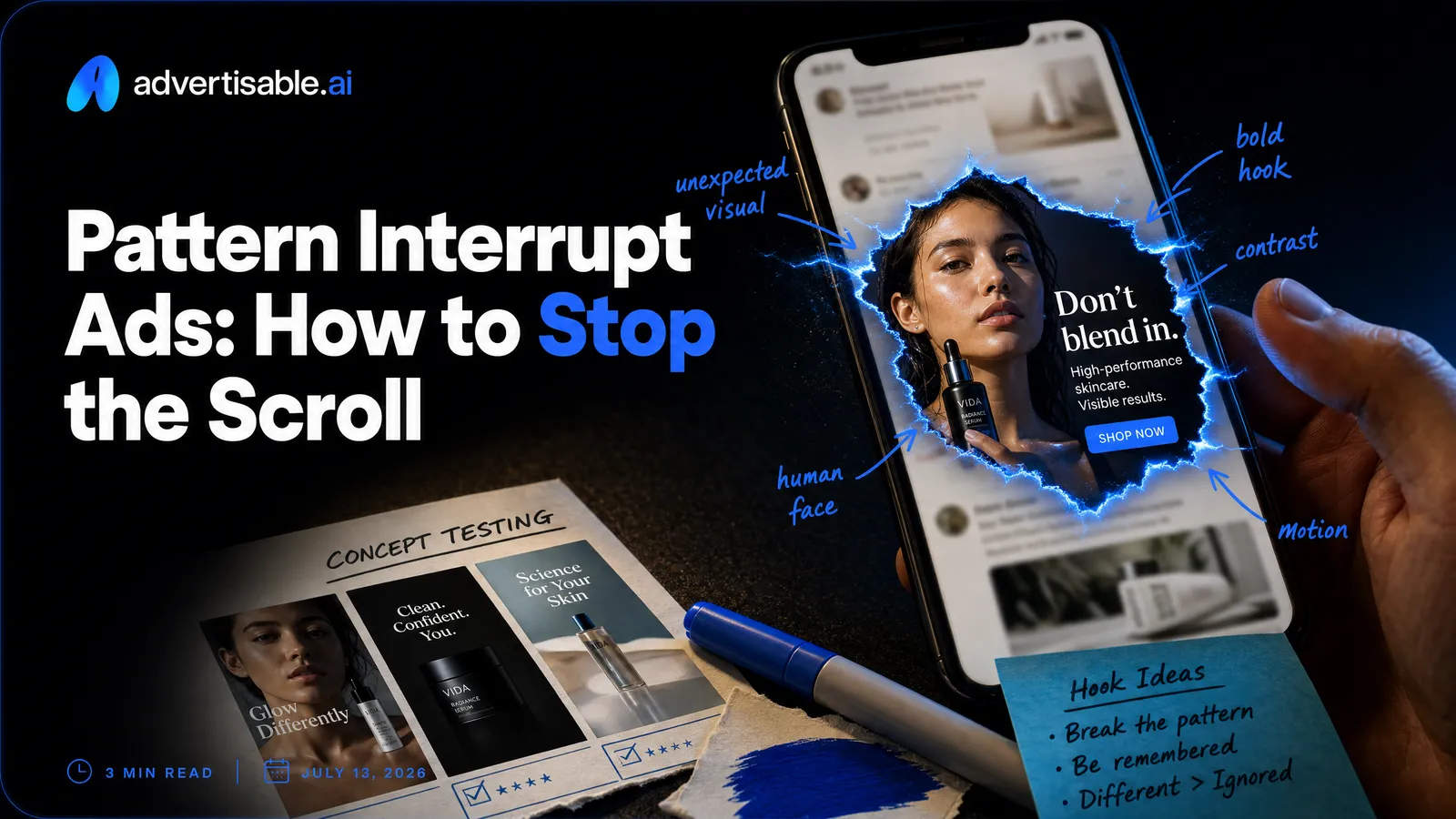
Pattern interrupt ads are scroll-stopping ads that deliberately break the feed’s visual or verbal rhythm in the first second, then immediately connect that interruption to a real product truth.
Here’s what matters most when you want interrupts that convert without brand drift:
- You have about one second to earn attention before the thumb scrolls.
- The interrupt is only a doorway; the next three seconds decide conversion potential.
- Random shock creates bait-and-switch and trains your audience to distrust you.
- Start from product truth, then find an unexpected way to introduce it.
- Use hook-only batches with identical bodies for clean, single-variable readouts.
- Judge success on hold and downstream actions, not views and clicks alone.
- Keep winners, retire losers fast, and document why each hook worked.
We built Advertisable AI for this exact production problem: you need high-volume pattern interrupt variations without losing brand accuracy. Our Brand DNA locks specs, claims, and voice, and our Storyboard Editor plus Scene-Level Regenerator let you iterate the hook scene without rerendering the entire ad, so your tests stay controlled and your outputs stay brand-locked.
Start by treating pattern interrupt ads as a two-part job: stop the scroll, then earn the next three seconds with a payoff that proves you are relevant. That framing changes what you build, what you keep constant, and what you measure.
Pattern interrupt ads are for stop the scroll and the next three seconds
How much time do you really have in the feed?
You have about one second to earn the pause. In the feed, viewers are not deciding whether they like your brand, they are deciding whether your opening frame is worth even 1 more second of attention.
Your first frame is doing most of the work. The brain can recognize image themes extremely fast, which is why a samey opener gets filtered instantly while a distinct opener buys you time. MIT neuroscientists found the brain can process entire images in as little as 13 milliseconds, and decide where to point the eyes in 100 to 140 milliseconds.
Operationally, treat the first second as a binary gate. Either you create contrast with the surrounding content, or you are competing with muscle memory.
- Acceptance criteria for the first frame: readable subject, clear contrast (scene, angle, composition, or line), and no slow brand intro
- QA check before you ship: screenshot the first frame and ask, “Would this look native next to five competitor ads?” If yes, it is not an interrupt
- Hold constant while testing: the ad body structure and offer, so you can attribute results to the opening
Break the pattern, then pay it off
A pattern interrupt is not “random weird.” It is an unexpected opening that is immediately explained by a product-relevant payoff in the next three seconds.
We see two common failure modes: the opening is surprising but unrelated (viewers feel baited), or it is relevant but delayed (viewers never get the reason to stay). Your job is to bridge from interrupt to meaning fast.
Storyboard it as two beats: Frame 0-1 breaks rhythm; second 1-3 delivers the product truth that makes the interruption feel earned.
- Interrupt lever you can change: cold open visual, first spoken line, on-screen text, or a cut that flips expectations
- Payoff requirement you should enforce: a concrete claim, proof cue, or problem statement that is specific enough to be falsifiable
- Next-test decision: if it stops the scroll but drops before second 3, keep the interrupt concept and tighten the payoff timing
Attention that converts, not attention alone
Scroll-stops are a diagnostic, not a win condition. You need attention that holds long enough to transfer a clear message and trigger the next action you care about.
Treat your measurement as a funnel: stop rate (first second), hold to 3 seconds (did the payoff land), then the downstream signal (click, view-through, or purchase depending on your objective). If the top-of-funnel spikes but downstream stays flat, your interrupt is winning on novelty and losing on relevance.
This is why we prioritize controlled, single-variable hook batches with 48-72 hour readouts: you can separate “got noticed” from “created intent” and iterate without guessing.
- Change: only the hook scene (visual plus first line) when diagnosing the interrupt
- Hold constant: the proof beat and offer beat so conversion shifts are attributable
- Ship criteria: the best hook is the one that improves hold to 3 seconds and lifts the downstream metric, not the one that generates the most comments
What a pattern interrupt actually is in ads
Why your brain flags broken patterns
Your brain is a prediction machine, and feeds are built to be predictable. When an opening frame violates what you expect, attention snaps to it because the system has to re-evaluate what it is seeing.
In practice, this is a fast, automatic “something is different” response that buys you a small window to earn the next seconds with relevance. research published in PMC points to the amygdala being distinctly responsive to novel unusual stimuli, which is exactly what your opening is trying to trigger.
Operator note: the interrupt is not the goal. The goal is the measurable behavior change that follows, typically thumb-stop plus early retention, not just a momentary glance.
Four interrupt types that scale in paid social
The interrupt formats that scale are the ones you can generate in batches, test as single-variable changes, and QA quickly. We treat these as hook-level swaps while holding the body structure constant for a clean 48 to 72 hour readout.
Four repeatable types:
- Visual contrast interrupt: a first frame that breaks the category’s usual lighting, framing, or texture (example: extreme close-up of the product surface instead of a talking head). Acceptance criteria: readable subject in 1 second, no clutter, brand-safe colors.
- Pattern break in motion: an abrupt move that does not match typical “smooth UGC” pacing (example: hard cut from static frame to fast hand movement). QA: no motion blur that hides the product; captions stay on-screen at least 1 second.
- Verbal frame-flip: the first line reverses the viewer’s assumption (example: “Don’t buy this if you hate refills”).
Acceptance criteria: one clear claim in under 12 words; no compliance-risk claims.
Context mismatch: start in an unexpected setting for the category (example: product shown in a drawer, car, or workspace instead of a bathroom counter). QA: setting supports the use case within 2 seconds, not random.
These types work because you can storyboard one ad body, then regenerate only the hook scene across 10+ variants without contaminating the test with new proofs or offers.
Category expectations you can violate (without losing trust)
You are not interrupting “the internet.” You are interrupting your category’s defaults. The safest violations are the ones that feel unexpected but still explainable by the product within the first 3 seconds.
Common expectations to challenge:
- Polished brand openers: replace logo-first with product-first, then introduce brand after the first claim.
- Overly generic promises: swap “better results” language for a concrete mechanism or constraint (what it is, what it is not).
- Perfect studio visuals: use intentional imperfection (handheld, uneven framing) while keeping labels and key details legible.
- Linear storytelling: start with the outcome or objection, then rewind to the proof.
A good violation passes a simple check: the opening is surprising, and the second scene makes the surprise make sense.
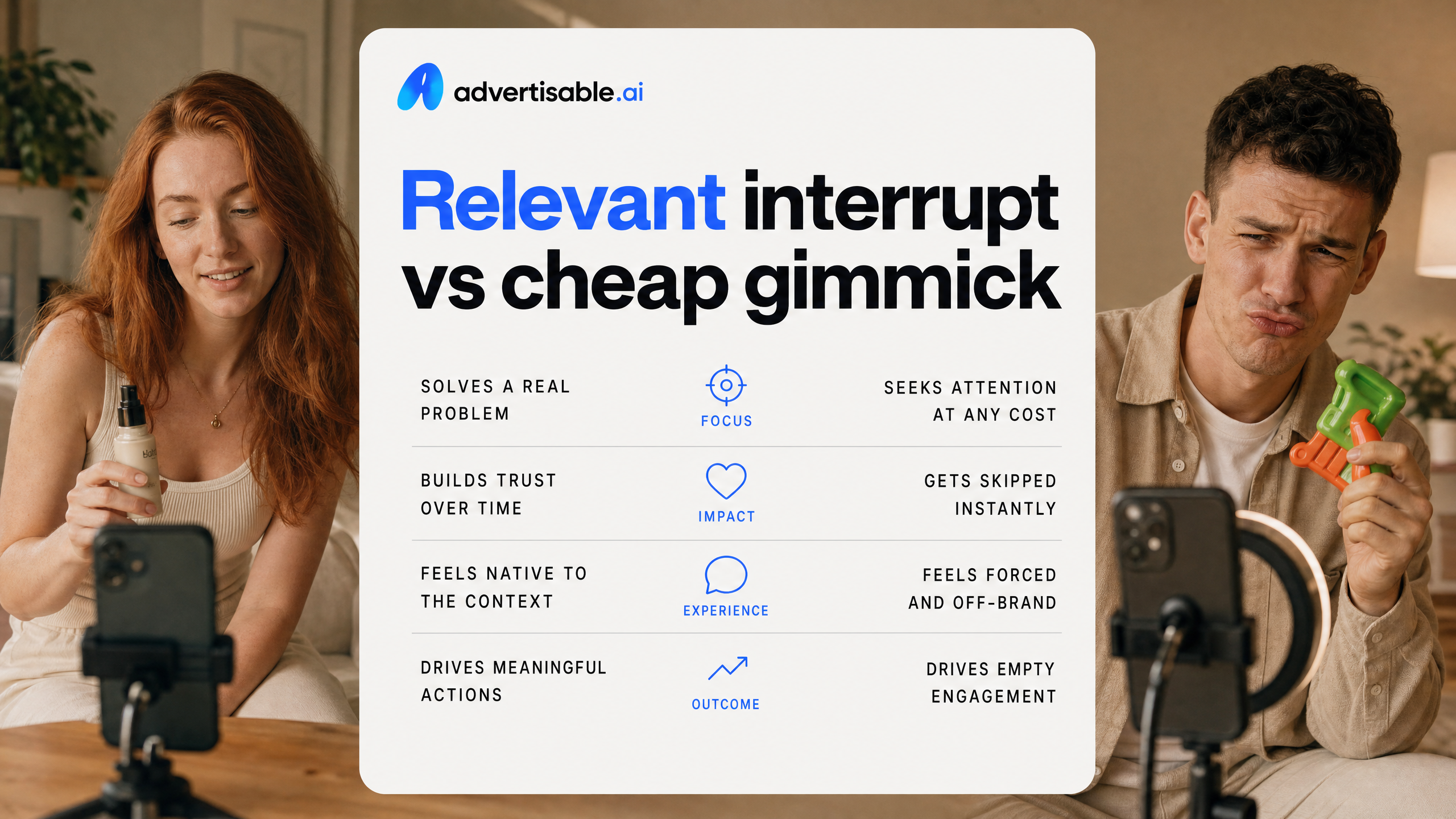
Relevant interrupt vs cheap gimmick
Why random shock turns into bait-and-switch
Random shock can buy you a scroll-stop, but it usually burns the next 2 seconds. The viewer realizes the opening had nothing to do with what you sell, and you convert attention into annoyance.
Operationally, you see it in the metrics: a strong first-second hold, then a steep drop before your product even appears. That is the bait-and-switch effect in plain terms, and it tends to raise negative feedback while lowering qualified clicks.
Use a simple QA check before you ship: can you draw a straight line from frame 1 to the product truth by second 3? If not, the opening is a gimmick, even if it is loud.
- Timing check: product or product consequence is visible or explicitly named by the 3-second mark
- Relevance check: the first visual or line can be restated as a product benefit, proof, or problem the product solves
- Continuity check: the hook scene and the next scene share the same object, setting, or claim so the handoff does not feel like a hard cut
Does your interrupt point to the product fast enough?
A working interrupt is a directional cue, not a detour. It should force attention and then immediately constrain the viewer’s interpretation toward your product, your claim, and your next scene.
This is why unexpected stimuli pull attention and stick in memory - but the memory attaches to whatever you pair with the surprise. If you attach it to a random bit, you train recall for the bit, not for the offer.
In our workflow we hold the body scenes constant and only vary the hook, because it makes the “points to product” question testable in 48-72 hours. If one hook earns early attention but does not increase downstream actions with the same body, it is not pointing clearly enough.
- Single-variable rule: change hook only, keep problem, proof, and offer scenes identical across the batch
- Acceptance criteria: the hook explicitly sets up the very next on-screen proof or demo, not a new topic
- Next-test decision: when a hook wins on hold but loses on clicks, regenerate only the hook scene and keep the rest locked
Unexpected but relevant is the repeatable approach
You can repeat “unexpected but relevant” without wearing out your audience because relevance gives you a stable spine. The surprise lives in the entry angle, while the product truth stays consistent.
Treat this like a controlled system: define one product truth you will not change, then generate multiple entry points that all land on that same truth. With scene-level control, you can keep your proof and offer scenes fixed while you iterate hook variants until you get both attention and continuity.
A practical target is 10 hook variations per concept, evaluated on a 48-72 hour readout. You are not chasing novelty for its own sake; you are isolating the few openings that stop the thumb and make the next scene feel inevitable.
- Hold constant: one claim, one proof asset type, one offer structure
- Vary intentionally: first line, first visual, and the object of focus in the first frame
- Pass criteria: the hook can be removed and the ad still makes logical sense, but it performs worse without it
Build pattern interrupts that hand off to your message
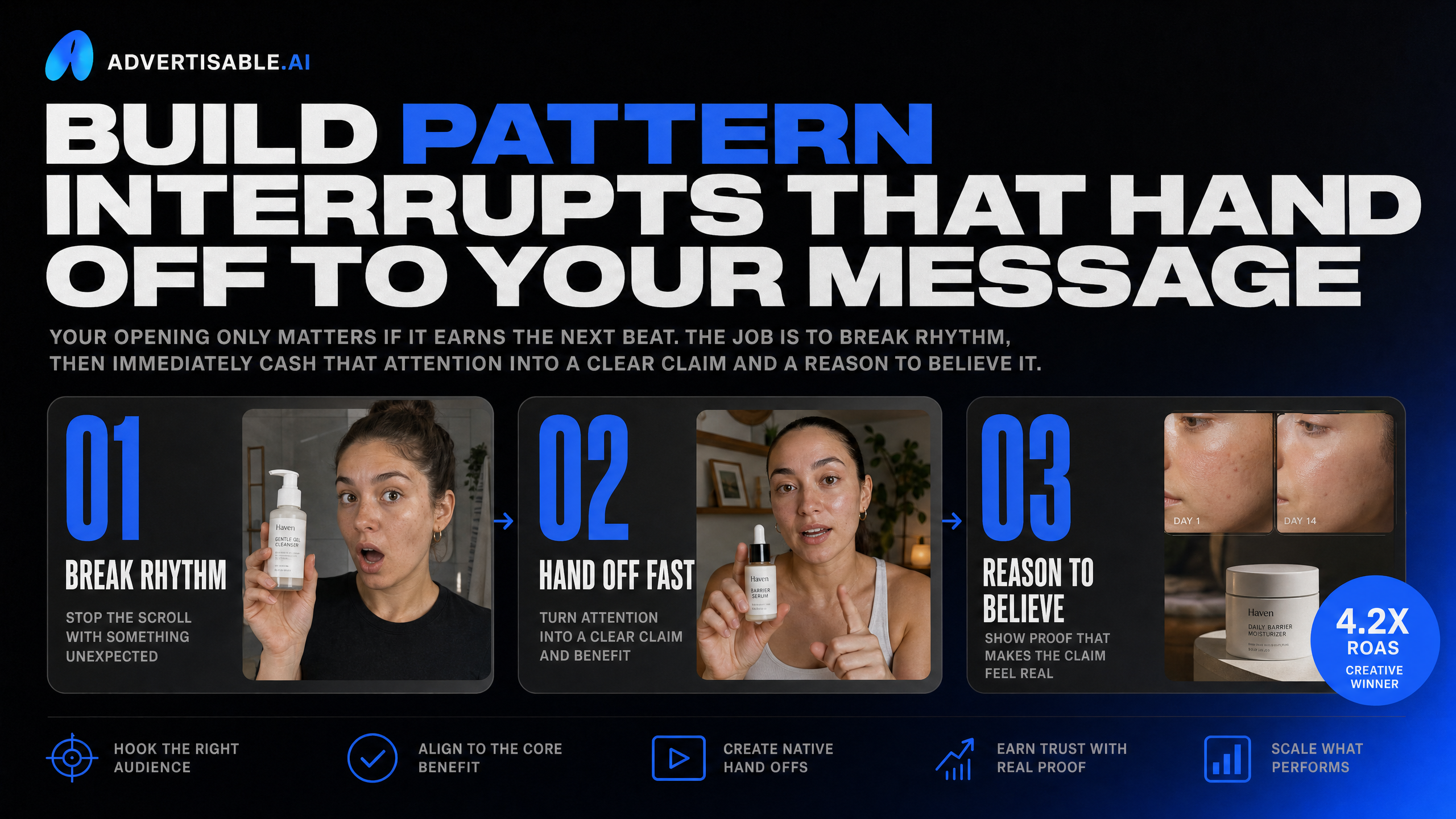
Your opening only matters if it earns the next beat. The job is to break rhythm, then immediately cash that attention into a clear claim and a reason to believe it.
How Do You Avoid Spectacle and Still Stop the Scroll?
You avoid spectacle by anchoring the interrupt to a product truth you can prove in the next 2 seconds. If the first moment is unrelated, you pay a curiosity tax and your retention drops the moment viewers realize it is a bait-and-switch.
We treat “product truth” as the smallest, concrete, testable unit: an observable before-after, a constraint you remove, a spec you can show on-screen, or a demo that only your product can pass. Build the interrupt as the unexpected way into that truth, not as a random visual stapled on top.
Acceptance criteria: you should be able to delete the first frame and still have the same core claim. If deleting it changes what you are selling, it was spectacle.
- Truth types that are easy to pay off fast: packaging detail you can zoom into, a UI state change, a one-step demo, a simple comparison against the old way, a single quantified claim you are allowed to make
- Guardrails we hold constant in batches: Brand DNA claim constraints, product naming, and the body structure (problem, proof, offer) so only the opening varies
Design the First Frame to Break Category Rhythm
Your first frame should look unlike what your category usually leads with, while still looking native to the platform. You are trying to trigger an orienting response, not announce “this is an ad.”
A practical workflow is storyboard-first: lock the body scenes, then generate 10 distinct opening frames as a single-variable batch. Read results in 48 to 72 hours and keep the winners, not the most creative.
QA it like an operator: can you understand the scene in 13 milliseconds? MIT neuroscientists found the brain can process an image in as little as 13 milliseconds, so cluttered first frames are a self-inflicted wound.
- Category rhythm breakers that stay relevant: abnormal crop (too close), unexpected angle on the product, “wrong” setting that matches the use case, hard-cut to the outcome before the problem, nonstandard on-screen text placement for your niche
- Frame QA checklist: one focal point, legible text at arm’s length, product visible or implied, no generic stock-looking lighting, no new claim introduced without a payoff queued
Handoff Fast: Hook, Then Proof
You have about 1 to 3 seconds to hand off from interrupt to hook and proof. The interrupt earns attention, the hook states the promise, and the proof removes doubt with something concrete.
Keep the handoff mechanically consistent so you can measure it: opening frame (interrupt) then one sentence hook, then one proof unit. That is it.
In production, we isolate this with scene-level regeneration: hold your body constant and regenerate only the hook scene until the stop and hold metrics stabilize across a few variations.
- Hook acceptance criteria: names the audience and outcome, avoids broad adjectives, and fits in one breath
- Proof acceptance criteria: shows the product, shows the mechanism or result, and matches Brand DNA claim guardrails
- Next-test decision rule: if you get stops but not holds, change the handoff line; if you get holds but no clicks, change the proof unit before you touch the interrupt
Test interrupts like a system, not a guess
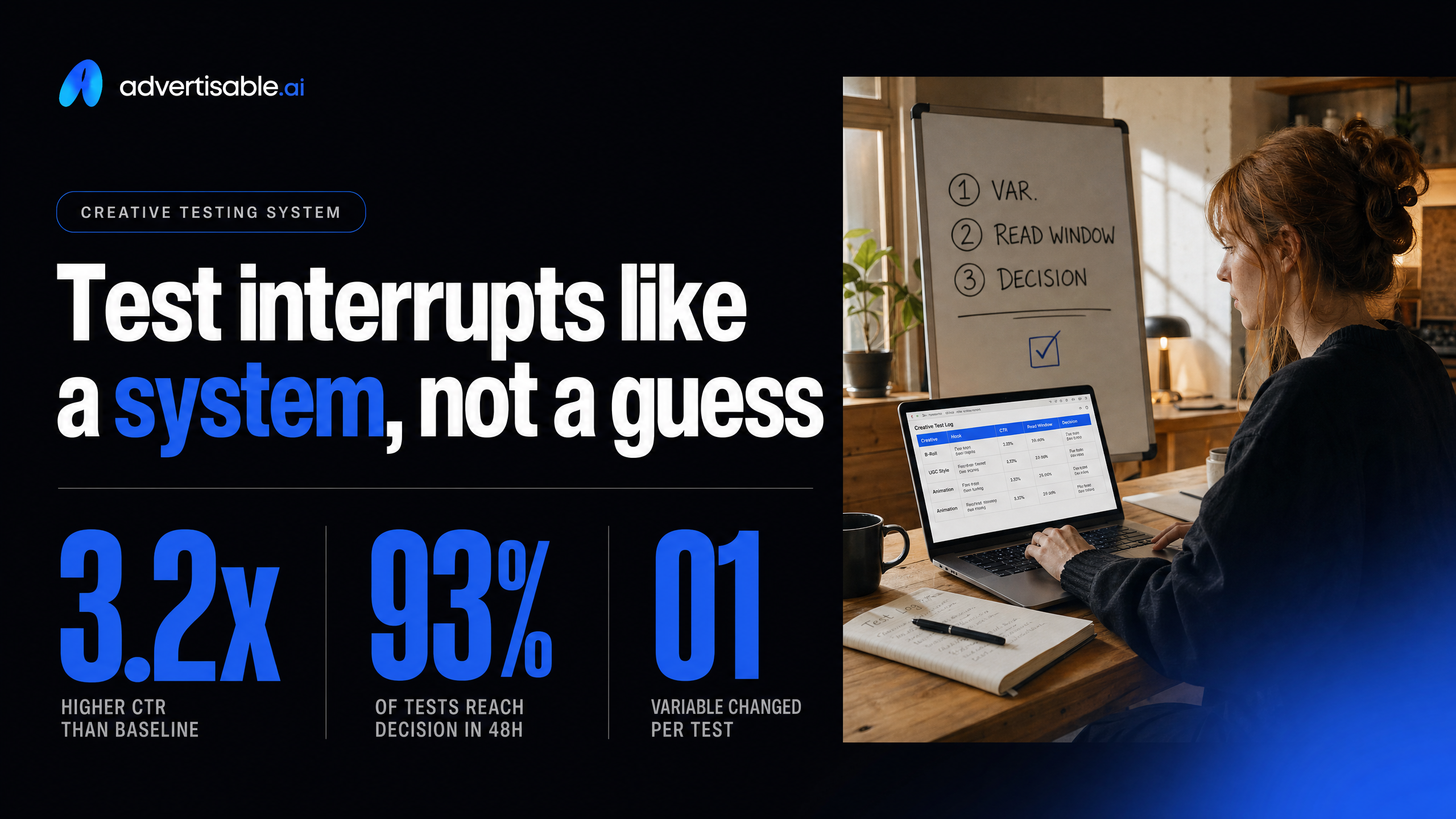
Interrupts are only “good” if you can prove they beat your baseline and you can reproduce the result. Treat testing like operations: isolate one variable, set a read window, and make a decision quickly.
How do you run hook-only batches without muddy reads?
Test hooks in batches where the body is identical, and only the first scene changes. That gives you attribution: you can say the scroll-stop moved because the opener moved, not because the offer, proof, or pacing changed.
Lock a storyboard-first workflow so the structure after the opening is fixed (problem, proof, offer beats stay constant). Then regenerate only the hook scene 10+ times and export each variation as its own ad.
QA matters here. A hook test fails when “identical body” is not actually identical because someone tweaked captions, swapped shots, or changed the CTA card.
- Hold constant: creator/avatar, body script, proof scene, offer scene, CTA text, aspect ratio, thumbnail/first frame after hook, audio bed
- Change: hook scene only (first 1-2 seconds), including the first line, first visual, and on-screen text
- Readout window: 48-72 hours per batch before you touch anything else
- Acceptance criteria before launch: Brand DNA guardrails applied, claims checked, export is platform-ready and legible on mobile
What should you measure for hold, not just views?
Views tell you distribution, not attention. For pattern interrupt ads, you need hold metrics that show whether people stayed through the handoff into your message.
Use a two-layer scorecard: early retention (did the opener earn seconds 1-3?) and meaningful continuation (did they stay through the proof or offer beat?). Track clicks and downstream conversion separately so you do not confuse curiosity with intent.
Set thresholds you will actually act on. Even simple rules beat “this one feels better.”
- 3-second view rate or equivalent early-retention signal (your scroll-stop proxy)
- Hook-to-body drop-off (retention dip right after the interrupt resolves)
- Hold to proof beat (did they make it to the first concrete product truth?)
- Outbound click rate and CPA/ROAS where available, segmented by hook ID
Keep winners, retire losers fast
Once you have a read, stop feeding spend to ambiguous creatives. Keep a small set of winning hooks live, and recycle production time into new openers rather than polishing weak ones.
We recommend a simple decision loop: after 48-72 hours, promote winners, pause clear losers, and regenerate only what failed. Scene-level control is the difference between shipping 10 more openers today versus re-rendering entire videos.
In Advertisable AI, that usually means keeping the storyboard body locked and using the Scene-Level Regenerator to iterate the hook until you have 2-3 openers that reliably hold attention.
- Keep: hooks that improve early retention and do not spike immediate drop-off after the handoff
- Retire: hooks that win the first second but lose people before the proof beat
- Next test: take the top 1-2 hooks and create a new hook-only batch that explores a single dimension (visual pattern vs. opening line), not a grab bag
Turn pattern interrupts into a controlled testing system
If your openings feel random, you are not missing creativity. You are missing control. The objective is simple: stop the scroll and earn the next three seconds without drifting off brand or turning the hook into bait.
We build this like an operator workflow. Start storyboard-first so your problem, proof, and offer stay constant. Then run single-variable batches on the hook only.
Generate 10 distinct hook interrupts, hold the body fixed, and read results after 48 to 72 hours. Promote winners. Regenerate only the losing hook scene.
Repeat.
With Advertisable AI, we pull Brand DNA from your product URL, generate production-ready UGC-style ads and Product ads, and let you make scene-level edits so you are never redoing the whole video. Next step: start the $5 3-day trial, import one product link, and ship your first hook batch today.
Frequently Asked Questions
Q: What is an example of a pattern interrupt?
A: A strong example is an opening frame or line that violates what your category usually does, then immediately pays it off with a product-specific truth. Think: an unexpected visual that highlights the exact problem your product solves, followed by proof or a clear demonstration in the next beat.
Q: How to create a pattern interrupt?
A: Start with your product truth, then choose one unexpected element that makes that truth impossible to ignore in the first second. Keep the interrupt relevant, and transition into your hook and proof immediately so attention converts into understanding.
Q: How does Brand DNA prevent off-brand renders?
A: Brand DNA locks the brand inputs that usually drift in high-volume creative: colors, fonts, logos, product specs, voice, and claim guardrails. That way, even when you generate many hook variations, your outputs stay brand-locked and export-ready without manual cleanup.
Q: Can I test multiple hooks without re-generating the entire ad?
A: Yes. The clean approach is hook-only testing: keep the body scenes identical and regenerate just the hook scene in a batch. That isolates the variable, protects your readout, and avoids wasting cycles re-rendering scenes that are already working.
Q: What's the difference between UGC-style ads and Product ads?
A: UGC-style ads are creator-style ads where an on-camera AI avatar delivers the message and carries the narrative. Product ads keep the product as the hero, using accurate packaging and specs so your benefits and proof land visually and credibly.