HeyGen vs Advertisable AI: Presenter Video or Performance Ads
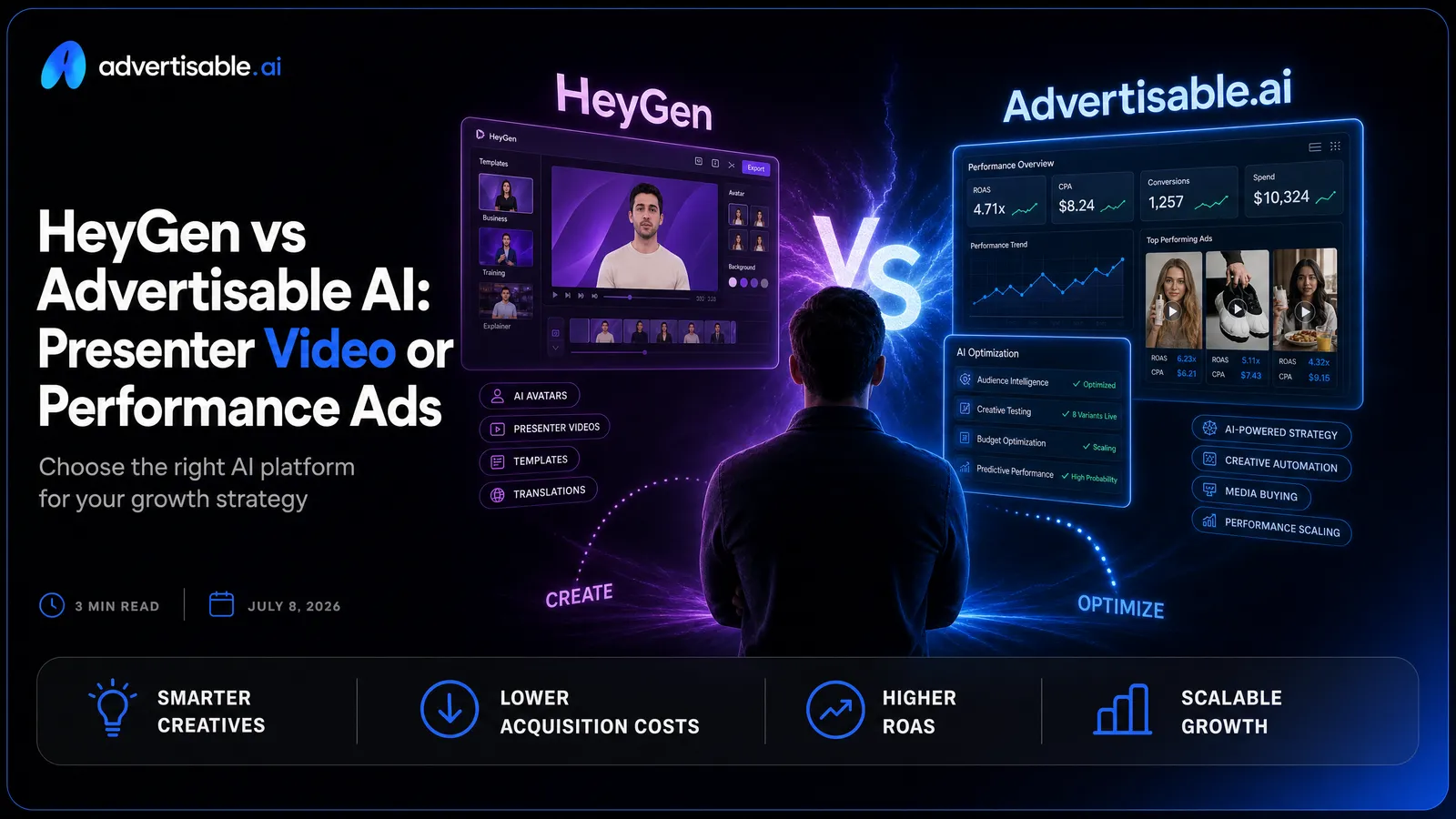
Choose HeyGen if your paid-social creative needs a realistic presenter delivering a script, especially across many languages. Choose Advertisable AI if you need performance product ads you can keep on-brand and iterate scene-by-scene without full re-renders.
Here’s the decision in plain operator terms:
- If your deliverable is a presenter clip, HeyGen is the better fit.
- If your deliverable is a complete ad unit, Advertisable is the better fit.
- HeyGen wins on presenter realism and lip-sync quality.
- HeyGen wins on multilingual output, including 175+ languages with lip-synced translation.
- Advertisable wins when Brand DNA must lock colors, fonts, voice, and approved claims.
- Advertisable wins when you need scene-level control to fix one weak beat.
- Switching pays off only when it removes rerender waste and increases shippable variations.
We built Advertisable AI after watching performance teams lose hours and credits to off-brand drift, incorrect product details, and full-video re-renders just to fix one moment. Our product URL import, Brand DNA, and Frame-by-Frame control are designed for product-first accuracy and controlled iteration, so your paid-social testing stays fast, consistent, and measurable.
Next, we’ll make the choice even safer with a quick verdict on who each tool is for, so you can map your workflow to the right output and avoid a costly switch for the wrong reason.
Quick verdict: who each tool is for
The dividing line is simple: do you need a believable presenter delivering your script, or do you need structured product ads you can iterate and scale for paid social?
HeyGen: presenter-led videos where delivery is the product
HeyGen is the right pick when the video is anchored by a presenter and your main job is getting clean, on-camera delivery without filming.
In practice, that means spokesperson content, training modules, explainers, internal comms, and localization where the same message has to be delivered consistently in many markets. HeyGen is also strong when you already have a script and you want the output to feel like a real person is saying it, not a slideshow with a voiceover.
A concrete checkpoint: if your creative brief starts with “who is saying this?” and “how believable is the delivery?”, you are in HeyGen territory.
- Best-fit outputs: explainers, training, spokesperson videos, product walkthrough narration
- Teams who win: HR/L&D, product marketing, customer education, founders who need a repeatable presenter format
- Useful pricing anchor: the Creator plan is $29/month ($24/month annual) with 1080p exports and no watermark
Advertisable: performance product ads built for testing loops
Advertisable fits when your priority is performance product ads you can ship, test, and iterate without losing brand control.
You are not just generating a clip. You are generating advertising creative with the parts you actually need to run paid social: a strong hook, product clarity, proof, and an offer, then variations you can A/B test without rebuilding from scratch.
This is where scene-level control matters. When one beat is weak, you want to regenerate that beat, not re-render the entire ad and burn time and credits.
If your brief starts with “how many variants can we launch this week?” and “can we keep claims, packaging, and brand look consistent?”, Advertisable is the tighter fit.
- Best-fit outputs: product ads, UGC-style ads, B-roll style ads, static ads for paid social
- Operators who win: DTC and e-commerce growth teams, paid-social agencies, in-house performance teams managing creative volume
- Core workflows: lock Brand DNA, generate multiple selling angles, swap hook variations, export channel-ready cuts for Meta, TikTok, and YouTube
Head-to-head comparison table for 2026
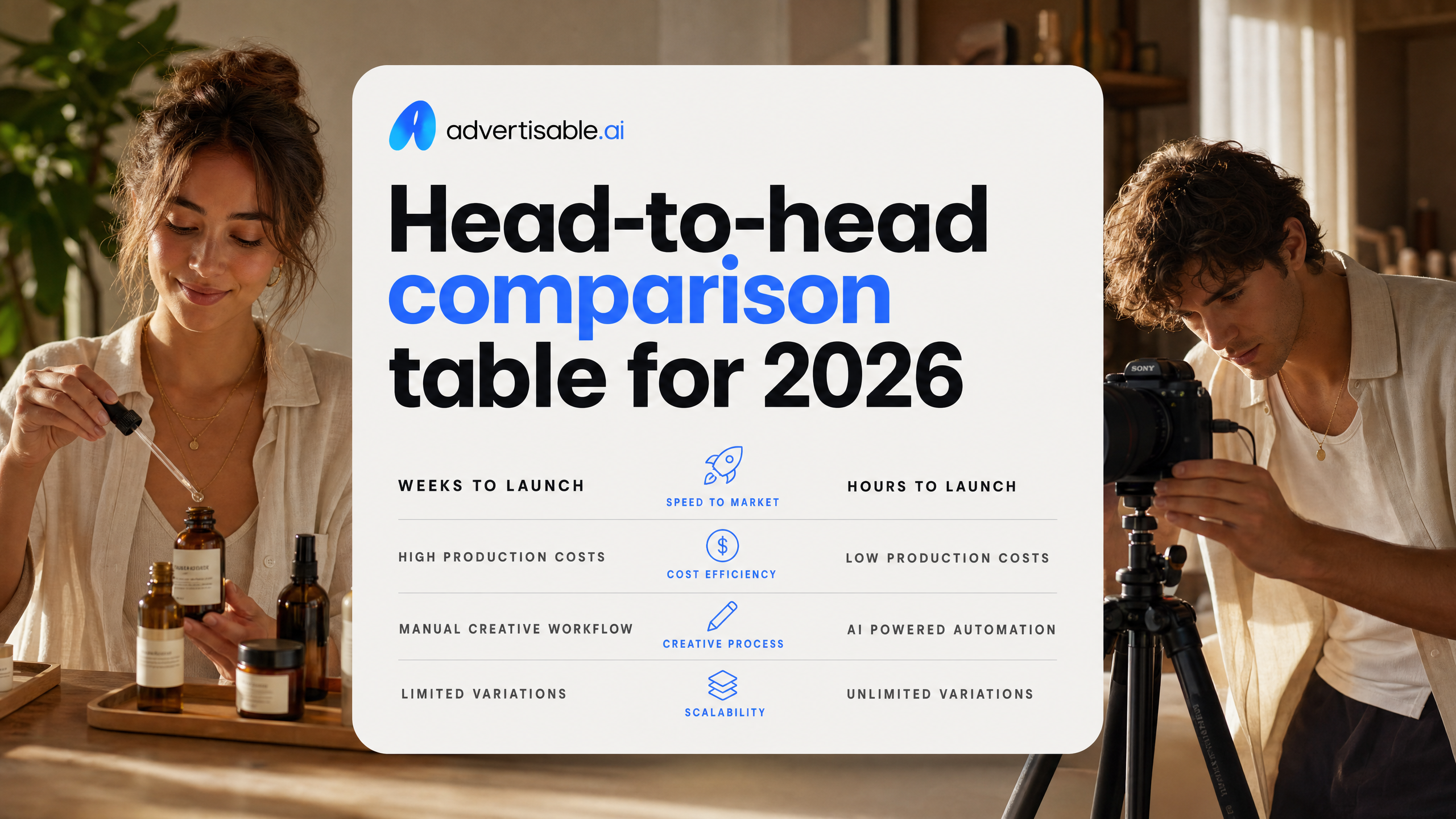
Comparison table: HeyGen vs Advertisable AI
The fastest way to choose is to compare the unit of output. HeyGen primarily delivers a believable AI presenter clip from your script, while Advertisable AI is built to generate a complete performance ad with structure and controls for scale.
Use the table to separate “presenter quality” decisions (HeyGen) from “ad system” decisions like brand locking, hook testing, and export-ready variants (Advertisable).
What the table means for your team
If your bottleneck is getting a human-like spokesperson on screen, HeyGen is the cleaner fit. It wins on avatar realism and multilingual output, including 175+ languages with lip-synced translation through HeyGen's translation capabilities.
If your bottleneck is shipping and testing paid-social creative without off-brand drift, Advertisable AI maps better to how performance teams actually work. You get brand constraints (Brand DNA), a structured ad format (hook, product, proof, offer), and the ability to regenerate a single weak scene instead of re-rendering a whole sequence.
Pricing also signals intent. HeyGen is credit-based across Free (3 watermarked videos/month), Creator ($29/month or $24/month annual), Pro (from $49/month), and Business ($149/month plus $20/seat), and premium avatars can consume credits quickly. Advertisable AI runs a $5 3-day trial, then $25 or $49/month, which is easier to forecast when your goal is volume testing.
- Choose HeyGen when your success metric is presenter believability, training throughput, or multilingual spokesperson coverage.
- Choose Advertisable AI when your success metric is cost per shippable ad variant and controlled A/B tests on hooks, proof, and offers.
| Dimension | HeyGen | Advertisable AI |
|---|---|---|
| Primary use case | AI avatar/presenter videos for explainers, training, and spokesperson content | Brand-controlled performance ads for paid-social testing |
| Output type | Talking-head presenter clip generated from a script | Complete structured ad: hook, product, proof, offer |
| Avatar/presenter realism | Best-in-class avatar quality and lip-sync (wins this category) | Not the core differentiator; focused on ad creative assembly and control |
| Multilingual | 175+ languages with lip-synced translation (wins this category) | Not positioned as a translation-first platform |
| Brand consistency | Limited brand locking compared to ad-first platforms | Brand DNA locks colors, fonts, voice, and approved claims across variants |
| Ad structure | Presenter segment only; no built-in b-roll assembly or hook/proof/offer structure | Builds full hook/proof/offer ads intended for performance use |
| Iteration/testing at scale | Typically re-render the whole video when changing elements | Frame-by-frame control to regenerate one scene and test hook variations |
| Pricing model | Credit-based: Free (3 watermarked videos/month), Creator $29/month ($24 annual), Pro from $49/month, Business $149/month + $20/seat; premium avatars consume credits quickly | $5 3-day trial, then $25 or $49/month |
| Ideal user | Teams needing a believable AI presenter or multilingual spokesperson video | Teams producing and testing brand-controlled performance ads |
Where HeyGen genuinely leads
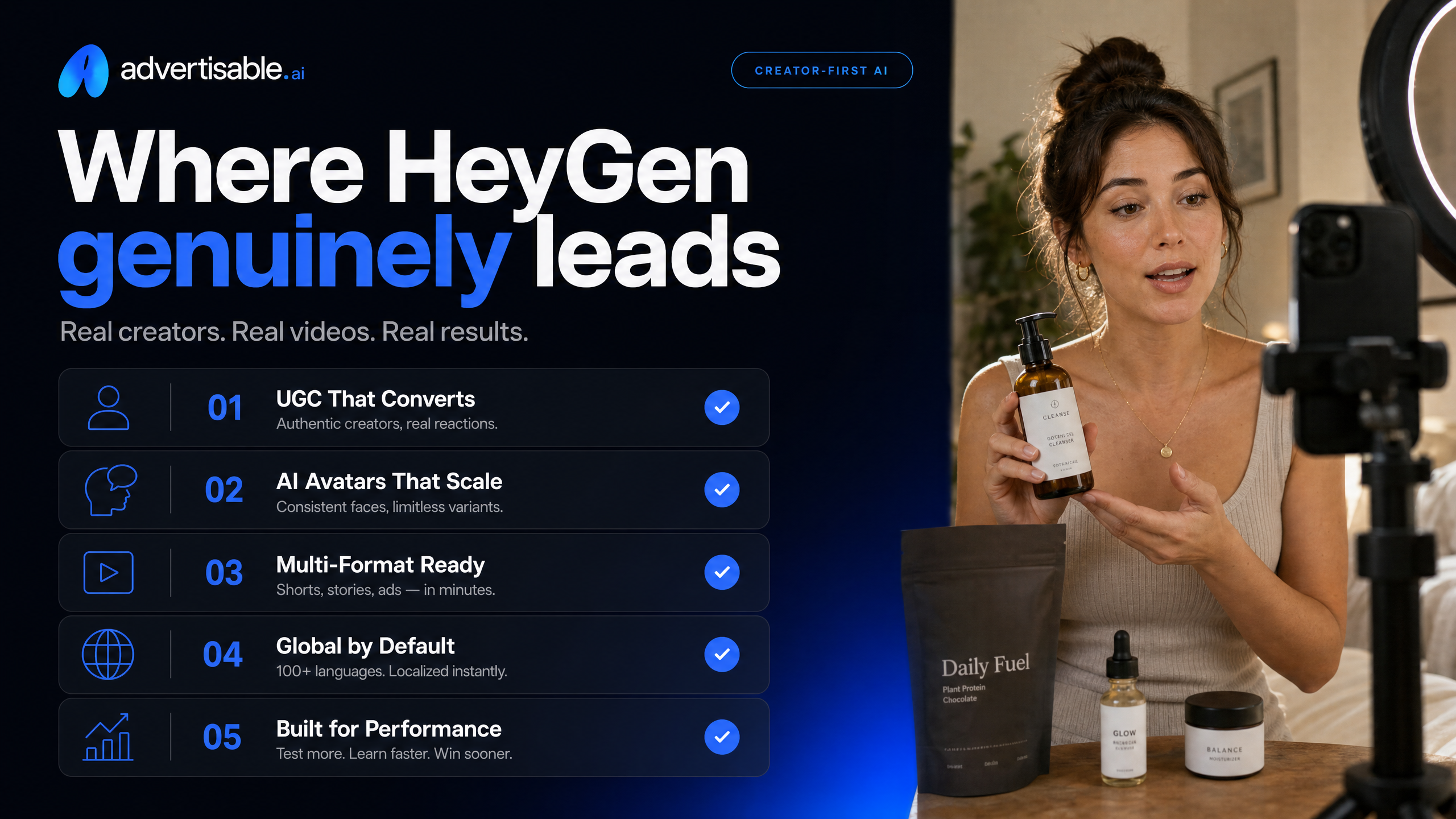
How realistic are HeyGen avatars and lip-sync, really?
HeyGen is the benchmark when you need a believable on-camera presenter that can carry a script without distracting facial artifacts. For most teams, the win is simple: the avatar looks human enough that your audience listens to the message instead of analyzing the tech.
In our experience building performance creative, this realism matters most in high-trust moments: intros, compliance-heavy explanations, and any ad angle where credibility lives in the presenter’s face. The gap shows up in small details that viewers unconsciously track, like micro-expressions, mouth shapes on hard consonants, and whether head motion feels anchored to the voice.
If your success metric is “would a cold viewer accept this as a real spokesperson in the first 3 seconds,” HeyGen tends to clear that bar more reliably than generalist generators.
- Best use cases: training, explainers, spokesperson-style ads, founder-style messages where delivery quality is the product
- Highest leverage moments: the first line of the hook, proper noun pronunciation, and any close-up shot where mouth motion is prominent
- Operational advantage: fewer takes and less post-fixing because the baseline output is already presentation-grade
Multilingual translation with lip-sync (where it saves real time)
HeyGen’s translation workflow is strong because it pairs language conversion with lip-sync, so your translated version still looks like the same person delivering the same message. That is the difference between “we translated the words” and “we localized the performance.”
HeyGen's translation capabilities cover 175+ languages and dialects, and the value is fastest when you have one hero script that needs to ship across regions without re-shooting. You avoid the common failure mode where audio changes but the mouth does not, which instantly signals “dubbed” and reduces trust.
For paid social, this is most useful when you already know a concept converts in one market and you are expanding spend. Translation plus lip-sync lets you keep the same framing and pacing while adjusting language, which keeps your testing cleaner than recreating the entire video from scratch.
Where Advertisable leads for performance ads
How does Brand DNA keep your ads on-brand?
Brand DNA matters in performance ads because you are not making one video, you are making dozens of variations. Without hard constraints, AI outputs drift fast: wrong colors, mismatched fonts, inconsistent claims, and even incorrect product details.
In our workflow, you lock the non-negotiables once, then generate at volume with the same guardrails every time. That is the difference between “more creative” and “more usable creative.”
Practically, Brand DNA is where you constrain elements like your logo usage, color specs, fonts, approved product specs, and approved claims so every new variation still looks and reads like your brand.
- You keep visual identity stable across high-volume outputs (colors, fonts, logo rules).
- You reduce compliance and QA churn by locking approved claims and product facts.
- You get cleaner test results because you are changing the angle or hook, not accidentally changing the brand.
Frame-by-frame control makes scaling predictable
Scaling performance creative breaks when every fix forces a full re-render. Frame-by-frame control fixes that by letting you regenerate a single beat without touching the rest of the ad, so iteration stays targeted and fast.
This is where a paid-social workflow actually lives: you identify the weak moment (usually the hook, proof, or offer beat), swap it, and keep everything else constant so your A/B test isolates one variable.
Advertisable AI's platform features include frame-by-frame regeneration, which means you can iterate on the hook twice while keeping product shots, brand styling, and timing intact.
For scaling, that turns “make 10 new ads” into “make 10 controlled variations,” which is how you increase volume without increasing chaos.
- Swap only the hook scene to test 2-3 hook variations against one baseline.
- Regenerate a single proof beat (testimonial, stat card, demo moment) without rebuilding the whole sequence.
- Keep the same structure while rotating selling angles (benefit, proof, comparison, offer) for cleaner learning.
The real separation: presenter clip vs complete ad
Most teams compare features and miss the bigger distinction: what you receive at export. One tool hands you a presenter clip. The other hands you an ad you can actually run.
HeyGen gives you a presenter deliverable
HeyGen’s output is a presenter asset: a realistic on-camera spokesperson delivering your script. It’s designed for clarity and believability, not for assembling a complete paid-social ad unit.
In practice, you’re responsible for everything around that clip: hook framing, product shots, proof elements, offer, pacing, captions, and platform-specific cuts. HeyGen can do the presenter part extremely well, especially when you need multilingual delivery at scale. HeyGen's translation capabilities cover 175+ languages and dialects with lip-sync.
This output is ideal when the “voice” is the product, like training, explainers, internal comms, or a spokesperson-led message where the primary goal is comprehension.
- Deliverable shape: a single talking-to-camera segment (the “spokesperson”)
- Primary control: script, delivery style, language, and presenter selection
- Common next step: you or your editor builds the ad structure around it
Advertisable outputs a full ad unit
Advertisable AI is built to export a complete ad unit, not a single component. You’re generating the structured creative you can ship directly into testing, with the product and brand constraints held steady so iterations stay clean.
That means the deliverable includes the ad’s storyline, not just a “speaker.” You can lock Brand DNA, pull accurate product details via a URL, and then iterate specific beats without rebuilding the entire sequence. Advertisable AI's platform features include frame-by-frame control to regenerate any scene, which changes the economics of testing.
When your job is performance marketing, the difference is simple: you want an ad you can version, QA, and launch in multiple aspect ratios without an extra assembly workflow.
- Deliverable shape: storyboarded ad with hook, product moments, and a clear end frame
- Primary control: Brand DNA plus product accuracy from the URL, so outputs don’t drift
- Iteration model: regenerate the hook or one weak beat without re-rendering everything
Choose HeyGen or choose Advertisable AI
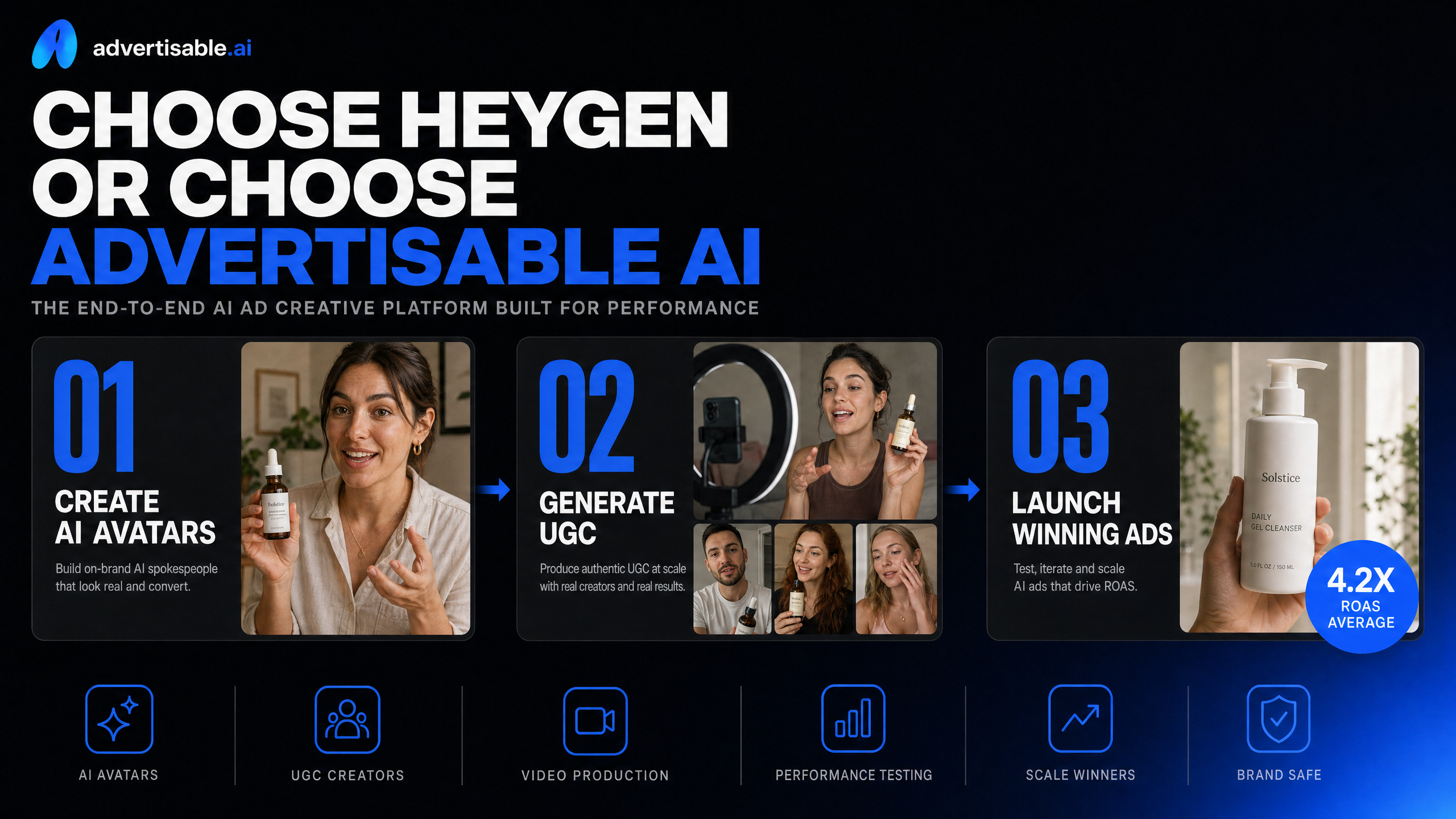
Choose HeyGen when a presenter is the product
Pick HeyGen when the job is a believable on-camera delivery and the presenter is the main creative asset. That is the lane where a talking-head style output beats product footage or montage-style ads.
In practice, this is the right call when your message needs trust transfer from a spokesperson, tight script control, and repeatability across markets. HeyGen is also a strong fit when translation is central to your distribution plan, because it is built for multilingual presenter delivery.
You should lean this direction when you are producing:
You can still run these videos as ads, but the creative testing loop is usually about script, offer, and delivery rather than rapid, scene-by-scene ad iteration.
- Explainers where clarity matters more than visual variety
- Training and internal enablement where consistency matters
- Spokesperson style top-of-funnel videos where the hook is the human presence
- Multilingual presenter content (HeyGen supports 175+ languages and dialects)
Choose Advertisable AI when you need testing velocity
Choose Advertisable AI when your bottleneck is volume, control, and learning: you need many on-brand variations, fast, and you need to change one weak moment without rebuilding the entire asset. That is a performance workflow, not a presenter workflow.
This matters because most paid-social outcomes are driven by iterative testing: hook variations, angle changes, proof swaps, and offer tweaks. Our platform is built around Brand DNA locking (so product details, colors, fonts, and approved claims do not drift) plus scene-level regeneration (so you can replace a single beat without re-rendering the full ad).
A tight decision rule we use with teams is simple:
- If your weekly plan requires 10 to 30 shippable variations per product or offer, you want a testing-first system
- If you need to A/B only the hook or proof beat while keeping everything else constant, you want scene-level control
- If off-brand outputs create review and QA risk, you want Brand DNA constraints
- If you ship to multiple placements, you want channel-ready exports in 9:16, 1:1, and 16:9
If your KPI is scalable ad testing, validate it with one controlled run
If you are comparing these tools because performance is the priority, make the decision the same way you run paid social. With a small, measurable test.
We built Advertisable AI for brand-controlled performance ads, not presenter-led clips. You lock Brand DNA once, import a Product URL, generate multiple selling angles, then use the Frame-by-Frame Editor to regenerate only the hook or a single beat without redoing the whole ad.
Start with one product. Export channel-ready cuts for Meta, TikTok, and YouTube. Launch a tight A B test.
If you ship faster, stay on-brand, and iterate with less waste, you have your answer.
Frequently Asked Questions
Q: What's the best AI for advertising?
A: The best option is the one built for your exact output. If you need a believable presenter reading a script, choose a presenter-first tool. If you need complete performance ad units you can iterate and scale with brand control, use an AI ad studio built for hook, proof, and offer testing.
Q: Can I control individual scenes without regenerating the entire ad?
A: Yes. In Advertisable AI you can use the Frame-by-Frame Editor to regenerate or swap a single scene, which is ideal when you are testing hook variations without changing the rest of the ad.
Q: What makes the product renders accurate?
A: Advertisable AI uses the Product URL Importer to pull packaging and product details from your product page, then keeps those details consistent with Brand DNA locks. That reduces off-brand drift and helps you avoid incorrect product claims in scaled variations.
Q: How does Advertisable AI differ from HeyGen or other video generators?
A: The core difference is the output. Advertisable AI is built to generate brand-controlled performance ads with structured messaging, selling angles, and scene-level iteration, while presenter-first tools focus on delivering a scripted presenter clip.