12 AI Prompts for High-Converting Ad Creative
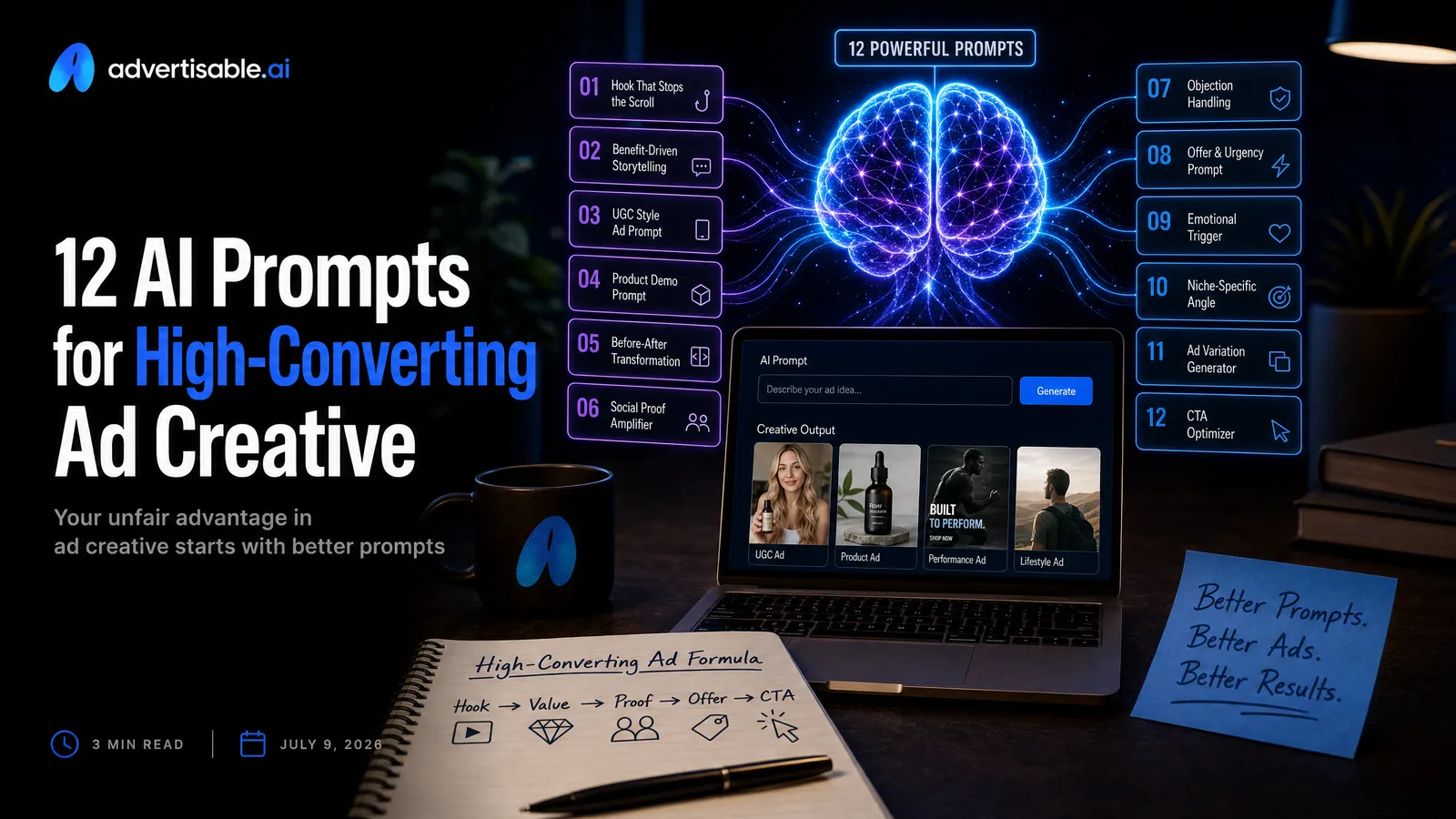
High-converting video ad creative comes from prompt templates that lock the ad creative anatomy, specify one variable to test, and add brand and claim guardrails so the model cannot drift.
Here’s what matters most:
- Treat every prompt like a creative brief, not a request for “a video ad.”
- Use one job per prompt: hook only, or full script only, or UGC concept only.
- Lock hook to CTA with a fixed sequence: hook, product moment, proof element, CTA.
- Add claim guardrails so the AI cannot invent features, pricing, or outcomes.
- Generate 10 to 20 one-variable hook variants with an identical body for clean readouts.
- Judge early winners in 48 to 72 hours using thumb stop, CTR, and CVR together.
- Regenerate only the weak beat so you do not restart the whole storyboard.
- Keep export readiness in mind so variants are usable across Meta, TikTok, and YouTube.
We built Advertisable AI for this exact bottleneck: you need volume without losing control. Our Brand DNA Module helps lock product facts and brand rules, our Storyboard Editor keeps the hook, product moment, proof element, and CTA in a tight, repeatable sequence, and our Scene Regenerator lets you fix one scene without rebuilding the entire video.
To get consistent outputs, you have to stop “asking for ads” and start writing prompts the way you would write a production brief, with specifics the model cannot guess and acceptance criteria you can QA before launch. That starts with one mindset shift: a prompt is a brief, not a request.
A prompt is a brief, not a request
What the model cannot guess (and will otherwise average)
A model can only interpolate from what you give it. If you do not specify your angle, constraints, and proof, you will get generic ad copy because the safest output is the average of everything it has seen.
In our workflows, the non-negotiables are the details you already know but the model cannot: the exact audience segment, the single objection you must neutralize, the proof element you are allowed to claim, and the landing-page truth you can support in the first 5-10 seconds.
- Audience: 1 persona plus one context (device, channel, awareness stage)
- Objective metric: thumb stop, CTR, or CVR (pick one for the draft)
- Claim guardrails: 1-2 allowed claims and 1-2 disallowed claims
- Proof element: one strongest evidence type (demo, testimonial line, statistic you can source)
- Offer terms: price, trial length, shipping threshold, or promo window (if real)
How do you keep a prompt testable? One job, one output
Give each prompt a single job and ask for one output type. When you ask for hooks, angles, scripts, headlines, and a landing page in one pass, you cannot diagnose what improved or broke.
Run single-variable batches: keep the body identical and generate 10-20 hook variations, then read results in 48-72 hours. Acceptance criteria should be explicit: deliver 15 hooks, each 6-10 words, each with one concrete promise, no new claims.
Lock the hook to CTA anatomy (Hook-Body-CTA)
Your hook is not a standalone line; it is a promise that must be paid off by the product moment, proof element, and CTA. If those beats do not reconcile, you will see attention without conversion, or conversion intent without volume.
Use Hook-Body-CTA as a QA check: hook states the outcome in 2 seconds, body shows the product doing the job, proof reduces risk, CTA tells the next step. The first few seconds decide whether an ad gets watched or scrolled past, so the hook is the highest-leverage part of the whole ad. 33%, with top performers reaching a massive 55%.
- Hook: one outcome + one qualifier (who it is for) in the first 2-3 seconds
- Body: product moment by second 5-10 that directly explains the hook promise
- Proof: one trust lever only (not a stack of claims)
- CTA: match intent (Shop Now for warm audiences, Learn More for cold)
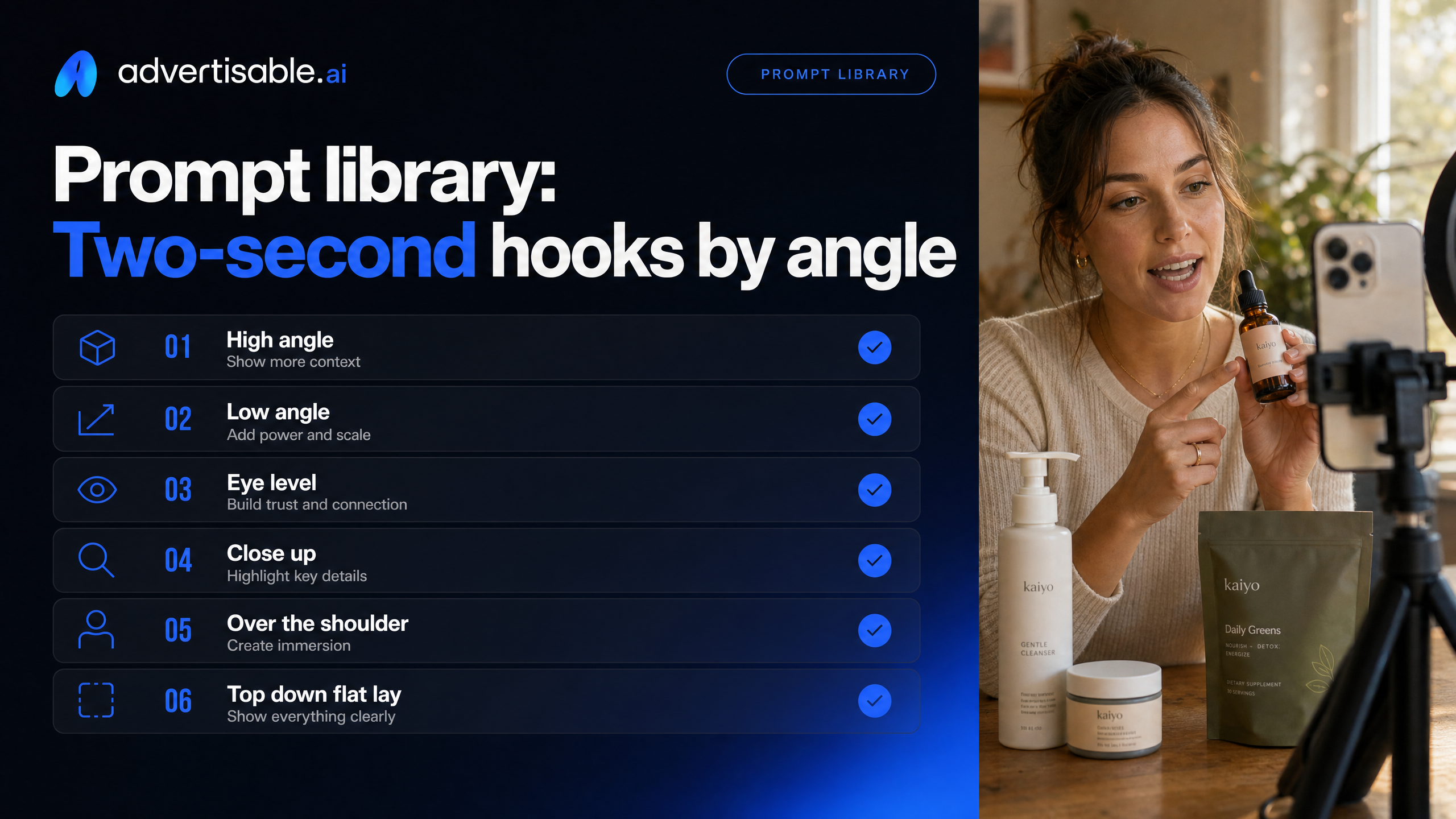
Prompt library: Two-second hooks by angle
Pain-to-promise hook briefs
A pain-to-promise hook works when you name one concrete pain and one measurable outcome in under 2 seconds. Keep it single-threaded so you can test it cleanly against an identical body.
Acceptance criteria: the hook is one sentence, includes the audience, and implies a timeframe or situation ("before X" or "in Y minutes"), without adding extra features or a second promise.
- Write 10-20 hook-only variants; hold product moment, proof element, and CTA constant for a 48-72 hour readout
- Template: “Still dealing with [pain] every [time/context]? Here’s how [product] helps you get [primary outcome] without [common tradeoff].”
- Template: “If [pain] is making [job-to-be-done] harder, switch to [mechanism/approach] so you can [outcome] by [timeframe].”
Curiosity without clickbait hooks
Curiosity hooks earn attention by setting up a real information gap, then paying it off fast in the product moment. You are not teasing; you are previewing a specific, verifiable point the ad can prove in the next 5-10 seconds.
QA check: you can underline the exact “unknown” and you can point to the exact scene that resolves it.
- Template: “Most people get [task] wrong at step 2. Here’s the version that [desired outcome].”
- Template: “You only need to change one setting: [variable]. Watch what happens to [metric/result].”
- Template: “The label doesn’t tell you this: [specific constraint].
Here’s what to look for instead.”
Social proof and authority hooks
Social proof hooks convert when the proof is specific enough to verify and narrow enough to trust. Use one proof type per hook so you can isolate whether trust or attention is driving lift.
Guardrail: never invent numbers, awards, or client logos. Pull proof from what you can substantiate, and lock those claims so variants cannot drift.
- Template (results): “In [timeframe], customers used [product] to achieve [measurable outcome]. Here’s the exact flow.”
- Template (authority): “Built with [credentialed input, eg. ‘dermatologist-reviewed ingredients’ or ‘ISO-certified process’]. Here’s what that changes in use.”
- Template (recognition): “Trusted by teams at [real client type or named client you’re allowed to claim].
The reason is [single differentiator].”
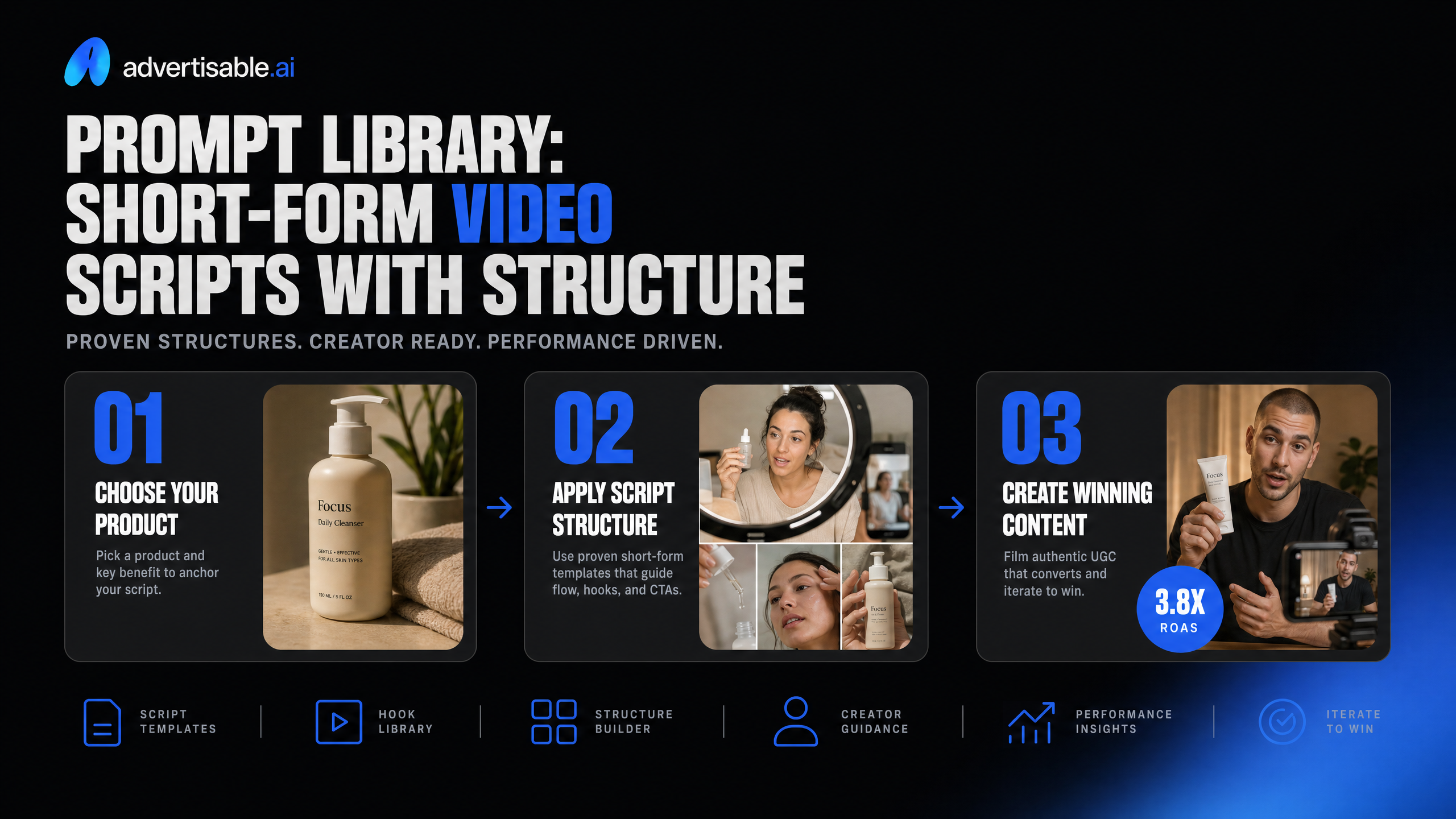
Prompt library: Short-form video scripts with structure
Hook, product moment, proof, CTA (the baseline script)
Use this structure when you want clean, comparable tests: the hook wins attention, the product moment removes confusion, one proof element earns trust, and the CTA converts.
Batch 10 to 20 hook variants while holding the product moment, proof, and CTA identical, then read performance at 48 to 72 hours so you can attribute lift to one variable.
- PROMPT: “Write a 20-second vertical video script with 4 scenes: (1) 2-second hook using [pain] and [specific outcome], (2) product moment showing [product] in-hand and what it does in 1 sentence, (3) proof element: use ONLY [review line / credential / statistic] with no new claims, (4) CTA: ‘[action]’ with [risk reducer]. Generate 12 hook options; keep scenes 2-4 word-for-word identical.”
- Acceptance criteria: hook is <= 7 words on screen, product name appears by second 3, proof is a single claim you can verify, CTA is one action (no “learn more + shop now”).
- Next test decision: if thumb stop is weak, regenerate scene 1 only; if CTR is weak, swap proof; if CVR is weak, tighten CTA and landing-page alignment.
Benefit demo scripts for cold traffic
For cold traffic, the job is clarity, not persuasion: show the primary benefit in under 10 seconds, with the simplest possible demo.
Keep the demo constant and rotate only one benefit angle per batch so you can tell whether the lift came from the claim, not the editing.
PROMPT: “Create a 15-second ‘benefit demo’ script for a cold audience. Scene 1: ‘What it is’ in 5 words. Scene 2-3: show a 2-step demo of [core benefit] using [prop/setting].
Scene 4: proof as [one verified line]. Scene 5: CTA. Generate 10 variations where ONLY the benefit line changes; everything else stays identical.”
QA check: no jargon, no feature lists, and the viewer can describe the product after watching once.
Before-After-Bridge scripts for retargeting
For retargeting, Before-After-Bridge works because you assume awareness and focus on risk reduction: what life looks like before, what changes after, and the bridge that makes it believable.
Swap objections, not story structure. You want 5 to 8 retargeting cuts that all share the same “bridge” so edits stay controlled.
- PROMPT: “Write an 18-second retargeting BAB script: Before = [specific frustration], After = [specific outcome], Bridge = ‘Here’s what changed’ with 2 steps: [how it works] + [proof]. Use one objection line: [price / time / complexity / trust]. Create 8 versions where ONLY the objection line changes.”
- Production note: if one scene drifts off-brand or invents claims, fix that single scene in a storyboard editor using scene-level regeneration, not a full rerun.
Prompt library: Angle variations for different buyers
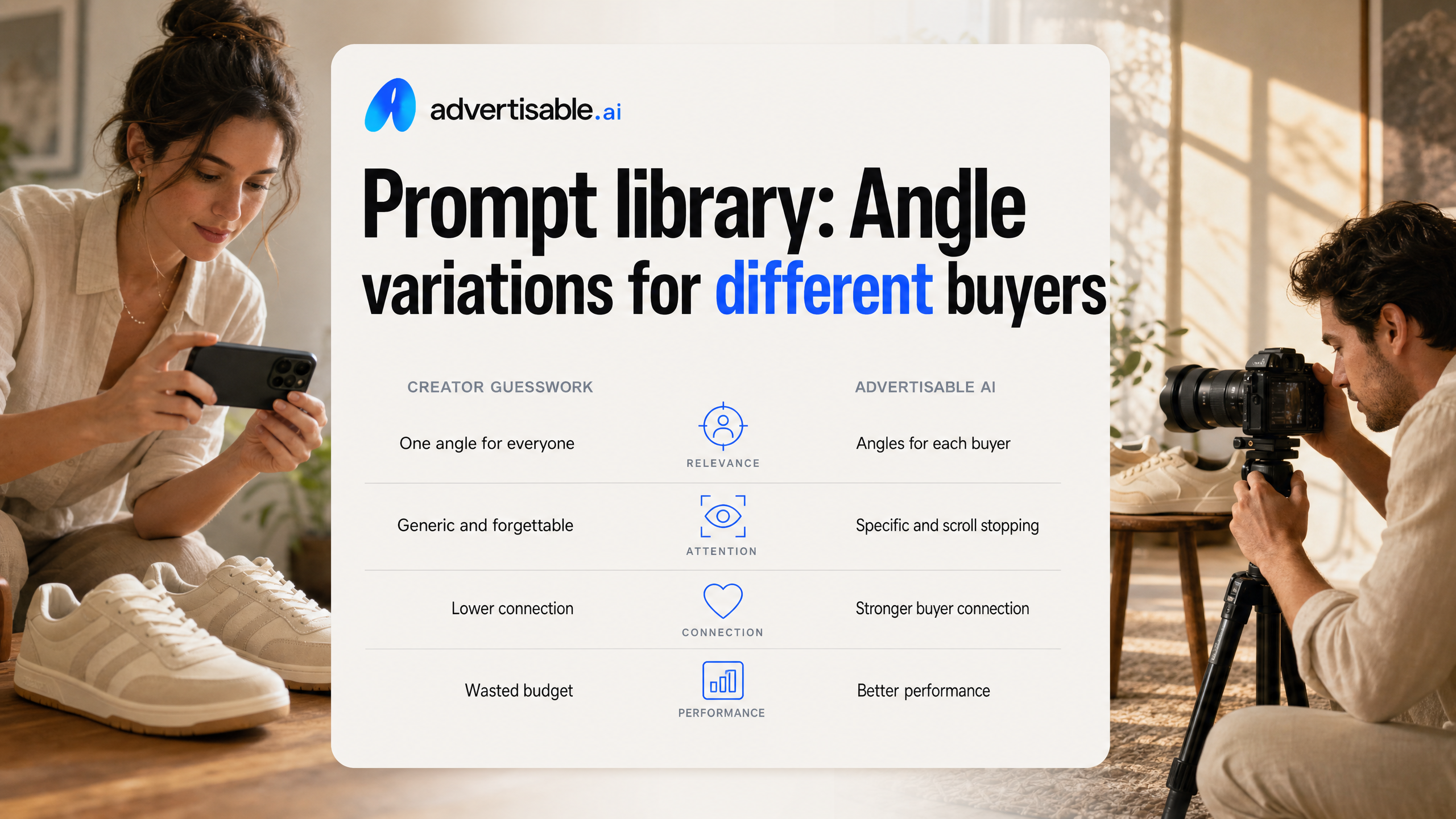
How do you reframe one truth for different audiences?
You keep the same core claim and swap only the audience context. The control point is a single “truth” line that never changes, so your 48-72 hour readout is attributable to the reframe, not a new offer.
Prompt template (swap brackets only): “Write 10 hooks that all state this one truth: [ONE-SENTENCE OUTCOME]. Create 2 hooks each for: [Persona A], [Persona B], [Persona C], [Persona D], [Persona E]. Keep product moment, proof element, and CTA identical across all variants. 2-second hook max, 9:16.”
- Hold constant: product moment timing (first 5-10s), proof element, CTA, aspect ratio
- Change: first line, vocabulary, stakes, and “why now” specific to each persona
- Acceptance criteria: no new claims, no new features, no price inventing, same CTA wording
Objection-led angles with locked proof
You turn the objection into the hook, then force the ad to cite one pre-approved proof element. This prevents the model from improvising credibility and keeps conversion quality stable.
Prompt template: “Generate 12 hooks that start from this objection: ‘[OBJECTION].’ Each hook must resolve using ONLY this proof: [PROOF ELEMENT]. Do not add additional evidence. Keep body scenes unchanged.
Output 12 scripts where only Scene 1 changes.”
- Proof lock list: [review snippet], [demo result], [policy], [certification], [before-after criteria you can verify]
- QA check before launch: proof appears by second 8, wording matches your source verbatim, no implied medical or financial claims
Prompt library: UGC concepts that sound real
Creator cold open and confession
A believable UGC opener sounds like a specific admission, not a headline. Your prompt should force one concrete mistake plus one measurable “I noticed X” observation within the first 2 seconds.
Hold your ad creative anatomy constant (product moment, proof element, CTA) and only vary the confession line across 10-20 versions so you can read results cleanly in 48-72 hours.
Prompt: “Write a 20-30s UGC script. Cold open: creator admits they did [specific wrong behavior] for [timeframe] and it caused [specific consequence]. No brand adjectives.
Add one sensory detail from the first use.”
- Prompt: “Generate 12 cold opens that start with ‘I was doing [habit] wrong’ and end with a specific outcome in 7 words. Keep the rest of the script identical.”
- QA check: confession must include a timeframe (3 days, 2 weeks) and a concrete outcome (stopped doing X, saved Y minutes), not ‘felt amazing’.
Unboxing to first result timeline
The fastest way to make UGC feel real is to sequence time on screen: unbox, first use, first result, and what changed by day 2 or day 7. Your prompt should require timestamps so the creator cannot jump from box to transformation.
Acceptance criteria: product moment appears in the first 5-8 seconds, and the “first result” is framed as a small win, not a before-after claim.
- Prompt: “Write a 25s script with on-screen time stamps: 0:00 unbox, 0:05 setup, 0:10 first use, 0:15 first result (small and specific), 0:22 proof element, 0:26 CTA.”
- Prompt: “Create 10 timeline variants where only the ‘first result’ line changes. Keep hook, proof element, and CTA word-for-word.”
Comparative story without naming rivals
A clean comparison is a trade-off story, not a roast. Prompt for “what you tried before” as a category and why it failed in one concrete way, then show why your product fits better for a specific use case.
Keep claims tight: no invented features, no price comparisons, no competitor naming. You are aiming for clarity and decision help.
- Prompt: “Write a UGC comparison script that references ‘the one I used before’ as a category (not a brand). Include 2 fair pros of the old option, 1 specific failure mode, then 1 reason this product is better for [context].”
- Prompt: “Generate 8 comparisons where the only variable is the prior category: ‘cheap version’, ‘popular version’, ‘subscription version’, ‘stronger version’. Everything else stays locked.”
- QA check: include exactly one trade-off (what you give up) so it reads like a real decision, not a pitch.
Prompt library: Objection handlers and risk reducers
How do you handle “it’s too expensive” without discounting?
Reframe price as cost-per-shippable-variation, not a monthly line item. Your objective metric is CPA or ROAS movement after a 48-72 hour readout on a controlled batch, not “did we spend more.”
Use a prompt that forces the model to quantify value in operational terms and hold your creative anatomy constant so you can attribute lift to the offer framing, not random changes.
PROMPT: “Write a 20-30s UGC script that addresses ‘price’ by comparing total cost of inaction vs. cost of the product. Include: 1 hook (2 seconds), 1 product moment by second 5, 1 proof element, 1 CTA. Use the numbers: [price], [typical cost of current workaround], [time saved per week], [return policy length].
No discounts, no urgency.”
QA: reject outputs that add new claims, change the offer terms, or introduce a second objection (keep one job per script).
Skepticism: choose one proof element, not a pile of claims
When you get “I don’t believe this works,” your job is proof selection, not louder language. Pick the single strongest evidence you can defend and build the entire proof beat around it.
structured objection handling research shows responding to objections effectively can increase closing rates by up to 38%, which is why we treat this as a scripted module you can test like any other variable.
- Proof priority order: 1 specific metric from your product or users, 1 clear demo that shows the mechanism, 1 credible third-party mention, 1 policy-based risk reducer (returns, warranty). Pick one.
- PROMPT: “Write 3 variants where only the proof element changes. Keep hook, product moment, CTA identical.
Proof options: [demo], [stat], [policy]. Flag any sentence that could be interpreted as a medical, financial, or performance guarantee.”
Fit objections: qualify fast so you do not attract the wrong buyer
Handle “is this for me?” by adding explicit qualifiers and disqualifiers. You reduce refunds and negative comments by making the fit rules visible inside the ad, not buried on the page.
Run this as a single-variable batch: keep scenes 2-4 locked, and only swap the qualifier scene to see if CVR improves without killing CTR.
- PROMPT: “Add a 1-sentence ‘best for’ and a 1-sentence ‘not for’ in plain language. Use these inputs: best for [persona], not for [persona], prerequisites [device, budget, skill level], timeline to first result [timeframe]. Keep total script 25s.”
- Acceptance criteria: qualifiers appear before the CTA, include 1 concrete requirement (budget, time, workflow), and do not introduce new features or pricing.
Prompt library: One-variable hook testing batches
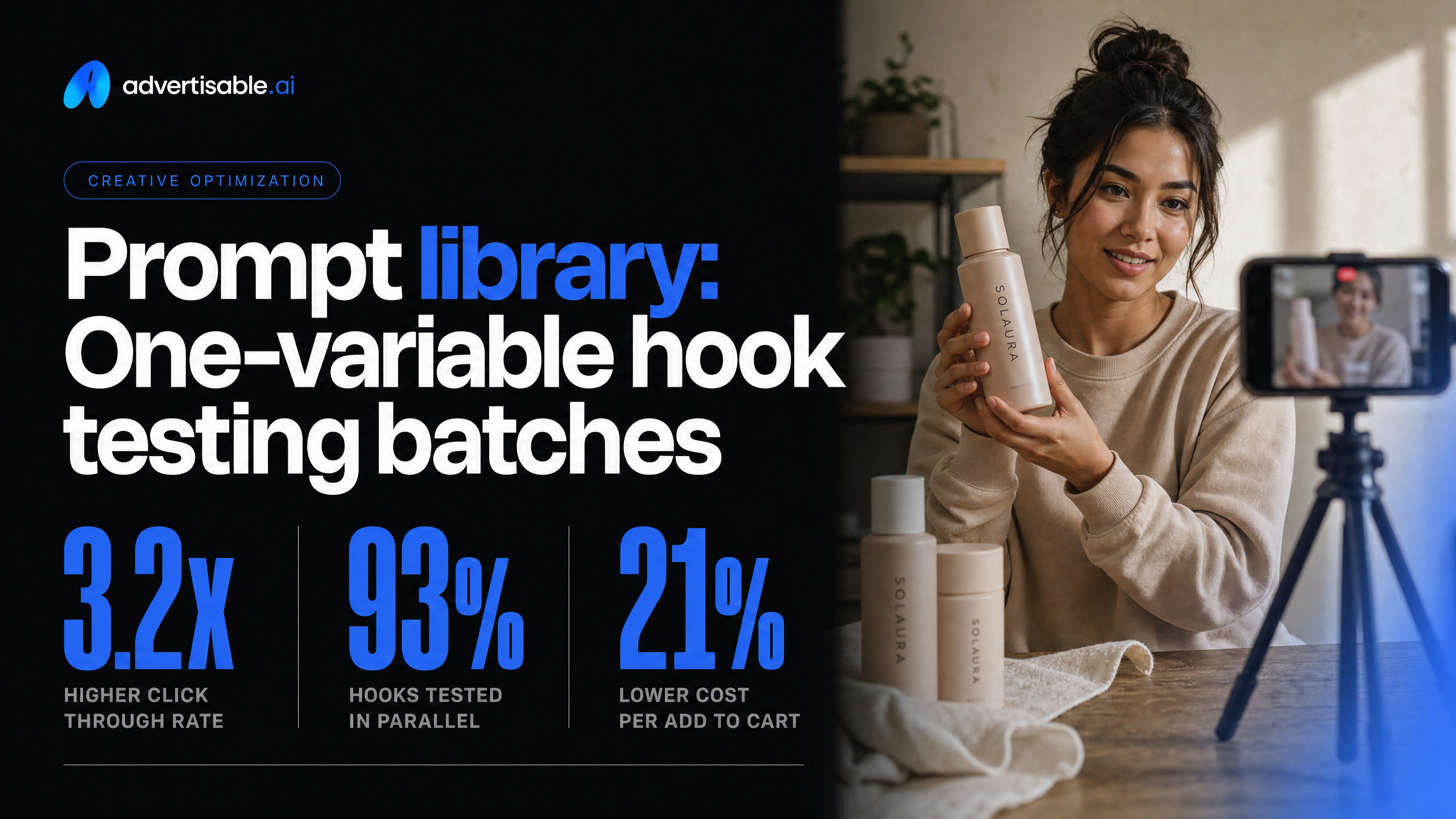
How do you generate 20 hooks while keeping the body fixed?
Generate 10 to 20 hook variants against an identical body so you can attribute lift to the first 2 seconds, not a rewritten script. Your body stays locked: product moment (what it is, what it does), one proof element, and one CTA.
Run one batch, read it in 48 to 72 hours, then only swap the losing hook scene instead of rebuilding the whole ad. In Advertisable AI, that is exactly what scene-level control is for: you regenerate the hook while the rest of the storyboard remains unchanged.
- Locked body template: [Product moment in 1 sentence] + [Proof element] + [CTA]
- Prompt line: “Write 20 two-second hooks in [brand tone]. Each hook must use one clear promise and avoid new claims. Output as a numbered list.”
- Acceptance criteria: every hook is 6 to 12 words and can be spoken in under 2 seconds
Hook families that give you clean learnings
Organize hooks into families so each batch teaches one thing. If you mix pain, curiosity, price, and proof in the same set, you will not know what actually moved thumb stop or CTR.
A practical split is 4 families of 5 hooks each. You keep the body identical and only vary the hook angle inside one family at a time.
- Pain-to-outcome: “Still dealing with [pain]? Try this.”
- Mechanism: “Here’s what [product] actually does to [outcome].”
- Objection flip: “No, it’s not for people who [objection].”
- Specific payoff: “Get [measurable result] without [common tradeoff].”
QA checks before you test
Do QA before launch so you are not testing errors. In our ops reviews, most “bad hooks” are actually off-brief claims, mismatched visuals, or a CTA that changes between variants.
Use a pre-flight checklist and block anything that breaks guardrails.
- One-variable check: only the hook scene changed (same product moment, proof, CTA)
- Claim lock: no new features, prices, or results introduced in any hook
- Hook-to-body alignment: the first 5 to 10 seconds resolves the hook promise
- Export readiness: correct aspect ratio per channel and consistent on-screen text styling
- Metric plan: define your readout window (48 to 72 hours) and primary decision metric before launch
Get more out of these prompts with your real inputs
Paste real customer language first
Start every generation with Voice of Customer, not your internal positioning. One pasted review or support-ticket sentence gives the model the exact nouns, verbs, and emotional stakes that generic prompts miss.
We treat this as an input spec: you are locking vocabulary so the hook and objection handling sound like the market, not like a creative brief. Ads written in your customers' own words tend to land harder than ads written in marketing language.
- Paste 3 to 5 raw lines of customer language (reviews, post-purchase surveys, chat logs)
- Highlight the exact problem phrase and desired outcome phrase
- Add one constraint: keep the hook under 12 words and reuse the customer’s outcome wording verbatim
Carry forward one proof element
Pick one proof element and keep it constant across your batch. This is how you avoid testing trust, attention, and offer clarity all at once.
Operationally: choose the single strongest evidence you can repeat without stretching claims, then pin it into the prompt so it shows up in the proof beat every time. Your acceptance criteria is simple: the proof line is identical across 10 to 20 variations, only the hook changes.
- A quantified outcome you can substantiate (number, timeframe, limit)
- A credible mechanism or demo moment tied to the product moment
- A risk reducer you can actually honor (trial, warranty, cancellation terms)
Regenerate only the weak beat
Do not rerun the whole asset when one scene is the problem. You will waste cycles, lose control, and accidentally change variables you meant to hold constant.
Use a storyboard-first QA pass at 48 to 72 hours: identify the single beat that fails (hook, product moment, proof, or CTA), then regenerate only that beat with explicit constraints. In Advertisable AI, we built Scene Regenerator for exactly this: fix the losing scene without rebuilding the entire video.
- Name the failing metric tied to the beat (thumb stop, CTR, CVR) and the 48 to 72 hour window
- Restate what must not change (product moment, proof element, CTA, Brand DNA guardrails)
- Regenerate 3 to 5 options for that single beat, then relaunch as a clean one-variable patch
Turn your best prompts into shippable variations
If your AI outputs still read generic, the bottleneck is not ideation. It is production control. You need a workflow that keeps your ad creative anatomy locked, your claims accurate, and your tests clean.
With Advertisable AI, we start from your product URL to extract Brand DNA guardrails, then build a storyboard-first draft in the Storyboard Editor so every version follows hook, product moment, proof element, CTA. From there, you generate 10 to 20 one-variable hook variations, hold the body constant, and read results in 48 to 72 hours. If one beat underperforms, you fix only that scene with the Scene Regenerator, run QA for on-brief accuracy and export readiness, then ship platform-ready formats via the Export Module.
Run your next batch like an operator, not a gambler.
Frequently Asked Questions
Q: Why does my generated ad feel inaccurate or off-brand?
A: Your prompt is missing enforceable constraints, so the model fills gaps with averages and guesses. Use Brand DNA guardrails to lock product facts and tone, then QA each scene for claim accuracy and landing-page alignment before you export.
Q: How many ad variations should I generate and test at once?
A: Batch 10 to 20 variations when you are isolating a single variable, usually the two-second hook. Hold the product moment, proof element, and CTA constant so your 48 to 72 hour readout tells you what actually changed performance.
Q: What's the difference between this and AdCreative.ai?
AAdvertisable AI is built for production-ready video and UGC style ads with storyboard-first structure and scene-level control. If your priority is repeatable video anatomy, fast one-variable batches, and the ability to regenerate only the weak scene, that is the gap we focus on.