Are UGC creator ads worth the money to you?

Yes, UGC creator ads are worth paying for only when they reliably ship usable test-ready variations with minimal back and forth. If you are judging creators by CPM, day rate, follower count, or engagement rate, you are using the wrong unit of measurement.
Here’s what matters most:
- A cheap creator is expensive if you spend hours fixing claims and brand drift.
- Revision drag is measurable: count revision rounds across your last 20 shipped ads.
- True UGC cost includes creator fees, shipping, internal feedback time, and rerenders.
- Clean A-B iteration depends on changing one variable and reading results in 48 to 72 hours.
- Claims control beats creative volume when you need consistent performance and compliance.
We built Advertisable AI because teams kept paying for output but losing time to rework and full rerenders. With our Brand DNA and allowed-claims controls, you can generate UGC-style variants from a product link, regenerate only the hook scene, and keep your testing cadence tight, starting with a $5 trial.
Before you decide whether creators are “worth it,” define worth in a way your ad account can audit: cost per shippable variation, not CPM or a day rate. That one shift makes the decision obvious.
Define “worth it” as cost per shippable variation
UGC costs feel like they are rising while performance stays flat because you are often tracking the wrong unit. CPM and a creator day rate are decoys: they tell you what you bought, not what you can actually test.
The performance lever is iteration speed. The more clean, on-brief variations you can ship without rework, the faster you find a winner and the less time you spend paying for “almost usable” drafts.
That only works with single-variable discipline: one hook change, one claim shift, one CTA edit. When every revision changes three things, you burn budget and you learn nothing.
Shippable means platform-ready
A variation is only “worth it” when it is shippable, meaning you can publish it to your ad account the same day without rewriting, resizing, or legal cleanup.
In ops terms, shippable is a pass-fail gate. The moment a draft needs heavy rework, your true cost is not the invoice, it is the creator cost plus internal time plus the delay to your next readout.
- Passes your brand QA checklist (voice, visual rules, offer details, required disclaimers, no brand drift)
- Claims match product truth (no implied outcomes you cannot support; aligned with FTC advertising requirements)
- Correct sizes and captions for the placements you are running (format, safe zones, on-screen text, caption length and punctuation)
- Approved within 24 hours (one feedback pass, minimal back-and-forth, no second-round script surgery)
The two numbers that matter
To decide whether creator-style ads are worth the money for you, track two operator numbers: cost per shippable variation, and hours to the next clean iteration.
Cost per shippable variation is your total spend divided by the count that passed the shippable gate. Include creator fees, product shipping, your team’s review time, and any rework you had to do to make the asset publishable.
Hours to next clean iteration is the delay from “we learned something” to “the next test is live.” That single clock controls how many variants you ship per week and how fast you can respond when creative fatigue hits and yesterday’s winner starts sliding.
- Cost per shippable variation: total cost / usable variants shipped
- Hours to next clean iteration: time from insight to the next approved asset
- Variants shipped per week: output rate that determines how many bets you can place
- Creative fatigue response time: how quickly you can refresh before performance compounds downward
Audit your last 20 ads for revision drag
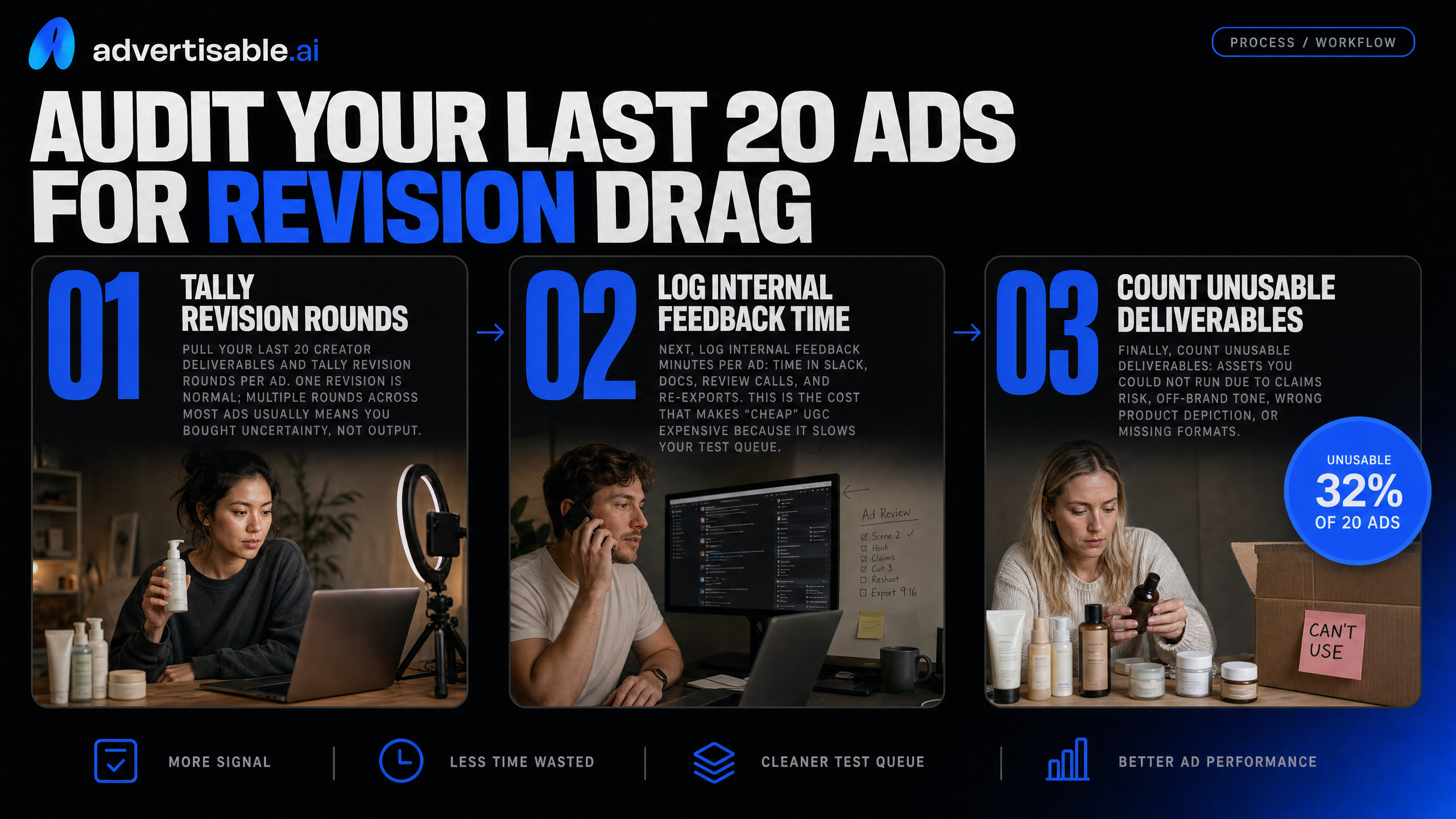
Pull your last 20 creator deliverables and tally revision rounds per ad. One revision is normal; multiple rounds across most ads usually means you bought uncertainty, not output.
Next, log internal feedback minutes per ad: time in Slack, docs, review calls, and re-exports. This is the cost that makes “cheap” UGC expensive because it slows your test queue.
Finally, count unusable deliverables: assets you could not run due to claims risk, off-brand tone, wrong product depiction, missing formats, or audio you could not clear. Unusable is not “bad performance”, it is zero shippable variants.
Hook score in five seconds
Most “unusable” UGC fails in the first line and first frame, then gets patched through revisions until it no longer resembles the original concept. Score each ad on whether the first five seconds earn a stop and a click without adding new variables.
We want a clear problem in the first line, stated like a customer reality, not a tagline. Generic hype forces your team to rewrite, and every rewrite changes the test.
Treat each variation as one angle only. When a creator mixes pain point, solution, discount, and social proof in the hook, you cannot tell what moved performance, so you revise again instead of learning.
- Clear problem in first line: the viewer should be able to repeat the problem in one sentence
- Specificity over generic hype: concrete situation, constraint, or use case instead of vague “best” language
- Thumbstop visual cue present: an immediate visual change, prop, product-in-hand, or on-screen text that matches the spoken hook
- One angle per variation: each version changes one hook idea, not the offer plus the problem plus the proof
Claims and proof QA
Revision drag often comes from claims your team cannot approve, not from editing preferences. Run a claims QA pass where every statement must be supported by what is on the product page you control.
Keep it on-page facts only. If a creator adds “clinically proven”, “doctor recommended”, or outcome claims you cannot substantiate quickly, you either cut the line or start a proof scramble that stalls shipping.
Check that a proof asset exists and is usable in an ad: the screenshot is legible, the before-after is permitted, the testimonial has permission, the citation is accurate. Also screen for implied medical promises and disallowed claims so you are not negotiating compliance in the comment thread.
- On-page facts only: every claim traces to your listing, PDP, FAQ, or published policy
- Proof asset exists and usable: readable on mobile, rights-cleared, and formatted for the placement
- No implied medical promises: avoid language that suggests diagnosing, treating, or curing
- Disallowed claims flagged: anything you have to “hope gets through review” is a non-shippable line item under FTC advertising requirements
Brand consistency pass fail
A creator can be charismatic and still cost you money if each deliverable feels like a different brand. Do a binary pass-fail on consistency so you stop spending hours debating taste.
Voice should match your existing ads: your level of directness, your vocabulary, and your tolerance for slang. When creators introduce their own catchphrases, you end up rewriting scripts instead of iterating scenes.
Visual identity needs to stay consistent across variations: lighting, framing, typography, and any logo or color usage you require. Also verify the product is shown correctly, used correctly, and not substituted, misassembled, or described in a way that triggers returns or support tickets.
- Voice matches your ads: tone, pacing, and vocabulary align with what you already run
- Visual identity stays consistent: recognizable look and on-screen design rules do not drift
- Product shown correctly: correct variant, correct usage, correct key details
- No off-brand creator phrasing: remove creator-specific slang or “their audience” language that does not fit your positioning
Calculate true UGC cost with a shippable-variant model
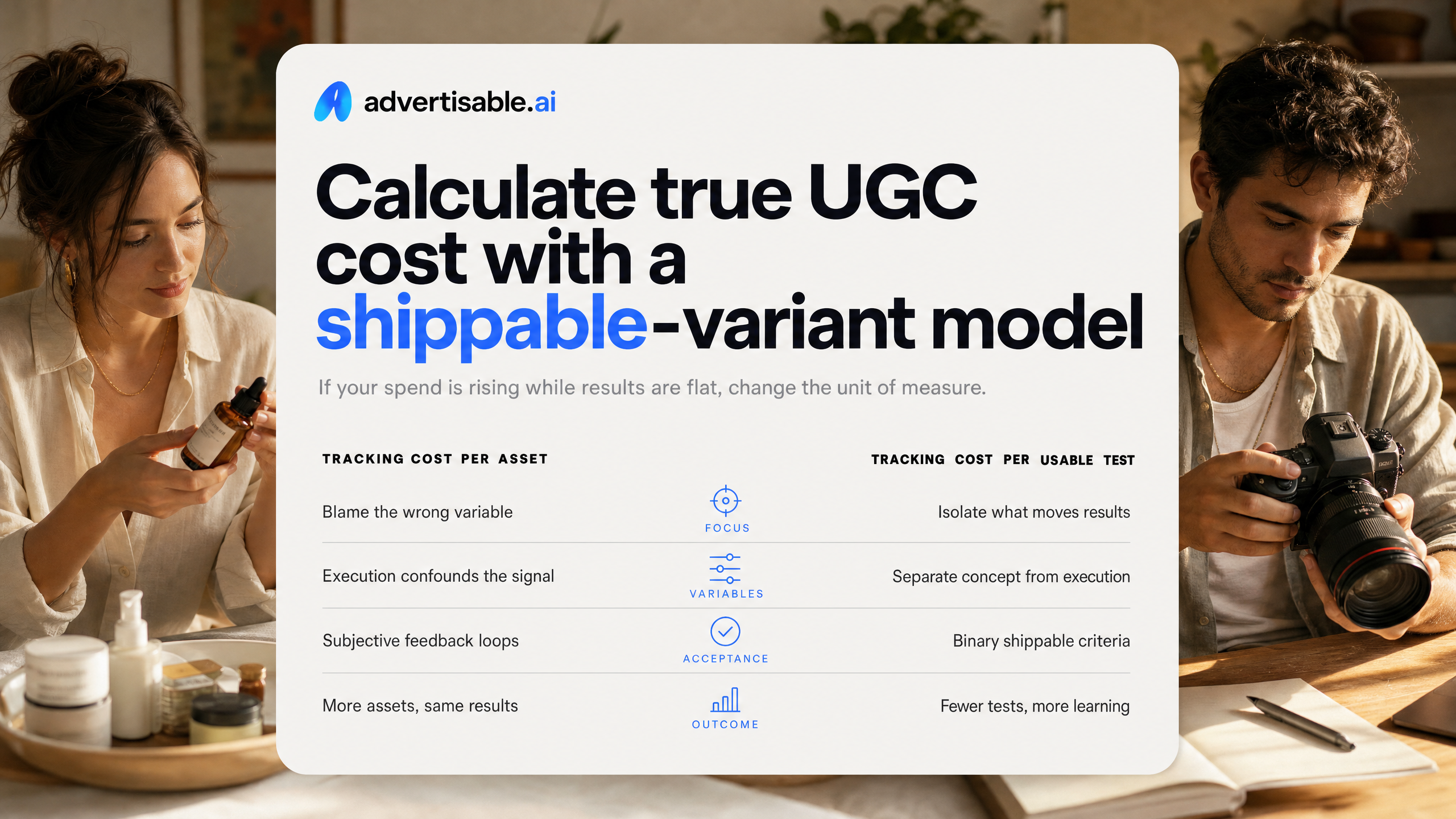
If your spend is rising while results are flat, stop tracking cost per asset and start tracking cost per usable test. Separate the concept (angle, offer, hook) from the execution (creator performance, lighting, pacing) so you do not blame the wrong variable. Set acceptance criteria upfront so “shippable” is binary, not a debate in Slack.
The shippable-variant formula
The right unit is cost per shippable variant, not a creator day rate. A “shippable” is a file you can put into an ad set today with no claims risk, no brand drift, and no missing specs.
Build one standard model and force every creator or alternative through it. You are pricing the usable output plus the internal time it consumes, because internal time is where “cheap” UGC quietly gets expensive.
- Creator fees + usage: the quoted rate plus whitelisting/paid usage window, plus any add-ons for extra hooks, aspect ratios, or raw footage access
- Shipping + product cost: outbound shipping, replacement units, samples that cannot be resold, and any returns processing time you actually spend
- Internal review hours (costed): (producer + growth + legal/brand) hours multiplied by your loaded hourly rate; only count time tied to approving or rejecting this asset
- Edits + rerenders (costed): internal editing time, freelancer edits, creator reshoots, and the “re-export tax” for new versions and platform-specific crops
Once you have cost per shippable variant, you can compare creators to controlled options on the same scoreboard: dollars per clean testable unit.
Revision drag as a tax
Revision drag is not a nuisance, it is a compounding tax on throughput. The same creator fee produces fewer shipped tests when you burn cycles on feedback, reshoots, and re-approvals.
Track it with operational metrics you can observe: how many revisions it takes per shipped ad, and how many days it takes to get from “brief sent” to “approved for launch.” When time-to-approve stretches, your weekly testing cadence collapses.
Missed test cycles show up fast: a two-day slip can push a 48 to 72 hour readout into next week, forcing you to make budget decisions on stale creatives. That is how performance stays flat even while you “produce more.”
Do not ignore fatigue. Every extra loop reduces review quality, increases inconsistency in feedback, and raises the odds you ship something you would have rejected on a fresh pass.
- Revisions per shipped ad: count rounds, not messages; 3 rounds means your team touched the asset 3 times
- Time-to-approve (days): calendar days from first delivery to final approval, including weekends if they block launch
- Missed test cycles per week: how many planned 48 to 72 hour experiments you could not run because assets were not ready
- Opportunity cost of fatigue: delayed launches plus lower QA rigor as your reviewers get overloaded
Run a one-week split test: creators vs controlled UGC-style variants
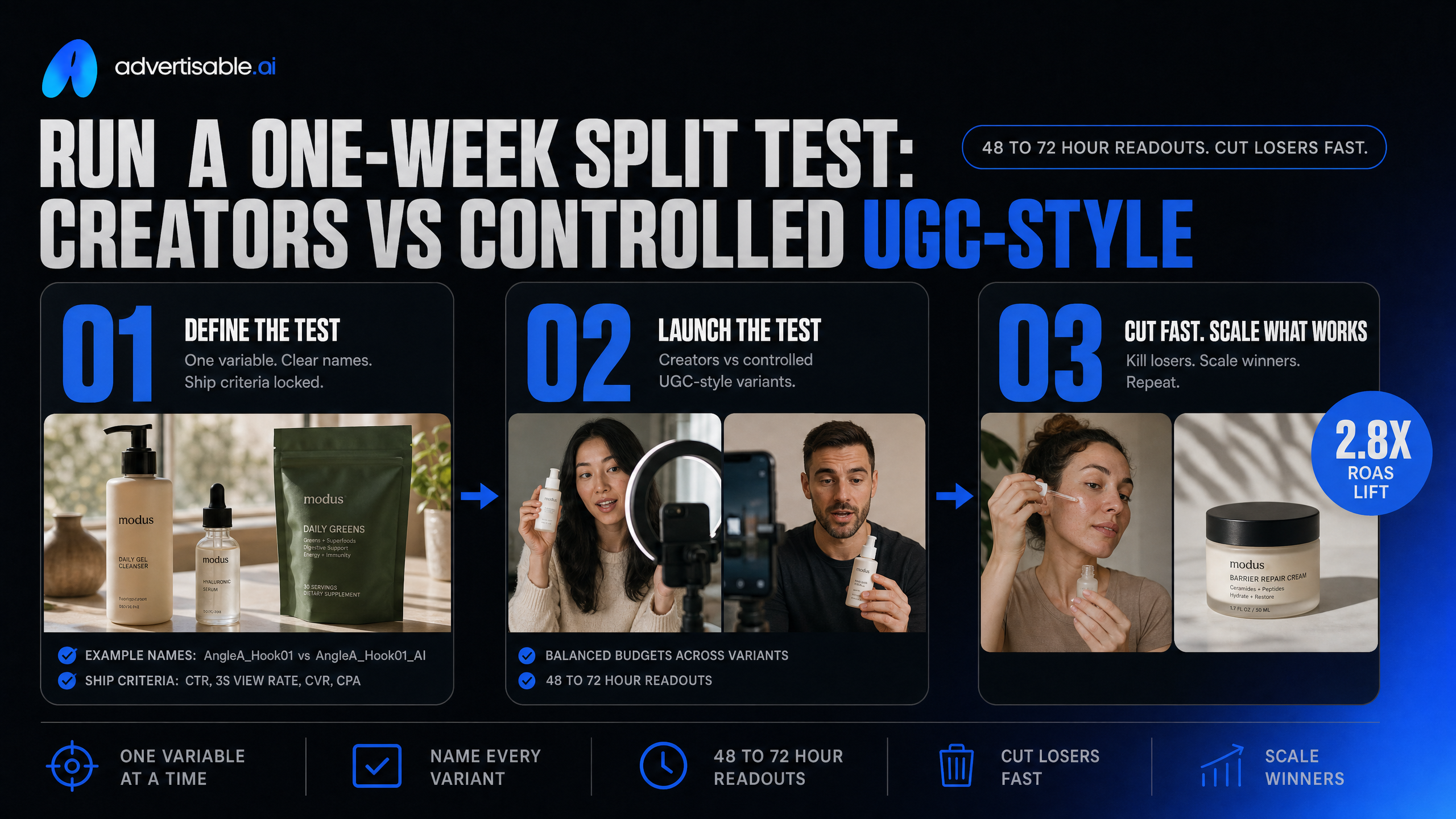
Run this as a one-week sprint with 48 to 72 hour readouts so you can cut losers fast without waiting for perfect significance.
Name every batch by a single variable (for example: AngleA_Hook01 vs AngleA_Hook01_AI) and write ship criteria before launch so you do not negotiate quality after you see results.
Test design that stays honest
You only learn whether creator output is worth it when the test removes the usual excuses: different offers, different pages, different spend, different placements.
Lock the same offer and the same landing page for both arms. Keep the angle identical, then change only execution: creator-recorded UGC versus controlled UGC-style production.
Match spend and placements at the ad set level. If one side gets cheaper inventory or different placements, you will confuse media mechanics with creative quality.
Define success thresholds up front, including a performance bar and a usability bar, because your core risk is paying for off-brand assets that cannot ship.
- Performance threshold: CPA at or below your current blended CPA (or within a range you pre-approve) within the first 48 to 72 hours
- Usability threshold: passes your brand QA (visual consistency, tone, no off-brand phrasing) with zero required reshoots
- Claims threshold: only approved product claims are present in script and on-screen text
- Velocity threshold: at least X shippable variants delivered per week (pick a number your team can actually traffic)
How Advertisable AI fits
Controlled variants work when you can generate volume without brand drift or claims cleanup, and that is exactly the failure mode you are trying to avoid with creators.
In Advertisable AI, you start from URL-to-ad grounding so the script and product details are pulled from your product page instead of improvised. Then you enable Brand DNA lock so fonts, colors, logos, and voice stay consistent across outputs.
You also enforce an allowed claims list, which keeps you out of the loop where a creator says something punchy, your team redlines it, and you end up paying for a reshoot. The result is UGC style without creators: creator-like delivery and pacing, but with operator-level controls you can QA before you spend.
- Creator route: higher authenticity potential, higher variance, and more revision drag when the first take is off-brief
- Controlled UGC-style route: slightly less human randomness, but tighter brand and claims safety and faster iteration on what actually drives results
Scene-level iteration plan
To keep variables clean, iterate at the scene level: regenerate the hook scene only and hold body scenes constant so performance changes map to the first 2 seconds, not a whole new video.
Export both 9:16 and 1:1 from the same storyboard so placement differences do not get mislabeled as creative wins.
Ship a daily batch of five hooks for five consecutive days. You will know quickly whether creators are giving you better hooks, or whether controlled UGC-style hooks are matching performance while staying on-brand.
- Day 1: Launch Creator_Hook1-5 vs Controlled_Hook1-5 on identical placements and budgets
- Day 2-5: Replace only the five losing hooks per arm, keep the body scenes unchanged, and keep naming to one variable per batch
- Every 48 to 72 hours: pause hooks that miss your predefined thresholds, scale the ones that clear both performance and QA
Protect performance with claims controls and AI disclosure rules
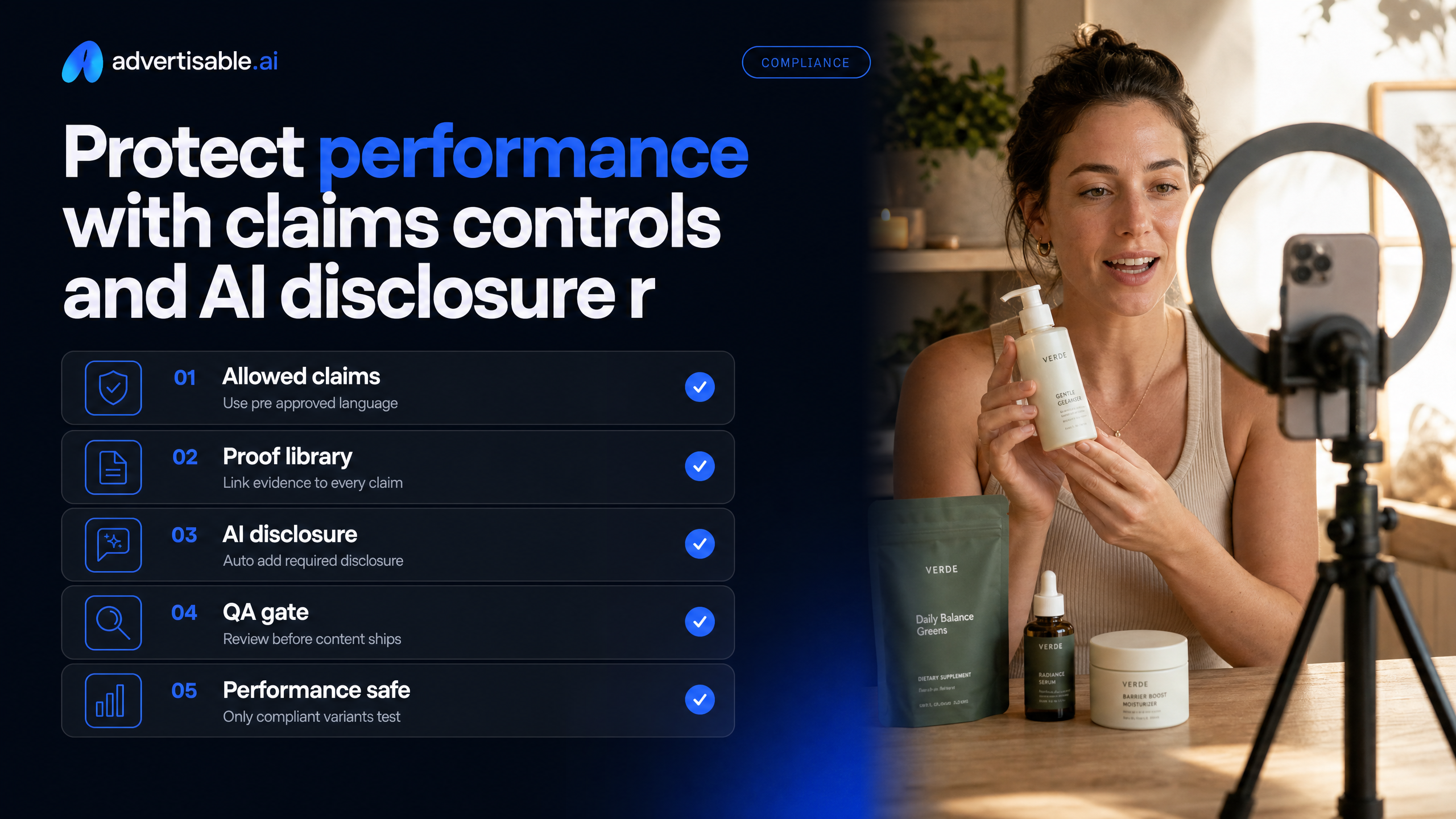
Treat compliance like performance infrastructure. Build an allowed-claims library, store proof assets per claim, and run a QA gate before export so bad variants never enter your testing pool.
Truth-in-advertising requirements
Policy issues usually start as creative issues: a line that cannot be proven, a result that sounds universal, or a testimonial that reads like a medical promise. You want every shippable variation to be evidence-backed before you spend impressions on it.
Use FTC advertising requirements as your baseline: objective claims need substantiation, endorsements must be truthful, and material connections must be disclosed.
- Objective claim substantiation: tie each measurable claim (speed, durability, savings, “reduces,” “increases”) to a specific proof asset you can hand to legal or a platform reviewer
- Typical results language: avoid “everyone” outcomes; use qualified phrasing and do not imply the best-case result is the expected result
- Before-after standards: keep originals, dates, conditions, and editing notes; do not use lighting, angles, or cropping that changes the apparent outcome
- Testimonial material connection: if the speaker is paid, gifted, or affiliated, disclose it clearly in the ad context, not buried in a profile
Platform synthetic content rules
Synthetic performers and AI-edited scenes can block delivery when disclosures are missing, and that interruption resets learning. Treat disclosure as a launch criterion, not a post-launch fix.
- Meta altered media labels: confirm whether your edit triggers altered or synthetic labeling, and ensure the correct label is applied before publishing
- TikTok AI-generated disclosure: use the platform’s AI disclosure mechanism when a real person’s appearance or voice is generated or materially edited
- YouTube synthetic disclosure: apply the synthetic or altered content disclosure when the ad includes realistic modified or generated people, voices, or events
- Internal disclosure checklist: (1) identify any AI generation or heavy edits, (2) choose the platform-specific label, (3) verify the label in preview, (4) log the disclosure decision alongside the creative ID and version
When you run this checklist as part of export QA, you protect continuity in spend and keep your test readouts clean over 48 to 72 hours.
Prove it in one week, then scale what ships
If your last creator batch needed heavy rework, you did not buy performance. You bought production drag. Your next move is a clean one week split test that measures cost per shippable variation and iteration speed, not vibes.
Run two lanes with the same offer and angle: creator UGC versus controlled UGC-style variants. Keep it honest. Change one variable at a time.
Read results at 48 to 72 hours and iterate at the scene level.
We built Advertisable AI for this exact workflow. Start with the $5 trial, generate platform-ready UGC-style ads from your product link, lock Brand DNA and allowed claims, then regenerate only the hook scene to produce new tests without another creator revision loop.