AI Ads vs Agency: Which Is Right for Your Brand?
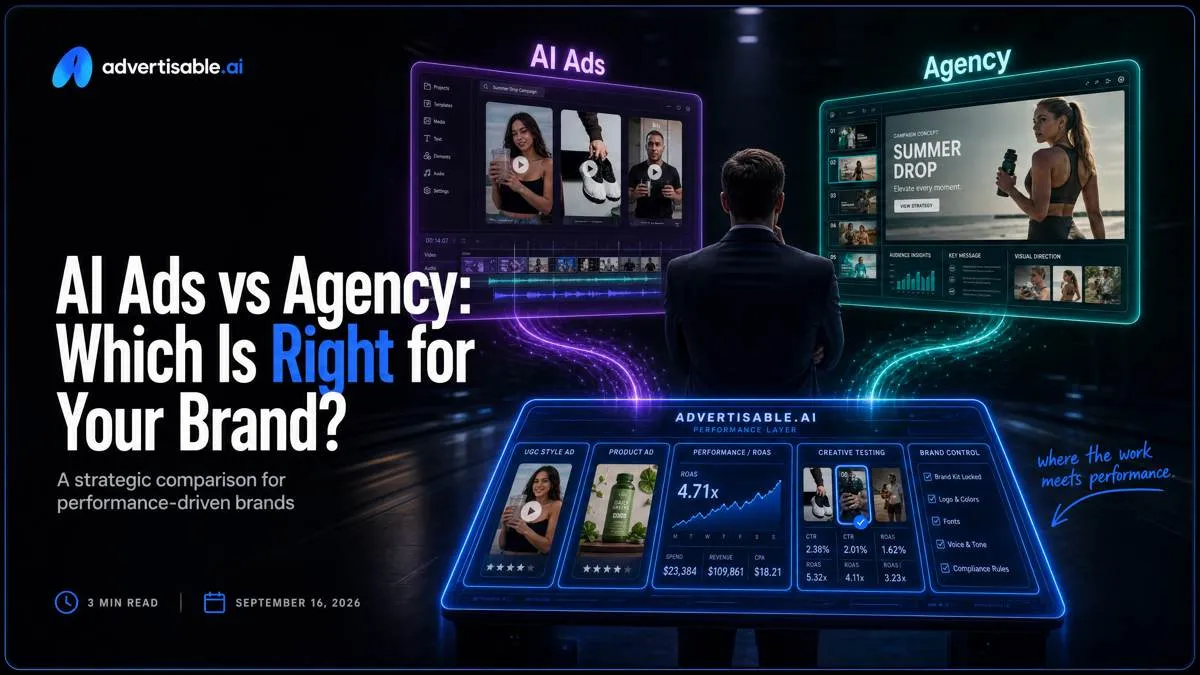
Use AI ad tools if your bottleneck is creative production speed, but use an agency if you need ongoing strategy, media judgment, and accountability.
Here’s what matters most when you choose AI ads vs an agency:
- If approvals and QA are your bottleneck, your cheapest option can become your slowest.
- If you lack a clear strategy owner, an agency can outperform tools through better judgment.
- If production is the bottleneck, AI tools unlock more hook variations with tighter control.
- Run single-variable batches: test hooks only while holding proof, offer, and CTA constant.
- Use 48 to 72 hour readouts and track revisions, brand issues, and time to ship.
- Claims risk is operational: you need a repeatable gate before anything exports.
We built Advertisable AI Studio for the exact moment where AI helps most: production and iteration without brand drift. You import a product URL to extract Brand DNA, lock a control storyboard in the Storyboard Editor, regenerate only weak moments with scene-level control, run the QA Module for claims and disclaimers, then ship channel-ready exports in 9:16, 1:1, and 16:9.
Before you compare retainers to software spend, cost the full workflow: how many rounds of rework you expect, who does QA, and how long approvals actually take when an ad is slightly off-brand. That true cost is where the AI tool versus agency decision usually becomes obvious.
Start with the true cost: rework, QA, and approvals
Sticker price misleads because you are not buying “an ad” from an AI tool or an agency. You are buying a throughput system that has to survive review, QA, and stakeholder decisions without collapsing into redo work.
Throughput changes learning speed: shipping 10 controlled variations this week teaches you more than perfecting 1 concept over three weeks, because your 48-72 hour readouts create faster next-test decisions.
Governance is a cost, not admin overhead. Every missing rule (voice, claims, packaging, disclaimers) turns into extra approvals, more revision loops, and higher risk exposure per batch.
Where ROI math breaks
ROI math breaks when you only compare fees or subscription cost and ignore the hours spent in revision loops, QA, and approvals. In practice, stakeholder time is often the most expensive line item because it is fragmented, slow to schedule, and hard to parallelize.
Revision loops compound when the brief is not specific enough to create a single “control” everyone agrees on. Each extra round pulls in marketing, brand, legal, and sometimes product, and the work becomes coordination, not creation.
QA is the second hidden sink. Any workflow that produces multiple variants has to verify claims, disclaimers, and pack accuracy every time, because one incorrect detail can be replicated across a whole batch.
Slow shipping has direct opportunity cost. If your creative readout window is 48-72 hours, pushing launch by even a week means fewer learning cycles per month, fewer winners found, and more budget left on fatigued ads.
- Revision loops: count reviewers (not just editors), their meeting time, and the number of “small” changes that trigger re-approval
- QA surface area: claims language, required disclaimers, product name/variant, packaging visuals, and on-screen text accuracy
- Shipping delay: how many 48-72 hour test cycles you lose when a batch waits on feedback or rework
What to count in true cost
To estimate true cost, track production as an operations metric: cost per shippable variation, not cost per draft. The two drivers are time to first shippable asset and how many iterations it takes to produce one winner you can scale.
Time to first shippable asset is the moment an ad clears brand and claims checks and is export-ready for launch, not when someone shares a storyboard or a rough cut. If your first output cannot pass QA, your clock is not really stopped.
Iterations per winner is where models separate. Automated creative systems can shorten iteration cycles by up to 70% in automated testing research, but only if your workflow holds constants (offer, proof, CTA) and changes one variable per batch so you can act on the readout.
Brand compliance issues per batch should be tracked like defects. The more issues you see, the more governance you need upstream, or you will pay for it downstream in approvals and rework.
- Time to first shippable asset (hours or days): brief received to QA-passed, channel-ready export
- Iterations per winner (count): how many batches it takes before you have one scalable concept
- Brand compliance issues per batch (count): claim creep, missing disclaimers, packaging/variant errors, voice or visual drift
Who owns what: strategy, media, creative direction, production, QA
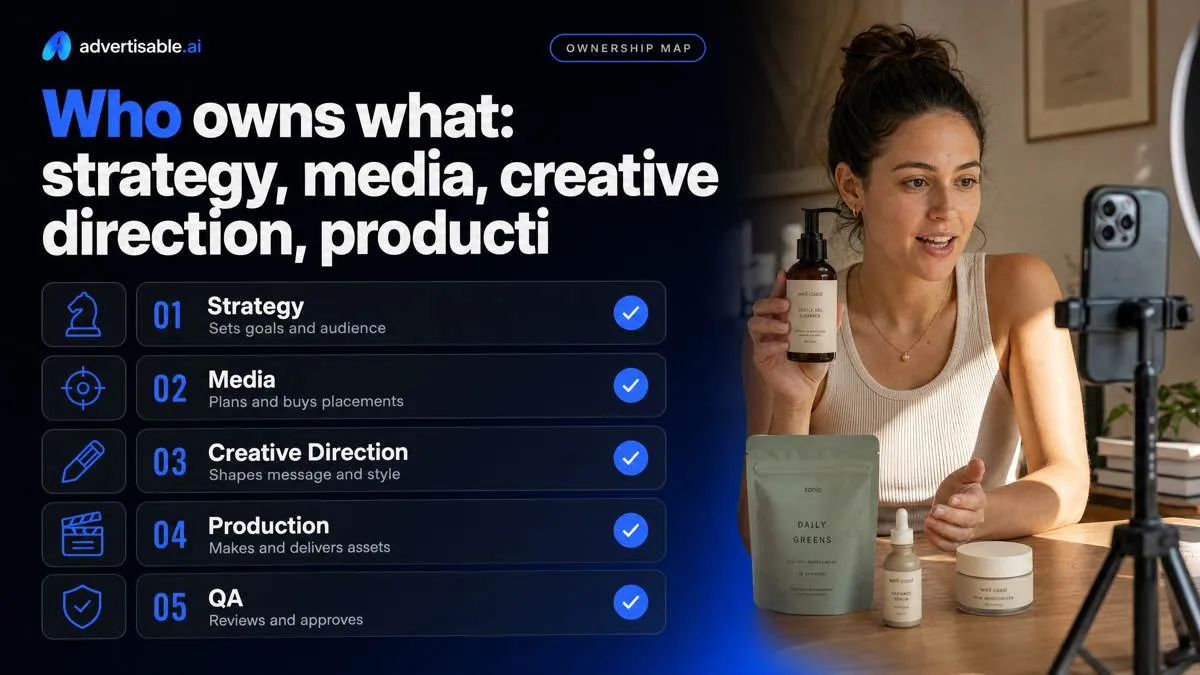
Use this as a scoping tool: before you buy an agency package or an AI platform, assign an owner to each function and name the acceptance criteria for “shippable.”
Use it as an internal hiring map: the gaps show you whether you need a strategist, a media operator, a producer, or simply a tighter reviewer gate.
Use it as a vendor accountability map: if a result is late or off-brand, you should be able to point to one accountable owner and one workflow step that failed.
Responsibility matrix by function
You should expect an agency to own judgment-heavy work (strategy and media decisions) and you should expect an AI tool to accelerate repeatable execution (production and formatting) only if you own the approval gate. In practice, the clean split is: humans decide “what to say and why,” systems help you produce “many correct versions.”
The ownership question is not theoretical. It changes what you measure: time-to-ship, number of revision cycles, and how often your team is forced into reactive fixes instead of controlled tests with 48-72 hour readouts.
- Strategy and positioning ownership: Agency owns the narrative, audience fit, and the “no-go” list (what you will not claim). You own business constraints (margin, inventory, seasonality) and the final call on tradeoffs.
- Media judgment and experimentation design: Agency owns channel-specific judgment, budget allocation, and test design discipline (single-variable batches, control vs variant definition). You own the objective metric and the decision rule after a 48-72 hour readout (scale, iterate, or kill).
- Production, QA, and client management: AI tools can generate volume, but you own QA acceptance criteria (brand guardrails, pack accuracy, claim/disclaimer checks) and who signs off.
Agencies often own project management and consolidate stakeholder feedback into one directive; without that, your team becomes the traffic cop.
Failure points without clear ownership
Most breakdowns happen when nobody is accountable for “brief integrity” and “release readiness.” The work shifts from shipping ads to debating interpretations, and the tool or agency gets blamed for what is actually a process gap.
Off-brief outputs usually trace back to conflicting inputs: multiple reviewers giving changes at different levels (strategy, tone, legal) without a single decision maker. Fix it by naming one brief owner and requiring feedback in one format: what to change, what to hold constant, and the next-test decision.
Claims risk is the other predictable failure. When production scales, so does the chance of claim creep and missing disclaimers, especially in health, beauty, and finance categories. Make disclaimers and approved claims an explicit QA checklist item, not an afterthought.
Approval bottlenecks become the work when you do not cap review cycles. Set a hard rule: one consolidated review pass per batch, then either ship or regenerate only the weak scene; otherwise, “faster production” just creates more items waiting in line.
Where agencies win and what you trade for it
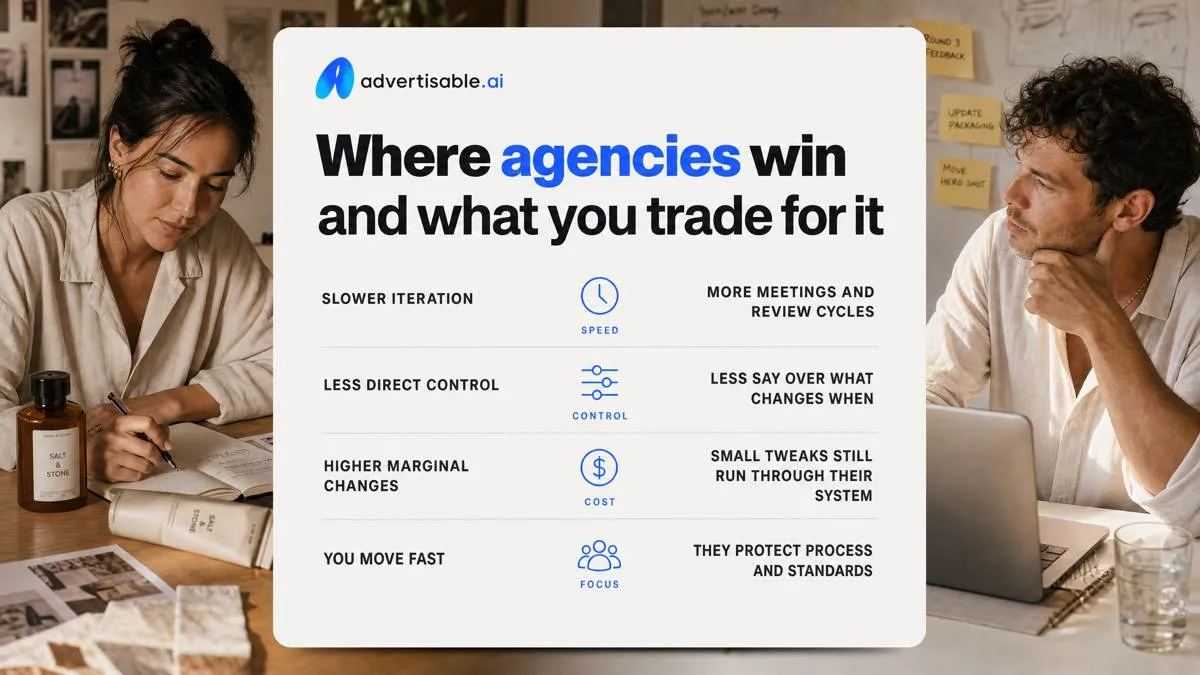
Agencies buy you judgment and process, but you pay for it in operating friction. Expect slower iteration (more meetings and review cycles), less direct control over what changes when, and higher marginal changes because “small tweaks” still run through their system.
Senior judgment and strategy
Agencies win when the hard part is deciding what to say and what not to say, not producing more variations. That shows up most when you have ambiguity: mixed performance signals, internal disagreement, or a brand that has grown without clear rules.
Positioning and message discipline is where experienced strategists earn their keep. In practice, that is a tight message hierarchy you can QA against: one primary claim, a small set of approved supporting proofs, and explicit “do not say” boundaries that prevent claim creep across channels.
Concept selection under uncertainty is the second edge. When you cannot run clean tests yet, they can pick the 1-2 concepts worth funding and define what stays constant (offer, proof, CTA) versus what changes (hook, first scene, framing) so you do not learn the wrong lesson.
Risk-managed brand building is the third. Senior teams will often trade a short-term CTR bump for a safer long-term posture by enforcing brand guardrails, legal-safe language, and consistency in how your product truth is presented.
- Acceptance criteria you should expect from senior strategy: a one-page positioning statement plus a short “approved claims and proofs” list your team can reuse.
- A concept decision log: what got picked, what got cut, and the risk rationale (compliance, brand dilution, audience mismatch).
- A measured learning plan: what signals they will read and on what timeline (typically a 48-72 hour readout for early creative signals).
Hands-off execution and accountability
Agencies also win when your internal constraint is coordination, not creativity. You are buying a timeline owner, an approval wrangler, and someone accountable when deliverables slip.
Project management and timelines matter because creative work expands to the calendar you allow. A strong agency will lock inputs, define revision rounds, and treat late feedback as a scope change, not a silent reset.
Stakeholder alignment is the quiet value. They run the approval gate across brand, legal, and product so you are not relitigating the same decisions in Slack, and you get a single version of “done.”
End-to-end campaign orchestration is the final advantage: they can keep the story consistent from brief to asset list to launch readiness, with QA checks for claims, disclaimers, and format requirements before anything ships.
- What to hold them to: a dated production plan, a named owner per deliverable, and explicit turnaround SLAs for feedback and revisions.
- A single approval workflow: who signs off, in what order, with what criteria (brand guardrails, claim accuracy, required disclaimers).
- Launch readiness checklist: correct aspect ratios, readable on-screen text, and a final compliance review before export.
Where AI ad tools win and the gates you must run
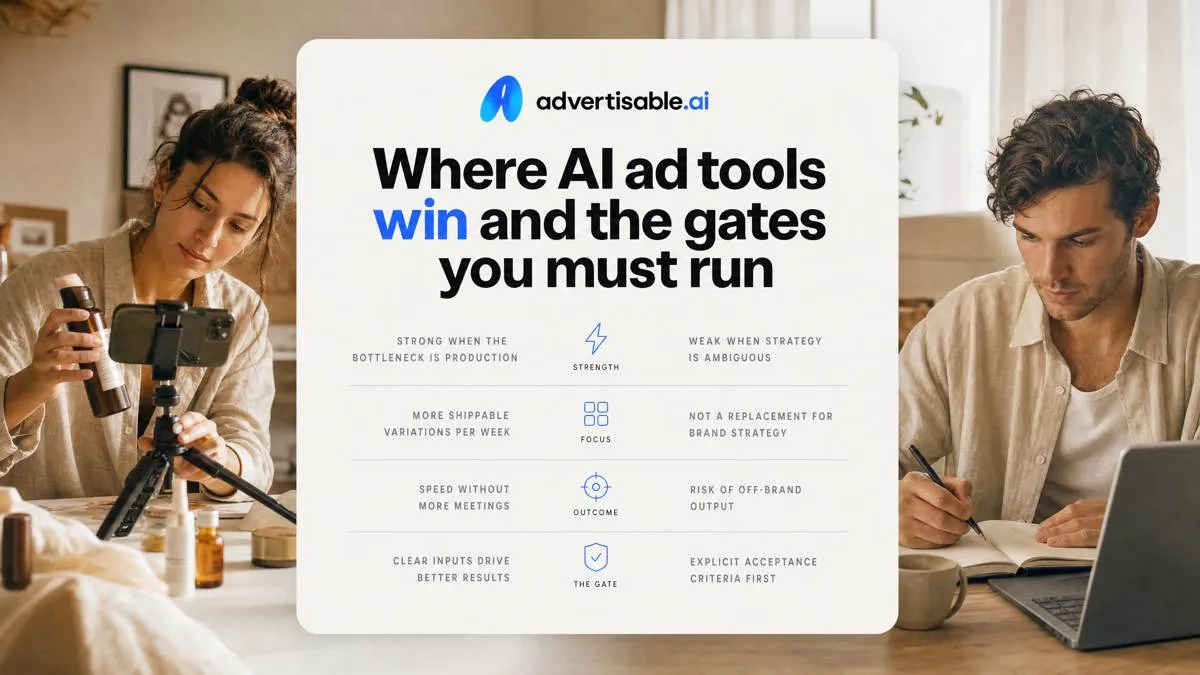
AI ad tools win when your bottleneck is production: you need more shippable variations per week, not more meetings. They are weaker when your brand strategy is still ambiguous, because the tool cannot decide your positioning, boundaries, and tone for you. To avoid off-brand output and heavy cleanup, you need explicit acceptance criteria before you generate anything.
Speed, volume, and iteration control
AI tools are most useful when you need lots of controlled variations fast, and you want to keep the testing surface clean. Automated creative testing can cut iteration cycles by 70% (automated testing research), but only if you structure output into batches you can actually read.
Operationally, you get leverage by generating many variations per creative angle while holding the rest constant. We typically start storyboard-first: lock one control structure (hook, problem, proof, offer, CTA), then produce 5 to 10 hook variants for a single angle, or 5 to 10 proof variants while the hook stays fixed. That gives you a 48 to 72 hour readout where you can attribute movement to one variable.
The other advantage is direct control over changes. With Advertisable AI Studio you can regenerate a single weak scene (or even adjust frame-by-frame) instead of rebuilding the whole video, which is how you keep iteration tight and prevent a “fix” from accidentally introducing a new variable.
- Variation math you can manage: 3 angles x 5 hook variants = 15 ads without rewriting the body each time
- Hook and proof testing cadence: launch in batches, read early signals in 48 to 72 hours, then only expand the winning angle
- Change control: edit or regenerate the hook scene only, and keep proof, offer, CTA, and visual system unchanged for clean comparisons
Breakpoints: drift, QA, and steering
The breakpoints are predictable: output quality is only as good as your inputs, and the approval work does not disappear, it moves in-house. If you skip guardrails, you will get tone drift, packaging inaccuracies, and claim creep across the very batch you are trying to scale.
Quality depends on inputs that are specific enough to constrain the model. That means a defined Brand DNA (voice, colors, must-say and must-not-say phrases, approved claims), plus a control storyboard that shows what “on-brand” looks like at the scene level. When the strategy is fuzzy, the model fills gaps with generic ad language, and your team pays for it in rewrites.
Plan for the approval load explicitly. AI reduces the time to create drafts, but increases the number of drafts your team can generate in a day, which can swamp legal, brand, and product reviewers unless you gate it.
Claims discipline needs a process, not hope. Use a pre-launch QA checklist (and a QA Module where available) to flag pack accuracy errors, missing disclaimers, and any claim that is not supported by your source-of-truth product page or PIM. Your acceptance criteria should be binary: pass or fail, before anything gets exported.
- Input gates (before generation): Brand DNA locked, approved claims list, one angle per batch, one control storyboard
- Approval gates (before launch): brand review for tone and visuals, product review for accuracy, legal review for claims and disclaimers
- Steering rules (during iteration): change one scene only, document what changed, and reject any variation that introduces new promises or new target audiences
Run a 48 to 72 hour batch test to decide
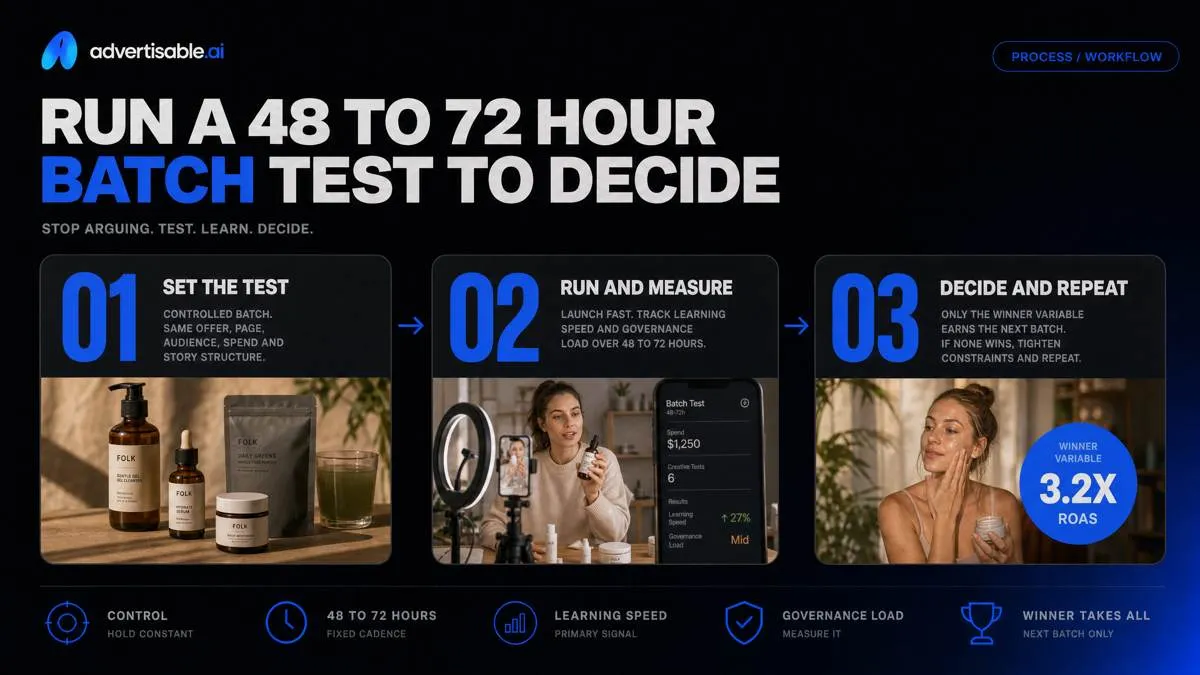
Stop arguing about whether you should pay agency rates for work software can automate. Run a controlled batch test and read results on a fixed 48 to 72 hour cadence so you measure learning speed and governance load, not just performance.
Decision rule: only the winner variable earns the next batch. If none clearly wins, you rerun the same batch with tighter constraints, not new angles. Each cycle, hold constant your offer, landing page, targeting, spend level, and core storyboard structure so you can attribute movement to the one thing you changed.
Design the batch with one variable
A clean batch is 6 to 12 assets where you change one variable and freeze everything else. That is the only way to separate “the idea worked” from “the edit was different” or “legal slowed us down.”
Batch 1: produce 5 to 10 hook-only variations while keeping the body (problem, proof, offer, CTA) identical to your baseline storyboard. Your acceptance criteria is simple: every hook must still land the same product truth and must be shippable without re-editing the rest of the ad.
Batch 2 (only after the hook batch): run proof-only variations. Keep the winning hook and the rest of the structure fixed, then change only the proof moment (what you show, what you claim, and any required disclaimer placement). This tells you whether your bottleneck is attention (hook) or belief (proof).
Build one control storyboard baseline first. In Advertisable AI Studio, we do this by importing the product URL to lock Brand DNA, then creating a single storyboard you treat as the control. From there, you generate variants and use scene-level control to regenerate only the hook scene or only the proof scene, rather than rebuilding the full video.
- Batch 1 (hook-only): 5 to 10 new opening scenes, same body and CTA every time
- Batch 2 (proof-only): keep the best hook, vary only the proof scene and disclaimer handling
- Control baseline: one storyboard you never edit except to fix factual errors, so it stays a stable reference point
Measure beyond ROAS
ROAS tells you which ad won. It does not tell you whether your workflow can keep learning without drowning in approvals. Track three operational metrics every 48 to 72 hour readout and you will see quickly whether an agency or a tool fits your reality.
Time to ship per batch is your speed metric. Include scripting, storyboard review, edits, QA, and exports. From our side, initial storyboard and first render typically takes 15 to 30 minutes once Brand DNA is locked, and regenerating a single weak scene is 3 to 5 minutes, but your internal review time is usually the limiting factor.
Revisions per approved asset is your friction metric. Count how many cycles it takes to get to “ready to launch,” and where the cycles happen (tone, visuals, compliance, or plain stakeholder preferences). High revision counts usually mean your constraints are not explicit enough to scale production.
Brand and claims issues count is your governance metric. Treat every packaging mismatch, unapproved claim, missing disclaimer, and off-brand phrasing as a logged defect. The more variants you ship, the more this matters, so use a pre-launch gate like the QA Module to flag claim creep before anything leaves your team.
- Time to ship per batch (hours): from brief to channel-ready exports
- Revisions per approved asset (count): how many edit loops to get a yes
- Brand and claims issues (count): every defect that would have caused a pullback or rework
If your fit is AI-led production: run the test in Advertisable AI Studio
This path fits when your constraint is volume, speed, and production control, not a lack of ideas. You use AI to generate and iterate variations quickly, and you keep humans focused on judgment work: deciding what to say, what not to say, and what is acceptable to ship.
If you still want a partner for strategy and accountability, read our AI Advertising Agencies piece and scope them to direction and decision-making, not routine production.
Lock Brand DNA from product URL
Start by importing your product page into Advertisable AI Studio so your variations inherit consistent brand rules from the same source. This is where teams usually win back time: you stop re-briefing basics every time you need 5 to 10 new creatives.
Use the import to lock guardrails before you generate anything. In our experience, the fastest way to create rework at scale is letting claims and tone drift between versions, then trying to “fix it in edit” after stakeholders see it.
Acceptance criteria for this step is simple: every output should use your approved claims and voice, and it should not invent product facts.
- Approved claims list: what the ad can state verbatim, plus what it cannot imply
- Voice guardrails: do and do-not examples for tone (short, direct, brand-safe)
- Fonts and colours: lock typography and palette so on-screen text does not vary across batches
- Disclaimers: required lines that must appear when a claim or offer is present
Build and iterate with control
Build one control storyboard first, then iterate one variable per batch so your 48 to 72 hour readout tells you what actually moved results. The storyboard workflow matters because it locks message architecture before you render: hook, problem, proof, offer, CTA.
When a version underperforms, fix the moment that failed instead of rebuilding the whole ad. Scene-level control is how you scale responsibly: regenerate just the hook scene if hook rate is weak, or just the proof scene if viewers drop before belief lands.
For micro-fixes, use frame-by-frame control to clean up a single frame where text is clipped, a pack shot is off, or a disclaimer is missing, without touching the rest of the sequence.
- Hold constant: offer, product truth, core proof, CTA
- Change per batch (5 to 10 variants): hook only, or proof only, not both
- Scene-level pass criteria: the weak scene is replaced, and the surrounding scenes remain unchanged
- Frame-level pass criteria: the specific frame issue is corrected with no knock-on edits to timing or copy
QA and multi-format export
Run the QA Module before export to catch accuracy and claims issues while they are still cheap to fix. This is your gate for pack accuracy, claim creep, and missing disclaimers, especially when you are generating volume.
Then export native formats for where you will actually buy media. You want channel-ready assets that do not rely on cropping, because composition and on-screen text legibility change across placements.
The output of this step should be ship-ready assets you can launch immediately for paid tests in your ad platforms.
- QA checks: claims match your approved list, product details match the page, disclaimers appear where required
- Export sizes: 9:16 for vertical placements, 1:1 for square feeds, 16:9 for horizontal inventory
- Release criteria: each format passes a 1-second hook legibility check (text, face framing, pack shot visibility)
Run the decision test this week, not next quarter
If your bottleneck is production throughput, stop debating opinions and run a controlled batch. We built Advertisable AI Studio for exactly this layer: repeatable, on-brand creative output with tight QA and fast iteration.
Here is the workflow we recommend. Import your product URL with the Product URL Importer to extract and lock Brand DNA. Build one control in the Storyboard Editor and hold the body, proof, offer, and CTA constant.
Generate 5 to 10 hook variations as a single-variable batch. Use the Scene Regenerator to replace only the weak moments, not the whole video. Run the QA Module for claim creep, pack accuracy, and missing disclaimers.
Then export channel-ready assets via the Multi-Format Exporter in 9:16, 1:1, and 16:9 for Meta, TikTok, and YouTube.
If you still want an agency, use this same framework to scope them to strategy and media judgment, not routine production.
Frequently Asked Questions
### Can I use Advertisable AI without an agency, or do I need both?
You can use our platform without an agency if you can own strategy, media decisions, and the approval gate. Many teams run AI-led production in Advertisable AI Studio and keep an agency focused on judgment work like positioning, testing strategy, and performance diagnosis.
### How long does it take to generate an ad with scene-level control?
Once Brand DNA is locked, you can typically move from storyboard to first render in 15 to 30 minutes. Scene-level fixes usually take a few minutes per scene, and exports are immediate. Your actual pace is driven by QA and approvals, not rendering.
### What is the difference between Advertisable AI and AdCreative.ai?
The core difference is output and control. Advertisable AI is built for production-ready video and UGC-style ads with storyboard-first planning, Brand DNA guardrails, and scene-level regeneration. If your priority is video iteration with controlled edits and QA, you will fit our workflow.