AI Ads for Supplement Brands
To make AI supplement ads that convert and stay compliant, you need two controls: product-locked rendering (so the real bottle, label, and ingredient panel stay accurate) and claims discipline (so every line is defensible structure-function language, not disease claims).
Here’s what matters most when you are scaling compliant supplement creative:
- Optimize for shippable variations: accurate packaging plus a clear, defensible hook.
- Lead cold traffic with pain-first moments, not ingredient or formulation explanations.
- Anchor trust with bottle and panel shots so buyers can verify details quickly.
- Use a storyboard structure: hook, problem, proof angle, offer angle.
- Batch single-variable tests by regenerating only the hook scene for clean readouts.
- Add Brand guardrails so approved claim wording cannot drift across 50 variations.
- Set QA acceptance criteria: label text, ingredients, and disclaimers match your source page.
We built Advertisable AI for performance teams stuck in the same loop you are: disapprovals, generic AI outputs, and re-rendering entire videos to fix one weak line. Our product URL import and Brand DNA Module are designed to keep your supplement packaging and on-brand claims consistent, while Scene-level control lets you edit the one scene that broke compliance or killed performance.
Before you scale output, you need a baseline definition of “accurate” and “claim-safe” that every variation must pass, because in supplements, product accuracy is not a nice-to-have, it is the floor.
Scale supplement creative only when accuracy and claims hold
AI creative only scales in supplements when you treat accuracy and claims as hard gates, not “nice to have.” Generic-looking AI ads are not a style problem first. They are usually a control problem: the bottle drifts, the label text becomes unreadable, and the copy starts implying outcomes you cannot defend.
Product accuracy is the baseline
Your fastest path to disapprovals and cold-traffic distrust is a product render that is “close enough.” In supplements, buyers zoom in, compare labels, and look for inconsistencies across ads. Nearly 70% of supplement purchasers were strongly influenced by container label information in a peer-reviewed purchasing study, so accuracy is performance work, not just compliance.
Treat accuracy like QA with acceptance criteria. When we review a batch, we do not “judge the vibe.” We check whether the visuals would still pass scrutiny if the viewer paused on frame 1 and took a screenshot.
- Real bottle and label match: shape, cap color, label layout, and brand marks are identical to what ships
- Ingredient panel readable on-screen: minimum 2 seconds on screen, high contrast, no blur, no tiny type that turns to noise on mobile
- No invented dosages or ingredients: never add milligrams, compounds, or claims that are not on your approved label and product page
- Consistent packshots across variants: each flavor or count uses its own correct packshot, and that packshot stays stable across all exports
Credible proof beats dramatic promises
Supplements convert better on cold traffic when you sound precise and routine-based, not dramatic. The goal is a claim a reviewer, a skeptical buyer, and your own team can all repeat without wincing.
We keep one variable moving at a time: you can run 5 to 10 storyboarded variations where only the hook changes, then read results after 48 to 72 hours. The body stays constant so you learn whether specificity, proof cues, or framing is doing the work.
Proof that reads as honest usually includes a tradeoff, a timeframe, and a normal routine. A UGC-style line like “I take two capsules with breakfast and noticed fewer mid-afternoon slumps by the end of week two” is more believable than “worked instantly,” and it avoids cornering you into medical outcomes.
- Specificity over vague benefits: name the use-case and context (“post-lunch crash,” “after heavy meals”) instead of “feel amazing”
- Routine framing over instant results: show how it fits a day (morning, gym bag, nightstand) and what consistency looks like
- UGC that reads as honest: natural language, no perfect scripts, and no absolute outcomes; include practical details like when they take it
- Evidence cues without overclaiming: show the Supplement Facts panel, third-party testing badges if you have them, and keep wording inside FDA's three claim categories
Why supplements demand tighter ad craft than beauty
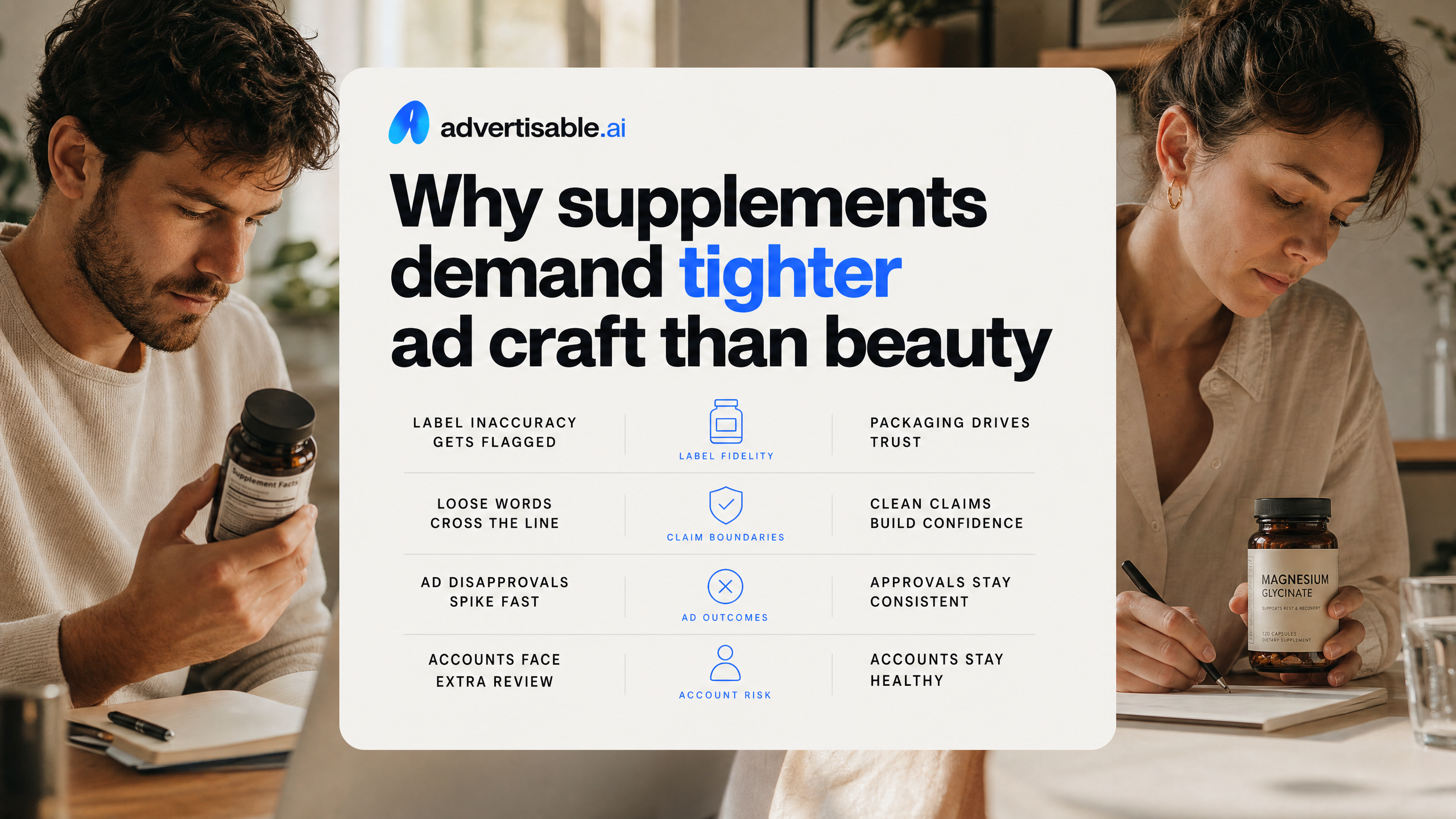
Supplements are fragile on paid social for two reasons you can control: label fidelity and claim boundaries. A single inaccurate panel shot or a loose line that implies treatment can trigger Meta disapprovals and, in the worst cases, put your account under extra review.
Buyers read the ingredient panel
In supplements, the label is the product. Your creative lives or dies on whether the bottle, Supplement Facts, and ingredient panel look real, legible, and consistent across scenes.
Panel zoom shots are not “extra,” they are a trust mechanic. When the zoom is blurry, cropped, or mismatched to the front label, you create the same doubt as a typo on a checkout page.
Expect scrutiny on dosage and servings. Buyers check “how many mg per serving” and “how many servings per container” to do a quick cost-per-day calculation, and they notice when an ad highlights a dose that is not actually on the panel.
Proprietary blends get skepticism because they can hide exact amounts. If the formula uses a blend, your safest creative move is transparency: show the panel clearly, and avoid implying specific dosages that are not disclosed. Third-party testing signals (like a COA callout or certification badge shown accurately on-pack) can reduce hesitation without changing your claims.
- Acceptance criteria for label shots: front label and panel match, text is readable at 100% zoom, no invented badges/seals, no altered ingredient list
- QA check: verify the highlighted ingredient, serving size, and servings-per-container are identical to the product page and on-pack panel before export
Hype trained your audience to doubt
Your audience has been trained by years of overstated wellness ads to filter out anything that sounds like a promise. The anti-hype tone is not a brand preference, it is a conversion requirement in a category where trust is already taxed.
Precise language wins attention because it reads as controlled. Naming the ingredient and what it supports (without dramatizing outcomes) consistently outperforms vague lines like “feel amazing” in cold feeds.
Production style matters. Clean demos beat flashy edits: stable lighting, real bottle handling, and straightforward “here’s what’s on the label” sequences reduce the mental load and make the ad feel less like a trick.
Avoid before-after implications even when you do not show images. Tight cuts that imply transformation, extreme timelines, or “results” framing can trigger both user skepticism and review friction.
- Hold constant in a test batch: the product shots, label zoom segment, and offer scene
- Change one variable: hook wording only (run 48-72 hour readouts before you edit the body)
- Pass/fail for tone: no superlatives, no dramatic transformation language, no timeline guarantees
Claims rules are the tightest
Supplements require the strictest claims discipline because the line between “supports” and “treats” is where disapprovals happen. You can usually communicate structure/function support, but you cannot imply disease prevention, diagnosis, or treatment without crossing into restricted territory.
Use “support” language, not disease claims, and avoid diagnose-or-treat phrasing even indirectly (for example, “fixes,” “cures,” “stops,” or naming a disease state as the promised outcome). This is where FDA's three claim categories is the useful mental model: structure/function is fundamentally different from health claims tied to disease-risk reduction.
Disclaimers are not decoration. If you use the standard supplement disclaimer, keep it present and readable where the claim appears, not buried after a fast cut or off-screen in tiny text.
Write with a substantiation mindset. Every objective claim you put in a script should have competent and reliable support behind it, and your creative team should have an approved-claims list so wording does not drift across 20 variations.
- Copy QA gate before launch: highlight every benefit line, label it “support” or “treatment,” and rewrite anything that reads like treatment
- Placement check: disclaimer on-screen during the claim scene (not only in the caption), with enough contrast and duration to be read
Build conversion with five supplement-native ad formats
Cold traffic does not convert because your AI video “looks cool.” It converts when the product is verifiably real and the claim is narrowly stated. Bottle shots and Supplement Facts panel zooms are trust anchors because buyers check them fast; a peer-reviewed purchasing study found nearly 70% of supplement purchasers were strongly influenced by container label information.
Build your proof hierarchy in every storyboard: label first (what it is, what’s in it, how much), then experience (what it feels like to use), then offer. Keep the offer scene compliant by staying in “what you get” and “how to buy” language: count of servings, flavor options, subscription savings, free shipping thresholds, and a clean CTA. No implied medical outcomes, no before-and-after framing.
Ingredient to benefit callouts
This format wins when you turn the label into comprehension, not hype. You name one ingredient, pair it with a support verb, and tie it to one everyday benefit per scene so a cold viewer can track it in 2 seconds.
Production control matters: pull the exact ingredient names and dosages from the Supplement Facts panel and lock them. In our workflow, we storyboard 6 to 9 seconds per callout and only change one variable per batch, usually the ingredient line or the visual treatment, then read results at 48 to 72 hours.
- Script pattern: “X (ingredient) helps support Y (function)” or “X supports Y” (avoid “treats,” “prevents,” “fixes,” or disease terms)
- On-screen text: ingredient + exact dosage from label (for example, “Magnesium glycinate 200 mg per serving” if that is what the panel states)
- One benefit per scene: “supports calm focus” is one scene; “supports sleep and stress” becomes two scenes
- QA check before export: ingredient spelling matches label, units match label (mg, mcg, IU), no therapeutic outcomes implied in captions or VO
Routine and consistency framing
Routine creative converts cold traffic by making the product feel low-risk and easy to adopt. You are not selling a transformation; you are selling a repeatable daily behavior with clear timing cues.
The acceptance criteria is simple: a viewer should be able to answer “who is this for” and “when do I take it” within the first 3 seconds, without you promising a timeline. We keep the bottle constant, regenerate only the routine scene variants, and run 5 to 10 timing angles side by side.
- Daily habit cues: “with breakfast,” “midday,” “after training,” “before bed” (pick one per variation)
- Who it is for and when: “for people who hit a 3pm slump” or “for busy mornings” (no personal attribute targeting language like “for diabetics”)
- Stacking: show it next to existing anchors like coffee, water bottle, vitamin organizer, or nightstand routine
- Expectation setting without timelines: “works best as part of a consistent routine” and “builds with regular use” without “in 7 days” or “by week two”
UGC, unboxing, first-use proof
UGC works on cold traffic when it proves the product exists in the real world and the first use is believable. The core shots are unboxing, packaging verification, panel zoom, then a serving demo.
Keep testimonial language inside guardrails: talk about experience and preference, not medical outcomes. We also treat this as a single-variable system: hold the script beats constant, swap the AI creator, and regenerate only the first-use scene to fix anything that feels generic.
- Unboxing: show the shipper, seal, bottle, and lot-coded packaging details you can safely display
- Taste and texture: “light citrus,” “not gritty,” “mixes clear,” “capsules are small” (concrete sensory notes beat vague praise)
- Panel zoom: 2 seconds on Supplement Facts with legible type; match on-screen callouts to what is printed
- Serving demo: scoop or capsule count, water volume cue, shake or stir, then the finished drink or the capsules in hand
- Testimonial guardrails: avoid “cured,” “reversed,” “stopped my anxiety,” or any disease claim; keep it to “I like,” “I noticed,” “fits my routine,” “easy to take”
Use a product URL workflow to keep the bottle and panel correct
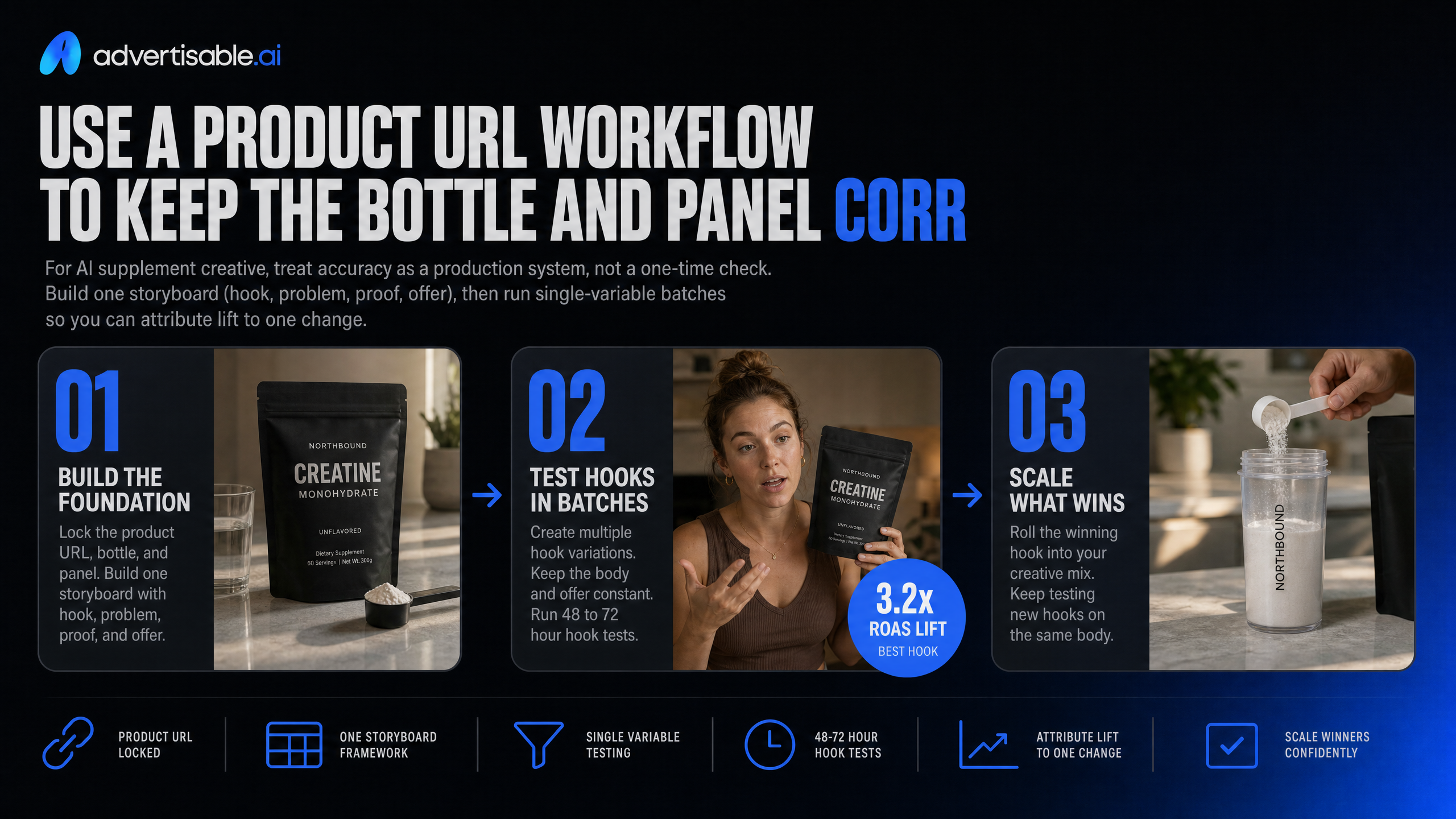
For AI supplement creative, treat accuracy as a production system, not a one-time check. Build one storyboard (hook, problem, proof, offer), then run single-variable batches so you can attribute lift to one change. Use a 48 to 72 hour hook test cadence, keep the body constant, and only rotate the opening.
Start from product URL import
Your highest-leverage control is starting every build from the live product page. URL import pulls the exact packaging and specs so your bottle, label, and supplement facts panel match the source of truth on variation 1, not after five rounds of fixes.
From that same page, extract ingredients, servings, and key directions into structured fields so your script callouts and on-screen text stay aligned. Then seed a short list of approved benefit angles from what is actually on-pack or already cleared internally, so you are not inventing new language mid-production.
- QA acceptance criteria before you generate variants: bottle matches current PDP imagery, ingredient list matches the panel, serving size and servings per container are consistent across script and captions
- Single source of truth rule: all ingredient and serving callouts must originate from the imported specs, not manual retyping
- Angle seed limit: start with 3 to 5 approved benefit angles so you can test without expanding claim surface area
Lock packaging with Brand DNA
Once you have a correct baseline, lock it. Brand DNA is how you freeze the label and panel renders, store an approved claims library, and keep fonts, colors, and voice consistent across scale.
This is what prevents drift when you produce 50 variants. You are holding the product constant and changing one variable at a time, not slowly letting the bottle tint shift, the typography change, or the benefit wording creep into unapproved territory.
In Advertisable AI, we use the Brand DNA Module to pin the product specs and visual rules, then generate in batches off that locked template so every export still looks like the same brand.
- Packaging lock: front label render plus a readable supplement facts panel render saved as the reference
- Claims library: only pre-approved structure/function phrasing is selectable for scripts and overlays
- Brand guardrails: fonts, hex colors, logo placement, and voice notes enforced across scenes
Iterate with Frame-by-frame control
Speed comes from editing the scene that failed, not rerendering the entire ad. Frame-by-frame control lets you regenerate only the hook scene while keeping the problem, proof, and offer identical, which is how you get clean reads in a 48 to 72 hour test window.
Use the same control to fix common QA issues: supplement facts panels that are too small to read, or a bottle angle that obscures the serving size. You can also swap creator delivery safely without touching the product shots, so you are not changing two variables at once.
Operationally, this reduces full rerender waste. You spend credits and time on the delta, not on re-producing scenes that were already correct.
- Regenerate scope: hook only (new line, new pattern interrupt, same product and body)
- Panel readability check: minimum 2 seconds on-screen, high-contrast crop, no motion blur over fine text
- Creator swap rule: change face or delivery, keep script and product scenes fixed for that test
Keep every line defensible with claims discipline guardrails
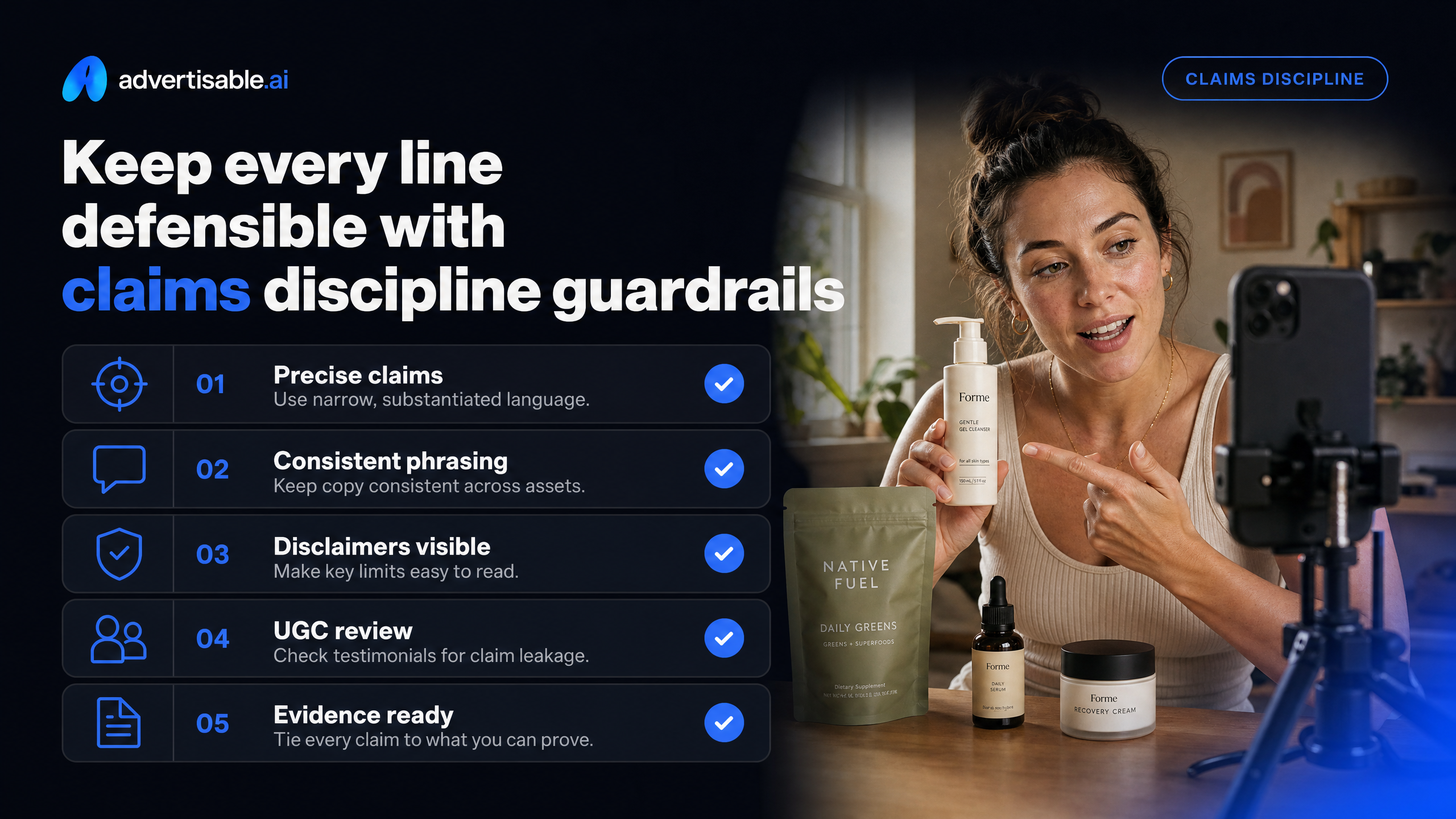
The fastest way to reduce Meta disapprovals and account risk is precision over hype. Your creative can still be direct, but every claim has to be narrowly scoped, consistently phrased, and tied back to something you can substantiate.
Make disclaimers readable on mobile: short, plain language, high contrast, and not crammed into a 1-second end card. Also review testimonials for claim leakage, because UGC-style lines like “it fixed my…” can turn an otherwise safe script into a high-risk ad variant.
Write support claims, not cures
Your safest lane is structure and function language: you can describe what the product supports, not what it treats. In practice, that means your verbs matter more than your adjectives.
Use support verbs that describe normal body function or routine outcomes (support, help maintain, promote, assist). Avoid disease and symptom terms entirely, even when they feel “everyday,” because ad reviewers and classifiers often treat them as health condition claims.
Cut guaranteed outcome language. “Works every time,” “fast relief,” and “permanent” are high-risk because they imply certainty and clinical performance. Also avoid implied medical comparisons like “better than a prescription,” “doctor-level results,” or “clinically stronger than medication,” even if you do not name a drug.
- Allowed framing: “supports calm focus,” “helps maintain healthy digestion,” “promotes restful sleep”
- High-risk terms to avoid: disease names, diagnosis language, symptom claims, and “pain,” “anxiety,” “depression,” “ADHD,” “insomnia,” “inflammation”
- Banned-by-default outcomes: “cure,” “treat,” “reverse,” “heal,” “eliminate,” “stop”
- Comparison traps: “like a prescription,” “doctor recommended” (unless you can substantiate and still clear platform rules), “clinically proven to outperform”
Substantiate what you choose to say
You do not need more claims. You need fewer claims you can defend, repeatedly, across 20 variations and three aspect ratios.
Run an ingredient-to-benefit mapping check before you write: list each ingredient you plan to mention, the exact benefit you will claim, and the evidence you hold. This is where FTC substantiation standards matter: both express and implied claims need competent and reliable scientific evidence before the ad runs.
Keep dosage consistent with the label. If the bottle says X per serving, the ad cannot imply 2X, a different frequency, or an “extra strength” effect unless the label supports it. Skip mechanism claims unless you can back them up; “boosts dopamine,” “detoxes hormones,” and similar biology-forward lines are common drift points that create review risk.
- Mapping check: ingredient -> claimed benefit -> internal source or rationale -> approval status
- Label lock: serving size, frequency, and per-serving amounts match the label exactly
- Mechanism filter: remove any “how it works” line you cannot substantiate in writing
- Internal documentation: store sources, claim rationale, and the approved phrasing in one shared location tied to the ad template
Lock approved wording in Brand DNA
Claim drift usually happens in variation generation: one synonym turns into a medical promise, or one testimonial line introduces a symptom. The fix is to treat claims like production constraints, not copy suggestions.
Maintain an approved claim phrase list and a blocked list, then enforce both at the template level. In Advertisable AI, we do this by putting approved and blocked language into the Brand DNA Module, then generating from a storyboard-first template so hooks can change without the claim base mutating.
Keep disclaimer text consistent across every cut. If you have a disclaimer, it should appear in the same place, with the same wording, and survive exports to 9:16 and 1:1 without becoming unreadable.
- Approved phrases: a short set of exact sentences you allow in ads (no synonyms)
- Blocked phrases and topics: disease terms, symptom terms, guarantees, medical comparisons, before-and-after style transformation claims
- Disclaimer standard: one canonical version, mobile-readable sizing, consistent placement across formats
- Variation QA checklist (run per batch): scan hooks and captions for blocked terms, verify on-screen text matches approved phrases, confirm dosage statements match label, re-review testimonials for “fixed/cured/treated” leakage
Ship accurate, claim-safe supplement creative in controlled batches
If you are serious about scaling, treat creative like a system. The objective metric is cost per shippable, claim-safe variation. We recommend one workflow: import your product URL so the bottle, label, and ingredient panel stay product-locked, then set Brand DNA guardrails for packaging and approved claims.
Next, storyboard hook, problem, proof, offer, and generate a single baseline. From there, run single-variable batches by regenerating only the hook scene, holding everything else constant for clean reads. Review performance after 48 to 72 hours, then promote winners and iterate the next variable.
If you want to do this inside one studio, we built Advertisable AI for exactly this. Start with the $5 3-day trial and ship your next batch with QA checks before export.
Frequently Asked Questions
Q: How does Brand DNA prevent off-claim outputs for supplements?
A: We use Brand DNA to lock the non-negotiables: your packaging details, product specs, and your approved claim language. That reduces drift across variations, so you are not re-auditing basic facts on every export.
Q: Can I test 10 different hooks without regenerating the entire ad?
A: Yes. You storyboard once, generate a baseline, then use scene-level control to regenerate only the hook. Keep the body constant so you can attribute any lift or drop to the hook alone.
Q: What makes an AI supplement ad look authentic instead of generic?
A: Specificity and production control. Use concrete, support-focused language tied to your actual label, and QA the first seconds for unnatural pacing, mismatched lighting, and vague claims before you scale the batch.