AI Ads for Beauty Brands
The most trustworthy way to make on-brand beauty video ads at scale is an AI ad generator that starts from your product URL and locks Brand DNA, so packaging, shade, and approved claims do not drift across variations.
Here’s what matters most when you pick and run an AI tool for beauty ads:
- Trust breaks fastest when skin texture, shade, or packaging details look even slightly off.
- In beauty, the visual is the product, so brand guardrails matter more than polish.
- Use a storyboard so every ad keeps the same hook, proof, and offer structure.
- Batch single-variable tests so you can read winners in a clean 48-72 hour window.
- Start from your product URL to pull real specs and reduce claim and label drift.
- Regenerate one scene at a time to fix proof shots without wasting a full rerender.
- Prioritize UGC-style creative and product ads over AI creators that feel deceptive.
Before you worry about volume, you need acceptance criteria for what “believable” means in beauty: accurate packaging, true-to-life texture, and proof that does not read like hype. That is why the first priority is making accuracy and believable proof your non negotiables.
Make accuracy and believable proof your non negotiables
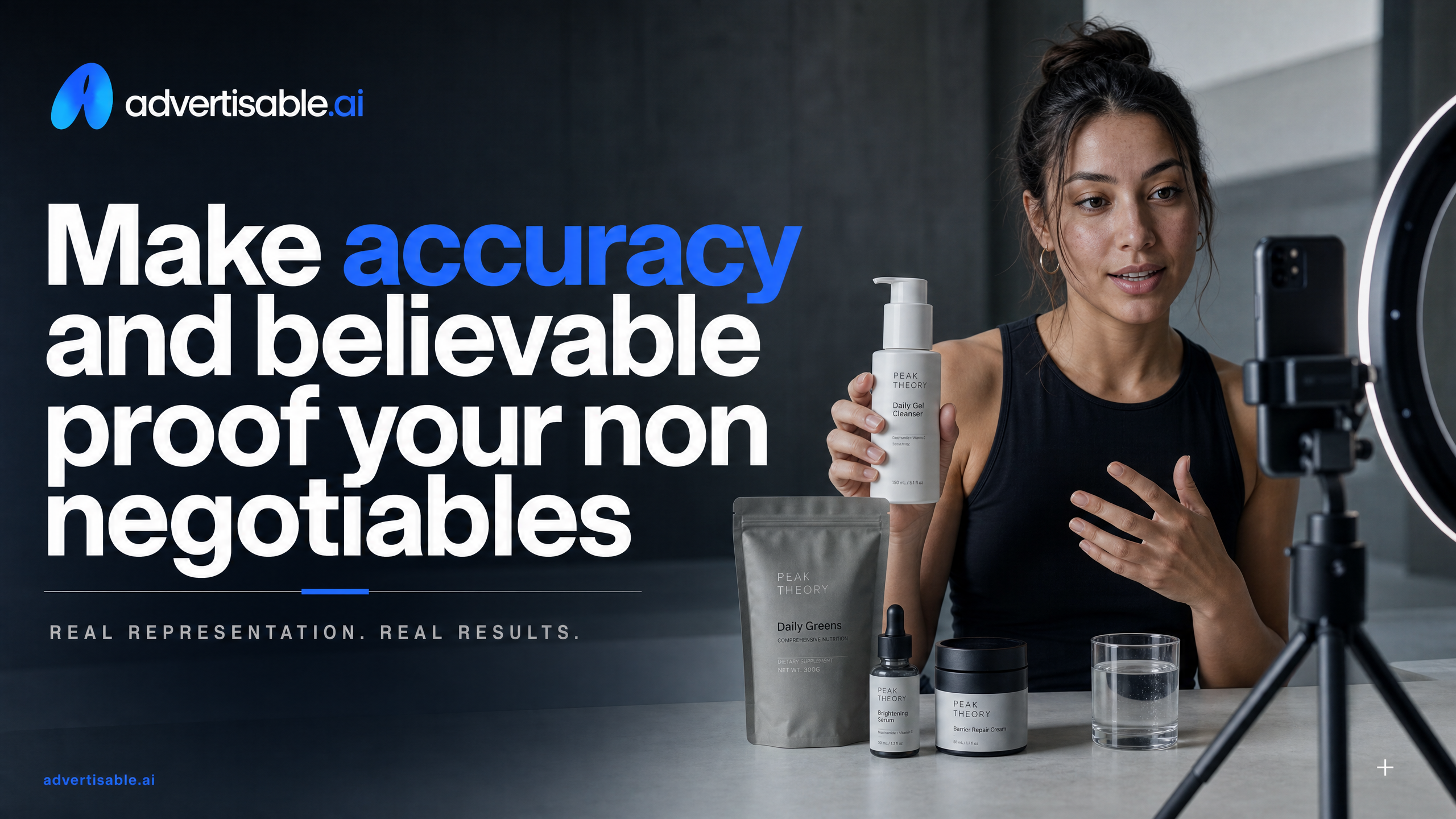
Beauty ads are audited by the eye first. If the shade, texture, or packaging reads “off,” you do not just lose a click, you trigger skepticism about everything else you say. Our operating rule is simple: nothing ships unless it is product-accurate and the proof is checkable.
Where beauty ads lose trust
Trust breaks in beauty when visuals imply a product you do not actually sell. Viewers will spot small inconsistencies fast, especially in complexion, lip, and skincare finish.
Shade drift is the fastest failure mode. A “neutral” foundation that renders warm, or a concealer that flips undertone between scenes, reads like deception because the buyer knows that one wrong undertone means a return.
Texture and finish are the next tell. Over-smoothed “plastic” skin, poreless under-eye, or a highlight that looks painted on makes the product feel synthetic and over-edited, even if the script is clean.
Packaging morphs are a quieter but equally damaging issue: label copy shifting, cap shape changing, logo placement moving, or the bottle silhouette warping across cuts. In performance reviews, we treat any packaging mismatch as a hard QA fail, not a “nice to have” fix.
- Shade drift: the same shade looks different across frames, lighting setups, or models, creating wrong undertones
- Fake texture/finish: overly blurred skin, unnatural shine, or “airbrushed” makeup that does not behave like real product
- Morphing packaging: inconsistent label text, cap geometry, bottle shape, or logo placement between scenes
What believable proof looks like
Believable proof is specific, sourced, and consistent across the whole ad, not just a dramatic end frame. Your goal is to make the viewer think “I can verify this,” not “this is vibes.”
Before/after works when you can point to real source assets and keep the conditions stable. NAD guidance on beauty claims is clear that before and after images are performance claims and must be substantiated, accurate, and representative.
Routine context is what makes results plausible. If you claim a skincare benefit, show where it fits in a routine (cleanse, apply, moisturize), keep the routine order the same across variants, and avoid swapping multiple variables at once so you can defend what caused the change.
Operationally, we match each claim to its evidence type before it goes in creative.
- Real before/after sources: original files, dates, and usage notes available internally, not recreated “results”
- Routine context and consistency: same application area, lighting, camera distance, and routine steps across the proof sequence
- Claims matched to evidence: texture claims shown in close-up, wear claims shown over time, and ingredient claims tied to what the product page actually states
Why beauty ads demand tighter controls than other verticals
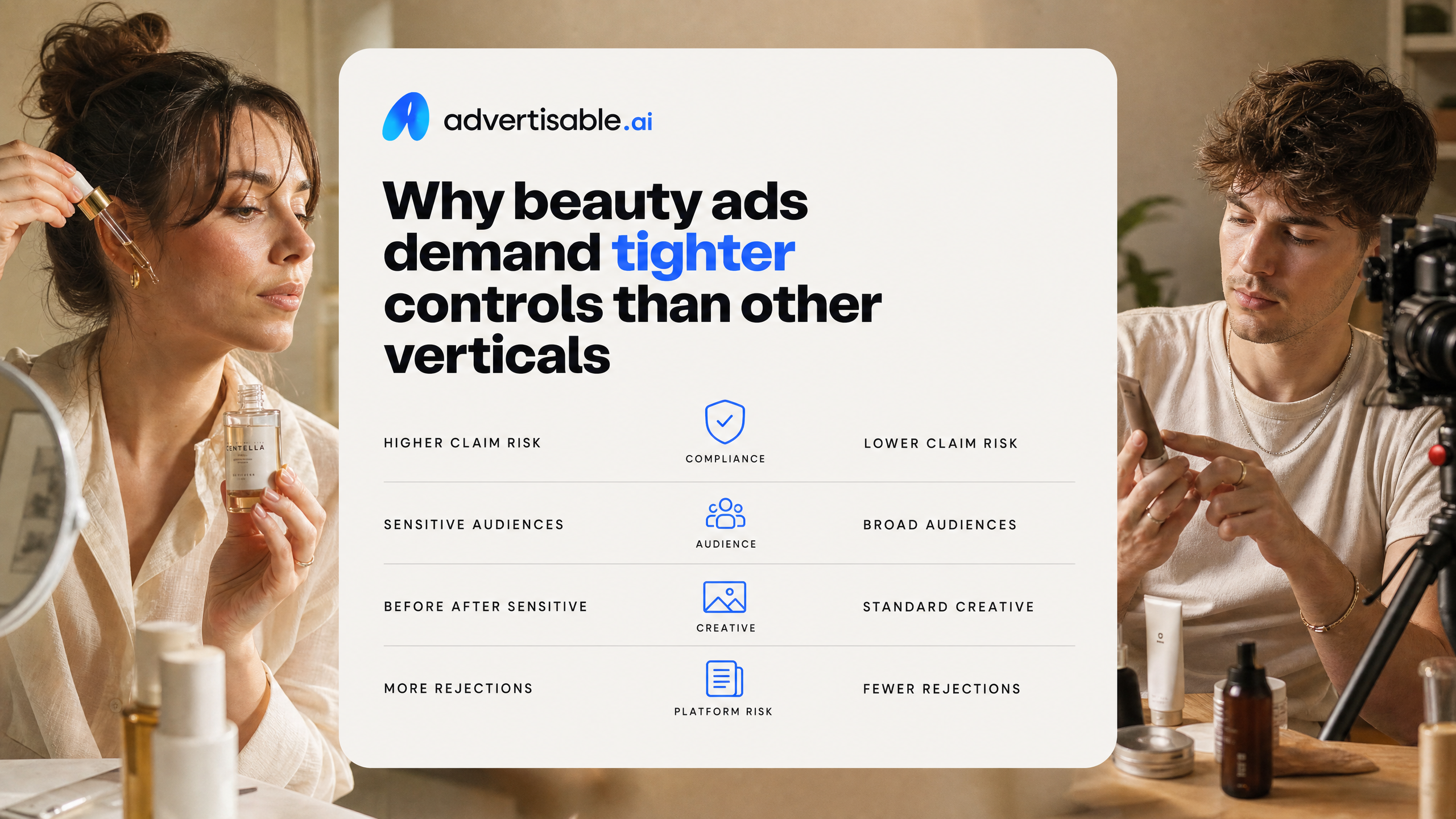
Product visuals are the product
In beauty, your ad is judged like a product page, not like entertainment. If the packaging, label, texture, or shade drifts even slightly, you are not just risking lower CTR, you are creating a mismatch that shows up as wasted spend and returns.
Macro shots raise the bar. Viewers pause on cap shape, label copy, ingredient callouts, and even small inconsistencies like logo placement. That is why teams need URL-sourced product truth and locked guardrails before they scale variations; otherwise each new render becomes a new opportunity for packaging to mutate.
Texture is the next credibility check. Buyers recognize cues like slip, tack, foam density, sparkle size, and how a product sits on skin or hair. If your visual implies a whipped balm but your SKU is a thin serum, the comment section will tell you fast.
Shade accuracy is the fastest way to trigger returns in color cosmetics. When the on-screen swatch reads warmer, cooler, deeper, or more saturated than what arrives, you lose the second purchase, not just the first click.
- Acceptance criteria for shippable visuals: label text is legible and matches the SKU, logo placement is consistent, and pack color does not shift between scenes
- Texture QA: application footage must show the real finish (matte vs dewy), opacity (sheer vs full coverage), and spread behavior without exaggeration
- Shade QA: keep one reference swatch per shade and compare every new variant against it before export
Proof is regulated by attention
Beauty proof gets scrutinized because it is easy to overstate and hard to verify in-feed. Before and after visuals are treated as performance claims, and a disclaimer cannot cure a misleading before and after - the image itself has to be truthful.
Operationally, that means you need proof guardrails that are as strict as your visual guardrails. We treat claims as assets: approved wording, approved ranges of outcomes, and approved scenes where proof is allowed to appear. Anything outside that gets cut or regenerated before it ever ships.
Clinical language is another tripwire. Words that imply treatment, diagnosis, or medical-grade efficacy require support you can stand behind. If you cannot substantiate it, keep the copy in consumer-benefit territory and let the product demo do the work.
Finally, avoid retouch signals that suggest deception: unreal poreless skin, impossible lash density, or perfectly uniform tone after a single swipe. Even when performance improves, the audience reads those artifacts as manipulation, and you pay for it in trust and CPM.
- Before and after controls: same lighting and angle, same framing distance, and an on-screen disclosure that matches the real test conditions
- Claims controls: block clinical terms unless you have substantiation and an approved script line for them
- Retouch controls: no blur-skin effects, no artificial shine that implies oil control, and no edits that remove real texture
Use five beauty native ad formats that buyers believe
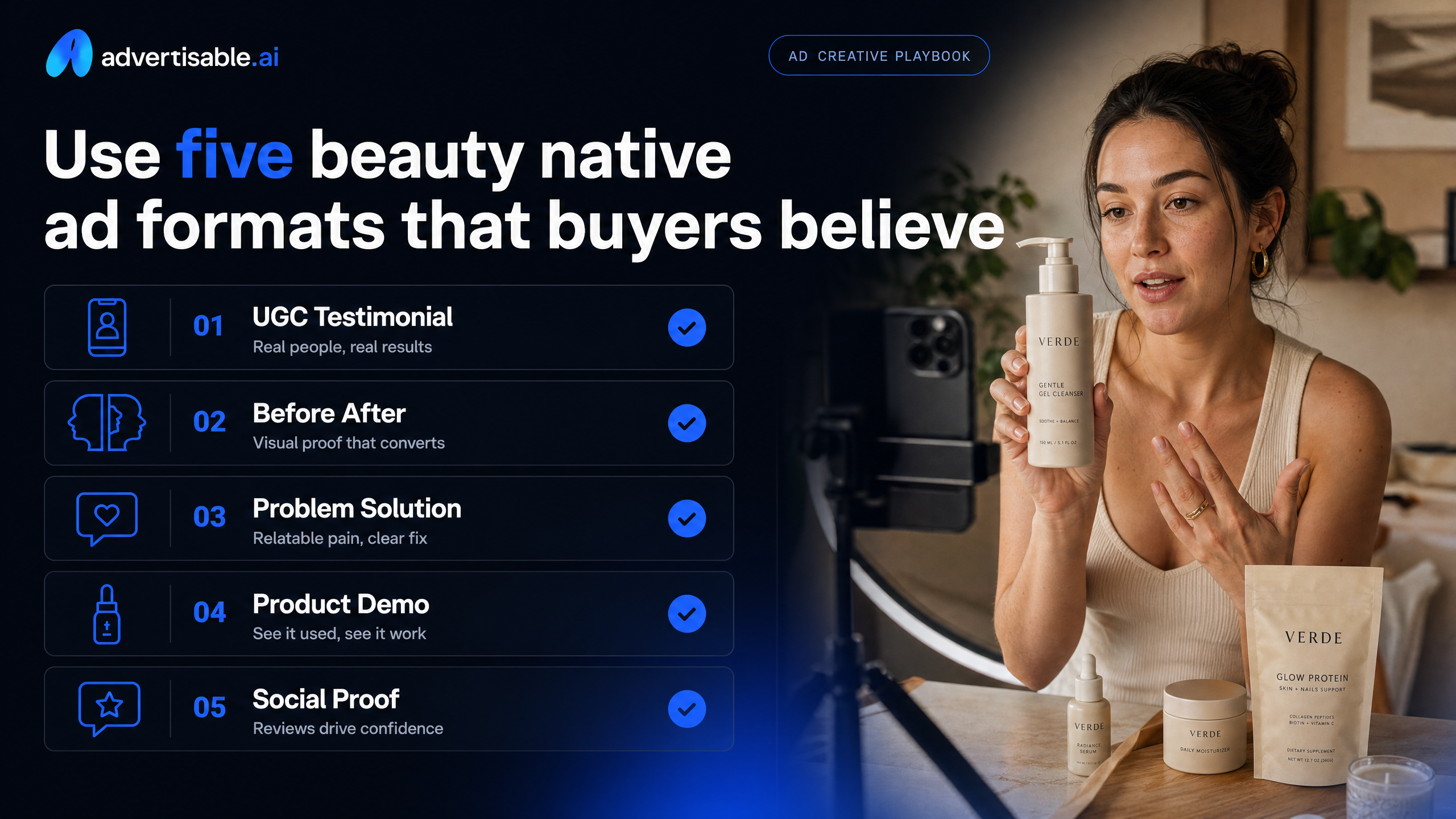
Beauty buyers do not reject AI because it is AI. They reject it when skin, shade, or proof looks “generated.” The fix is to choose formats with built-in credibility signals, then lock what must stay constant (product, claims, camera rules) while you test one variable at a time on 48-72 hour readouts.
Before after done honestly
The most believable “before/after” is a controlled comparison, not a dramatic transformation. Your goal is one clean variable: the skin change, with everything else held constant so viewers can trust what they are seeing.
Treat this as a production checklist, not a vibe. We see trust drop fast when the “after” is brighter, closer, or smoothed.
- Same lighting and angle rules: lock focal length, camera height, background, and time of day; match face orientation (chin tilt and eye line) and distance to camera; no beauty filter, no skin-smoothing pass.
- Timeframe and routine disclosure: overlay “Day 0” and “Day 14” (or your real interval), plus exact cadence like “AM cleanse + serum, PM cleanse + moisturizer”; state what stayed the same (SPF, diet, makeup removal).
- Overlay proof without hype: use small, checkable overlays like “unretouched,” “same bathroom lighting,” “0.5x camera,” and a simple 2-frame split; avoid superlatives and avoid implying atypical results.
Texture and application shots
Texture and application is where “AI fake” is easiest to spot, so you win by being literal. These ads are for reducing uncertainty: shade depth, viscosity, spread, absorption, and finish.
Run swatches like QA. One close-up clip can outperform a face-led pitch because it answers the buyer’s core question in under 2 seconds: “Will this look like that on skin like mine?”
- Close-up swatch realism checks: micro-texture stays imperfect (pores, peach fuzz, fine lines); specular highlights move with light; no edge halos around swatches; pigment falloff looks natural at the edges.
- Finish language buyers understand: label the finish as dewy, matte, or satin and show it under one hard light and one soft light so the finish reads without overexplaining.
- Hands, tools, and skin cues: show the applicator (dropper, doe-foot, spatula) and one tool (fingers, brush, sponge); include real cues like pilling risk, tackiness for 10 seconds, or dry-down at 60 seconds.
Ingredients routines and UGC
Ingredient, routine, and UGC-style formats work because they create a reason to believe, not just a pretty result. Use them when your buyer needs mechanism, consistency, and a believable user voice.
A GRWM sequence beats a single hero shot because it shows steps and timing. Build a 4-scene storyboard (hook, routine, proof, next step) and only change one variable per batch, like the ingredient angle or the hook line, then judge performance after 48-72 hours.
- Ingredient callouts tied to benefits: pair one ingredient with one concrete role (for example, “supports barrier feel” or “targets the look of redness”) and keep claims inside your approved guardrails.
- GRWM sequencing: 15-30 seconds total; show product amount, order, and wait time (for example, “wait 60 seconds before layering”) so the routine looks replicable.
- Testimonial structure (problem to use): 1 line on the specific problem, 1 line on how you used it (frequency and where), 1 line on what changed and when (for example, “by week 2 my makeup stopped separating on my cheeks”).
Run the URL to export workflow that locks product truth
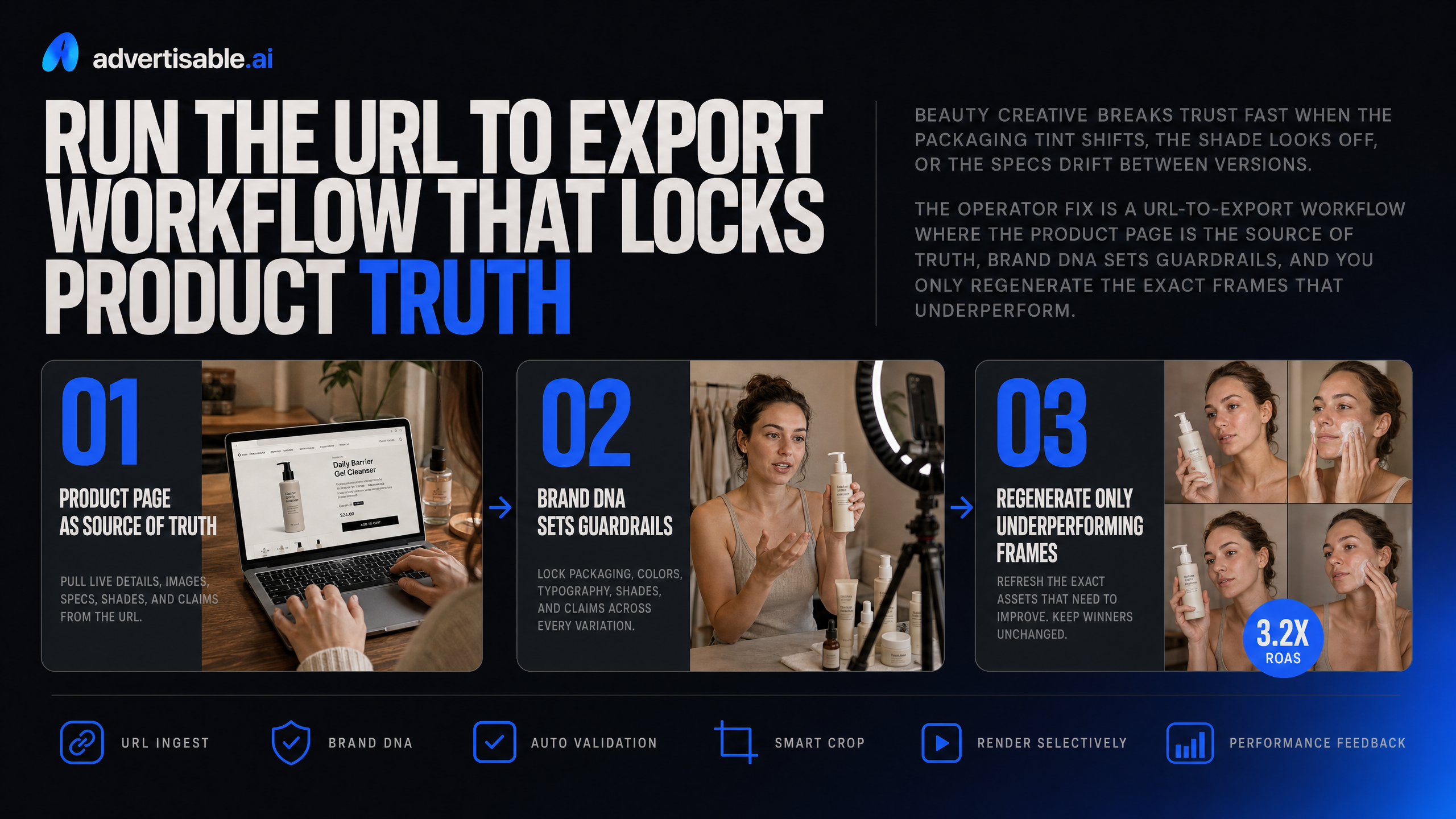
Beauty creative breaks trust fast when the packaging tint shifts, the shade looks off, or the specs drift between versions. The operator fix is a URL-to-export workflow where the product page is the source of truth, Brand DNA sets guardrails, and you only regenerate the exact frames that underperform.
Import from your product URL
Start every batch by importing your product URL so packaging color, label text, and key specs are captured once and reused across every variation. This is the simplest way to stop “close enough” renders that create shade confusion in-feed.
For testing, pick one hero SKU and keep it fixed for at least a 48-72 hour readout. You want your first batch to teach you about hooks and angles, not get contaminated by swapping shade names, pack sizes, or label variants mid-test.
Operationally, the URL import becomes your one source of product truth. In Advertisable AI, this is the Product URL Import that pulls the product facts and visual references you want reflected consistently in storyboards and final exports.
- Capture checklist: exact shade name, finish descriptor, pack size/volume, applicator type, and any on-pack callouts you expect to appear on-screen
- Hero SKU selection criteria: highest margin, highest inventory depth, clearest shade differentiation, and the SKU you can support with consistent landing page messaging
- QA acceptance criteria before you generate variants: packaging hue matches your PDP images, label text is legible and correct, and specs are not invented or rounded
Lock consistency with Brand DNA
Brand DNA is where you lock what must not move: packaging shade, on-screen text rules, and claim language boundaries. You are not trying to restrict creative, you are preventing drift that forces rewrites and re-exports later.
Set explicit guardrails for color and typography so your pack does not wander toward a different shade family across variations. Then set tone boundaries and a claim vocabulary list so scripts stay inside what you can stand behind.
You still get variation by changing only the variable you are testing: hook, proof format, or visual mood. The product truth stays constant, so performance shifts map cleanly to the thing you changed.
- Shade and packaging guardrails: “do not alter label colors,” “no alternate cap color,” “no new graphics,” “keep shade swatch true-to-pack”
- Text guardrails: approved font family cues, max words per overlay, and banned phrases that imply unverified outcomes
- Claim boundaries: paste your approved claims and required qualifiers into Brand DNA so every storyboard stays within those lines
Fix weak scenes frame by frame
When an ad loses, you rarely need a full rebuild. Regenerate only the losing scene so you protect what is already working and keep iteration tight within a 48-72 hour cycle.
Hold constant the product, packaging, and approved claims while you change a single scene variable: the first-second hook, the application close-up, or the proof moment. That is how you avoid “new ad, new everything” tests that cannot be diagnosed.
Use frame-by-frame control to correct the exact failure mode: a shaky pack shot, an off shade read, or an overlay that crowds the product. Then export channel-ready sizes so the same creative is comparable across placements.
- Scene triage rule: only regenerate scenes that are responsible for the miss (usually hook clarity, product readability, or proof believability), not the whole timeline
- Non-negotiables to freeze: hero SKU visuals, shade name, pack specs, and the claim set locked in Brand DNA
- Export readiness: render 9:16 for TikTok, 1:1 and 4:5 for Meta placements, and 16:9 for YouTube without rebuilding the storyboard
Ship claims accurate creative without triggering scepticism
Claims QA checklist for beauty
Your fastest way to lose trust at scale is shipping AI-generated creative that overstates efficacy. We treat claims as production constraints: if it cannot be proved, it cannot ship, even if the video looks perfect.
Run every script, on-screen text, and caption through a QA pass before you generate variations. Keep one variable changing per batch, then read results after 48-72 hours without “improving” claims mid-test.
- Ban list (auto-reject): “clinically proven” (or “clinically tested”) unless you have the underlying substantiation package ready to share internally
- Quantifiers: avoid absolutes (always, instant, permanent); use bounded language and include “results may vary” when describing outcomes that differ by skin type, routine, or baseline condition
- Supporting assets to attach to the claim: the study or substantiation file, the relevant test summary (instrumental, consumer, dermatologist), and a small set of representative reviews that match the exact claim wording
This keeps your “proof” feeling like documentation, not persuasion, which is what sceptical beauty buyers are actually screening for.
Before after governance rules
Before/after is a performance claim, so your QA on it needs to be tighter than your normal creative check. The image itself has to be honest - no disclaimer can fix a misleading before and after.
Treat before/after as an audited asset type with hard acceptance criteria, not a style choice. That is how you scale output without drifting into synthetic “results” that look too perfect to believe.
- Source files and permission tracking: store original captures, model release/usage rights, product batch/lot if relevant, and the exact creative IDs each asset appears in
- No filters, retouch, or relighting: same camera settings, angle, distance, and lighting setup; no skin-smoothing, exposure shifts, or color grading that changes redness, pigmentation, or shade match
- Captions must include: timeframe (for example, Day 0 vs Week 4), routine details (frequency and companion products), and any required qualifiers tied to the claim
Build beauty creative that stays product-true, then scale it
Beauty ads live or die on the product looking exactly right, real packaging, true texture, accurate shade, and on proof that feels believable, not exaggerated. We built Advertisable AI for that constraint.
Start with one hero SKU. Import your Product URL so the platform pulls the real source of truth. Then lock Brand DNA so packaging, labels, specs, and approved claims do not drift across variations.
Generate a single-variable batch of hooks and angles in the Storyboard Editor, then run 48 to 72 hour readouts. Only change the losing scene, hold the rest constant, and regenerate at the scene level.
Acceptance criteria: shade match is consistent, claims match your approved list, and exports are channel-ready in 9:16 and 1:1. If you want to pressure test this workflow fast, start a $5 3-day trial.
Frequently Asked Questions
Q: How is this different from HeyGen or other AI video tools?
A: We are built for performance creative, not presenter-style videos. You start from your Product URL, lock Brand DNA for packaging and claims accuracy, and produce UGC-style and product ads you can test and iterate with scene-level control.
Q: Can I regenerate just the hook without redoing the entire ad?
A: Yes. You can regenerate a single scene, like the hook, while holding the rest of the storyboard constant. That lets you run clean, single-variable hook batches and keep your 48 to 72 hour readouts interpretable.
Q: How do you ensure product specs and claims stay accurate?
A: We pull product facts from your Product URL, then you lock them in Brand DNA as guardrails. Your QA check is simple: packaging and labels match the source page, and every claim shown is on your approved list before you export.