Ad Fatigue: How to Tell If That's Really Your Problem
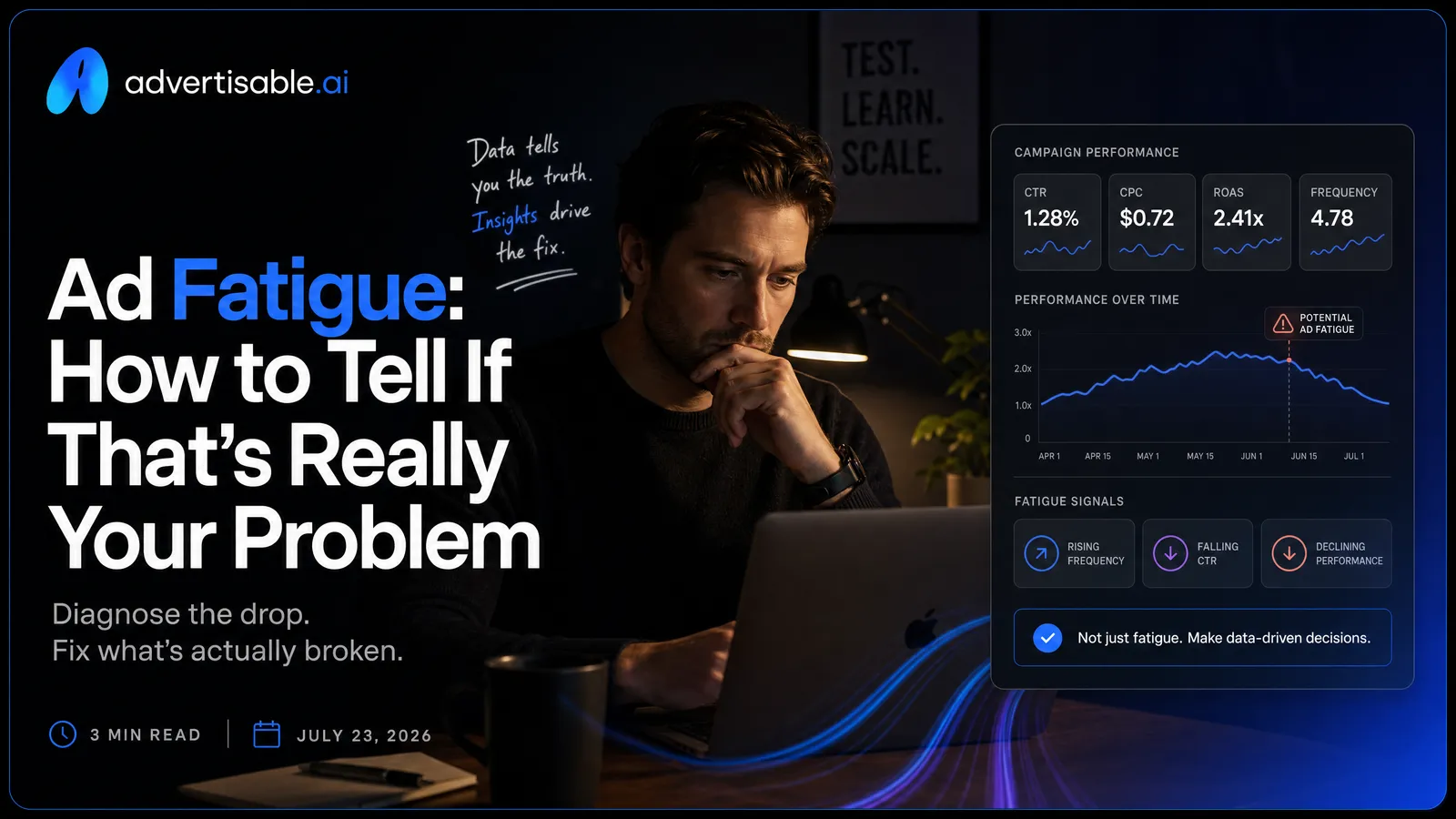
Ad fatigue is when the same ad keeps getting shown to the same audience and performance declines because attention and response drop with repetition.
Here’s the fastest way to diagnose and respond without rebuilding your whole creative strategy:
- Segment before you interpret: separate prospecting vs retargeting and key audience pockets first.
- Call it “true fatigue” only when frequency climbs and performance decays gradually together.
- If performance was bad from day one, you do not have fatigue, you have a weak hook.
- Use a one-variable test batch: change only the hook and hold everything else constant.
- Lock the four-beat anatomy so results map to a single decision, not a messy rebuild.
- Set QA acceptance criteria for the first frame so your pattern interrupt is actually distinct.
When the bottleneck is shipping enough on-brand hook variations quickly, we built Advertisable AI Video Ad Generator to support controlled iteration: Brand DNA guardrails keep claims and voice consistent, the Storyboard Editor locks your hook, product moment, proof element, and CTA structure, and Scene Regenerator lets you regenerate only the weak beat without introducing mixed-variable noise.
Start by treating “my ad stopped working” as a symptom, then work backward to what actually changed in your system before you blame the audience.
Treat 'my ad stopped working' as a symptom
Why refreshes often fail
Most “refreshes” fail because you change too much at once, then try to interpret noisy results. A new edit, new offer framing, new proof, and a new hook might ship together, but you have no idea which change caused the drop or the temporary rebound.
Operationally, a refresh also tends to preserve the wrong parts. Teams tweak copy lines or swap a new opening clip, but they keep the same first-frame structure and the same two-second promise, so the audience experiences it as the same ad again.
Finally, you can do a clean refresh and still see decline because the root cause was never creative in the first place. Repetition is only one input, and perception degrades before clicks do - people start tuning an ad out well before they stop clicking it.
- Mixed-variable refresh: hook, product moment, proof element, and CTA all change in one push, so the readout is unattributable
- Cosmetic refresh: minor scene swaps that leave the same hook logic and first-frame silhouette intact
- No readout window: judging within hours instead of a consistent 48-72 hour window
- No acceptance criteria: no pre-set “keep, kill, or iterate” rules tied to a primary KPI (for example CTR or CPA)
A quick working definition
Use this working definition: “My ad stopped working” is a KPI trend shift caused by the audience learning your pattern faster than you are shipping distinct creative variations.
In practice, it looks like this: you keep delivery steady, but engagement and efficiency slide because the hook no longer earns a pause and the message gets filtered out as familiar.
Treat it as a symptom, not a diagnosis. Until you can point to which metric moved first, in which audience, over a consistent 48-72 hour readout, you do not know whether you are dealing with repetition effects, audience limits, or a measurement issue.
- Symptom statement: “Performance is down.”
- Working definition: “Performance is down because repeated exposure reduced attention to this specific creative, within this specific audience, over this specific time window.”
- Minimum specificity: audience segment + primary KPI + time window (48-72 hours) + what stayed constant
How genuine creative fatigue shows up in performance
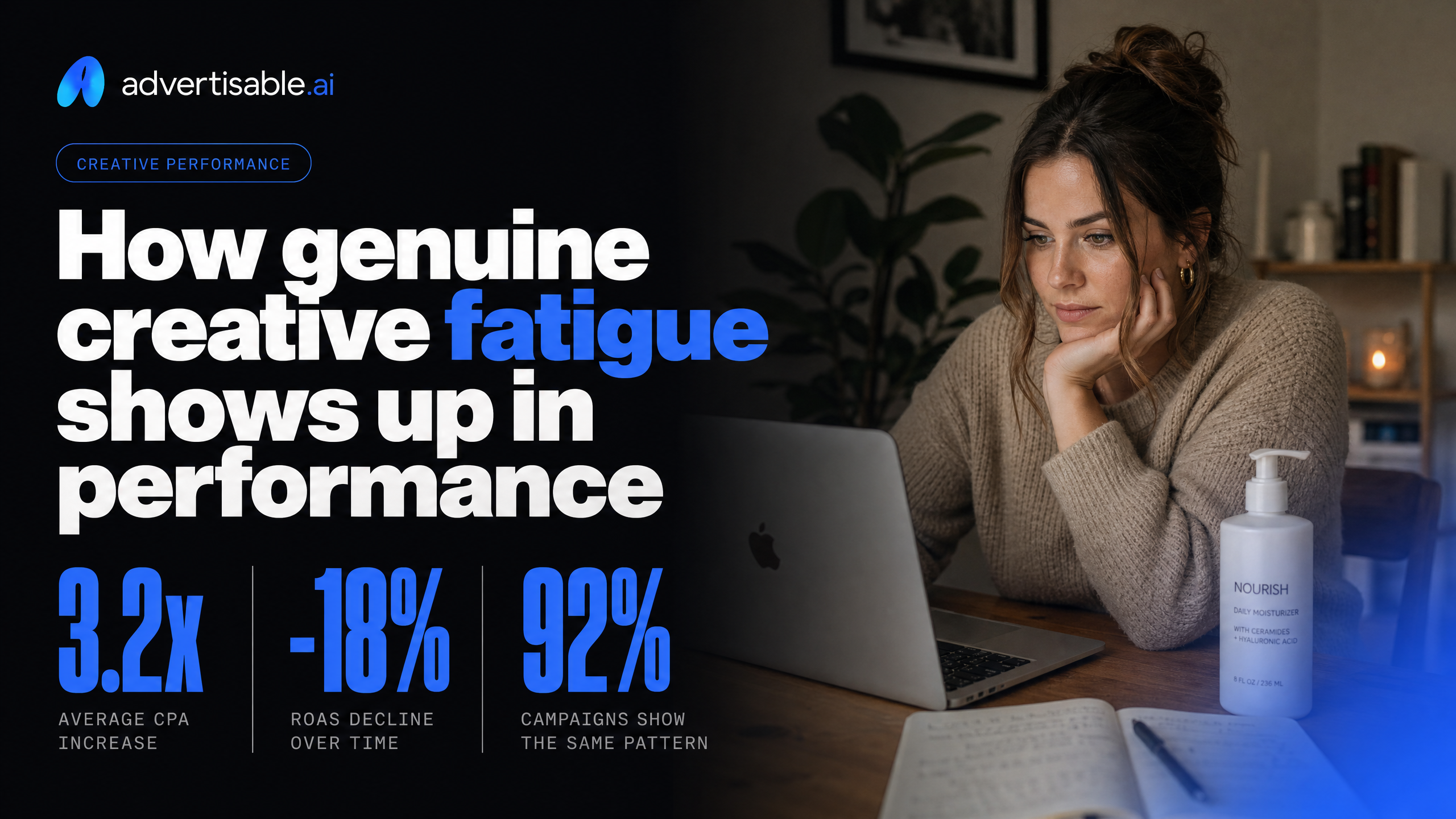
Genuine creative fatigue looks like a specific KPI shape: the ad works, then slowly loses efficiency under the same conditions. The key is the slope, not the single bad day.
Gradual decay after a real run
Real fatigue usually shows up as a gradual decline after a proven stretch, not an immediate faceplant. You see a steady weakening in early attention signals first, then downstream cost efficiency follows.
Operationally, this is easiest to spot when you are holding constants: same offer, same four-beat anatomy, same placements and budget posture, and no major audience edits. When those are locked and the creative has already demonstrated viability, a slow slide is more diagnostic than volatility.
A practical readout window is 48-72 hours per batch, and you are looking for consistent directionality across multiple checks, not a single noisy day.
- Thumb-stop or hold-time proxy softens first (your first 1-2 seconds stop earning attention)
- CTR trends down while CPC trends up over successive readouts
- CPA drift is delayed relative to the CTR drop because the funnel is still converting the remaining clickers
Why does the same audience start feeling repetitive?
When the audience does not change, repetition rises even if you think you are rotating, because the platform learns who is most likely to respond and keeps serving them. Your frequency climbs, your best pockets get over-served, and incremental reach gets harder.
In practice, you start seeing variation-level performance compress: new cuts do not break out, and the winners decay faster. The creative is not failing to convert, it is failing to feel novel.
This is why we treat “new creative” as a controlled variable, not a vibes-based refresh. If you change hook, product moment, proof, and CTA at once, you cannot tell whether repetition or mixed variables caused the miss.
- Same targeting, rising frequency, falling marginal returns
- Hook lines start sounding interchangeable across your own ads
- Higher spend goes to the same responder cohort instead of expanding reach
Relief when reaching new people
A strong tell is relief when you reach genuinely new people: performance rebounds without any fundamental change to what you are selling. The same creative becomes “good again” because the audience has not been exposed to it yet.
This is where a simple test separates the two: if a new creative cut restores CTR and lowers CPC within the same audience, you are dealing with fatigue; if the rebound only happens when you expand to a fresh audience, you are closer to saturation.
From an ops standpoint, your acceptance criteria should be simple: does a single-variable hook batch move attention metrics inside 48-72 hours without needing an audience change?
Three common problems that get mistaken for ad fatigue
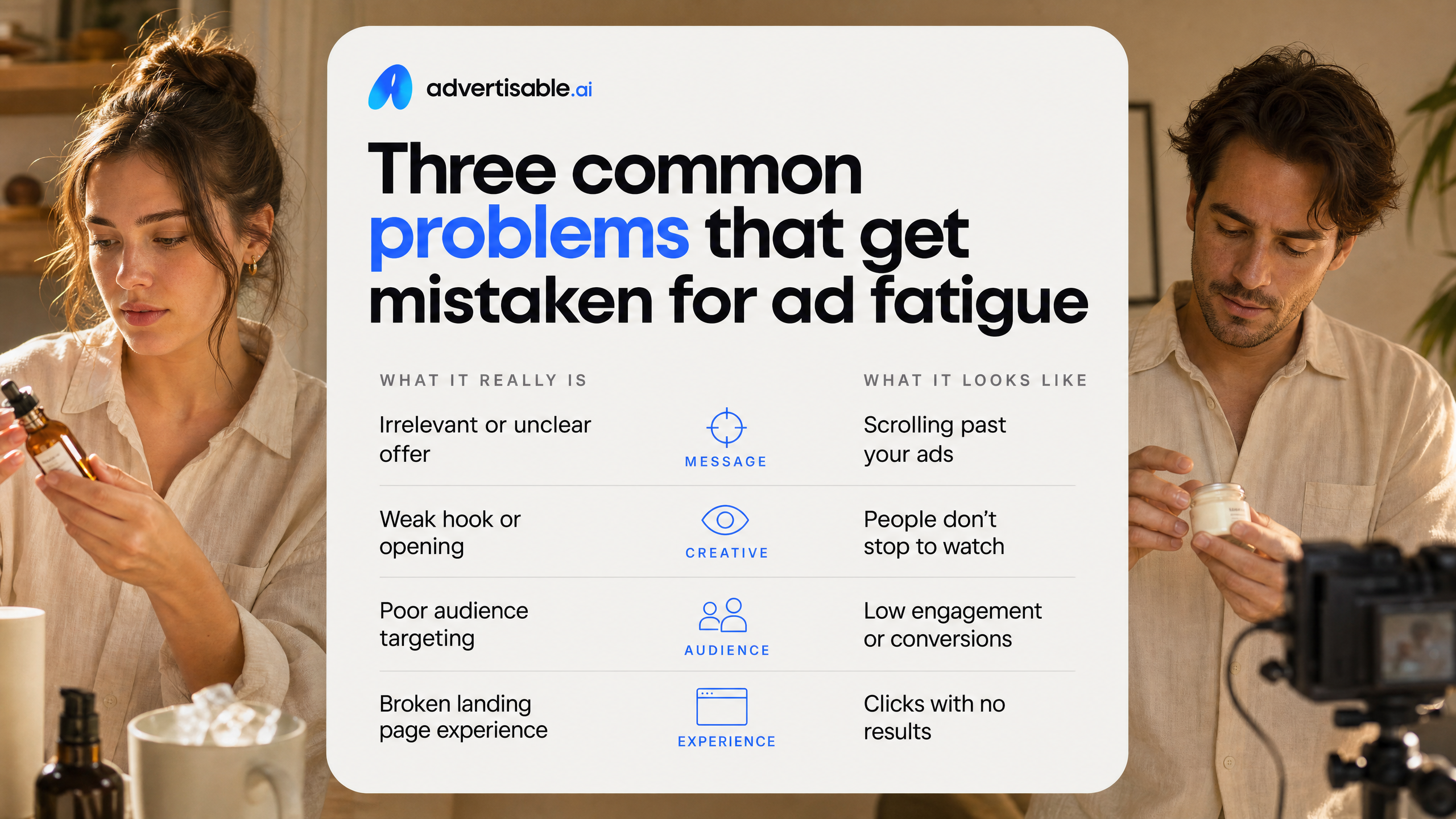
The ad was never good
Sometimes performance drops because the concept had no real edge to begin with, not because the market got tired of it. In that case, you are seeing normal regression after an initial delivery burst, not a “worn out” message.
Use a controlled check: keep the same audience and landing experience, then run a 48-72 hour one-variable test batch where only the hook changes. If your CTR does not materially improve across 10-20 hook variations, the problem is usually upstream: weak product truth, unclear promise, or a first frame that does not create a pattern interrupt.
- Acceptance criteria: the first frame is visually distinct in-feed and the promise is understandable in under 2 seconds
- QA check: the four-beat anatomy is intact (hook, product moment, proof element, CTA) so a hook loss is not caused by a missing product moment or proof
- Next-test decision: if none of the hook variations move CTR, do not “refresh” randomly; rebuild the core promise and proof, then re-test hooks
Is your audience the bottleneck?
If your creative is solid but your audience is tapped out or mismatched, it will look like fatigue while actually being saturation or targeting friction. The distinction is testable: a new creative cut that restores CTR and lowers CPC within the same audience points to fatigue, but a rebound that only happens after you reach a fresh audience points to saturation.
Look for a split by audience segment: in saturation, engagement and conversion tend to slide together as you burn through intent; in fatigue, conversion rate often holds while costs rise. In fast-cycle environments like short-form video, a narrow audience can saturate in a matter of days, so check the size of the pool before you blame the creative.
- Hold constant: spend level and creative structure; change only the audience
- Readout metric: CTR and CVR move together (audience issue) vs. CTR down while CVR holds (more consistent with fatigue)
- Next-test decision: broaden or re-map targeting before you rebuild the ad
Delivery and auction conditions shifted
Auction dynamics can change while your ad stays identical, and the dashboard will still look like “people are tired of it.” The result is higher CPC, worse CPM efficiency, or less stable delivery that drags CPA without any meaningful change in the creative itself.
Treat this as an environment change until proven otherwise. Run a 48-72 hour control window where you freeze the creative and compare performance against your own recent baseline for the same audience and conversion event, then re-run the exact same creative in a second window.
If the KPI drop repeats without rising frequency and without a creative-side change, prioritize diagnosing delivery conditions before you spend a week regenerating hooks.
- Acceptance criteria for “not fatigue”: frequency is flat, but CPM and CPC jump at the same time
- QA check: no unplanned edits to captions, offer, or proof element that would contaminate the readout
- Next-test decision: keep the current creative stable and isolate one variable at a time when conditions normalize
A practical diagnostic order you can run today
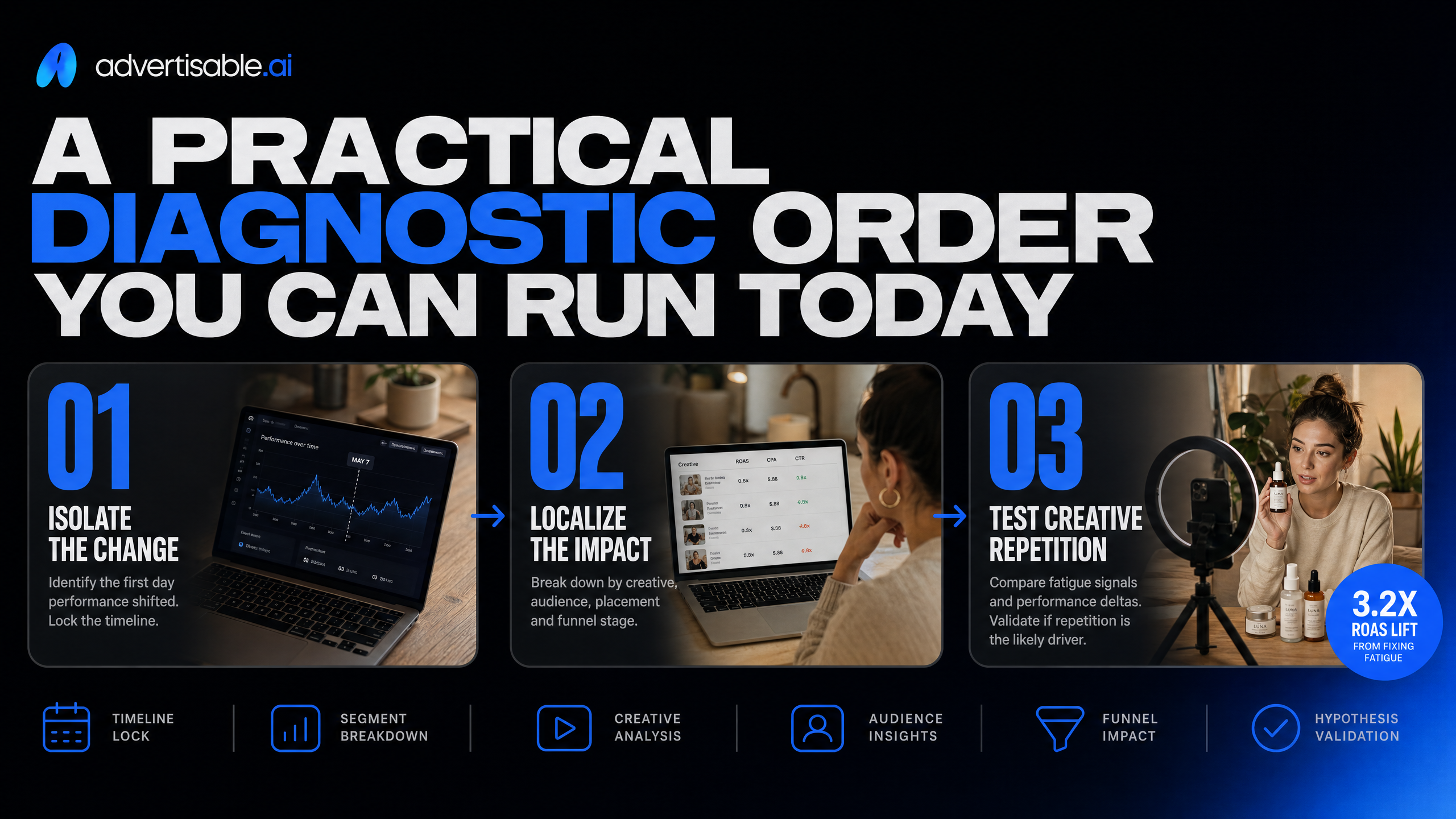
Your goal is not to explain every metric move. Your goal is to isolate what changed, where it changed, and whether creative repetition is the most likely driver.
Segment before you interpret trends
Trend lines lie when you average unlike audiences together. Segment first, or you will mislabel normal mix-shift as creative wear-out.
Keep your readout window tight enough to act. We use a 48-72 hour snapshot for direction, then rerun if volume is thin.
- Break out by audience type: prospecting vs retargeting
- Break out by creative age: new (0-3 days), mid (4-10 days), old (11+ days)
- Break out by placement or format only if you can keep spend and audiences consistent across the cut
Read the chain, not one KPI
Diagnose in sequence, because upstream problems create downstream noise. We read thumb stop or hold first, then CTR, then CPC, then CVR, then CPA or ROAS.
Creative fatigue often shows up as weaker attention and click intent before conversion behavior changes. If CVR stays roughly stable while CPC and CPA rise, your hook is usually the first place to look.
Acceptance criteria: you can point to one obvious break in the chain, not five small moves that all contradict each other.
- Hook problem: hold drops and CTR drops, then CPC rises
- Offer or landing mismatch: CTR holds but CVR drops, then CPA rises
- Tracking or attribution noise: CTR and CVR look stable but CPA swings without a matching upstream shift
Match signals to one cause
Do not “fix” three things at once. Pick one cause hypothesis, then run one one-variable test batch so the result is attributable.
A clean test means you lock your four-beat anatomy (hook, product moment, proof, CTA) and change only one beat. The operating range is 10-20 hook variations with everything else held constant for 48-72 hours.
In our workflow, Brand DNA guardrails plus the Storyboard Editor and Scene Regenerator are how you ship that batch without accidental claim drift or mixed-variable edits.
- Hypothesis: hook is fatigued -> change only the first 2 seconds, keep product moment, proof, CTA identical
- Hypothesis: proof is stale -> swap only the proof element, keep hook and CTA identical
- Stop rule: if results are directionally mixed, rerun the same single-variable batch rather than adding new changes
What to do next for each diagnosis, with a 48-72 hour hook test
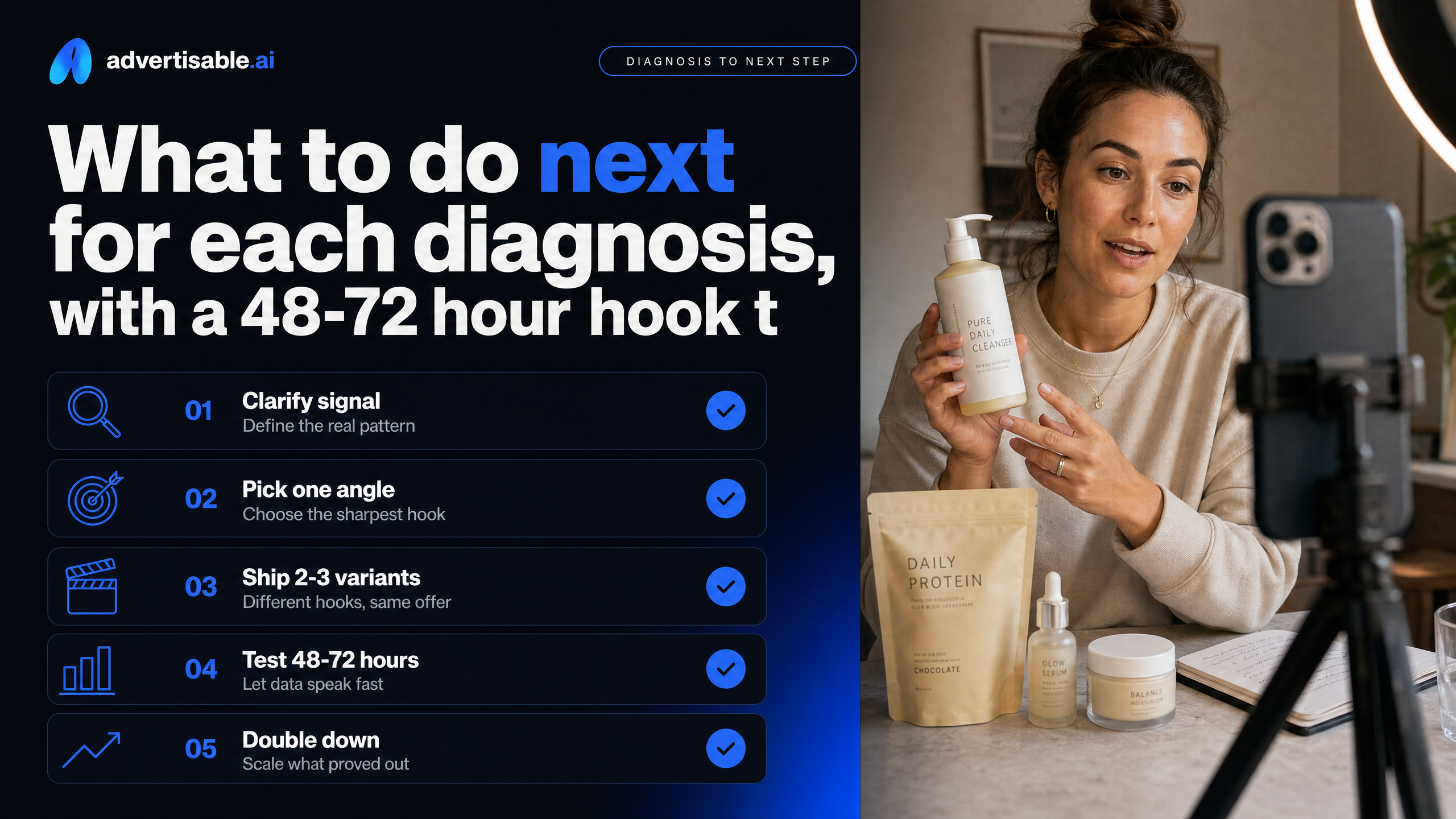
How Do You Run a One-Variable Hook Batch in 48-72 Hours?
Ship 10-20 hook variations where only the first 2 seconds change, then read results after 48-72 hours using the thumb stop to CTR to CVR chain. Your goal is a clean learning, not a “winner” you cannot explain.
Lock the four-beat anatomy before you generate anything: hook, product moment, proof element, CTA. That prevents mixed-variable noise and keeps your downstream metrics interpretable.
Acceptance criteria: any hook you keep must earn attention (thumb stop or hold proxy), improve CTR, and not degrade CVR. If CTR lifts but CVR drops, you likely wrote a bait-and-switch hook and should rewrite the promise, not the offer.
- Define one learning goal: “Which promise earns attention from this audience?”
- Hold constant: product moment scene, proof scene, CTA scene, offer, landing page, aspect ratio, and run window
- Change one thing only: the hook (visual pattern interrupt, first-line copy, or first-frame composition)
- QA before launch: screenshot the first frame of every variation and confirm the claim is allowed under your Brand DNA guardrails
- Pre-set decisions: kill hooks that lose on CTR, scale hooks that lift CTR without CVR loss, rewrite hooks that spike clicks but reduce conversion
Next Steps by Root Cause (Based on the Hook Batch Readout)
Use the hook batch as a fork in the road. The same 48-72 hour readout tells you whether you have a hook problem, a proof problem, or an audience-level ceiling.
If new hooks restore CTR and keep CVR stable, treat it as creative fatigue: keep the winning hook pattern, then produce the next 10-20 hooks in the same structure. If hooks lift CTR but CVR is flat or down, your “product moment” and proof are not matching the promise, so iterate proof next while holding the hook constant.
If none of the hooks move CTR meaningfully, your issue is usually not the opener. Move the variable to proof (stronger, more specific credibility) or the product moment (clearer reveal earlier). In Advertisable AI, we run this as scene-level regeneration: keep beats 2-4 locked and regenerate only the weak scene until the story reads clean.
- Diagnosis: Hook fatigue (CTR down, CVR stable) -> Next test: another hook-only batch; keep product moment, proof, CTA locked
- Diagnosis: Message mismatch (CTR up, CVR down) -> Next test: proof-only batch; keep hook and CTA locked; remove exaggerated implications
- Diagnosis: Weak clarity (CTR flat, comments like “what is this?”) -> Next test: product moment-only batch; reveal product in beat 2 earlier and more explicitly
- Diagnosis: Creative same-ness (first frames look interchangeable) -> Next test: pattern-interrupt-only batch; change first-frame composition and opening verb without changing claims
When it is true fatigue, refresh the tired beat without starting over
Keep the winning structure locked
When fatigue is real, your fastest path back is to keep the proven four-beat anatomy locked and refresh only the beat that is losing the audience. Rebuilding the whole ad resets learning and introduces mixed-variable noise you cannot attribute.
Lock the sequence (hook, product moment, proof, CTA), lock the offer and claims, and keep the product moment timing consistent. Your acceptance criteria should be operational, not vibes: the new cut must be export-ready, on-claim, and readable sound-off in the first 2 seconds.
Use a 48-72 hour readout with the same audience conditions you used to identify fatigue. You are looking for a clean signal that the structure still converts when the opening is refreshed.
- Hold constant: product moment, proof element, CTA, offer, on-screen claim language, aspect ratio
- Change: one hook variable only (opening line, first frame, first 2-second pattern interrupt)
- QA gate before launch: first frame distinctiveness, claim compliance, captions legible on mobile, no off-brand visual drift
How do you ship on-brand hook variations fast?
Speed comes from batching, not improvising: generate 10-20 hook variations in one pass, then test them as a one-variable batch over 48-72 hours. This keeps the readout attributable while giving you enough surface area to find a new thumb-stop.
Your guardrail is Brand DNA, not a creative director review loop that takes a week. In Advertisable AI, we use Brand DNA to lock specs and voice, then generate hooks that stay inside those constraints so you are not trading speed for drift.
Set a simple pass-fail bar before you look at performance: each hook must clearly state one promise, show visual contrast in frame one, and not introduce a new claim you cannot support.
- Batch size: 10-20 hook variations per test window
- One learning goal per batch: restore thumb stop without changing downstream beats
- Naming convention: HookAngle_V1 to V20 so you can map results to the exact opening
Swap one scene with control
When a single beat is tired, swap one scene, not the whole video. Scene-level regeneration is how you keep everything else constant and avoid production churn.
Treat the swap like an operator change request: specify the exact beat, what must remain unchanged, and what the new scene must accomplish. The Scene Regenerator in Advertisable AI is built for this: regenerate only the weak scene while preserving the storyboard sequence and locked claims.
Acceptance criteria: the new scene must be visually distinct from the previous cut, preserve the same product truth, and pass QA in a single review cycle.
- Define the target: “Replace first 2 seconds only; keep product moment frame and CTA text unchanged.”
- Control inputs: same script lines after the swap point, same proof asset, same CTA
- QA checks: first-frame contrast, caption timing, product shown clearly, no new unsupported claim
Run the 48 to 72 hour hook batch, not another full rebuild
If your KPIs dipped after a basic refresh, your next move is controlled iteration, not more random changes. We recommend you pick one objective metric to validate first, typically CTR before you debate CVR, then ship a one variable test batch focused only on the hook.
In Advertisable AI Video Ad Generator, you start by pasting your product URL so we can extract Brand DNA guardrails. Generate 10 to 20 hook variations while you hold the product moment, proof element, and CTA constant. QA each first frame for pattern interrupt, verify claims match your Brand DNA, then export platform-ready formats.
After 48 to 72 hours, keep the hooks that lift your target metric and use the Storyboard Editor to regenerate only the weak scene beats. Repeat weekly so fatigue becomes predictable, not an emergency.
Frequently Asked Questions
### What is an example of ad fatigue?
You see steady performance for a stretch, then frequency keeps climbing in the same audience while CTR falls and CPA rises even though your offer and landing page did not change. The ad is still delivering, but people are signaling they have already processed it and are scrolling past.
### What causes ad fatigue?
Most fatigue is repetition plus relevance decay: the same hook and first frame stop earning attention, so fewer people enter the click and conversion path. It accelerates when you keep serving near-identical openings to the same audience segment.
### How many ad variations should I actually test?
Start with 10 to 20 one variable hook variations in a 48 to 72 hour readout window. More only helps if each hook is meaningfully distinct and you can QA first frames, claims, and export readiness without creating noise.
### What's the difference between a winning hook and a durable hook?
A winning hook improves early attention signals in your initial readout, typically CTR. A durable hook also holds up downstream, meaning CVR does not break and results stay stable when you repeat the hook in new audiences.
### Why do my AI-generated ads look like competitor ads?
Most generators default to common direct-response openings and familiar UGC framing, so your first frames converge with everyone else. Use Brand DNA guardrails and scene-level edits so each hook variation stays on-brand while still delivering a clear pattern interrupt.