Agentic Advertising: What the Shift Means for Your Ads
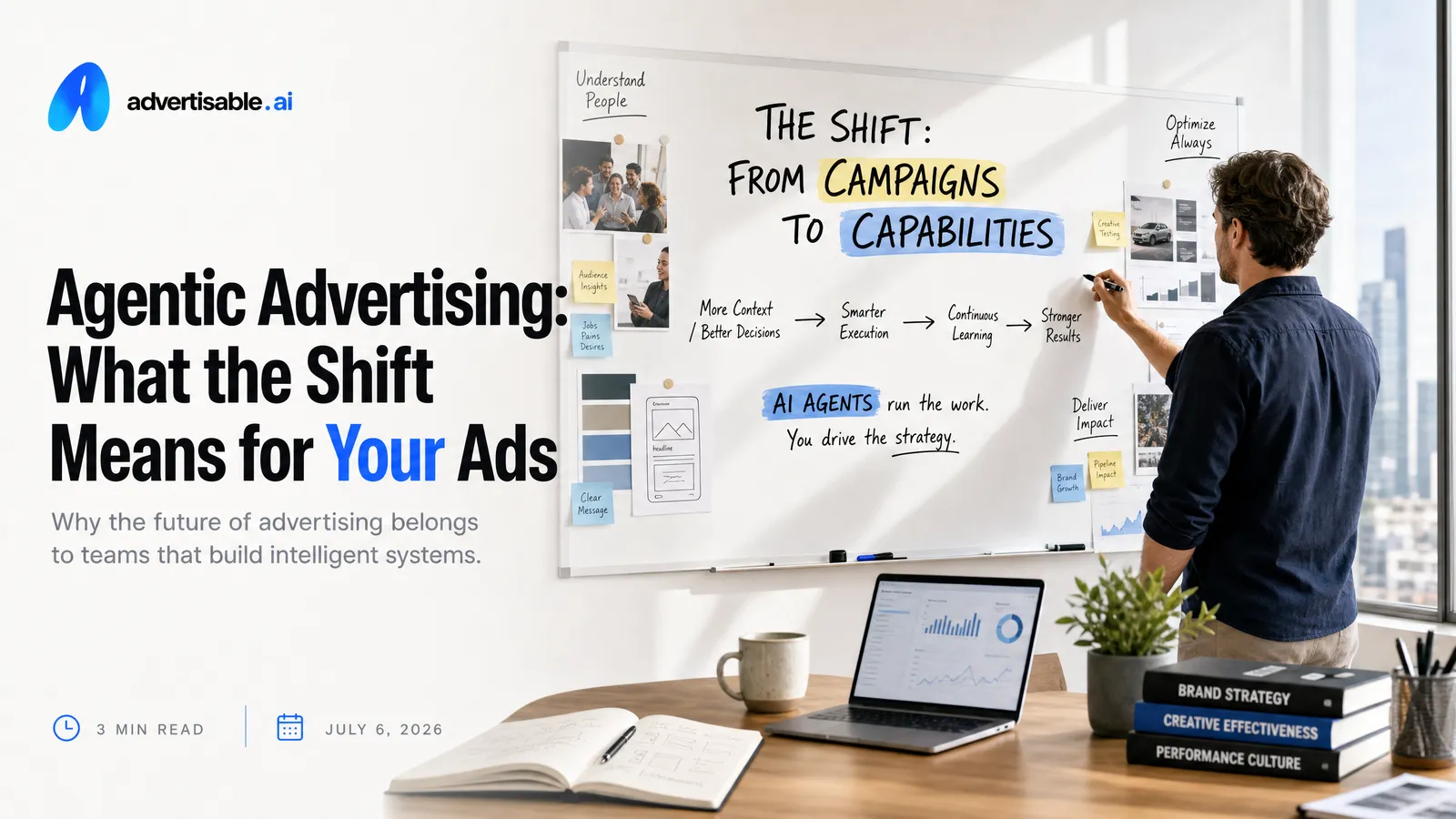
Agentic advertising is when you direct an AI agent toward an outcome and it executes the ad creation work for you, with clear constraints and approvals.
Here's what matters most right now:
- Agentic advertising means you direct outcomes and the agent executes the production steps.
- Your workflow becomes prompts, specs, feedback loops, and review, not manual asset stitching.
- The winning guardrail is brand-locked constraints that prevent drift across variations.
- You stay in control by reviewing every output before anything publishes.
- Agents should not autonomously spend, buy, or publish without explicit direction.
At Advertisable AI, we built an MCP-native advertising workflow where Claude operates the studio, Brand DNA locks on-brand decisions, and frame-by-frame control lets you review and adjust before production-ready exports. That is the practical version of "agentic" teams actually need: speed with human review, not speed without oversight.
The reframe: agentic advertising means directing, not clicking
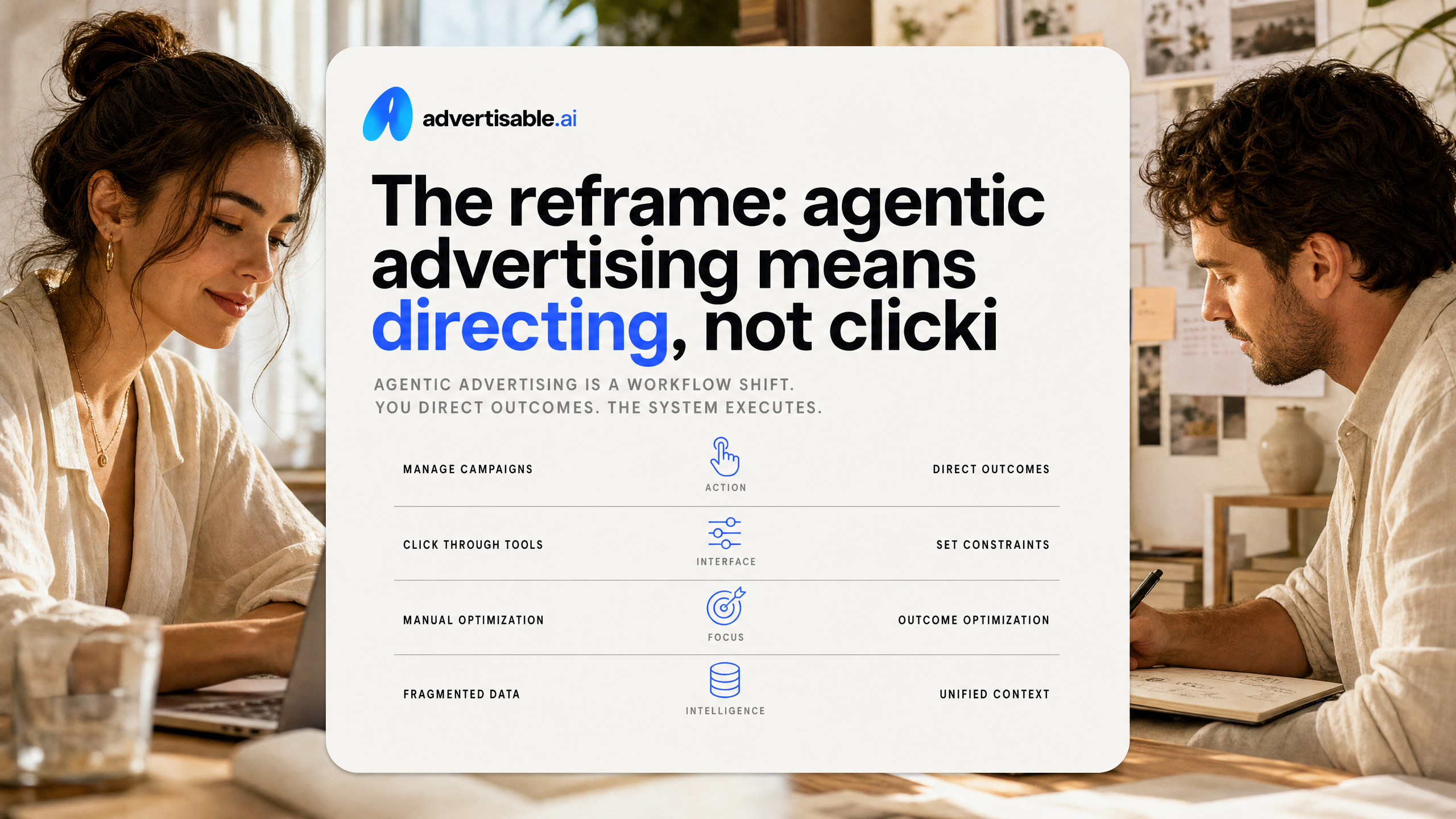
Agentic advertising is a workflow shift: you stop managing ads through endless tool clicks and start directing an intelligent system toward outcomes, with constraints you define.
From dashboards to directed outcomes
The practical reframe is simple: your job moves from operating platforms to specifying the result you want, and letting an agent execute the mechanics. You are no longer rewarded for being the fastest clicker in a dashboard.
In day-to-day performance work, most time disappears into repetitive execution and troubleshooting, not strategy. The promise of agentic systems is that execution becomes the “how,” while you stay accountable for the “why,” the guardrails, and the business goal.
You give direction in terms of outcomes and constraints, then you evaluate whether the system’s choices reflect your intent. That means you have to be explicit about what “good” looks like, not just what buttons to press.
- Outcome: what you are optimizing for (trial starts, qualified leads, incremental revenue)
- Constraints: brand boundaries, audiences you will not target, claims you will not make
- Inputs: what the agent is allowed to use (approved product facts, offers, creative elements)
- Review: where you look at what the agent produced and decide what goes forward
Ad making moves into the agent layer
The bigger change is not bidding automation. It is that creative production itself is moving into the agent layer, where generation, variation, and iteration happen inside the same interface you use to direct work.
Instead of exporting briefs, waiting on versions, then re-briefing after results, you iterate by intent: “keep the proof and CTA, regenerate only the hook,” or “make this a UGC Style video for 9:16.” That is a fundamentally different production loop than traditional creative workflows.
This is where quality diverges fast. If your agent can’t stay on-brand across high-volume variations, you will burn cycles reviewing rewrites and reworks. The control point becomes brand-locked context and scene-level edits, not more prompts.
Why the shift is happening now, even without hype
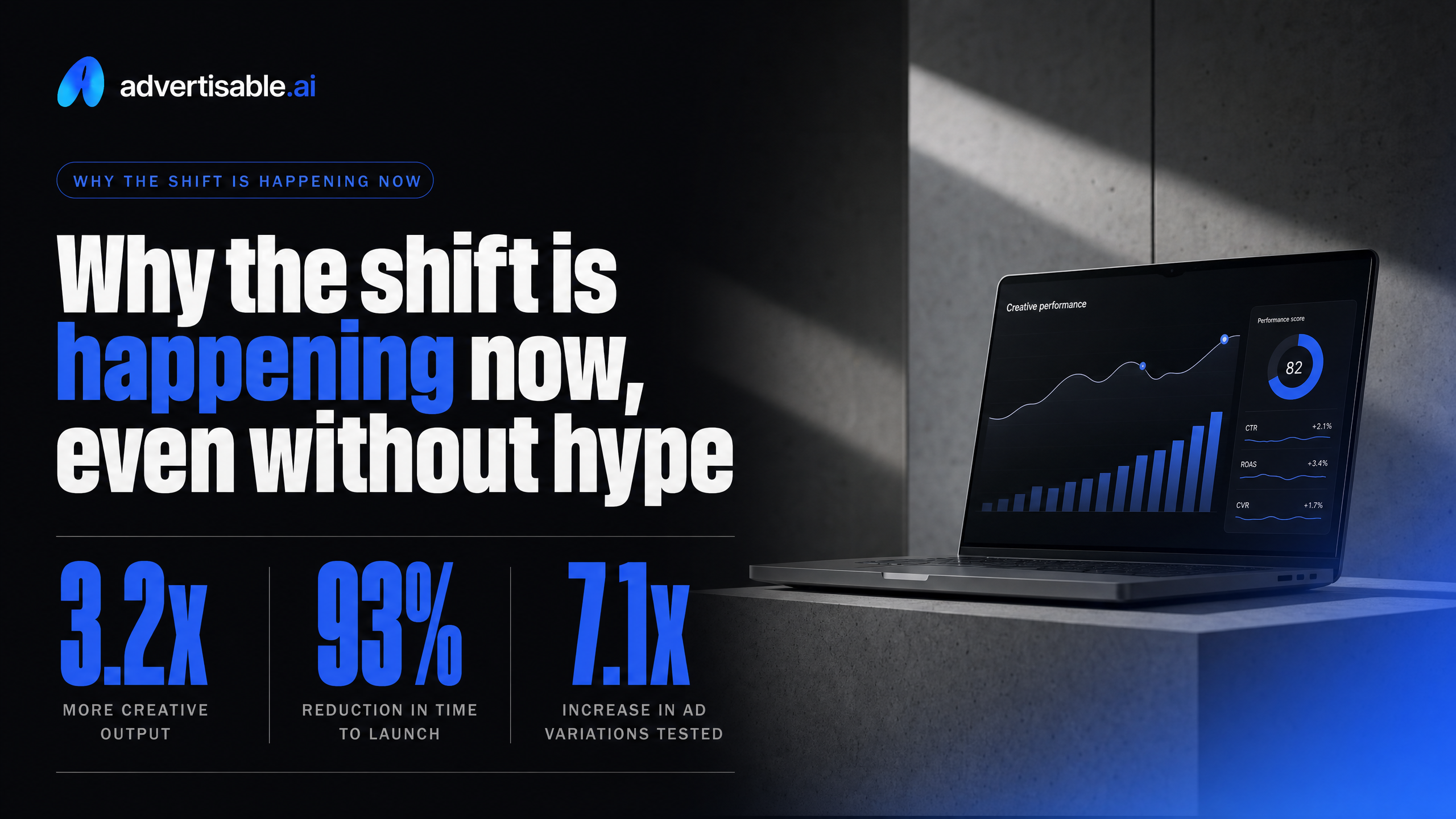
Platforms are becoming agent-ready
This shift is happening because the major ad platforms are increasingly built to accept agent-driven workflows, not just human clicks in a dashboard. You can feel it in the product direction: more APIs, more structured inputs, and more places where “do X with these constraints” is the primary interaction.
In practice, that means the platform is less of a UI you operate and more of an environment your tools can operate inside. For performance teams, the win is speed without improvisation, because you can standardize the request and keep the outputs consistent across campaigns and formats.
The operational change you should watch for is not “autonomous media buying.” It is whether your creative and execution systems can take a clear goal, apply brand constraints, and produce ready-to-review assets fast enough to match your refresh cadence.
- More endpoints that let software create, update, and validate assets (not just export reports)
- Richer schemas for creative specs, placements, and formats, so an agent can generate correctly the first time
- Permissioned access patterns that separate “generate and draft” from “publish and spend,” so humans stay in control
Marketplaces and protocols cut integration time
The second reason this is landing now is integration friction is dropping fast. Instead of custom one-off integrations, you are seeing marketplaces and protocols that make tools interoperable by default, so agents can move from planning to execution without a pile of glue code.
Protocols like MCP matter here because they turn "chat advice" into "chat that can operate your studio." That is the difference between an assistant and an operator: one suggests, the other can actually create the artifact you approve.
From a workflow standpoint, you should expect faster setup, clearer governance, and fewer handoffs between tools. In our world, MCP-native integration patterns are exactly what make it realistic for Claude to generate ads inside an AI ad studio while you keep approvals in a storyboard editor.[](https://advertisable.ai/pricing)
- Standardized connectors, so you are not rebuilding the same integration per vendor
- Clear separation, so the agent handles creative generation while you keep the higher-risk decisions
- Reusable brand constraints, so you are not re-explaining your brand every session
What changes for advertisers: your workflow becomes a conversation
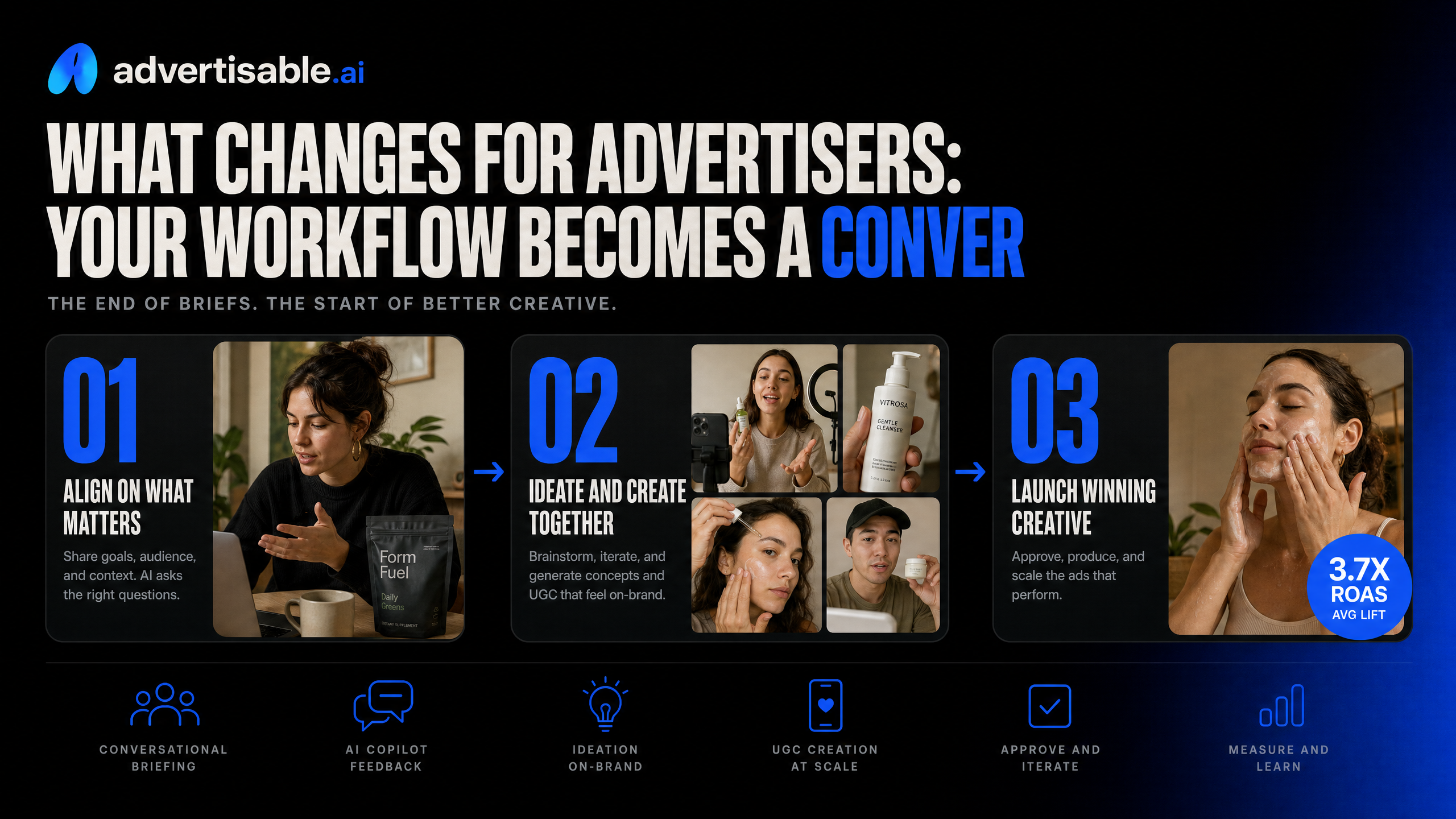
Production becomes prompts, specs, and feedback
In an agentic workflow, “making ads” turns into directing production through language. You spend less time clicking through tools and more time writing prompts, setting constraints, and giving targeted feedback on what the agent returns.
The practical shift is that your best operators start thinking like creative producers: clear inputs up front, fast iteration loops, and structured approvals. Done well, this is how you get volume without brand drift or endless rework.
- Prompts that name the job: channel, objective, audience, offer, and angle (for example: 9:16 prospecting video, hook-first, trial-focused messaging)
- Specs that remove ambiguity: length, aspect ratios, pacing, voice, required claims, and “do-not-say” rules
- Brand constraints: brand-locked guidelines and assets so variations stay consistent at scale
- Feedback that is surgical: regenerate only the hook, tighten proof, swap CTA, or adjust one scene instead of restarting the whole creative
Teams shift from making to judging
As generation gets faster, your team’s bottleneck moves from creation to judgment. The highest-leverage work becomes deciding what is on-brand, what is compliant, and what is likely to perform before you spend budget.
This changes roles more than headcount. Designers and editors still matter, but they increasingly operate as creative directors and QA: they set standards, review outputs, and push iterations toward a specific performance hypothesis.
Your operational muscle becomes evaluation. You need consistent review criteria and a shared language for what "good" looks like across hooks, proof, and CTAs.
In our experience, teams that win here treat the agent as the production layer and keep humans accountable for taste, risk, and go-to-market truth.
- Creative judgment: Does the hook match the ICP and stop the scroll without overselling?
- Brand judgment: Are voice, visuals, and positioning consistent across variations?
- Claims judgment: Are the claims accurate, honest, and consistent with your product positioning?
- Test design judgment: Are you changing one variable at a time so results are readable?
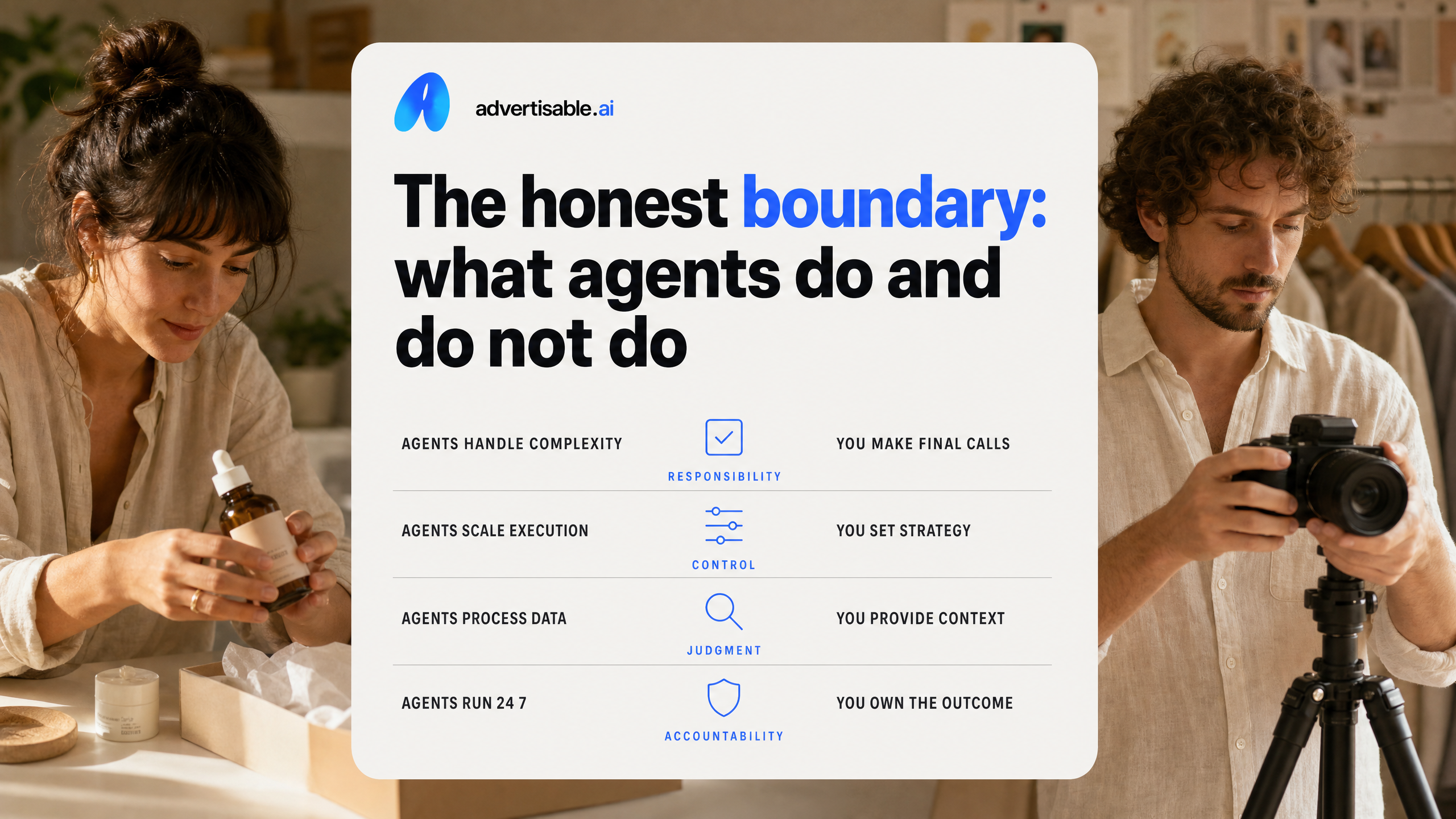
The honest boundary: what agents do and do not do
Agents execute what you direct
In agentic advertising, an agent is not a decision-maker. It is an execution layer that takes your instruction, applies your constraints, and produces the output for you to review.
That distinction matters because it changes what you should expect from the workflow. You are still setting the objective, defining what “on-brand” means, and deciding what counts as acceptable risk. The agent’s job is to compress the busywork into a few clear requests and iterations, so you spend time on judgment instead of production.
- Be explicit about the deliverable (for example: “create 3 hook variations for a 9:16 UGC Style video”)
- State your constraints (brand rules, claims you cannot make, required proof points, formats)
The more precise your direction, the more you can treat the agent like a reliable operator instead of a creative roulette wheel.
No autonomous spend, buying, or publishing
A serious agent workflow does not mean hands-off budgets. You should assume the safe default is: no autonomous spend, no autonomous media buying, and no autonomous publishing.
This is where most hype falls apart in the real world. The most damaging failures are not "the agent made a bad ad," they are "the agent did the wrong thing at scale." You prevent that by keeping humans in the loop at every step that matters, not by wishing the agent gets it right.
Keep the agent focused on creative execution and prep work, while you retain the keys to distribution. With Advertisable AI, Claude generates the ads and you review them using frame-by-frame control before anything gets exported. That is the whole model.
- No payment method access or budget authority
- No ability to launch, edit, or scale campaigns without a human step
- No publishing to live channels without your review and sign-off
How to be ready without losing control
Turn brand rules into constraints the agent cannot ignore
You keep control in an agent-led creative workflow by converting “brand taste” into rules the system can enforce every time. That means your guidelines stop being a PDF and start behaving like constraints.
In practice, this means writing your brand rules in a form an agent can actually parse and apply - your colors, fonts, voice, claims, and product facts captured as clear constraints, not a PDF style guide no tool can read. The win is not just consistency, it is speed, because you are not re-explaining voice, claims policy, visual rules, and exclusions in every session.
The key is to write rules in measurable terms so the agent can fail fast and self-correct instead of drifting.
- Voice and claims boundaries: banned words, disallowed promises, and required qualifiers for sensitive statements
- Formatting constraints: max headline length, max on-screen text per frame, and CTA phrasing you allow
- Visual constraints: logo placement rules, color usage, typography do-not-use list, and safe zones
- Audience guardrails: ICP definitions and excluded segments you never want targeted in creative concepts
When the rules are explicit, review becomes verification, not subjective debate.
Keep human judgment at the center, not the edge
The fastest way to lose control is to treat review as a formality. The agent handles production. You handle judgment. That division only works if you actually look at what comes back before it goes anywhere.
In practice, that means reviewing the storyboard before export, every time. Not because the system forces you to, but because that is where your brand taste, your knowledge of what the market is ready for, and your read on what is accurate all come together. No automated check replaces that.
In our experience, most problems happen when the agent does a reasonable thing at the wrong scale, to the wrong audience, or with a claim that felt fine in isolation but was not. The fix is not a governance system. It is a habit: direct clearly, review before publishing, and keep the brand rules locked.
- Direct clearly: name the job, the format, the audience, and what you will not say
- Review before publishing: look at what the agent produced and decide what goes forward
- Keep brand rules locked: your Brand DNA carries the constraints so variations stay consistent without you re-explaining them every session
- When something is off, correct it at the source: update the brief or the brand rules, not just the output
Advertisable: built agent-native from the start
Most teams will experience agentic advertising first as an interface change: less tab-hopping, more directing work in natural language. We built Advertisable AI for that reality.
MCP-native: Claude operates the studio
MCP-native means Claude is not just generating ideas or copy. Claude can actually run the ad studio, so your instructions turn into real creative actions.
That difference matters because it removes the brittle handoff between chat and tools. Instead of copy-pasting prompts, assets, and revisions across a stack, you direct the work where it happens and get outputs inside the same operating loop.
In practice, you tell Claude what you want changed and at what granularity, and the system produces the result for you to review.
- Connect the Advertisable AI MCP-native integration in Claude settings
- Request a first draft from a product URL
- Review what comes back and give targeted direction before exporting
Brand DNA plus storyboard approvals keep you in control
Speed only helps if the output stays on-brand and nothing ships without you. That is why we pair Brand DNA with frame-by-frame control instead of treating generation as the finish line.
Brand DNA locks your guidelines from a product URL plus your assets, so high-volume variation does not drift in tone, visual rules, or positioning. You get consistency without rewriting the same constraints every session.
Then you review the storyboard before export. Frame-by-frame control lets you regenerate only what needs testing, like the hook, while keeping proof and CTA stable.
You are adopting the agent-native way of working without surrendering judgment. The review stays human, and the agent stays accountable to the rules you set.
- Brand DNA setup: URL input, asset library, buyer context, then lock the rules
- Storyboard review: look at every frame, give targeted direction, or request regeneration scene-by-scene
- Export only after you have reviewed, in platform-ready formats like 9:16 and 1:1
Move fast in the agent layer without giving up the wheel
If your ad workflow is becoming a conversation with an agent, your edge is not more automation. It is tighter constraints, cleaner approvals, and faster creative iteration you can actually trust.
That is exactly what we built Advertisable AI for. You direct outcomes in Claude, and our MCP-native integration routes the work into a real ad studio, not a copy box. Your Brand DNA keeps every variation on-brand, and frame-by-frame control lets you review and regenerate only what you want, like hook-only A/B tests, before you export.
Start with the $5 3-day trial. Drop in your product URL, lock Brand DNA, generate two hook variations, and ship production-ready exports to test.
Frequently Asked Questions
Q: What is agentic advertising?
A: Agentic advertising is when you set a goal and constraints, then an AI agent executes the work steps to get you there. In practice, it shifts your job from clicking through tools to directing outcomes and approving what ships.
Q: What is an example of agentic?
A: You tell an agent to create two new hooks for a top-performing ad while keeping the proof and CTA unchanged, then you review the storyboard and export both versions for testing. The key is you direct the change, and the agent handles the production work.
Q: Is ChatGPT an agentic AI?
A: On its own, it is usually a conversational model, not an agent that can take action inside your tools. It becomes agentic when it can operate connected systems with explicit permissions, constraints, and approval steps.
Q: What is MCP-native advertising and how is it different from regular AI ad tools?
A: MCP-native advertising means Claude can operate an ad studio through an MCP-native integration, so your instructions turn into real creative actions, not just text output. The workflow stays in one place, with governed permissions and a review step before export.
Q: Do I lose control if AI generates ads automatically?
A: No, not if you review before publishing. With Advertisable AI, you look at what Claude generates and use frame-by-frame control to make targeted changes before exporting production-ready files.