Seasonal Ad Creative Shipping in 72 Hours Fast
Build seasonal ad creative that performs and scales predictably by locking one four-beat creative anatomy, testing one variable at a time (usually the hook), and running a fixed 48 to 72 hour readout before you iterate.
Here’s what matters most right now:
- Optimize thumb stop first, because it gates every downstream metric in the chain.
- Use one storyboard: hook, early product moment, proof element, CTA, then iterate safely.
- Hold three beats constant and change one variable to keep attribution clean.
- Batch 10 to 20 hook variants, ship them together, and avoid day-to-day toggling.
- Read results at 48 to 72 hours, then decide: kill, iterate one beat, or scale.
- Set kill rules and QA checks upfront to prevent claims creep and off-brand drift.
We built Advertisable AI Studio for this exact bottleneck: teams that need production-ready performance creative fast, with control. Our workflow extracts Brand DNA from your product URL, keeps you storyboard-first, lets you regenerate a single scene instead of rerendering the whole video, and exports platform-native formats for Meta, TikTok, and YouTube.
Before you touch timelines and tools, you need to see why seasonal creative ships late in real teams, because the delays usually start upstream in approvals, unclear briefs, and preventable rework.
Why seasonal ad creative ships late in real teams
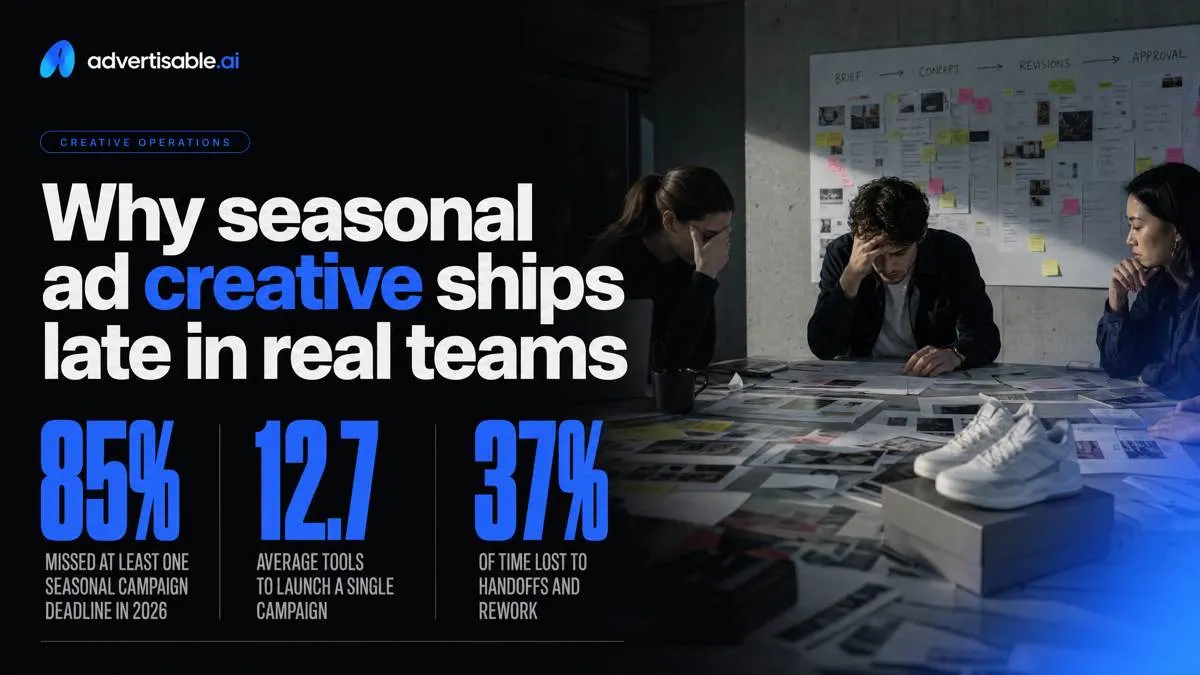
Seasonal ad creative ships late because your system is optimized for coordination, not throughput. It is rarely a “taste” problem. It is an operations and control problem: too many handoffs, too many tools, and too many opportunities for small changes to cascade into full resets.
In a 2026 Knak report, 85% of marketing teams missed at least one planned campaign launch during the past 12 months because of workflow constraints.
You feel it most in approvals. Legal wants safer language, brand wants consistency, paid wants performance hooks, and nobody is looking at the same source of truth. The result is late approvals, late launches, and you miss the highest-intent days because the final sign-off arrives after the window starts.
Then come the rerenders for single-beat changes. A one-line hook tweak, a swapped proof card, or a CTA timing adjustment should be a scene edit. In most workflows it becomes a full-video rerender, new exports for each placement, and another round of review, which turns “one change” into a multi-day slip.
Under time pressure, claims creep is the silent killer. Rushed rewrites stack extra promises into the hook or proof to “make it punchier,” and suddenly you are QAing substantiation instead of testing performance. That creates more review cycles and higher risk of shipping something you later have to pull.
Finally, old seasonal ads stay running because there is no clear ownership of end dates and no kill rule tied to the calendar. You wake up to last season’s offer still spending, not because anyone chose it, but because nobody had a controlled shutdown plan.
What is the one metric you should optimize first?
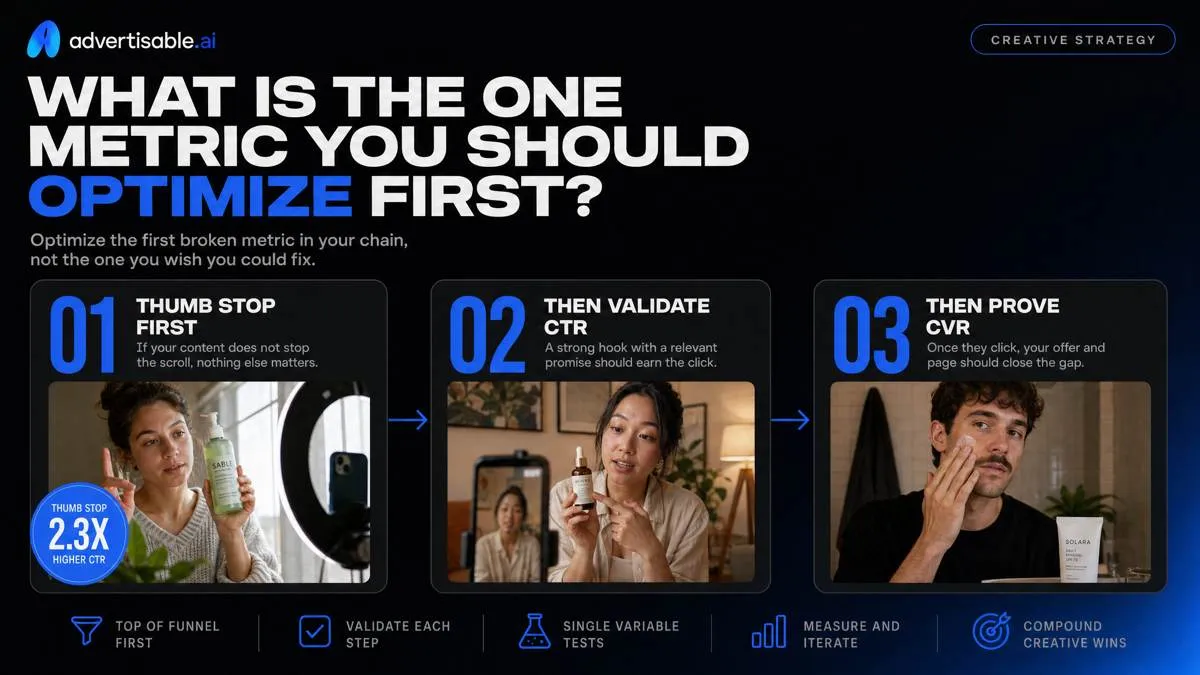
Optimize the first broken metric in your chain, not the one you wish you could fix. For seasonal creative, that usually means starting at the top of the funnel (thumb stop), then validating CTR, then proving CVR, while keeping tests single-variable so every win is attributable.
Thumb stop is your entry signal
Start with thumb stop when you are selling to cold audiences. The first 1-2 seconds are the gate: if people do not pause, your product moment, proof, and CTA never get a chance to work.
This is attention before intent. Thumb stop is not “interest,” it is simply the viewer choosing to give you 2 seconds instead of continuing the scroll. That is why it is the cleanest metric to optimize first in cold prospecting, where you cannot assume desire or familiarity.
Operationally, this forces hook-first iteration priority. We do not touch the proof beat or CTA until the hook earns view time; otherwise you end up “fixing” downstream beats that were never actually seen.
- Acceptance check: the hook states one clear promise inside the first 1-2 seconds, with the product category identifiable on-screen (or verbally) before second 2
- Test design: generate 10-20 hook variants in one batch, hold product moment, proof, and CTA constant
- Readout: evaluate on a fixed 48-72 hour window so you are not reacting to day-one noise
- Definition reminder: thumb-stop performance data frames thumb stop as the percentage of impressions that earn at least 2-3 seconds of video play
CTR diagnoses message clarity
CTR is your message-clarity diagnostic. It tells you whether the promise you made in the hook aligns with what the viewer expects to get by clicking.
A CTR drop with stable thumb stop usually means the hook earned attention, but the value proposition is fuzzy, over-broad, or aimed at the wrong angle for that audience. Treat it as an audience-angle mismatch flag, not a cue to rewrite everything.
To keep CTR attributable, hold the landing page constant while you test. When the page changes during the same window, you cannot tell whether the click behavior moved because of the ad or because the destination changed.
- QA check before you ship: the hook promise, on-screen text, and headline in the first frame agree on the same outcome
- Control rule: do not change URL, page layout, pricing, or offer language while iterating CTR
- Quality check: watch link click quality (bounce and time-on-page) so you do not “win” CTR by attracting the wrong click
CVR proves proof and offer
CVR is where you prove the proof beat and offer are doing their jobs. When conversion rate is the first broken metric, you are usually facing either weak credibility (proof does not land) or weak offer clarity and trust (the viewer hesitates at the decision point).
This is also where retargeting fit shows up. Retargeting audiences often have enough context to click; CVR tells you whether the proof element and offer resolve the last objections.
Avoid multi-change confusion here. If you change the proof, the offer, and the landing page at once, CVR becomes unusable as a learning signal because you cannot attribute the outcome to a specific creative decision.
- Test one variable: keep hook, product moment, and CTA fixed while swapping a single proof element type (for example, one testimonial vs one stat vs one demo outcome)
- Trust QA: remove invented claims, keep the proof specific and believable, and ensure the offer terms are stated once and consistently
- Next-test decision: if CVR is weak but CTR is healthy, iterate proof and offer before you touch hooks again
Build one seasonal storyboard that you can iterate without chaos
Iteration gets chaotic when every seasonal refresh is a rewrite. The control point is a single storyboard that stays structurally identical while you swap one beat at a time, read results in 48-72 hours, and keep your learnings attributable.
The four-beat creative anatomy
A seasonal storyboard is stable when every ad follows the same four beats: hook, early product moment, proof element, and CTA. You keep three beats locked, change one beat per batch, and you can actually explain why performance moved.
Each beat has one job tied to a metric chain. The hook earns the first 1-2 seconds (thumb stop). The product moment prevents “wait, what is this?” drop-off.
Proof carries belief so clicks convert. The CTA removes decision friction so intent becomes action.
Seasonality is a layer, not a rebuild. You can rotate the seasonal context inside one beat (usually the hook) while holding product, proof, and CTA constant, then only regenerate the underperforming scene instead of rerendering an entire video.
Keep the structure consistent across Meta, TikTok, and YouTube by keeping beat order identical and only adapting format constraints (9:16, 1:1, 16:9) and safe-text placement, not the storyline itself.
- Hook (first 1-2 seconds): one clear promise that earns attention
- Early product moment (next 1-3 seconds): show what it is and what happens when you use it
- Proof element (next 2-4 seconds): one credibility signal that reduces doubt
- CTA (final 1-2 seconds): one explicit next step (shop now, get offer, start trial)
When you treat the storyboard as the control, seasonality becomes a fast scene swap instead of a full creative cycle.
Seasonal hook specs that convert
Your seasonal hook spec should communicate one promise in the first 2 seconds, then earn the right to explain. This is the beat we usually batch first because it gates everything downstream.
Moment-specific urgency needs to be concrete. “Ends tonight” or “48-hour drop” is operationally testable; “holiday vibes” is not. You are aiming for clean attribution, so the hook should change one thing: the seasonal angle or the opening line, not the offer, proof, and product all at once.
Avoid vague holiday theming that could run in any month. A hook that could be swapped from “Spring” to “Black Friday” without changing meaning is too generic to teach you anything.
- Deadline hook: specific time box (24 hours, 72 hours, weekend-only) tied to the moment
- Problem-first hook: seasonal pain stated plainly, then the promise (avoid ornamentation)
- Outcome-first hook: a measurable or visible result you can honestly show in the product moment
- Comparison hook: “old way vs new way” without naming competitors or making claims you cannot support
- Offer hook: the simplest version of the deal, stated once, with no extra qualifiers
Batch 10-20 hook variants against the same storyboard, launch together, and take your readout at 48-72 hours so you are optimizing signal, not noise.
Proof elements that stay compliant
Proof is where teams accidentally introduce risk. Keep it to one proof type per ad (review, demo, stat, or guarantee) so QA is fast and you do not stack claims you cannot substantiate.
Do not invent claims, benchmarks, or customer outcomes to make a seasonal angle feel stronger. Proof must be traceable to a real review, a real demo you can show on-screen, or a stat you can verify internally.
Put disclosures and disclaimers on-screen, not buried in caption-only text. If your proof implies conditions (limited-time pricing, results vary, eligibility, regional availability), the qualifier needs to be visible for the same duration the claim is visible.
Use platform-policy-safe phrasing by describing what the viewer will see or get, not what you cannot prove will happen. Favor “shown,” “demonstrated,” “customers report,” and “limited-time offer” over absolute outcome statements.
- Reviews: direct quotes from verified sources, edited for length but not meaning; add “paid partnership” or incentive disclosure when applicable
- Demos: real product-in-hand footage, screen recordings, or before-after only when the same conditions are shown
- Stats: exact numbers you can document (shipping time, number of users, trial price), not performance promises
- Guarantees: state the exact policy language and constraints, then mirror it in small text on-screen
How do you run a 10 to 20 hook batch in 72 hours?
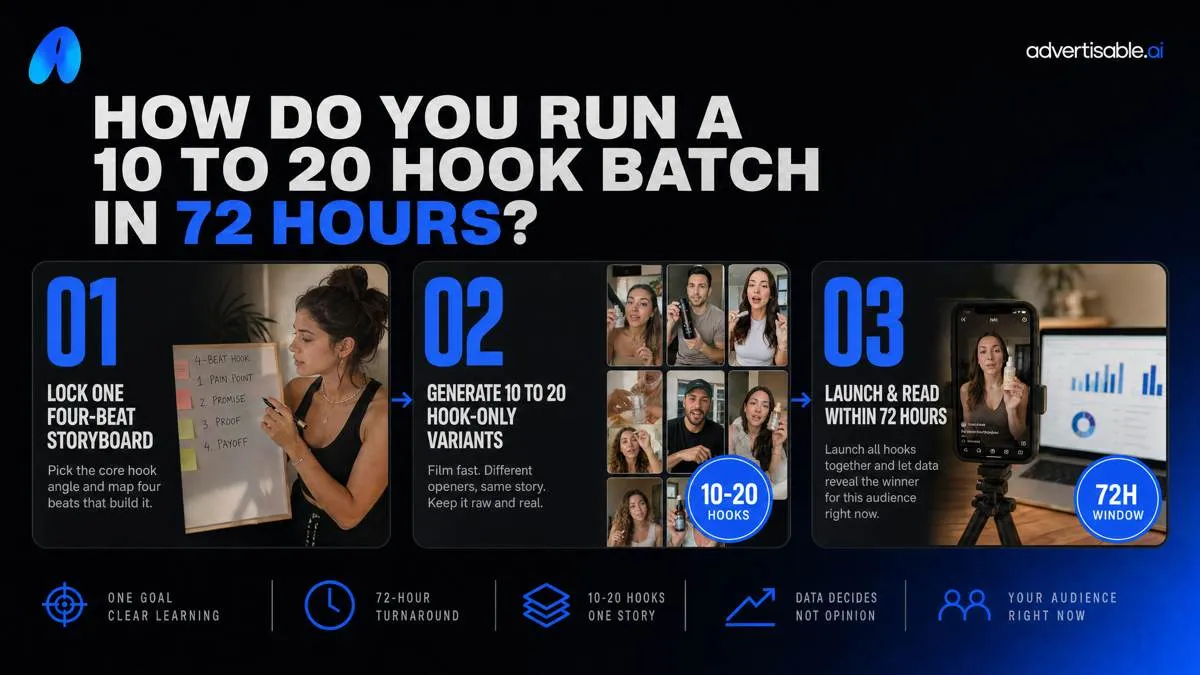
A 72-hour hook batch works because you lock one four-beat storyboard, generate 10 to 20 hook-only variants fast, then launch them inside the same 48 to 72 hour window so the readout is attributable. Your goal is not “more seasonal ads.” Your goal is one clean learning about what hook promise wins for this exact audience right now.
Your 72-hour production timeline
You can ship a 10 to 20 hook batch in 72 hours by front-loading decisions on Day 1, producing only hook variants on Day 2, and launching all variants together on Day 3 for a fixed 48 to 72 hour readout. The discipline is the timeline, not the tool.
Day 1 is storyboard lock. You approve one four-beat creative anatomy and you do not touch it for the next 72 hours. In Advertisable AI Studio, this is where Brand DNA guardrails and the Storyboard Editor matter: you eliminate invented claims and “close enough” visuals before you render anything.
Day 2 is hook variant generation. You generate 10 to 20 openings that deliver different promises or frames in the first 1 to 2 seconds, while keeping every downstream beat unchanged. You should be able to scan them as a set and confirm they are the only variable.
Day 3 is launch and tagging. All variants go live within the same day-part, with the same placements, and the same budget distribution logic, then you leave them alone. No mid-window edits means you do not swap captions, thumbnails, headlines, or landing pages while the clock is running.
- Day 1 acceptance criteria: one storyboard, four beats approved, product facts verified, proof and CTA copy locked
- Day 2 acceptance criteria: 10 to 20 hooks that are meaningfully different in promise, but still accurate to the same product truth
- Day 3 acceptance criteria: all ads launched within the same day, with tagging in place, and a scheduled read time at 48 to 72 hours
- Mid-window rule: if anything feels “off,” log it for the next batch, do not edit it inside the readout window
One-variable rules that hold
Your one-variable rule is simple: change the hook only. Everything else stays fixed so you can attribute movement in thumb stop, CTR, and CVR to the first 1 to 2 seconds.
Hold the early product moment constant. Same scene, same timing, same visual order. If you change when the product shows up or how it’s demonstrated, you are no longer testing hooks.
Hold proof and CTA constant. Same proof element type (one per ad), same claim language, same offer framing, same CTA line. creative testing best practices align here for a reason: once you change multiple inputs, your “winner” is no longer explainable.
- Allowed change: the hook line, hook visual, or hook pattern in the first 1 to 2 seconds
- Not allowed: moving the product reveal earlier or later, changing the demo steps, swapping proof type, rewriting the CTA, changing the offer language
- Keep conditions stable: same audience segment, same placements, same optimization event, same run window (48 to 72 hours)
Naming, tracking, and QA checks
You only learn fast if you can identify variants instantly and trust what shipped. Treat naming, tracking, and QA as production requirements, not “nice to have.”
Use a naming convention that encodes the only variable you changed: the hook. Then attach UTMs and creative IDs before launch so your ad platform reporting and site analytics reconcile cleanly.
QA is where seasonal batches usually fail: mismatched promo text, clipped captions, or audio that is unusable in-feed. Catch it before spend lands.
- Variant naming: SEASON-AUD-PLAC-FORMAT-HK## (example: BF_RTG_META_9x16_HK07)
- Tracking: unique creative ID per variant plus a UTM field that includes the hook number (HK07) and batch date
- Pricing and promo QA: offer amount, promo code, dates, exclusions, and on-page price match the ad exactly
- Delivery QA: audio levels are consistent, captions are correct, key text sits inside safe zones, and nothing critical is covered by UI on 9:16
When your IDs and QA are clean, your next decision is also clean: you can regenerate only the hook that lost, without rewriting the rest of the ad.
When should you refresh seasonal creatives so old ones stop spending?
Old seasonal ads linger because teams wait for “certainty” and keep spending on stale signals. You fix it by committing to a readout window and pre-defining what metric movement actually means “refresh now” versus “hold steady.”
The 48 to 72 hour readout
Use a fixed 48 to 72 hour window to decide whether a seasonal creative stays live, gets refreshed, or gets paused. Shorter windows create false alarms, and longer windows let post-moment ads keep spending after demand has already moved.
The operator mistake is daily toggling. When you pause, duplicate, relaunch, or rotate every morning, you reset learning and you can no longer attribute what changed.
Read results in metric chain order: thumb stop first, then CTR, then CVR. If attention fails, fixing the proof or CTA is usually wasted work because you are not earning clicks in the first place.
Minimum consistency checks keep you from reacting to a single weird hour: you want stable delivery, a consistent audience, and the full batch living through the same 48 to 72 hour window before you call a winner or declare decay.
- Lock the test window: set a calendar reminder for hour 48 (first read) and hour 72 (decision) before you launch.
- Hold conditions constant: same audience segment, placement mix, and offer language for the entire readout.
- Validate delivery: confirm spend is actually distributing across ads and not trapped on one outlier variation.
- QA seasonal accuracy at hour 48: date language, holiday naming, shipping cutoffs, and pricing callouts still match reality before you let it keep running.
Fatigue fingerprints by metric
Refresh when you see a fatigue fingerprint, not when performance is merely “down today.” The classic pattern is frequency rising while CTR falls, usually paired with cost per result worsening over the same window, which aligns with Meta fatigue diagnostics.
A thumb stop drop is hook fatigue. Your audience has seen the opening promise too many times, so you rotate the first 1 to 2 seconds while keeping the product moment, proof element, and CTA constant.
A CVR drop with stable CTR is proof fatigue. You are still getting clicks, but belief is decaying or the proof is no longer relevant to the season, so you change the proof scene (testimonial, demo, stat) without rewriting the entire ad.
Expect segment-specific fatigue. Prospecting often shows hook fatigue first, while retargeting can show proof fatigue first because the audience already knows what the product is and needs a fresh reason to act.
- Frequency up + CTR down: rotate hook variants immediately; keep the rest fixed to preserve attribution.
- Thumb stop down first: regenerate hook-only batch (10 to 20 variants) and reread at 48 to 72 hours.
- CTR stable + CVR down: swap proof element (one change) and re-QA claims before scaling.
- Only one segment decays: refresh creative for that segment, not across the entire account.
How do you remove approvals and rerenders from the loop without losing brand control?
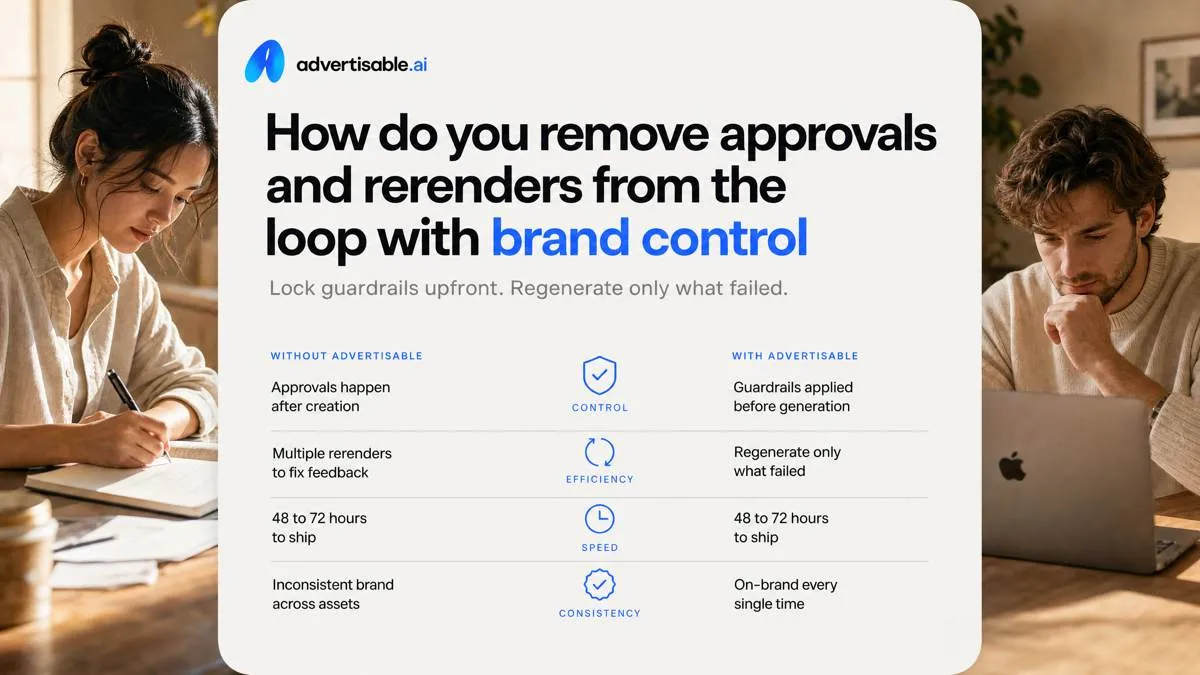
Approvals slow down because reviewers are reacting to finished assets instead of enforcing rules before anything gets generated. You keep control by locking brand guardrails upfront, then only regenerating the exact scene that failed so your 48 to 72 hour shipping cycle stays real.
Brand DNA guardrails before output
You remove approval loops by turning brand feedback into constraints the system can follow on every output, not comments on every draft. The goal is simple: reviewers only check exceptions, not rewrite the ad.
We treat this as a one-page control doc that lives above every storyboard: what is allowed to be said, shown, and priced. In Advertisable AI Studio, our Brand DNA module pulls core product facts from your URL and gives you a starting point, but you still need explicit guardrails for seasonal promos and compliance-sensitive categories.
- Approved claims and constraints: exact promises you can make, required qualifiers, and a short list of banned phrases or comparisons
- Tone, fonts, colors, usage: voice rules (formal vs direct), typography, color palette, logo safe-area, and do-not-crop rules for product shots
- Pricing and promo rules: approved price points, discount math rules, start and end dates, and what must appear on-screen (for example, “limited time” language or exclusions)
- Compliance review checklist: a pass-fail QA list (claims match PDP, pricing matches promo window, required disclaimers present, no unapproved testimonials, correct trademark usage)
Scene-level fixes, not rerenders
You stop rerender churn by editing at the scene level: swap the failing beat, keep everything else constant, and ship the next test batch. This is how you protect attribution in one-variable testing and avoid turning every review into a full creative rewrite.
Operationally, we default to replacing the hook scene first because it drives thumb stop in the first 1 to 2 seconds, while holding the early product moment, proof element, and CTA steady. When the hook is the only variable, your 48 to 72 hour readout tells you what actually changed performance.
In Advertisable AI Studio, the Scene Regenerator is built for this exact workflow: regenerate one scene on the storyboard timeline instead of redoing the whole video, then export updated platform-native files without reopening approvals on unchanged beats.
- Replace weak hook scene: generate 10 to 20 hook variants against the same locked product moment, proof, and CTA
- Keep proof and CTA locked: treat these scenes as “do not edit” unless the metric chain shows a downstream issue (CTR or CVR) rather than attention failure
- Reduce revision cycle time: reviewers approve the storyboard beats once, then only re-review the single swapped scene
- Prevent scope creep in reviews: require every comment to map to one checklist item (brand rule, claim accuracy, pricing rule, compliance) or it does not enter the revision queue
Put the workflow on rails with Advertisable AI Studio
The fastest way to ship seasonal creative in 72 hours without brand drift is to turn your playbook into enforced guardrails: fixed four beats, one-variable batches, and scene-level iteration instead of full re-renders. Advertisable AI Studio is built for that operating model, starting with Brand DNA pulled directly from your product URL so scripts, visuals, and product facts stay anchored to what you actually sell.
In practice, you work storyboard-first. In the Storyboard Editor, you lock the four beats before you render anything: hook (first 1-2 seconds), early product moment, proof element, and CTA. That lets you run clean one-variable batches with clear acceptance criteria, for example: the hook is the only change across 10-20 variants, while product, proof, and CTA remain constant, then you hold placement and targeting steady and read results after 48-72 hours.
When one beat is weak, you do not rebuild the whole ad. You use the Scene Regenerator to replace only the failing scene, which keeps attribution intact and keeps approvals focused. Our QA checks are simple: the early product moment matches the offer on the page, the proof element is a single believable claim (no stacking), and the CTA is one clear next action.
Once the batch is approved, you export platform-native versions for Meta, TikTok, and YouTube so sizing and deliverables do not become the last-minute bottleneck. If you want to operationalize this immediately, start the $5 3-day trial and build your first storyboard-driven seasonal batch from a single product link.
Put your seasonal workflow on rails in the next 72 hours
If your seasonal ads keep shipping late, lingering past the moment, or slipping in outdated pricing, the fix is not more holiday-themed volume. You need a controlled system you can run every week.
We built Advertisable AI Studio to operationalize that system. Start with one storyboard using the four-beat creative anatomy, then lock Brand DNA guardrails from your product URL so claims, tone, and visuals stay consistent. Generate a 10 to 20 hook batch where you change one variable only, launch, then take a fixed 48 to 72 hour readout against your metric chain.
When one beat underperforms, use scene-level regeneration instead of full rerenders.
Start your $5 3-day trial of Advertisable AI Studio and ship your first seasonal batch, then export platform-native versions for Meta, TikTok, and YouTube.
Frequently Asked Questions
### What's the difference between performance creative and regular ads?
Performance creative is built to be measured and iterated, using a four-beat structure and one-variable batch testing so you can attribute lift to a specific change. Regular ads often mix multiple changes at once, which makes results harder to diagnose and slows down iteration.
### Why test one variable at a time instead of testing multiple changes together?
Because you need attribution, not guesses. When you hold three beats constant and change one, you can tie movement in thumb stop, CTR, or CVR to a single creative decision and compound what you learn in the next batch.
### How long should I wait before reading test results?
Use a fixed 48 to 72 hour readout window. It is long enough to collect signal across the metric chain, and short enough to keep seasonal creative from overstaying its window while you chase day-to-day noise.
### Can you give me an example of seasonal marketing?
A practical example is running a seasonal hook batch where only the first 1 to 2 seconds change, while the product moment, proof element, and CTA stay fixed. You read results after 48 to 72 hours, keep the winning hook, and refresh the losing beat without rebuilding the whole ad.