AI ad creative service vs in-house team total cost
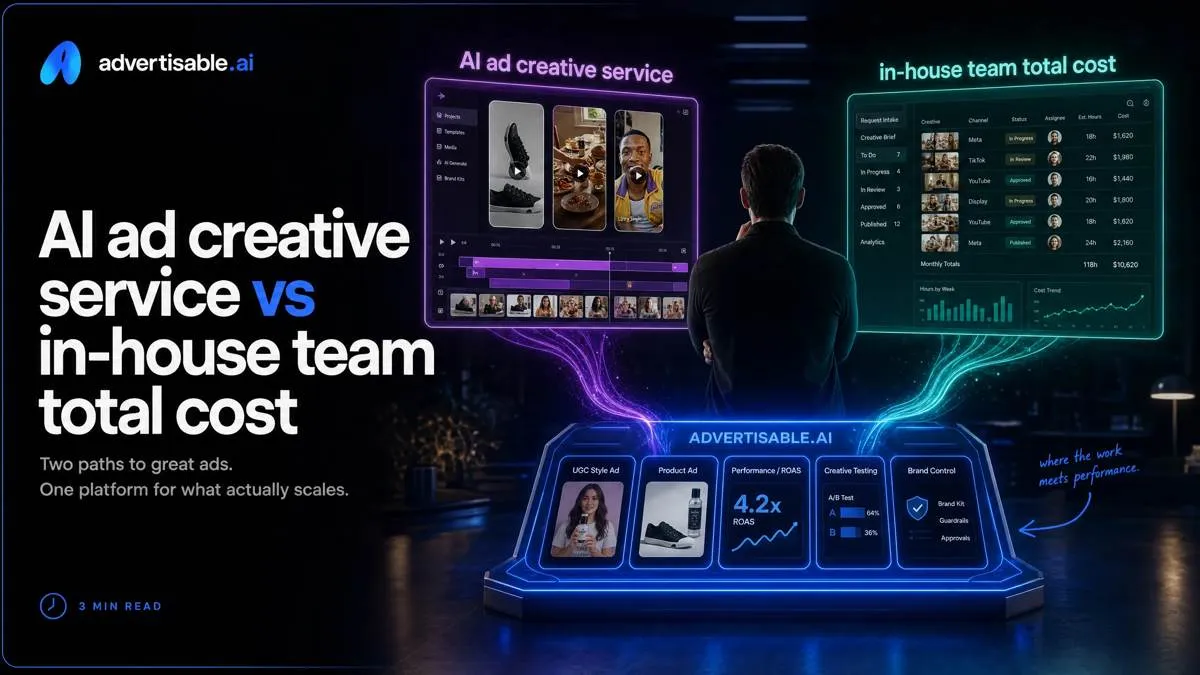
Use an AI ad creative service when you need 50 to 100 on-brand testable variations in days, not months, and you cannot afford a hiring ramp or single-point-of-failure risk.
We built Advertisable AI for this exact operator problem: you need more variations per week, but you need control more. Our workflow starts from a product link, extracts Brand DNA guardrails, generates scripts and storyboards, and lets you edit or regenerate at the scene or frame level before exporting platform-ready assets for Meta, TikTok, and YouTube.
Before you run any cost math, you need a clean definition of what you are buying: an AI ad creative service is a throughput and workflow system, while an in-house team is a capability and ownership bet, and the day-to-day differences decide your real total cost.
What is the real difference between an AI ad creative service and an in-house team?
The real difference is operational: an AI ad creative service is built to maximize throughput fast, while an in-house team is built for long-term ownership of taste, process, and institutional memory. An AI ad creative service typically runs a defined production workflow for you (or with you), aiming to ship many platform-ready variations in days, not quarters.
Scope is where teams talk past each other. Services optimize for volume and turnaround; you keep strategic ownership, but you are buying capacity. In-house optimizes for deep brand stewardship, but you also own recruiting, management, tooling, and coverage when someone is out.
Constraints are asymmetric: hiring has a ramp and turnover risk, while implementation is mostly about integrating briefs, approvals, and edit gates. Control points show up in who can approve and where edits happen: services win when edits are scene-level and approvals are explicit; in-house wins when ad hoc iteration and stakeholder alignment are constant.
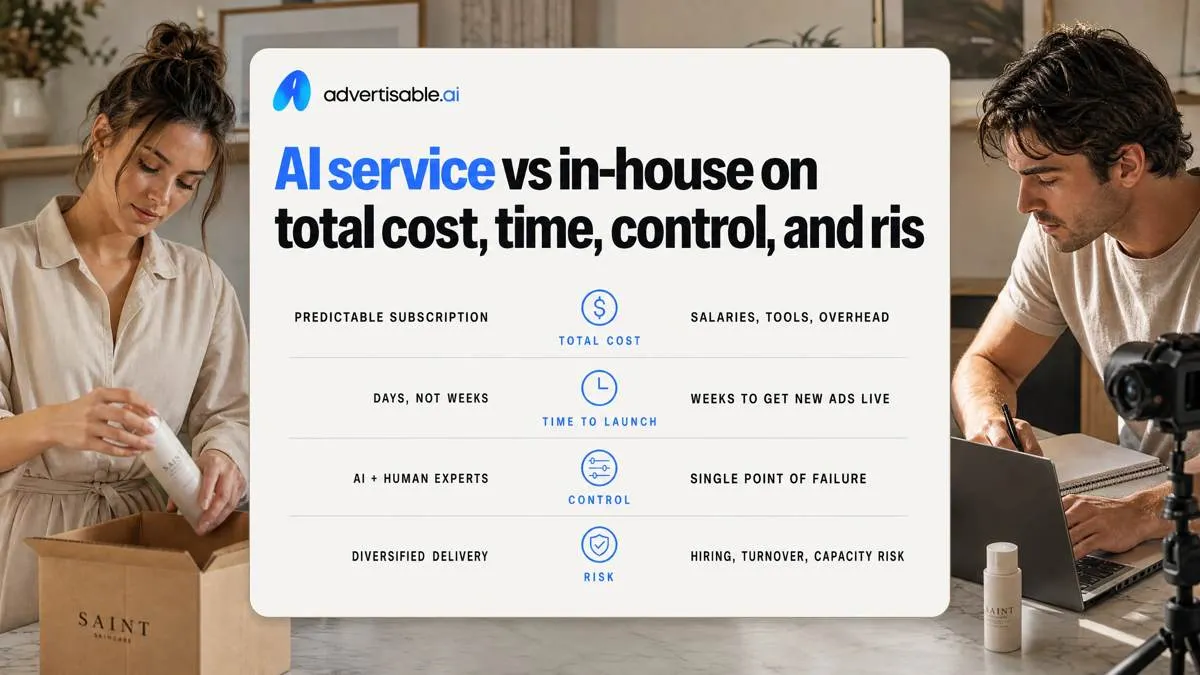
AI service vs in-house on total cost, time, control, and risk
Creative fatigue is a revenue leak because you spend the weeks where performance is sliding waiting for new ads to exist. The slower your production loop, the more days you run “tired” winners past their shelf life instead of rotating net-new hooks on schedule.
The risk model is usually a single point of failure: one hire who is late, leaves, or just cannot hit throughput. Output volatility matters more than talent on paper when your media team needs a steady weekly stream of shippable variations.
Agencies still win when the work is genuinely bespoke: high-end shoots, complex product demos, or situations where you need new footage you do not have.
Time-to-output: days vs months
In-house is measured in months; an AI service is measured in days. Recruiting alone typically runs 6 to 12 weeks, then you still have 2 to 6 weeks of onboarding and process setup before you see consistent output.
With an AI ad creative service, first output can be same day because you are not waiting on hiring, tool access, and a new operator learning your review standards. What matters next is iteration speed: can you fix the one scene that failed review, or do you have to re-render the whole ad and restart approvals.
We see throughput break when teams treat edits as “full re-renders.” Your acceptance criteria should be: scene-level edits (hook, proof, CTA) and storyboard-first review so feedback hits beats, not finished videos.
- In-house timeline reality: 6-12 weeks recruiting + 2-6 weeks ramp before stable weekly delivery
- Service timeline reality: same-day first drafts, then daily iteration while you test in 48-72 hour windows
- Iteration unit: scene edit/regeneration beats full re-render loops for hook testing
Fully loaded cost per variation
The clean comparison is fully loaded cost per shippable variation, not salary vs subscription. In-house cost includes salary plus benefits plus overhead (hardware, software, contractors, turnover risk), and it scales poorly when volume spikes.
Manager review time is also a real cost. If your creative lead spends hours per week rewriting briefs, chasing versions, and clarifying claims, that time belongs in your unit economics.
Revision loops are the silent waste: drafts that never ship, rework caused by unclear feedback, and “almost approved” versions that die in Slack threads.
- Cost-per-shippable-variation = (production labor + benefits/overhead + review time + rework waste) / shipped variations
- Track rework waste as: (drafts started - variations shipped) per week, then multiply by your internal hourly rate
When you put the equation on a weekly dashboard, the decision usually flips from “who is cheaper” to “who can keep unit cost stable as volume rises.”
Brand control and approvals
Control is not “we own the files.” Control is whether your team can approve quickly, trace changes, and make precise fixes without restarting the whole chain.
Require editable storyboards and a real timeline editor so brand and legal feedback can point to the exact beat that needs change. Add approval gates and an audit trail so you can answer: who approved which version, with what claims, on what date.
Claim accuracy has to come from a product source of truth. Platforms that start from your product URL and extract product facts reduce the odds you ship an ad with unverified language.
Clarify creative ownership and reuse rights up front: whether you can reuse scripts, storyboards, and exported assets across channels, and what happens if you stop the engagement.
- Approval workflow requirement: storyboard-first gate, then scene-level revisions, then export QA
- Audit requirement: version history with approver names and timestamps
- Rights requirement: explicit reuse terms for scripts, timelines, and exports
Which option fits your current creative bottleneck?
Your real constraint is usually not “who owns creative,” it is weekly shippable variants. If you are paying retainers and still cannot field enough clean hook tests, you have a throughput problem, not a taste problem.
When in-house is the right call
In-house is the right call when the cost of a single off-message ad is higher than the cost of slower output. That is common in regulated or brand-sensitive categories where legal review, claim language, and substantiation are part of the workflow.
It also fits when your creative depends on original shoots you control: demos, lab footage, founder scenes, clinical environments, or anything you cannot reliably source from a product page.
Acceptance criteria: you can stay under 10 net-new variants per week and still learn, because the work is deeper product storytelling, not high-frequency hook churn.
- Your approvals are compliance-led, with non-negotiable phrasing and mandatory disclaimers
- Your best ads require regular in-person production days, not template recombination
- Your weekly backlog is stable and predictable, not a constant reset from offer changes
- Your performance gains come from narrative depth (proof, mechanism, demonstrations), not sheer volume
When AI services win on throughput
AI services win when you need 20 plus weekly variants and your current retainer model cannot physically cycle briefs, edits, and exports fast enough. Motion's 2026 creative benchmarks shows the top quartile at $50K to $200K monthly Meta spend ships 15.9 new creatives per week, so 20 is not an edge case at scale.
This model is strongest when you are running hook testing across multiple personas, and when SKUs or offers change weekly. The bottleneck becomes operator bandwidth: one editor cannot keep up with storyboard revisions, scene swaps, and spec-ready exports.
- You batch one variable per test (hook or persona angle) while holding product moment, proof, and CTA constant
- You need fast scene-level corrections to pass brand review without re-rendering full videos
- You are constantly refreshing: new bundles, seasonal offers, price tests, or SKU launches
- You are constrained by how many iterations a single creative operator can push through QA each week
When a hybrid model holds up
Hybrid holds up when you keep one core strategist in-house and outsource production volume to AI, so your testing system stays consistent while output scales. You are not buying “ideas,” you are buying capacity with control.
This works cleanly when you do quarterly shoots for net-new footage, then iterate weekly on hooks, pacing, and structure from that asset base. Use an agency for brand film and flagship narrative, not for weekly testing loops.
The operational win is resilience: when performance spikes or a channel needs new formats, you have backup capacity without a new hire cycle.
- In-house owns: offer priorities, persona map, guardrails, and pass-fail QA for publishable output
- AI production owns: variant generation, storyboard iterations, and scene swaps at weekly cadence
- Agency owns: brand film and high-stakes launches where polish beats speed
- Surge plan: pre-approved templates and guardrails so spikes do not create off-brand drift
What numbers tell you it is time to switch?
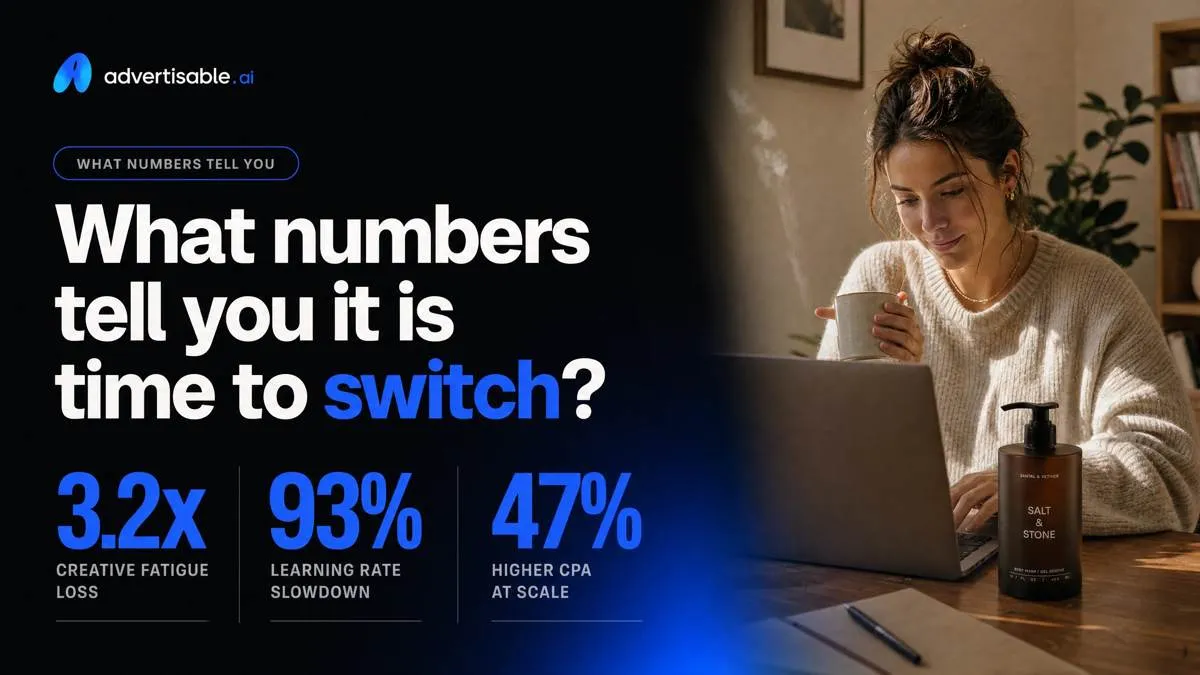
You do not need more opinions. You need a dashboard that shows, in numbers, whether your current model can keep pace with fatigue and platform learning.
Weekly shippable variations
The metric is shippable variations per week, meaning the ad passes QA and is approved to launch. When you cannot clear 10 per week consistently, you are operating below the minimum testing cadence most accounts need to avoid creative stall.
Use target bands to set expectations by spend and team maturity. Motion's 2026 creative benchmarks put average output at 6.6 new creatives per week (top quartile 15.9) for $50K to $200K monthly spend, and 11.2 per week (top quartile 31.1) for $200K to $1M.
- 10 per week: baseline survival rate when you are resource constrained
- 25 per week: stable testing cadence for one core offer across angles
- 50 per week: aggressive learning with clean one-variable batches per concept
- 100 per week: multi-offer, multi-angle scale with rapid replacement
- Batch rule: one variable per batch (hook or proof or CTA), hold the rest constant
- Channel split: ship Meta variants heavier on iteration volume; ship TikTok variants heavier on native pacing and format diversity
Turnaround time and revision loops
Your brief-to-launch SLA should be 48 to 72 hours for incremental variants. If your median is a week, you are not testing, you are publishing.
Cap revision loops at two. After two rounds, you are seeing a system problem (brief quality, guardrails, or approver behavior), not a creative problem.
- Track approval latency: time in stakeholder inboxes, not time in production
- Tag rework causes: claims compliance and brand consistency are the two repeat offenders
- Acceptance criteria: spec-ready exports, QA pass, approver sign-off in the same cycle
Net-new hooks per week
Aim for 3 to 10 net-new hooks per week, separate from pure edits. If hooks are flat, performance will eventually follow.
Watch fatigue through CPA drift, rising frequency, and declining thumbstop. When those move together, you need new hooks, not more color swaps.
- Write each hook as a hypothesis: audience belief + promise + proof mechanism
- Define the readout window: 48 to 72 hours per hook batch before you judge it
- Decide next test: keep concept, rotate hook; or keep hook, rotate proof; never both at once
How do you keep AI-generated ads on-brand and compliant?
The main failure mode is hallucinations: the model invents features, prices, or results. Your fix is a single source-of-truth product page that every script, overlay, and visual callout must map back to.
Brand guardrails and QA checks
You keep control by turning “brand” into pass-fail rules, then QA’ing every export against them. Treat every variant as untrusted until it clears checks.
In practice, we run a lightweight gate before anything ships: voice, claims, rights, then approvals.
- Brand voice and visual rules: allowed phrases, banned words, CTA style, logo placement, safe colors, and on-screen text size
- Claim substantiation checklist: every performance, pricing, or “best” statement must be supported by the product page or approved internal proof
- Asset rights and usage proof: store license/creator release links for music, UGC, and product images in the project record
- Approval workflow: one named owner approves, with a documented backup who can ship within 24 hours
Meta and TikTok policy basics
Meta and TikTok reject ads for the same core reasons: misleading claims, sensitive targeting language, and synthetic media that is not handled cleanly. Build your review process around those three rejection modes.
Avoid “before-after” framing and implied outcomes. For regulated areas like health or finance, remove absolutes and make the landing page match the creative exactly.
For disclosure and review, align to TikTok's official advertising policies: their review checks eligibility, ad content, audience, landing page consistency, and landing page functionality.
- Misleading claims and before-after rules: no guaranteed outcomes, no exaggerated transformations, no deceptive edits
- Health, finance, and sensitive attributes: avoid calling out personal traits (for example, “you have X”), and keep disclaimers consistent with the landing page
- Synthetic media and disclosure rules: label AI-generated spokespeople when required and never impersonate real people or brands
- Creative review escalation process: if an ad is borderline, route it to your policy owner before spending time generating more variants
Two-week pilot: prove 50-100 variations with Advertisable AI
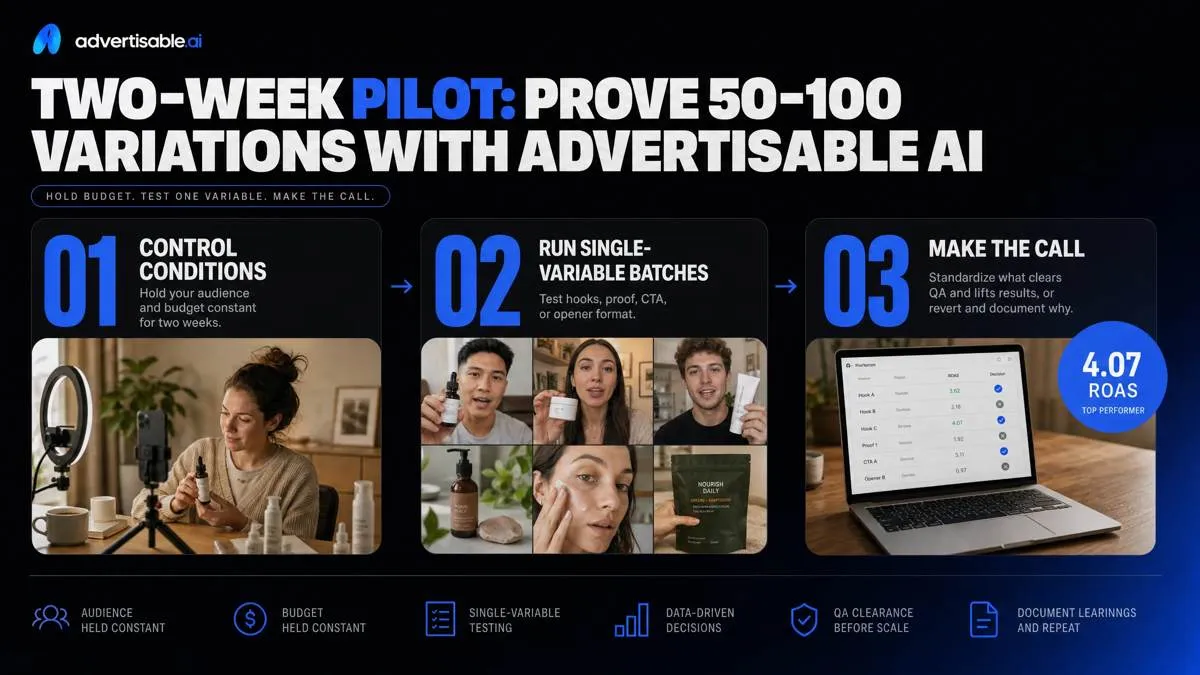
Hold your audience and budget constant for two weeks so the readout is clean. Run single-variable batches (hooks, proof, CTA, or opener format), then make a binary call: standardize what clears QA and lifts results, or revert and document why.
Pilot setup and acceptance criteria
A useful pilot is narrow: one SKU URL, one offer, one measurement window. You are proving throughput and brand safety first, then performance in a fixed 48 to 72 hour readout.
Set acceptance criteria before you generate anything so internal review does not turn into taste debates. The goal is 50 to 100 variants shipped to platform with a high QA pass rate, not 50 to 100 drafts.
- Input scope: 1 SKU product page URL and 1 offer (same price, incentive, and landing page for all variants)
- Throughput target: 50 to 100 platform-ready variants delivered inside the two-week window
- QA threshold: define a minimum pass rate (for example, 90%+) for spec compliance and brand correctness before launch
- Performance readout: run each batch long enough to get directional signal, then evaluate at 48 to 72 hours
Build variations without full re-renders
The fastest way to hit 50 to 100 without quality drift is to lock guardrails once, then iterate the smallest unit of change. In Advertisable AI, you start from the SKU URL so Brand DNA is extracted from the page and used to constrain assets, claims, and tone.
Build concepts, then force hook discipline: three hook variants per concept before you touch anything else. When a version fails review, regenerate only the failing scene in the storyboard or timeline instead of re-rendering the whole ad.
Export in native placements for Meta and TikTok so the pilot measures shippable output, not edit time in downstream tools.
Named options to compare before you commit
Bespoke production still wins when you need original on-camera talent, high-concept storytelling, or a director-led shoot day.
For everything else, choose by workflow, not feature list: where the handoffs, approvals, and fixes happen is what drives total cost.
Advertisable AI
Advertisable AI fits when your bottleneck is shipping lots of platform-ready variants, not getting to a first draft. We start from a product URL, pull what we can from the page, and turn it into an ad workflow you can actually operate week over week.
You get Brand DNA guardrails to reduce drift as volume scales, plus scene-level edits and regenerations so a failing hook or proof beat does not force a full rebuild. Exports are designed for paid social placements, so you are not resizing and reformatting by hand.
- Input: URL-to-ad workflow (URL plus prompt)
- Control: Brand DNA guardrails for repeatable reviews
- Iteration: scene-level edits and regenerations
- Output: multi-format exports for Meta, TikTok, and YouTube placements
Jasper
Jasper is strongest when your primary need is on-brand copy at scale. The Pro plan is $69 per seat per month (or $59 per seat per month annually), and it is well-suited to teams standardizing tone across channels.
Use it to generate scripts, angles, and variations quickly, then move that output into your editing stack. The gap is a full video assembly workflow, so it fits best when you already have editors and templates downstream.
Canva
Canva leads on templates and collaboration for design production. Pricing ranges from a Free plan to Pro at $18 per month, with Business at $25 per user per month.
It is a strong fit for static creative and simple motion when you need fast approvals and shared brand assets. The gap is a built-in system for performance variation management, so you will still need a separate process to control what changes vs what stays constant in tests.
Adobe Firefly
Adobe Firefly is a strong option if your team lives inside Creative Cloud and you want AI image generation integrated into that workflow. Plans range from free limited use to $9.99 per month (Standard) up to $199.99 per month (Premium).
Use it for asset ideation, generative fill, and extending or repairing visuals you will later cut into ads. The gap is end-to-end short-form ad output, so it fits Adobe-native orgs that already have video assembly and QA handled elsewhere.
Run the 2-week pilot that settles the in-house vs service question
If your weekly creative throughput is the constraint, you do not need another hiring cycle. You need a controlled production system that ships shippable ads on schedule.
We built Advertisable AI for this exact workflow. Start with one product URL, lock your Brand DNA once, then generate 50 to 100 short-form video variations without reopening brand debates on every version. Route stakeholders through storyboard-first approvals so feedback lands on hooks, proof, and product moments before you render.
When a variant fails review, regenerate only the failing scene, not the full ad.
Then run a clean readout. Launch single-variable batches on Meta and TikTok, hold the product moment and CTA constant, and read results in a fixed 48 to 72 hour window. If you hit throughput and QA targets, standardize this as your default creative operating model.
Frequently Asked Questions
Which type of AI system is best suited to creative tasks?
Use a system that is built for controlled iteration, not just generation. You want Brand DNA guardrails, storyboard-first approvals, scene-level regeneration, and platform-ready exports so you can scale variants without off-brand drift or re-render loops.
What are the three types of agencies?
In practice you will run into strategy-led agencies, production-led creative shops, and performance creative operators focused on testing velocity. If your goal is to increase weekly shippable variations, evaluate partners on throughput control: approvals, QA process, and the ability to change one scene without rebuilding everything.
Who are the big 4 ad agencies?
They are large holding-company networks built for broad brand and media services. For paid social creative throughput, size is less predictive than the operating model: how fast you can approve storyboards, ship platform-ready assets, and iterate with single-variable tests on a 48 to 72 hour readout.