How to Test Ad Creatives Faster Without Noise
The fastest workflow for testing lots of video creatives with clear attribution is a one-variable batch: lock a four-beat structure, change only one element (usually the Hook) across 10 to 20 variants, then read results in a fixed 48 to 72 hour window.
We built Advertisable AI because performance teams kept hitting the same wall: you can generate plenty of variations, but without storyboard-first control, Brand DNA guardrails, and scene-level regeneration, speed just produces more off-brand drift and less usable learning.
Before you touch volume, you need to see why your “fast” tests still feel slow in practice, because mixed batches create attribution fog that no dashboard can clean up.
Why do fast creative tests still feel slow?
Mixed batches create attribution fog
Fast testing feels slow when you ship mixed batches: you change the hook, the offer, and the CTA in the same set of ads, then try to explain performance after 48 to 72 hours. You end up with a winner, but you do not have a cause you can reuse.
When three beats move at once, the postmortem becomes opinion-driven. The team argues about taste ("the hook is stronger") instead of diagnosing a single variable ("this hook lifted thumb stop while everything else stayed constant").
The cost shows up the next week: you unknowingly retest the same question again because last week never answered it. Volume goes up, but attributable learning stays flat.
- Hook-offer-CTA changed together means every result has multiple plausible explanations
- Winner known, cause unknown prevents you from rebuilding the win on demand
- Taste debates replace diagnosis because there is no clean control
- Retesting the same question weekly becomes the default loop
Production speed without control backfires
Speed without control creates noise. When you ship 10 to 20 near-duplicate variants, you dilute signal, fragment spend, and still cannot defend a decision because the differences are too small or too inconsistent.
Operationally, variability multiplies editing churn. Every time you tweak multiple beats, you re-open script, storyboard, edit, and render decisions that should have stayed locked, which slows throughput even when tools are fast.
Approvals break the same way. Reviewers cannot build a repeatable standard when each ad has different claims, phrasing, and structure, so cycle time increases and spend goes to tests you cannot learn from.
- Near-duplicate variants dilute signal and make it hard to see real CTR or CVR movement
- Editing churn across many beats turns one test into multiple untracked rewrites
- Approvals break under variability because reviewers have to re-interpret "acceptable" every time
- Spend gets wasted on unlearnable tests because you cannot attribute the outcome to one change
What is the fastest workflow that keeps tests clean?
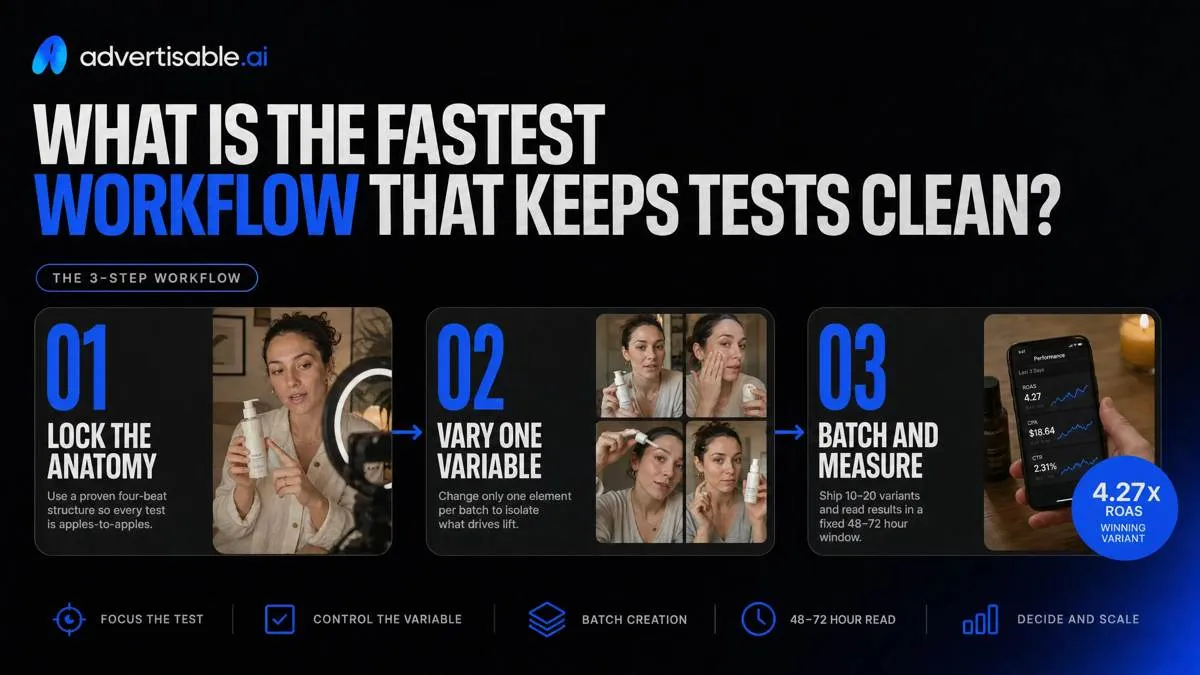
The bottleneck is rarely “making more ads.” It is shipping volume without turning every batch into noise you cannot attribute. The fastest clean workflow is: lock a four-beat anatomy, vary one variable, batch 10 to 20 outputs, then read results in a fixed 48 to 72 hour window.
Lock the four-beat anatomy
You get speed without chaos by freezing structure: hook, product moment, proof, CTA. Once those beats are locked, you stop rebuilding from scratch and start making controlled swaps you can actually learn from.
Put the constants in one brief so production and QA do not improvise. This is the same logic as controlled experiment methodology: control everything you can, then change a single independent variable so the result is attributable.
Name one dependent metric for the batch, then choose one independent variable to test first. For most accounts, that independent variable is the hook because it drives the first 2 seconds and your thumb stop behavior.
- Locked beats: Beat 1 Hook (0-2s), Beat 2 Product moment (2-5s), Beat 3 Proof element (single cue), Beat 4 CTA (specific instruction)
- Constants in the brief: placement, format, duration target, product facts, 1-2 allowed claims, 1-2 disallowed claims, proof type, brand guardrails (tone, do-not-say list)
- Dependent metric (pick one): thumb stop rate OR CTR OR CVR
- Independent variable (pick one): hook angle, or if you are past hook work, proof element
Batch 10-20 hook variations
Generate 10 to 20 hooks in one batch while keeping beats 2 to 4 identical. That volume is large enough to create separation, but small enough to review and ship inside a day.
Use three hook families so you get meaningfully different openings, not synonyms. The goal is to test distinct promises and scenes, then keep the winner’s downstream beats untouched so you know what actually moved the metric.
- Pain hook: names the problem and stakes in one line
- Proof hook: leads with the credibility cue before the promise
- Curiosity hook: sets up an information gap the product moment resolves
- Difference check: each hook should change the angle, not just swap adjectives
- QA before render: claims are substantiable, pacing is readable at 1x, and the hook still fits your Brand DNA guardrails
Run one-variable launches in parallel
Launch your batch in parallel only when every variant shares the same placement and format. Same aspect ratio, same length band, same caption rules, same landing destination. Otherwise you are testing distribution artifacts, not creative.
Keep the launch window identical and commit to no mid-test creative edits. A clean 48 to 72 hour readout beats a “helpful” tweak at hour 12 that invalidates the comparison.
- Naming convention: [Date]_[Channel]_[Batch]_[IV=Hook]_[Variant##] so the test survives handoffs
- Identical launch window: publish all variants within the same narrow time block and evaluate at the same hour cutoff
- Edit freeze: no swaps to thumbnails, captions, on-screen text, or audio during the window
- Fix losers by regenerating only the losing scene for the next batch, not by changing multiple beats at once
How long should you run a batch before deciding?
The 48-72 hour readout rule
Run each one-variable batch for 48 to 72 hours, then make a call. Shorter windows tend to overreact to hour-by-hour delivery noise; longer windows start blending in market shifts that make results harder to attribute.
This window is also long enough to produce a usable signal for most teams: test duration benchmarks commonly use 24 hours as a minimum, and note that slower-to-act audiences often need 48 or 72 hours to show the real shape of performance.
Operationally, the fixed readout stops the endless checking behavior that quietly expands cycle time. When you know the decision point is Tuesday morning or Friday afternoon, your week stays predictable and your next batch does not slip.
- Set the readout timestamp at launch (for example: “read Wednesday 10am”).
- Do not change creative, naming, or proof elements inside the window.
- Decide once: keep, kill, or iterate the next batch off the same structure.
Decide with one primary metric
Pick one primary metric per batch, or you will debate yourself into delays. The metric should match the single variable you changed, so the decision feels defensible.
Use thumb stop when you are testing hooks, because you are judging the first 2 seconds. Use CTR when you are testing message clarity, because it reflects whether the promise and product moment make sense together. Use CVR when you are testing proof alignment, because the proof element is supposed to reduce skepticism and produce qualified action.
- Hook batch: optimize for thumb stop.
- Clarity batch: optimize for CTR.
- Proof batch: optimize for CVR.
- Document one decision per variant at readout: keep, kill, or regenerate the weak beat.
Evidence benchmarks to expect
Expect a heavy-tail outcome: a small number of ads will carry results, and most will not. A typical winner rate is about 6-7%, which is exactly why tight windows and clean attribution matter.
Treat the rest as learnings, not waste. In a one-variable batch, a “loser” still tells you what not to repeat, and it often points to the single beat that needs rework.
- Plan volume: 10 to 20 variants per batch.
- Expect 0 to 2 clear winners in that set.
- Assume most variants will become labeled learnings you can reuse in the next prompt or storyboard.
Guardrails that keep speed from breaking Brand DNA
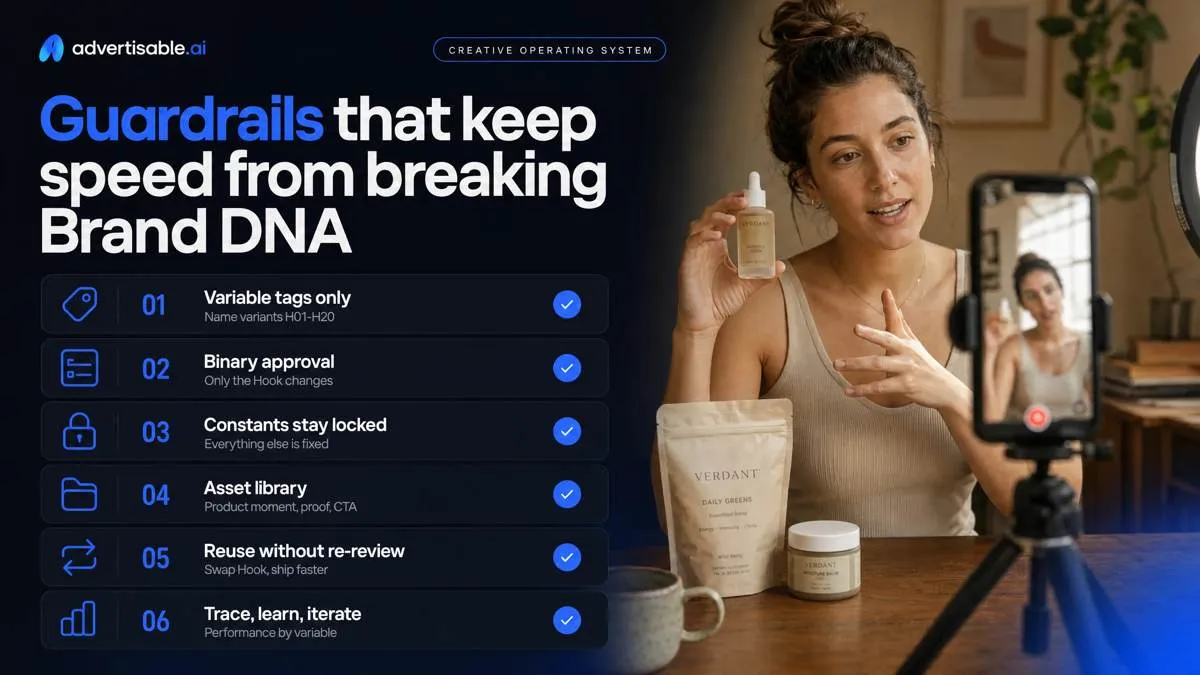
Keep your variants traceable: name them with variable tags only (H01-H20), not creative themes. Your approval checklist stays binary: only the Hook changed, everything else is constant. Build an asset library of constants (product moment clip, proof card, CTA end frame) so you can reuse them fast without re-review.
Claims control in every variant
High-volume iteration fails approvals when claims drift. We run every batch with a pre-written allowed and disallowed list, and every variant must map to one proof source.
- Allowed claims (examples): “reduces dry skin appearance” (supported by product page testing summary); “lasts 24 hours” (supported by packaging or lab report).
- Disallowed claims (examples): “clinically proven to cure eczema”; “FDA approved” unless you have category-specific documentation and clearance.
- Proof source rule: each claim gets a single citation source (PDP, spec sheet, lab result, or legal-approved language), documented in the brief.
- Regulated categories: add an extra review step (legal or regulatory) before rendering, not after performance data lands.
One change per batch, always
To keep learning integrity, your batch can change one thing only. For hook tests, that means zero movement on offer, CTA, product moment, or proof.
We also ban mid-test tweaks. The moment you adjust the offer or CTA on day two, you have created a mixed batch and your 48 to 72 hour readout stops being attributable.
- No mid-test offer changes (price, discount, bundle, shipping) inside the same batch window.
- No new CTAs inside batch: the CTA line and end frame stay identical across all variants.
- Same product moment footage across the batch so the only thumb stop variable is the Hook.
- Reuse the same proof element (same demo shot, same metric card, or same testimonial line) in every variant.
How do you fix losing ads without re-rendering everything?
Diagnose the losing beat first
Start with the drop-off timestamp and map it to a beat in your four-beat structure. When you do that, you stop “fixing the whole ad” and start fixing the exact moment that lost the viewer within a 48 to 72 hour readout.
Hook failure usually shows up as weak thumb stop in the first 2 seconds or high early exits. Proof failure shows up later: people stay through the product moment, then leave when the credibility cue hits (or CTR holds but downstream quality softens).
Use qualitative comments sparingly, only to explain an already-obvious metric signal. Then write one sentence you can hand to production: “We lost at Beat 1 because the promise is unclear; keep Beats 2 to 4 identical and regenerate only the opening line and visual.”
Regenerate only the losing scene
Fix the loser by swapping the losing scene, not rebuilding the full video. The highest-leverage move is often to replace Beat 1 while leaving the product moment and proof untouched, which is why a hook-first testing approach tends to find faster wins than re-editing everything.
Hold constants so the next result is attributable: keep duration, scene timing, and the exact CTA frame identical. Reuse the winning storyboard template so every new version is the same ad, with one beat changed.
In Advertisable AI Studio, this is a Scene Regenerator workflow: regenerate the Hook scene, QA it against Brand DNA guardrails, export, and relaunch without resetting the rest of your production.
- Change: Hook script line, opening visual, first on-screen text
- Do not change: Beat 2 product moment, Beat 3 proof element, Beat 4 CTA copy and timing
Executing the system at volume with Advertisable AI Studio
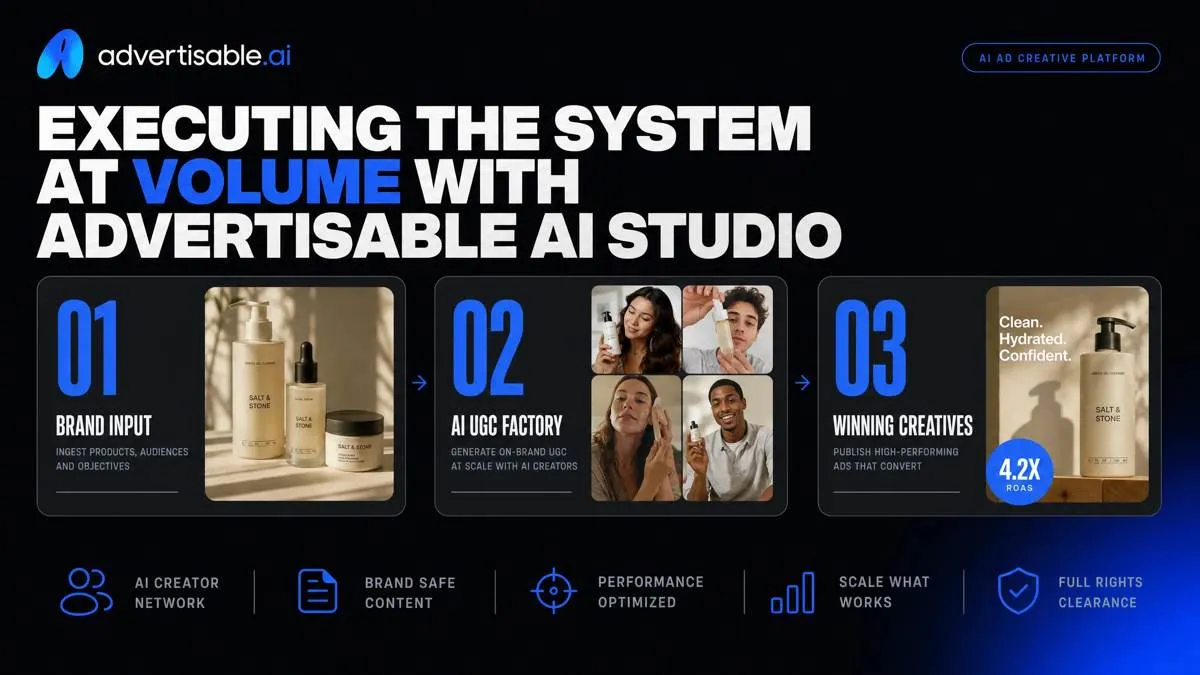
URL to Brand DNA guardrails
Volume breaks when your inputs change every batch. Advertisable AI Studio starts from a product URL and turns what is true on the page into Brand DNA guardrails you can reuse across 10-20 variations without re-briefing.
In practice, that means you are not relying on memory or copy-paste. The system captures product facts for scripting, pulls the same on-page visual assets so the product stays visually consistent, and applies brand rules so tone, colors, and naming do not drift as you scale.
Claims creep usually sneaks in during iteration. Defaults help here by constraining what the model is allowed to say unless you explicitly approve new language.
- Acceptance criteria: facts match the product page, product visuals are the right SKU/variant, and disallowed claims are blocked by default
- QA check before launch: every Hook still maps to the same product moment and proof element, with no new implied outcomes
Storyboard-first batch production
To keep one-variable testing clean, you lock the four-beat structure (Hook, Product Moment, Proof, CTA) and only batch-generate the Hook. We typically produce 10-20 hooks per batch because it is enough diversity to learn without turning review into a week-long meeting.
Approval should happen on boards, not final renders, because you can catch drift and claims risk while edits are still cheap.
- Locked constants: Product Moment visuals, single Proof element, CTA language
- Variable: Hook only (Beat 1), 10-20 distinct angles
- Decision gate: approve storyboard text and scene intent before rendering video
- Output: export-ready formats sized for Meta, TikTok, and YouTube
Scene-level regeneration after readout
After your 48-72 hour readout, you should not rebuild the whole ad. Replace the Hook beat only, and keep Proof and CTA fixed so performance movement stays attributable to one change.
Scene-level regeneration is the operational win: you can iterate a losing opening without redoing Beat 2 through 4, then relaunch inside the same week.
As winners emerge, you turn them into reusable templates: the same locked proof and CTA, with a catalog of validated hooks you can re-run when you need fresh volume.
- Next-test decision: if thumb stop or CTR is weak, regenerate Beat 1; do not touch Beats 3-4
- Template rule: promote only versions where the hook promise matches the product moment and proof exactly
Put the system into production this week
If your last “fast test” created more noise than learning, you do not need more variants. You need tighter control. Lock your four-beat structure, pick one independent variable, and commit to a fixed 48 to 72 hour readout so you can attribute the lift and repeat it.
If you want to execute that workflow at volume, we built Advertisable AI Studio around it. Start by pasting a product URL to capture Brand DNA guardrails, then storyboard a locked four-beat template once. Generate 10 to 20 Hook variations as a clean one-variable batch, export platform-ready assets, and ship.
After your readout, do not restart from zero. Use scene-level regeneration to replace only the losing beat, keep constants truly constant, and roll the next batch with clear next-test decisions.
Frequently Asked Questions
Why should I test one variable at a time instead of multiple variables?
Because mixed batches remove attribution. When Hook, product moment, proof, and CTA all change together, you can pick a winner but you cannot explain the cause, reproduce it, or scale it with confidence. One-variable batches keep learning transferable across weeks.
What is the right measurement window for ad creative testing?
Use a fixed 48 to 72 hour window for every batch. It is long enough to collect signal, and short enough that shifting conditions do not blur what your creative change actually did. Keep the window consistent so comparisons stay clean.
How many hook variations should I generate for a single test batch?
Generate 10 to 20 Hook variants in one batch, then hold the other three beats constant. That volume is typically enough to surface a clear direction without flooding your account with near-duplicates. If results are unclear, your next move is another Hook batch, not a mixed rebuild.