What is industry intelligence in advertising?
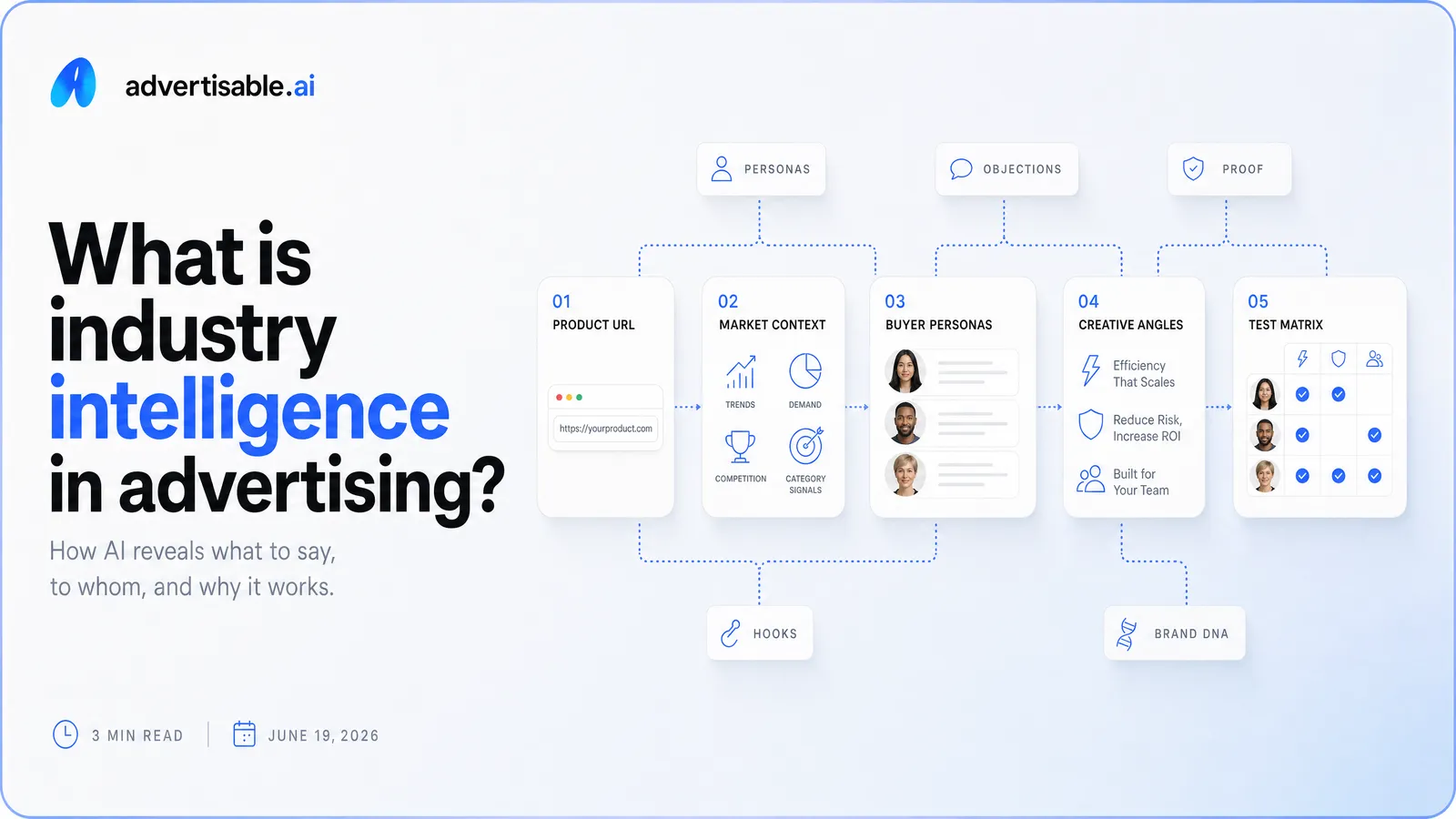
Industry intelligence in advertising is a clear, specific understanding of the market you're selling into and the buyer you're selling to: who they are, what they believe, what they're trying to get done, and what makes them act. It's the difference between writing for an abstract "target audience" and aiming every ad at a real person with a situation, a hesitation, and a reason to buy today.
Here is how we will make this practical for Tuesday morning, not theoretical:
- What industry intelligence actually means for ads, and how it differs from performance analytics (which look backward at your account, not forward at who to speak to).
- Why most teams have market research and personas, yet none of it ever changes the ad they ship.
- What that intelligence should actually shape: the buyer, the objections, the proof, and the angle.
- How to turn it into aimed creative: one persona, one angle, one job, then a focused test.
At Advertisable AI, we built Industry Intelligence into our setup because we kept seeing the same failure: teams have personas and market research, but it sits in a slide deck while the actual ads get made from generic prompts. Our Industry Intelligence is built during Brand DNA setup, from your product URL: it maps your industry, your target market, and specific buyer personas, then uses them to generate ads aimed at those real buyers, not an abstract audience.
Before you worry about tools or workflows, you need a clear definition of what industry intelligence actually means for ads, and how it changes the way you aim creative at a real buyer instead of chasing your own metrics.
What industry intelligence means for ads
Most teams can pull up competitor ads, trend reports, and ad libraries in minutes, but nothing changes in what they ship. In advertising, industry intelligence only matters when it turns into a concrete creative decision and a test in your account.
Aim creative at a real buyer
Industry intelligence in advertising is a specific understanding of who your buyer is and what moves them: the situation they're in, the objections they carry, and the proof that earns their trust. It is not market trivia. It is the understanding that shapes your next hook, angle, offer framing, and format for a specific customer type.
The practical goal is tighter message-to-market fit. You stop writing for an abstract “target audience” and start writing for a buyer with a situation, a fear, and a reason to act today. That is what keeps you from burning budget on creative that looks polished but lands vague.
- Buyer and context: who the ad is for and what moment they are in (new to category, switching, comparing, re-activating)
- Angle and claim structure: which promises are being made and what proof is used (demo, outcome, social proof, founder narrative)
- Hook patterns: opening lines, visual interrupts, and pacing that consistently earn attention in that category
- Format choices: UGC ads vs creator-style ads vs B-roll video vs statics, and how each is positioned to the buyer
Category signals vs performance analytics
Category signals tell you what is likely to work before you spend. Performance analytics tell you what happened after you spent. You need both, but they solve different problems.
Industry intelligence is forward-looking: it helps you decide what to produce and test next based on what is sustaining attention in the market. Your analytics are backward-looking: they quantify how your last batch of ads performed for your audience, in your account, under your constraints.
Treat category signals as inputs to creative direction, not proof. A pattern that's resonating in your category suggests real demand, but it does not guarantee it will work with your product, your price point, or your brand voice.
A clean rule: use industry intelligence to reduce bad bets, then use your own results to choose winners and scale.
Why most industry intelligence never reaches the work
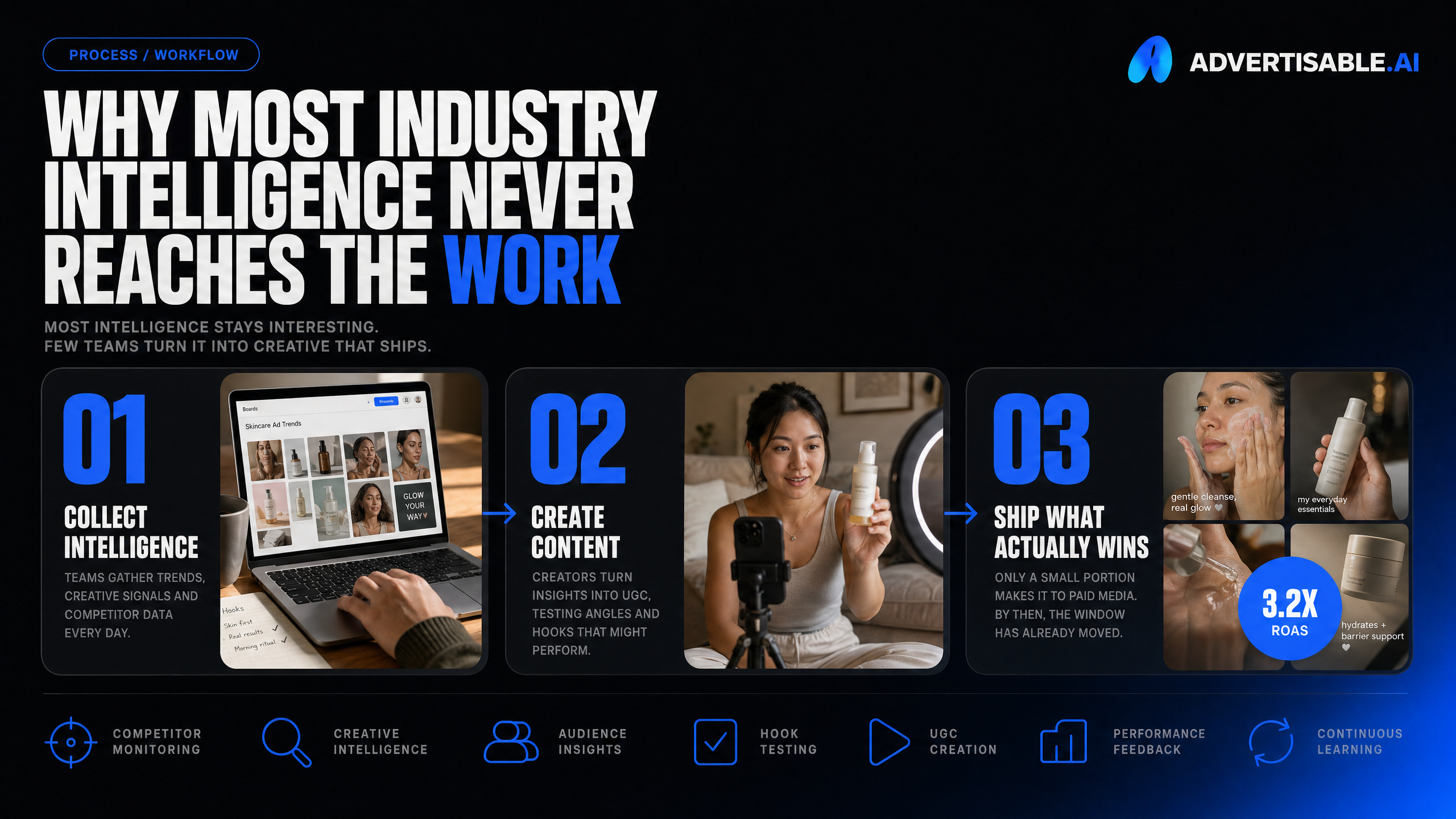
Most teams do not fail at collecting industry intelligence in advertising. They fail at moving it from “interesting” to “shipped” fast enough to change creative outcomes. The problem is not that you lack personas or competitor visibility, it is that the intelligence never gets operationalised inside the creative workflow.
Research that stays in slideware
The most common failure mode is a clean report that never touches a live ad. Intelligence becomes a quarterly deck, a Miro board, or a shared folder that nobody opens during production week.
This happens because the deliverable is built for presentation, not execution. It over-indexes on breadth (every competitor, every trend) and under-delivers on decisions (which hook to test next, which format is sustaining spend, what to cut).
You end up with a “we already have personas” objection because the output feels like planning collateral, not creative direction. The issue is not whether the research is true, it is that it is not packaged in a way that changes what you ship.
- Too much synthesis, not enough specificity: angles and hooks are described, not made testable
- No expiry date: insights live forever, so nothing feels urgent
- No ownership: research is “done,” but nobody is accountable for turning it into variations
No translation layer into briefs
Even when the intelligence is solid, it often dies at the handoff. Creative teams do not need another document, you need a translation layer that turns signals into a brief your team can produce against in hours.
A workable brief is structured around what a creator can actually make and what a performance marketer can actually test. Without that structure, the insight stays abstract and the team defaults to familiar concepts.
In our experience, the translation layer fails when it cannot answer, in plain language, what changes in the next ad you launch.
- Hook options written as on-screen and first-3-seconds lines, not themes
- Angle definition tied to one promised outcome and one proof mechanism
- Format call (UGC ads, Creator-style ads, B-roll video, Static ads) based on what is winning now, not preference
- A variation plan: what stays fixed (Brand DNA) vs what changes (hook, offer framing, first scene)
Backlog speed kills the edge
Industry intelligence has a half-life. When your creative backlog runs on two-week cycles, the “winning” angle you spotted turns into a me-too execution by the time you launch.
Speed breaks in predictable places: approvals, rework, and full regenerations when only one scene is wrong. The result is that you either ship late, or you ship something watered down to meet the deadline.
This is where operational tools matter. In our workflows, frame-by-frame control and a clear variation engine are what keep the loop tight enough for intelligence to influence what goes live, not just what gets discussed.
- Insight captured Monday, but brief not written until Thursday
- First cut reviewed in a batch meeting, not as it is built
- Revisions trigger full remakes instead of scene-level swaps
- Testing waits for “perfect,” so the account learns too slowly
What market intelligence should shape in an ad
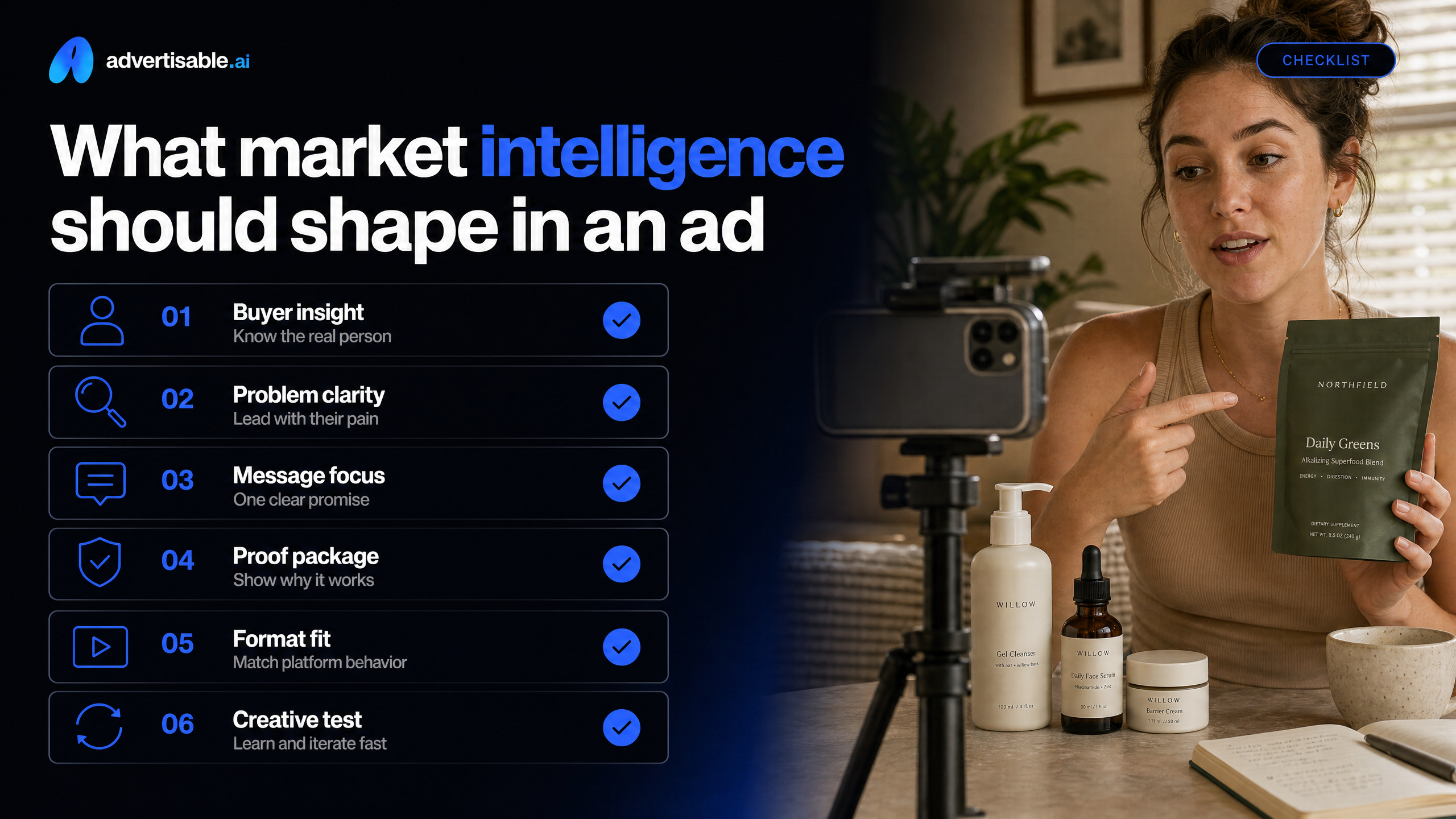
Market intelligence only matters if it changes the creative decisions you ship. Your job is to translate what the market is rewarding into a specific message, format, and proof package that makes sense to one real buyer at a time.
Personas that feel like customers
Personas should be written as buying situations, not demographics. You are using industry intelligence to answer: who is this ad for, what are they trying to get done this week, and what would make them stop scrolling.
In performance creative, the most useful persona details are behavioral and contextual. They tell you what to show, what to say first, and what to avoid so the ad does not feel like it was made for everyone.
When teams skip this, AI-generated drafts tend to drift into broad claims and safe hooks, which rarely matches how customers talk or decide.
- Context: first-touch prospecting vs retargeting, and what they already know about the category
- Job-to-be-done: the outcome they want (faster setup, fewer mistakes, clearer ROI), stated in plain language
- Channel-fit: what the persona expects on that feed (creator-style UGC vs product walkthrough vs outcome-focused static)
- Vocabulary and constraints: the exact phrases they use, plus what they cannot do (no time, no team, compliance limits, procurement steps)
- Creative implication: what must appear in the first 2 seconds (UI proof, product-in-hand, before-after, or a hard number)
If you cannot point to a single line of copy, a first scene, and a visual proof element that your persona definition forces, you do not have a persona you can build ads from.
Objections, proof, and decision triggers
Industry intelligence should tell you which objections are actively blocking conversion in your category, and which proof formats are earning trust right now. That mapping is what keeps your ad from sounding plausible but unconvincing.
Nielsen creative effectiveness data shows creative quality drives 56% of a campaign’s sales lift, which is why the proof package matters as much as the hook. You are not only informing, you are reducing perceived risk in the exact order the buyer experiences it.
Build your ad so each major objection has a dedicated proof moment, then place decision triggers where the buyer is most likely to commit.
- Objection: “This won’t work for my situation” -> Proof: category-specific demo, interface footage, or a tight use-case walkthrough
- Objection: “This is off-brand or unsafe to ship” -> Proof: brand consistency controls (Brand DNA), plus one concrete example of what gets locked (claims, fonts, voice)
- Objection: “Switching costs are high” -> Proof: speed-to-output and editing control (frame-by-frame control) shown as a before-after of one scene change
- Trigger: “I’m ready to compare” -> Creative: side-by-side static or animated statics with one variable per frame
- Trigger: “I just need confidence to start” -> Creative: offer clarity and risk reducers (cancel any time, no annual lock-in) placed after proof, not before
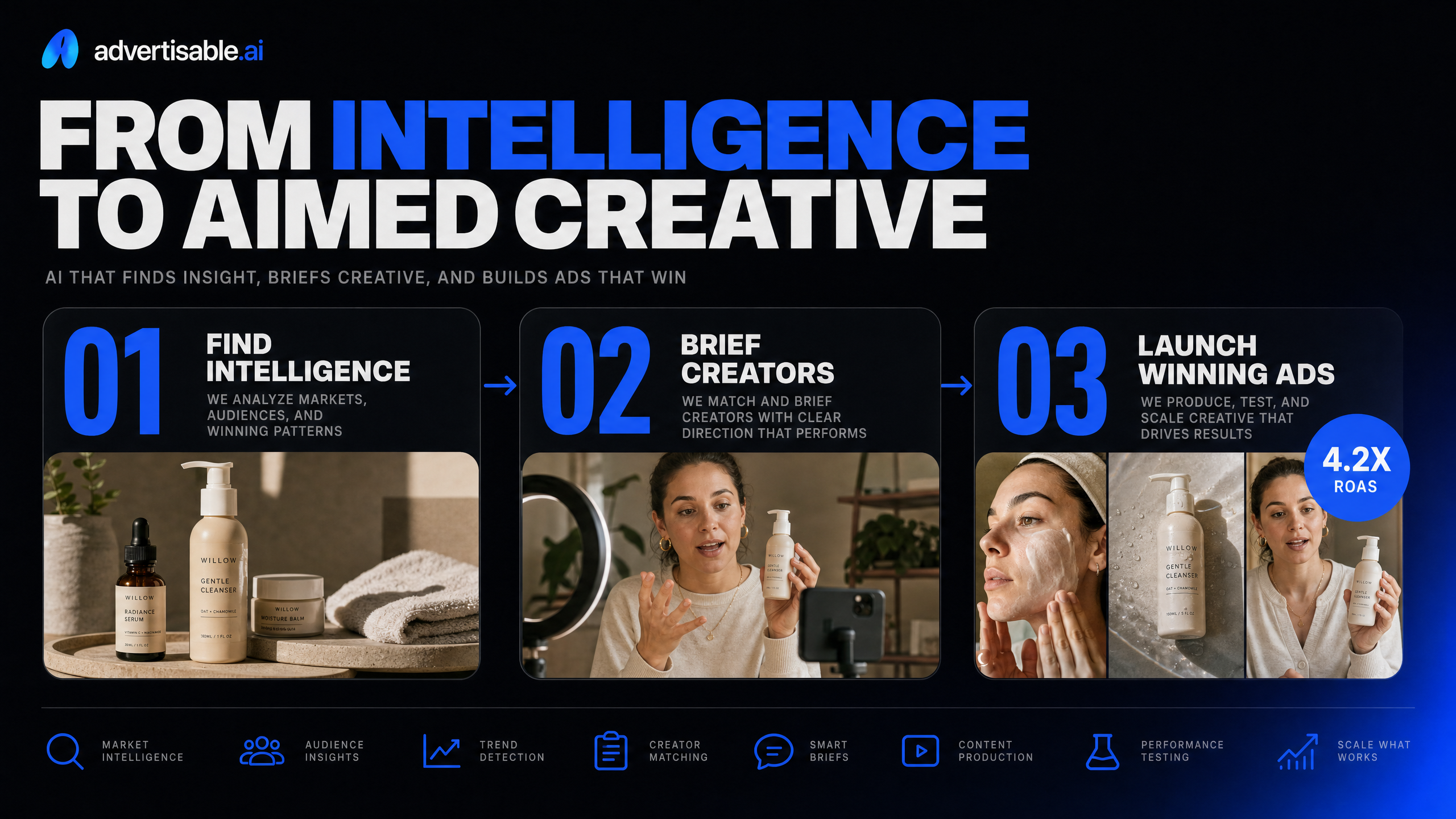
From intelligence to aimed creative
One persona, one angle, one job
Speed comes from constraints. When you turn industry intelligence into creative, you do it by locking three things: one persona, one angle, one job the ad must perform.
Pick a single buyer persona from your signals (who is clicking, who is commenting, who the competitor is clearly speaking to). Then pick one angle you saw sustaining spend in-category (problem, outcome, objection, or proof point). Finally, assign one job so you can judge the ad in 3 seconds: get the click, earn the hold, drive a trial start, or qualify out the wrong user.
This stops the most common waste: mixing personas (CFO + practitioner), mixing angles (speed + security + price), and ending up with a creative you cannot diagnose. You want a clean creative brief you can hand to anyone and still get the same output: “This is for [persona]. We are selling [angle].
The ad must do [job].”
- Persona: name the role and context (for example: “DTC growth lead scaling Meta,” not “marketer”)
- Angle: one promise or tension you can show in a single sentence (for example: “reduce brand drift across 50 variations”)
- Job: one measurable action on-platform (for example: “drive a trial start,” not “increase awareness”)
When those three lines are tight, every creative decision becomes easier: hook, scenes, proof, and CTA all have a single north star.
Test matrix by persona and hook
Once your constraints are set, you build a small matrix so you can learn fast without flooding your account with noise. Hold persona constant, then test hooks as the primary variable.
A practical Tuesday workflow is to ship 6 to 12 variations per persona: same angle, same offer, same format, different hook openings. This matches what persona-based targeting studies consistently show, where persona-tailored messaging can drive 20-40% CTR lifts versus generic versions.
- Rows = personas (start with 1-2 max); Columns = hooks (3-6 max)
- Keep the body consistent: same proof point, same CTA, same first visual style
- Only change the first 1-2 seconds: question hook vs. contrarian hook vs. outcome hook vs. objection reversal
- Pre-tag every asset with Persona + Hook so you can read results without guesswork
- Promote winners by expanding scenes, not rewriting the whole concept (this is where frame-by-frame control matters when one moment is failing)
How advertisable.ai Industry Intelligence works
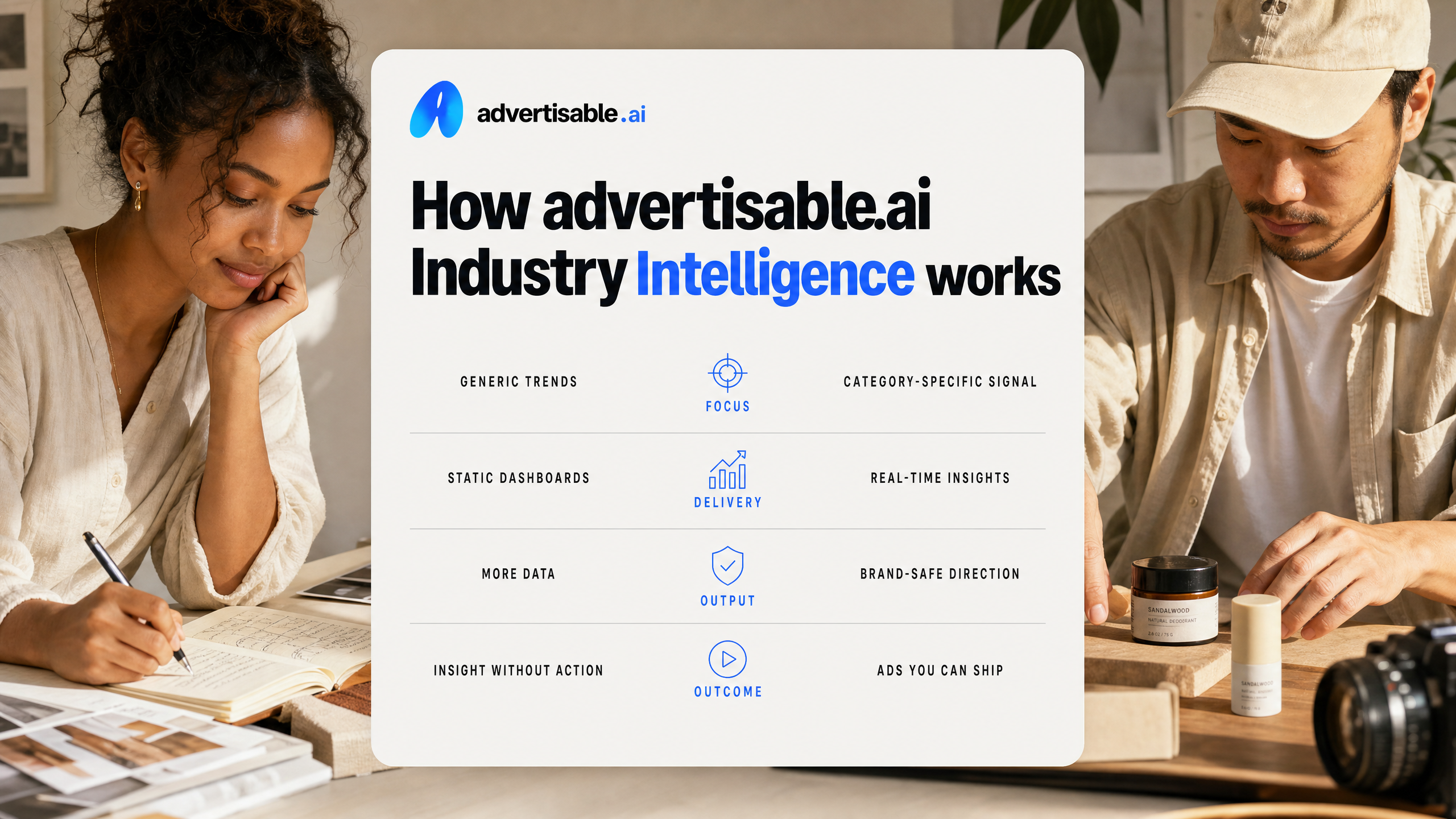
Most “industry intelligence” breaks down at the exact moment it matters: turning what you see in the market into something you can actually ship as an ad. Our approach is designed so the signal does not sit in a dashboard. It becomes a brand-safe creative decision.
Built during Brand DNA setup
Our Industry intelligence is only as accurate as the brand and buyer context it is anchored to, so it is built during Brand DNA setup. That is where you define what can and cannot be said, shown, and styled, before a single variation gets generated.
In practice, Brand DNA is the control layer that prevents brand drift when you move fast. You lock your fonts, colors, visual assets, product specs and claims, plus the voice and tone you want enforced across every output. That means when intelligence suggests an angle, your execution stays inside your guardrails instead of improvising.
- Visual rules: colors, fonts, and brand assets that are enforced across formats
- Messaging rules: product specs and claims you want consistently applied
- Voice rules: tone parameters so variations still sound like you
You get speed without losing control, which is the real failure mode of high-volume creative pipelines.
From product URL to market context
You can start from a product URL, and we use it to ground both Brand DNA and category understanding. This is the fastest path from “here is what we sell” to “here is how the market frames this problem.”
The output you care about is not a scraped summary. It is a usable context layer for creative: what your product is, what it claims, and how it should be positioned in the category so generated ads do not wander into irrelevant promises or mismatched language.
- Faster onboarding: less manual copy-pasting of product details into prompts
- Cleaner inputs: the generator starts with your real product information, not guesswork
- More consistent creative: every variation begins from the same source context
Buyer personas drive on-target characters
Buyer personas are what turn industry intelligence into ads that feel aimed, not accidental. Once your Brand DNA and ICP analysis are in place, personas can drive the “character” of the creative: which objections get answered, what proof points lead, and which tone lands.
This matters most in creator-style ads and UGC ads, where the speaker, pacing, and angle have to match the buyer’s worldview. We have found that teams get better results when they generate variations per persona instead of forcing one message to do every job.
- Hook selection: persona-specific opening lines and pain framing
- Angle selection: benefits and objections prioritized by buyer type
- Format selection: creator-style, B-roll, or statics based on how that persona prefers to evaluate
The point is not to generate more ads. It is to generate the right ads per buyer, without rewriting prompts all day.
Turn industry intelligence into ads you can actually ship.
If your market research and buyer personas live in a slide deck, they are not changing what you put in front of customers.
That is exactly how we built Advertisable AI. You bring a product link, and we build your Brand DNA and Industry Intelligence together: your industry, your target market, and specific buyer personas. From there, those personas drive the ads we generate, so each variation is aimed at a real buyer instead of an abstract audience.
Start with your product link, let it build your buyer personas, and generate your first batch of ads aimed at the people who actually buy. Then let your account data decide what wins.
Frequently Asked Questions
Q: Is industry intelligence the same as market research?
A: No. Market research is the gathering, the surveys and reports that tell you what's true about your category. Industry intelligence is that turned into something that shapes the ad: the specific buyer, their objections, the angle that moves them. Research in a deck becomes intelligence only when it changes what you ship.