What Is AI UGC? Definition, How It Works, and AI UGC vs Real UGC
AI UGC is UGC-style ad content generated by AI instead of filmed by human creators.
You will leave with clarity on:
- What counts as AI UGC (and what does not), so you do not label standard UGC editing as “AI UGC.”
- How AI UGC is built as a controlled creative pipeline: product inputs and claims checklist, brand rules locked first, then storyboard, generate, edit at the scene level, and export.
- AI UGC vs real UGC for paid ads: speed, cost per video versus creator fees, revision cycles, usage rights clarity, and when real creators still win.
- AI UGC vs a general AI video generator: why ad formats and brand-consistency guardrails matter more than open-ended prompting.
- Where AI UGC performs, where it breaks fast, and what disclosure and policy realities you need to plan for.
We built Advertisable AI around one idea we kept seeing in ad accounts: UGC-style ads work, but scaling them usually breaks on control. Our Advertisable AI UGC Platform is designed for performance creative with a Brand Identity Lock System, Scene-Level Control Interface, and a Creative Sequence Approval Workflow so you can scale output without letting brand safety drift.
Before you decide whether AI UGC is viable for your paid ads, you need a plain-English definition you can actually enforce, plus clear lines for what counts and what does not. Let’s start there.
Plain-English definition and what counts
AI UGC in two sentences
AI UGC is UGC-style ad content generated by AI instead of filmed by human creators. You keep the same creator-format cues that make UGC convert, but production becomes a controlled, repeatable pipeline you can scale and iterate quickly.
What counts and what does not
AI UGC is a category label, not a vibe. It counts when the core “creator footage” is synthetic, meaning the on-camera person, voice, visuals, or the full video is generated and assembled by AI to look and feel like creator-shot UGC.
It does not count when a real human creator filmed the footage and you simply used AI to polish, edit, or repurpose it. That is still traditional UGC, just produced with modern tools.
- Counts as AI UGC: AI creators or avatars delivering a scripted or structured message in a UGC-style format (selfie framing, direct-to-camera, product-in-hand, etc.)
- Counts as AI UGC: Video generated from product inputs (for example, product details pulled from a link) and rendered into UGC-style scenes
- Counts as AI UGC: AI voiceover used as the primary “creator” voice, when the performance is synthetic rather than recorded by a human creator
- Does not count as AI UGC: Real creator-shot videos where AI is used for captions, jump cuts, background cleanup, color, audio leveling, or resizing
- Does not count as AI UGC: Real creator UGC where AI only helps write the script or generate a shot list, but the creator still records the final performance
AI UGC vs broader AIGC
AI UGC is a specific slice of AIGC. AIGC (AI-generated content) is the umbrella term for anything AI creates, including images, articles, animations, music, and experimental video that is not designed to behave like creator-made ads.
The practical difference is intent and constraints. AI UGC is purpose-built to mimic UGC ad conventions and fit performance marketing workflows, so it usually comes with tighter guardrails around brand, product details, and scene structure. Broader AIGC is often open-ended: great for exploration, less reliable when you need repeatable ad-ready outputs.
- AI UGC: Narrow format target (UGC-style ads) and optimized for paid social deliverables
- AIGC: Broad output category that includes everything from concept art to long-form video, with no requirement to match UGC conventions
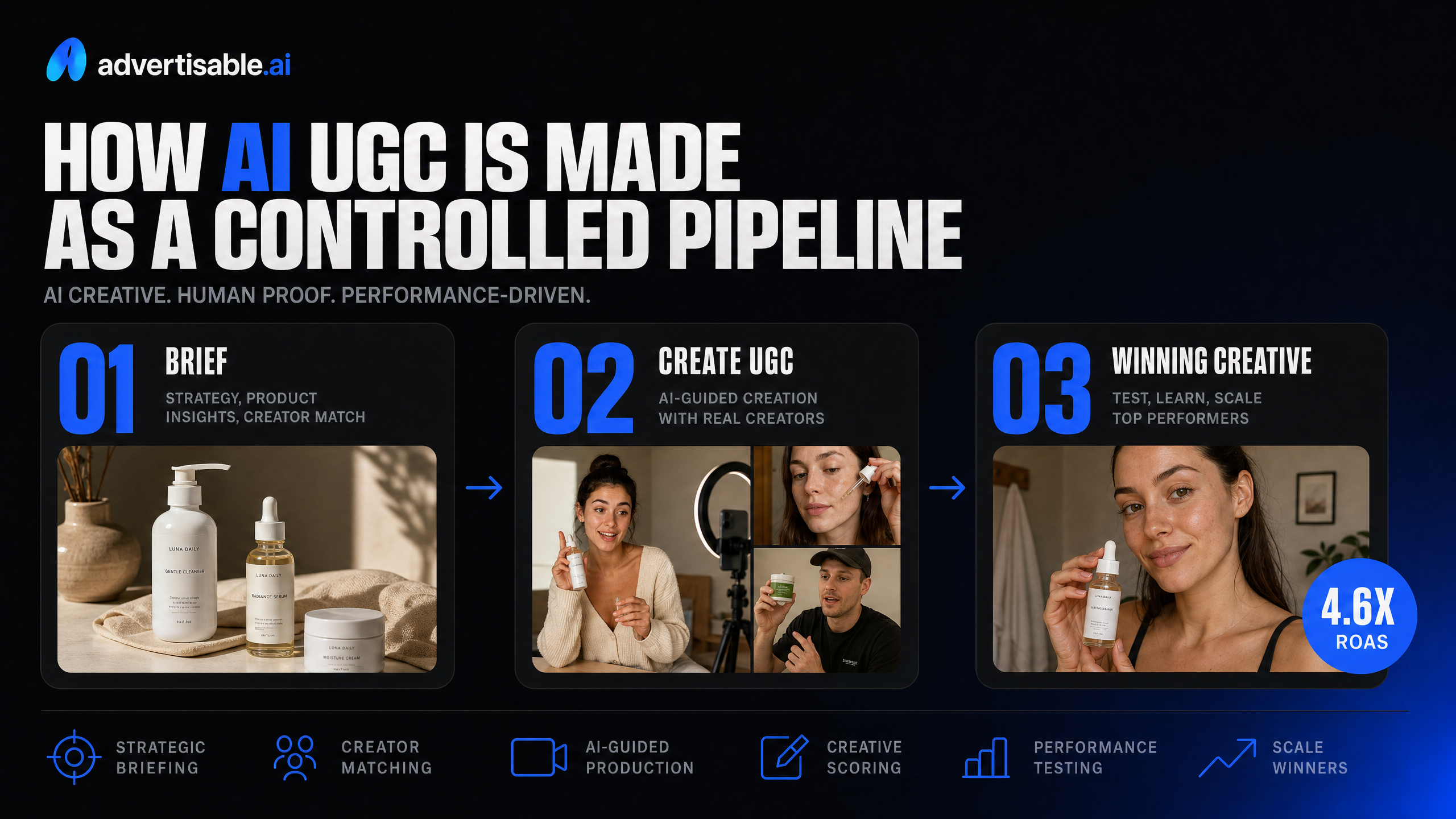
How AI UGC is made as a controlled pipeline
Product input and a claims checklist
The fastest way AI UGC goes wrong is when the model is forced to guess product details. A controlled pipeline starts with structured product input and a claims checklist, so the system has facts it can safely say and guardrails for what it must not say.
Your product input is usually a product URL (or a tight brief) plus the assets that matter for ads: what the product is, who it is for, the top benefits you can substantiate, and the non-negotiables that create compliance risk.
Minimal example: you are promoting a vitamin C serum. You can input the INCI highlights, skin types, allowed benefit language like “helps brighten the look of dull skin,” and hard exclusions like “no acne cure claims” and “no before-and-after assertions.”
- Allowed claims: specific phrases you approve (and any required qualifiers like “helps,” “appearance of,” or “supports”)
- Disallowed claims: medical outcomes, time-bound promises, competitor comparisons, or anything you cannot substantiate
- Required disclosures: shipping limits, subscription terms, contraindications, or offer terms that must appear when referenced
- Source-of-truth fields: price, sizes, colors, bundle contents, and what is or is not included
Lock brand rules before generation
You get brand-consistent AI UGC by locking your brand rules before a single frame is generated. When you do this upfront, you are not “fixing AI later,” you are preventing off-brand output from being created in the first place.
In practice, brand-consistency guardrails cover your tone, banned phrases, visual constraints, and any compliance language your category needs. On an AI UGC ad platform, this is where a Brand Identity Lock System matters: it turns brand guidance into enforceable constraints instead of optional suggestions.
The operational win is simple: you can produce variations without re-briefing every time, because the platform is generating inside the same box each run.
- Voice and vocabulary: approved tone, reading level, and phrases your brand does not use
- Visual boundaries: logo placement rules, color palette, on-screen text limits, and product depiction requirements
- Audience rules: ICP alignment, sensitivity topics to avoid, and any restricted targeting language
- Compliance guardrails: claim categories that require qualifiers, disclaimers, or outright bans
Storyboard, generate, edit, export
A controlled AI UGC workflow is storyboard-first, not prompt-first. You approve the creative sequence before you spend time generating a batch, which is how you avoid discovering a fundamental issue after you have 20 unusable exports.
The production loop is straightforward: build a storyboard, generate scenes, edit at the scene level, then export in the formats your media team needs. What we have found is that scene-level control is the difference between “close enough” and ads you can confidently run at scale.
Using a Storyboard Editor and a Creative Sequence Approval Workflow (like we built in Advertisable AI), you can swap a hook, re-write one claim line, or change a product shot without restarting the entire video.
- Storyboard: define hook, problem, product moment, proof point, CTA, plus on-screen text per scene
- Generate: create multiple takes inside your locked brand and claims constraints
- Edit: adjust only the failing scene (voice line, subtitle, background, pacing, overlay text) while keeping the rest intact
- Export: output platform-ready variants for Meta, TikTok, and YouTube with consistent naming and aspect ratios
AI UGC vs traditional UGC for paid ads
Production model, speed, and costs
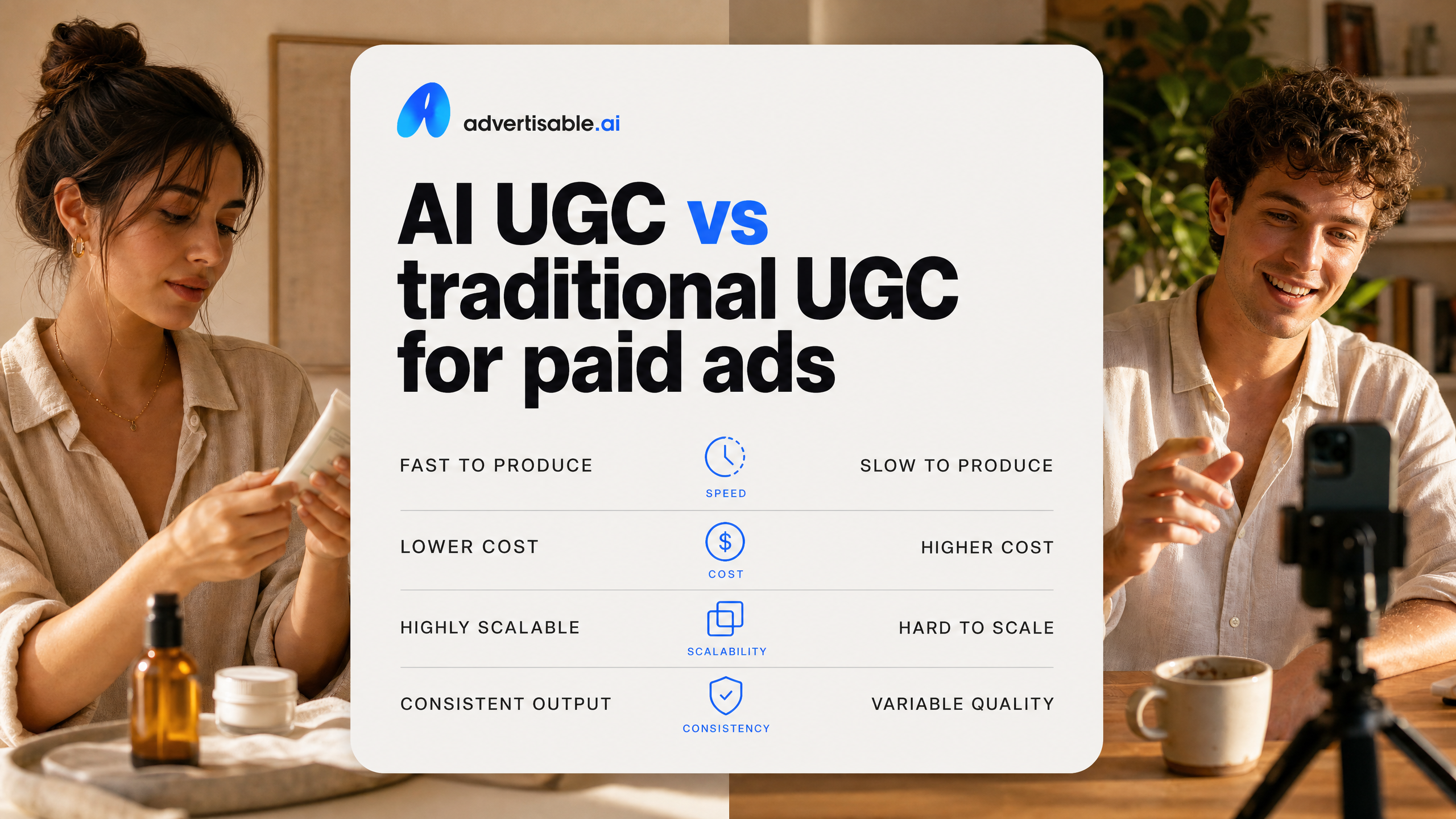
AI UGC turns UGC-style ad production into a repeatable pipeline, while creator-shot UGC is a people-driven process. That difference shows up immediately in how fast you can ship, how predictable the output is, and how your costs behave when you need volume.
With traditional UGC, you are sourcing creators, coordinating briefs, waiting on shipping (sometimes), managing timelines, and accepting that performance-ready variations might require multiple separate shoots. It can work extremely well, but it is not built for same-day iteration when you want 10 new hooks before tomorrow’s budget increase.
With an AI UGC ad platform, you are generating variations from structured inputs, then refining at the scene level and exporting for testing. The cost structure is typically subscription or credits, so marginal cost per new iteration drops when you are producing at scale.
- Traditional UGC: variable lead times, per-asset fees, extra costs when you need more angles, more hooks, or more formats
- AI UGC: fast iteration cycles, predictable throughput, and easier scaling for high-volume testing without recruiting and managing more creators
Usage rights and revisions clarity
Usage rights are usually clearer with AI UGC because you are generating assets inside a platform with defined terms, instead of negotiating creator-specific licensing. For paid ads, that clarity matters because rights limits can quietly cap where, how long, and how aggressively you can run winning creatives.
Creator-shot UGC often comes with a base deliverable plus add-ons: extended usage windows, whitelisting, raw footage, cutdowns, or exclusivity. That is normal, but it means your true cost and your ability to iterate depend on what was negotiated, not just what was delivered.
Revisions also behave differently. With AI UGC, revisions are usually operational: change a claim, swap a scene, tighten pacing, regenerate a hook, then re-export. With creators, revisions depend on availability and willingness, and certain fixes require a reshoot rather than an edit.
- Ask creators for: explicit paid usage duration, platforms allowed, whitelisting terms, raw footage terms, and whether you can edit freely
- Ask AI UGC platforms for: commercial usage scope, whether synthetic performers require disclosure in your target region, and how revisions are handled within credits/workflows
When real creators still win
Real creators still win when trust is inseparable from identity. If your performance relies on a creator’s lived experience, existing audience relationship, or credible on-camera nuance, AI UGC can look like an imitation instead of evidence.
In our experience, human-shot UGC tends to outperform when the ad is doing heavy credibility work: founder-led storytelling, sensitive categories, highly technical products that need real hands-on proof, and brands whose differentiation is community. Viewers are also quicker to call out anything that feels unnatural when the product is expensive, high-stakes, or intimately personal.
The practical approach is to use both formats with intent: run AI UGC for high-velocity testing and structured iteration, then reinvest in creator partnerships for your best-performing angles where authenticity and recognizable presence lift conversion and reduce skepticism.
- You need a real person’s authority: expertise, credibility signals, or community standing that cannot be synthesized
- You need proof that is hard to fake: true demonstrations, nuanced reactions, or multi-step use cases where continuity matters
- Your brand risks backlash if the audience feels misled, especially in categories where trust is the product
AI UGC vs generic AI video generators
Claims control and guardrails matter
In paid ads, the fastest way to burn spend is letting a model invent product details, pricing, results, or disclaimers. Claims control and guardrails keep you inside what your brand can actually stand behind.
In our experience, the real risk is not “AI looks weird.” It is AI confidently stating the wrong thing. An ad-grade AI UGC platform is built to prevent off-brand visuals and uncontrolled copy before you generate at scale, then adds an approval step so nothing ships accidentally.
- Lock brand inputs before frames are generated (logos, colors, tone, banned phrases)
- Constrain scripts to allowed product attributes and approved offers
- Scene-level control so you can fix one claim or shot without regenerating the whole ad
- Creative sequence approval so only reviewed variants get exported
Ad formats vs open-ended prompts
Ads are structured formats with predictable building blocks: hook, problem, proof, offer, CTA. Open-ended generators optimize for “make something cool,” not “make something compliant and testable.”
That difference changes your workflow. With ad formats, you want repeatability: the same concept rendered in multiple hooks, angles, and aspect ratios, while keeping brand rules constant.
Open prompting can be useful for exploration, but it is fragile for performance creative because a tiny wording change can produce a totally different story, product depiction, or claim.
- Choose ad templates that map to your funnel (testimonial, demo, founder-style, offer-led)
- Feed real product data (for example, from a product URL) instead of relying on imagination
- Edit at the scene level to keep winners intact while iterating only the hook or offer
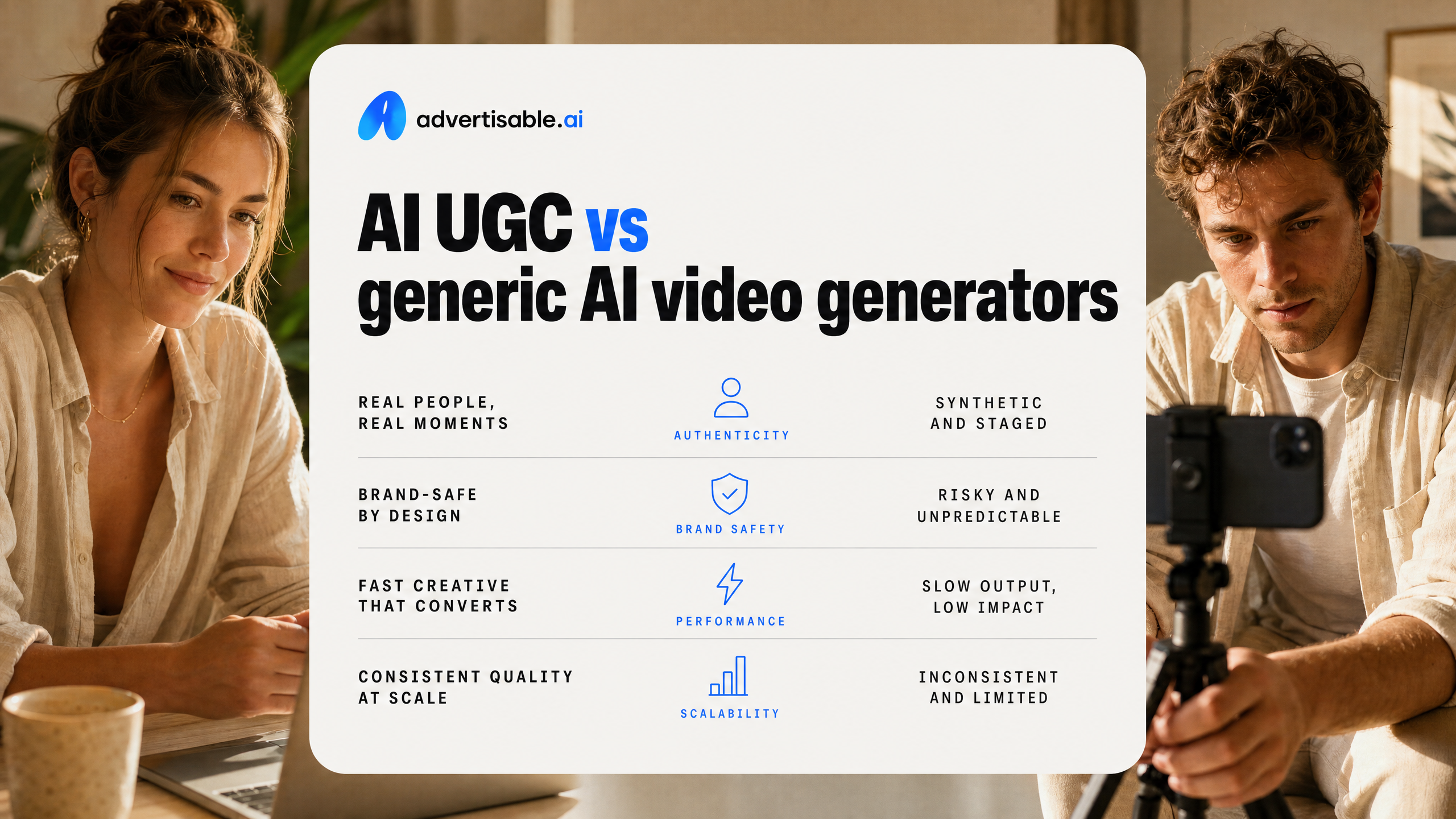
AI UGC vs AI video table
Both categories can generate video quickly. The separation is whether the system is designed for performance advertising with controls, or for broad content creation with unlimited variability.
- Primary goal: AI UGC ad platform = scalable performance creative testing | Open-ended generator = creative exploration and storytelling
- Inputs: AI UGC ad platform = product facts + brand rules + structured scripts | Open-ended generator = prompt-first, loosely constrained
- Controls: AI UGC ad platform = brand-consistency guardrails + scene-level control | Open-ended generator = limited enforcement, more drift
- Risk profile: AI UGC ad platform = reduced chance of off-brand or unapproved claims | Open-ended generator = higher chance of hallucinated details
- Workflow: AI UGC ad platform = storyboard and approval pipeline | Open-ended generator = generate, then manually salvage
- Output readiness: AI UGC ad platform = production-ready ad variants for Meta, TikTok, YouTube | Open-ended generator = often needs extra formatting and compliance review
Where AI UGC works and where it breaks
Best-fit paid ad use cases
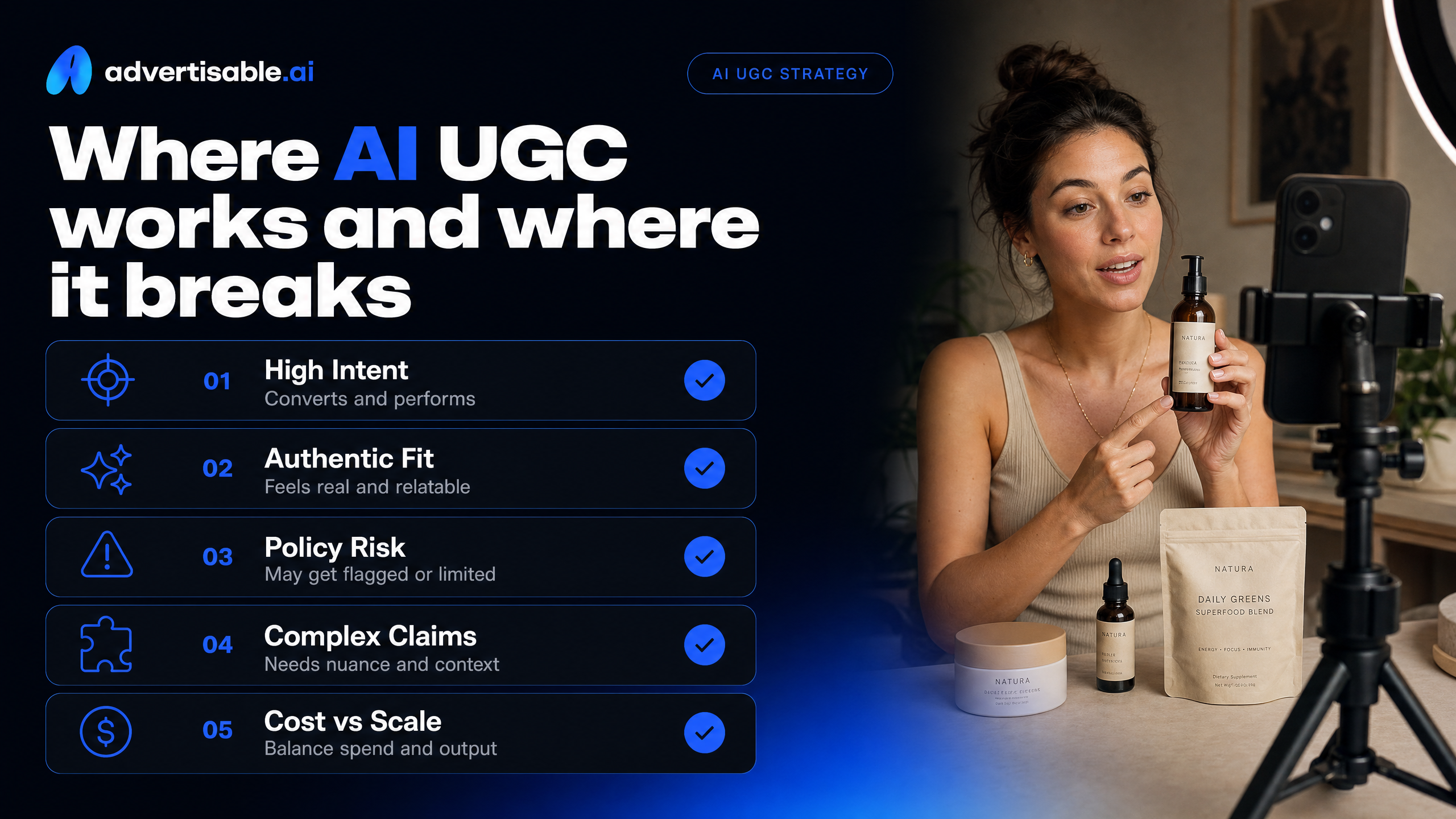
AI UGC earns its keep when you need speed, consistency, and volume in paid social, not a one-of-one creator moment. It is strongest when performance creative is the priority and you want a repeatable pipeline you can iterate daily.
In our experience, the wins show up fastest in top-of-funnel and mid-funnel placements where the job is to stop the scroll, explain one value prop, and drive a clean click or view-through.
- High-velocity hook testing: rapid variations on the first 1 to 3 seconds for Meta and TikTok
- Multi-SKU and variant-heavy catalogs: keep the same structure while swapping product inputs
- Always-on retargeting: fresh angles without re-briefing new creators every week
- International scaling: adapt language and on-screen text while keeping brand-consistency guardrails
- Tight brand requirements: brand identity locked before generation and scene-level control to reduce off-brand risk
Failure modes you will see fast
AI UGC breaks when your ad depends on lived credibility, hard-to-fake product nuance, or spontaneous human imperfection. You will usually spot the issues in the first review pass, before you ever spend media.
The most common operational failure is skipping control and approval. Without a structured creative pipeline and a creative sequence approval workflow, teams publish too many variants that are technically different but strategically identical.
- Uncanny delivery: facial movement, eye focus, or cadence that reads as synthetic
- Product truth gaps: visuals or wording that overstate what the product does or implies features you do not offer
- Sameness at scale: too many ads share the same pacing, gestures, and shot logic, so fatigue hits quickly
- Brand drift: tone, colors, or terminology wander when you do not lock guardrails before generation
- Comment-section risk: audiences call out “fake creator” vibes and the ad becomes about the format, not the offer
Disclosure and policy realities
You should assume disclosure requirements exist in some form, and that platform policies can change faster than your creative cycle. Treat this as a compliance workflow problem, not a one-time checkbox.
At a practical level, you need a repeatable review step: confirm the performer is synthetic, confirm claims match your landing page and substantiation, and confirm the ad meets the destination platform’s current labeling rules.
If you advertise in the US, New York's synthetic performer law is one example of where disclosure expectations can be specific for ads that include AI-generated synthetic performers. For broader enforcement posture around AI-generated deception, FTC enforcement actions are a useful signal without being a substitute for legal advice.
- Build a disclosure convention you can apply consistently across channels (caption, on-screen text, or both, depending on placement)
- Keep a paper trail of inputs, approvals, and final exports so you can respond to policy reviews quickly
- Avoid “testimonial-like” scripts unless you can substantiate them and label them appropriately
Common questions marketers ask about AI UGC
Is AI UGC legal?
Generally, creating and running AI UGC is legal, but legality depends on what you say, what you show, and where you run it. The biggest risks are the same ones you already manage in performance creative: deceptive claims, misleading endorsements, and using a person’s likeness or brand assets without rights.
Treat AI UGC like any ad: substantiate performance or health claims, avoid fabricated “customer” specifics, and keep product details accurate. We also see teams reduce brand risk by locking brand-consistency guardrails and running a formal creative sequence approval workflow before anything ships.
- Keep scripts and on-screen text aligned with what you can prove
- Do not present AI-generated testimonials or reviews as real customer experiences
- Get clear rights for any real names, logos, or identifiable people you reference
Do AI UGC ads need disclosure?
Sometimes. Disclosure rules vary by platform, region, and ad category, and they can change quickly, so you should confirm the latest requirements for where you advertise.
As a practical standard, disclose when the ad could reasonably lead someone to believe a real person is speaking or endorsing the product, especially when you use synthetic performers. New York's synthetic performer law is one example of a jurisdiction moving toward mandatory disclosure in ads.
- Check platform policies for “synthetic media” or “manipulated media” language
- Coordinate with your legal or compliance owner for regulated categories
- Standardize disclosure language so it is applied consistently across variants
Does AI UGC perform like real UGC?
It can, but it is not automatic. AI UGC tends to perform best when you use it as performance creative: fast hook iteration, controlled messaging, and consistent brand execution.
Real creator UGC still wins when the product needs lived experience, nuanced emotion, or high-trust authority. In our experience, teams get the strongest results when they treat AI UGC as a scalable testing and iteration engine, then double down on the winners with either more AI variants or selective creator shoots.
- Where AI UGC often wins: high-volume testing, multi-SKU catalogs, fast localization
- Where real UGC often wins: credibility-heavy niches, founder-led storytelling, community-driven brands
What does AI UGC cost vs creators?
Creator UGC pricing is usually per deliverable, plus usage rights and add-ons. AI UGC is typically subscription or credit-based, so your unit cost drops as you produce and iterate more variations.
creator economy spending trends show average UGC rates ranged between $150 and $212 in 2024, with usage rights commonly adding 30% to 50% of the base rate. If you need dozens of variants per week, AI UGC often becomes the more predictable cost structure.
For a concrete breakdown, use our AI UGC cost vs creators guide and pair it with our AI UGC workflow guide so you can model cost against throughput and approval time.
Turn AI UGC into a repeatable testing engine
If you already know UGC-style ads work, your bottleneck is production, not strategy. You need AI UGC you can control, iterate, and ship fast without rolling the dice on off-brand outputs or unclear usage rights.
That is exactly what we built Advertisable AI for. You start from a product link, lock your brand rules before any frames are generated, then use scene-level control to dial in hooks, claims, and pacing. When you are ready, run everything through a creative sequence approval workflow and export production-ready ads for Meta, TikTok, and YouTube.
Take the next step: run a $5 trial, recreate one of your current UGC winners as an AI UGC variant, and launch five hook angles this week.
Frequently Asked Questions
Q: How is an AI UGC platform different from a general AI video generator?
A: An AI UGC platform is purpose-built for performance creative, meaning it is designed around ad formats, repeatable testing, and brand-consistency guardrails. Instead of relying on open-ended prompts, you work inside a structured creative pipeline where your brand rules and product details are set first, then the video is generated within those constraints. The practical outcome is fewer off-brand surprises and faster iteration on hooks and angles that you can actually run in paid campaigns.
Q: Can I control individual scenes in generated ads?
A: Yes. With scene-level control, you can adjust specific moments like the hook, product demo, benefit callout, or offer screen without rebuilding the entire ad from scratch. This matters in AI UGC because small scene changes are often what separates a watchable video from a scalable winner.
You keep overall brand consistency while iterating where performance teams usually need the most leverage.
Q: What approval process happens before ads go live?
A: A creative sequence approval workflow gives you a checkpoint before anything ships, so you can review the final cut for claims accuracy, brand alignment, and format fit. In practice, it helps you avoid spending budget on creatives that look right at a glance but break standards in a single scene. This is especially useful when you are producing variations at volume and need a consistent QA step.