Ship AI Animation Ads Fast Without Brand Drift
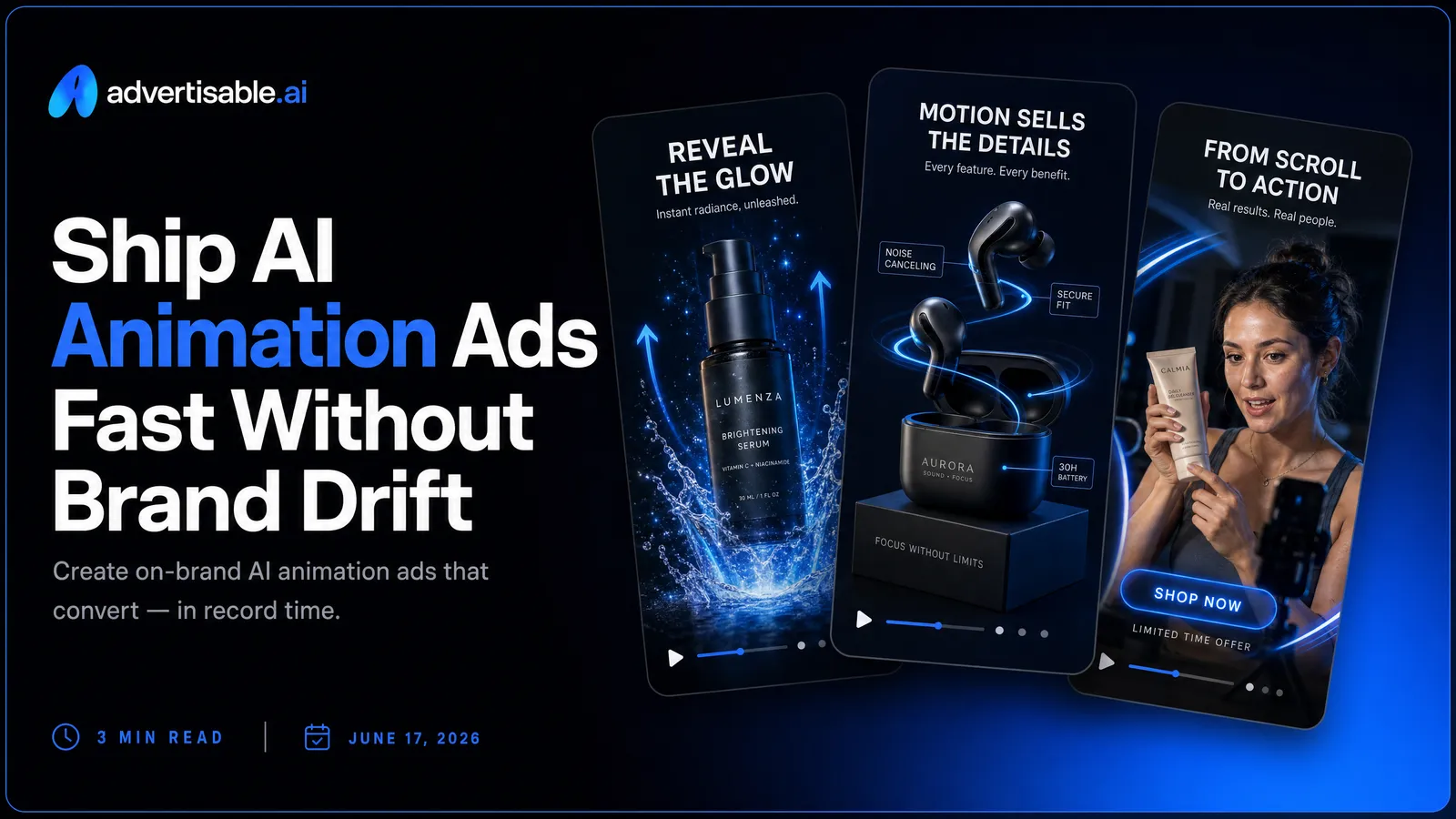
Ship AI animation ads fast without brand drift by locking Brand DNA first, storyboarding before you generate, and iterating with scene-level control instead of full rerolls.
An AI animation ad is simple: one clear concept, AI-generated motion, and a production-ready export built for feed and story placements. The win is not perfect cinematics. The win is controlled iteration at testing scale.
You will get a full workflow from brief to export with quality checkpoints, including:
- How to treat motion like a near-static cost decision so your testing plan changes
- How to stop fake-looking scenes early with brand guardrails and proof layers
- How to start from a static that already converts, then regenerate only the weak scenes
- What you still own: angle, offer, hook clarity, and compliance
- How to pick tools for frame-by-frame control, brand locking, and fast versioning
We built Advertisable AI for teams that need production-ready ads at volume without losing control. Our platform uses Brand DNA guardrails to lock your colors, fonts, logo, specs, and voice across variations, plus a storyboard editor that lets you regenerate individual scenes instead of rebuilding the entire ad when one moment misses.
Once you see AI animation as motion you can test like a static, the whole process gets simpler: you make smaller bets, you learn faster, and you scale winners instead of polishing guesses. Start there, because the economics of near-static motion is what turns “we need a video” into a repeatable testing system.
AI animation ads are motion you can test like a static
Animated ads used to mean a motion designer, a timeline measured in days, and a single “hero video” you hoped would carry the month. AI collapses that constraint. When motion is fast to produce and easy to revise, you stop treating it like a one-shot bet and start treating it like any other testable creative variable.
What counts as an AI animation ad
An AI animation ad is any paid-social creative where AI generates or applies the motion, not just the layout. In practical terms, it is motion you can produce from a static concept, a prompt, or a product link and ship in the same placements you already buy (feed, stories, short-form video).
That includes “motion statics” where a previously static ad gets animated transitions, text movement, product motion, or scene-to-scene flow. It also includes AI-generated video ads where the scenes themselves are generated and assembled into a production-ready sequence, as long as the output is built for advertising: clear hook, proof layer, offer, and CTA.
What does not count is manually edited motion where AI is only doing minor cleanup, or a one-off clip generator that cannot keep your message and brand elements consistent across iterations.
- Animate a still into a short video unit (motion statics) for placements that favor video
- Generate a multi-scene ad from a storyboard concept where you can revise individual scenes
- Batch variations of the same concept, keeping the body consistent while swapping hooks or proof moments
Why motion stopped being a hero bet
Motion used to be a hero bet because the cost of change was high. When every revision means reopening a project file, re-rendering, and re-exporting versions, you naturally overinvest in one concept and under-test alternatives.
AI changes the economics and the operational friction at the same time. You can generate motion variants quickly, and you can correct misses without rebuilding from scratch when the workflow supports scene-level or frame-by-frame control. That matters because performance almost never fails on “video-ness” alone.
It fails on angle, hook clarity, proof, and offer structure.
This is where people misread the problem and blame the tech. “Janky” motion is usually a strategy failure: no proven angle, no clean hook test, and no disciplined iteration. High-performing AI animation is controlled motion, on-brand typography and pacing, and a message that survives variation.
Near-static cost changes your testing plan
When motion approaches the cost and speed of static production, your testing plan should change immediately. You stop asking “Can we afford to make video?” and start asking “Which static concept earned motion, and which parts should vary?”
The cleanest approach is to treat animation as an extension of what already converts. Start from a static ad concept that has signal, then use motion to create more hooks, more stopping power, and more variants before fatigue sets in.
- Promote motion from a “special project” to a standard variant type alongside statics
- Hold the body constant and test multiple hooks first, because the opening seconds decide whether people watch or scroll
- Generate batches of small motion differences (pacing, text entrance, proof moment order) instead of rewriting the entire message each time
- Plan for targeted fixes: replace a weak hook scene or proof scene without rerolling the whole ad
You get to spend your creative budget on learning velocity, not on protecting a single asset from change.
Stop fake-looking output before it hits your account
“AI animation looks fake” is usually a process problem, not a technology problem. When you lock the angle, constrain the brand, and add proof in the right places, AI-generated motion reads like a real ad instead of an experiment.
Janky output is a strategy failure
The fastest way to get awkward-looking AI animation is to start from a blank prompt instead of a proven ad angle. You end up optimizing visuals while the message stays unclear, and the ad feels off before the viewer even processes the offer.
In our experience, strong AI animation ads are built like performance ads, not like short films: one job, one idea, one conversion path. The creative can be simple, but it has to be intentional.
Treat motion as the delivery mechanism for an already-solid structure: hook, problem, proof, offer. When teams skip that and “make something cool,” AI just makes the inconsistency show up faster.
- Start with a single angle you can say in one sentence (the promise, not the feature list).
- Lock the hook you want to test before you touch styling.
- Keep the body consistent while you iterate on openings so you can read performance cleanly.
- Decide what must be shown on screen (product, result, UI, ingredients, sizing) vs. what can be implied.
Motion does not rescue a weak angle; it amplifies whatever strategy you brought into the build.
Brand guardrails stop visual drift
Brand drift is what makes AI animation look “fake” at scale: colors shift, logos warp, product details change, and scenes stop feeling like they belong to the same company. Guardrails fix that by making consistency the default, not a manual cleanup task after the fact.
This matters even more when multiple people touch creative, because subtle variations creep in across versions and platforms. brand consistency research highlights that automation can enforce standardization across large volumes when you implement the right frameworks.
In practice, you want constraints on the non-negotiables, plus the ability to correct only what is broken. That is why we built Brand DNA and storyboard-first, scene-level control: you lock fonts, colors, logos, specs, and voice, then regenerate the single scene that drifts instead of re-rolling the entire ad.
- Non-negotiables: exact logo usage, brand colors, typography, product names and specs, claim language you are allowed to use
- Style boundaries: camera distance, background type, lighting mood, on-screen text density
- Consistency checks: the first frame and last frame of each scene still look like the same brand and product
Proof layers earn trust in seconds
Viewers do not need “perfect realism” to trust an ad, but they do need proof quickly. Proof layers are the visual elements that reduce uncertainty: they answer “Is this real?” and “Will this work for me?” without forcing the viewer to take your word for it.
The mistake we see is treating proof as a caption or a disclaimer at the end. In performance creative, proof has to appear early and often, especially in high-consideration categories where skepticism is high.
- Demonstration: show the product doing the job (or the interface, flow, or output) rather than describing it
- Specifics: on-screen specs, what is included, sizing, compatibility, and concrete constraints that prevent disappointment
- Social validation: ratings, review snippets, or “as seen in” style elements where you can substantiate them
- Comparative clarity: simple side-by-side tables or before/after framing when it is claim-safe and accurate
When motion is paired with real proof, AI stops feeling like a gimmick and starts feeling like an efficient way to ship credible creative at testing scale.
The fastest workflow from winning static to on-brand motion
Fast motion ads are not about generating more. They are about making a few high-confidence decisions up front, then using scene-level control to spend credits only where the ad actually needs work.
Start with a static that already converts
The fastest path to on-brand motion is animating a static that has already proven it can sell. When you start from a winner, you are not asking AI to invent an angle, you are asking it to add movement and pacing to something you already trust.
Pick one static with clear performance signals (CTR, CPA, or simply the one that has survived fatigue the longest). Then lock Brand DNA before you generate anything, because drift shows up fastest when you scale variations across formats and placements.
- Choose a static built on a single, obvious promise: one product, one outcome, one offer
- Use the same hierarchy in motion: hook visual first, proof layer next, offer last
- Decide your motion approach upfront: Animate a proven static for speed, or use UGC Style or B-Roll Style when you need a presenter or a stronger proof layer
When the angle stays constant and only the motion changes, your tests stay clean and your iterations stay meaningful.
Storyboard first so credits follow decisions
Storyboard before you generate so you can approve the structure once and stop paying to discover mistakes. In our experience, most wasted spend comes from rerolling entire ads because the hook, proof, and offer were never defined scene-by-scene.
Treat the storyboard like a decision gate. You are deciding what each scene must accomplish, what must remain fixed (brand elements, product specs, claims), and what you are willing to vary (hook lines, opening visual, CTA phrasing).
A practical storyboard for paid social is usually short and functional: hook scene, problem or tension, proof layer, offer, CTA. Your goal is not cinematic storytelling. Your goal is controlled iteration.
- Scene objective: what the viewer should understand or feel by the end of the scene
- On-brand guardrails: fonts, colors, logo placement, and any non-negotiable product details via Brand DNA
- Variation plan: which scenes will be A/B tested (often just the first 2 seconds) and which scenes stay identical
- Pass-fail criteria: what counts as unusable (incorrect product details, brand drift, unclear message)
Regenerate only the weak scenes
Do not reroll the whole ad when one scene misses. Scene-level and frame-by-frame control is what turns AI motion into a production workflow instead of a slot machine.
Quality problems are usually localized: the hook is unclear, a product detail drifted, an avatar delivery feels off, or a proof shot is not accurate. Fix that specific scene, keep the rest, and you preserve the winning structure you already approved.
- Hook underperforms or reads confusing: regenerate only the opening scene while keeping the body identical for a clean hook test
- Brand drift shows up (colors, fonts, logo usage): reapply Brand DNA and regenerate the affected scene only
- Product accuracy is off in a proof shot: regenerate that proof scene and keep the offer and CTA untouched
- One scene feels slow: swap the scene length or pacing while keeping the script and sequence order stable
This is the loop that scales: batch variations, isolate what is weak, and replace only that piece until the ad set is production-ready.
What you still own when AI makes the video
AI can generate the motion, but it cannot own the strategy. Performance stays high when you stay accountable for the choices that actually move outcomes.
Angle and Offer Are the Strategy
Your angle and your offer decide the outcome, not the animation style. AI can package a message fast, but it cannot choose a message that deserves spend.
The angle is the why-now story you are telling a specific customer. The offer is the concrete trade you are asking for: price, bundle, trial, guarantee, or incentive. If those are weak or mismatched, you will just produce faster losing ads.
The decision rule you still own is simple: only animate what has earned the right to scale. In practice, that means taking a static concept that already converts, then using a tool like Animate to create motion variations without changing the underlying promise.
- Write the angle in one sentence (problem, enemy, or desired outcome) and refuse to ship versions that drift
- Define the offer terms explicitly so every variation stays claim-accurate and consistent
- Set kill rules before launch (for example: if hook retention collapses, cut the variant, do not "wait for learning")
Hooks Win the First Two Seconds
You own the first two seconds. That is where the ad earns attention, and everything after it is irrelevant if the viewer keeps scrolling.
Platform81's hook analysis is blunt: the hook is the single most important part of the entire ad, and the first second or two determines whether viewers stop or move on. You still pay to reach people either way, so a weak hook is spend that never reaches your offer.
Treat hooks like testable hypotheses, not creative flourishes. Keep the body and proof consistent, then swap only the opening scene so you can read performance cleanly.
- Lead with the outcome (what changes for the buyer), not the product category
- Show the proof layer early (demo, result, or constraint) so the claim feels earned
- Make the first on-screen text legible in-feed, not designed for a pause
Compliance Still Lands on You
AI does not carry legal or platform risk. You do, because you are the advertiser of record.
Meta's advertising standards are clear that it is your responsibility to understand and comply with policies, Terms of Service, and applicable laws, regardless of how the creative was produced. Reviews do not catch everything, and ads can be re-reviewed later.
Own compliance as a pre-flight checklist, not a last-minute panic. Lock the exact claims you are willing to make, decide what visuals are allowed to imply, and kill any variant that gets close to a line you cannot defend.
- Claims: only promise what you can substantiate, and keep wording consistent across variants
- Targeting and personal attributes: avoid calling out sensitive traits or implying you know the viewer
- Before/after and results: ensure they are permitted for your category and presented in a non-misleading way
- Disclosures: include required terms, conditions, and limitations where the platform expects them
Choose tools by iteration control, not one perfect render
Tool choice determines whether AI animation ads feel like a controllable production line or a slot machine. Prioritize systems that let you iterate precisely, stay on-brand automatically, and ship variants without redoing work.
Scene control beats full rerolls
The fastest teams do not chase a “perfect” one-shot output. They pick tools where you can change one scene, or even a few frames, without regenerating the entire ad.
In performance creative, most fixes are local: the hook feels flat, one proof shot looks off, the offer card needs a different CTA. When your tool forces a full reroll for a single miss, you burn time, credits, and consistency because the parts that were working get re-randomized.
A practical rubric is simple: can you lock the structure, then iterate only the failing segment until it is usable? That is how you keep testing velocity high without turning production into rework.
- Storyboard-first workflow so you can review scene-by-scene before you generate
- Scene-level regeneration (hook, problem, proof, offer) instead of “start over”
- Frame-by-frame control for small fixes that should not cascade into new errors
- Hook A/B ability: swap only the first scene while holding the body constant
Brand locking beats prompt gymnastics
Prompting your way into brand consistency is slow and fragile. You want Brand DNA style guardrails that apply your colors, fonts, logo usage, product specs, and voice automatically across every variation.
When brand elements are locked, you can focus your iteration energy on what moves performance: the hook, the proof layer, and the offer presentation. Without guardrails, you end up spending cycles policing drift across 10, 30, or 100 versions, and each “fix” creates another opportunity for mismatch.
This is where tools like our Brand DNA plus a storyboard editor matter: you get repeatability across batches, and you can correct the one scene that missed without rewriting your entire prompt stack.
Export and versioning save production time
Shipping is where most creative velocity quietly dies. Choose tools that treat export, naming, and version history as core features, not afterthoughts.
You are rarely making one ad. You are producing an ad set: multiple aspect ratios, multiple hooks, and clean versions for Meta and TikTok uploads. If exports are manual and versions are scattered, you spend more time managing files than learning from tests.
- Batch export in the aspect ratios you actually run (feed, story, vertical-first placements)
- Versioning that preserves prior iterations so you can revert without rebuilding
- Clear variant labeling by hook or scene so performance results map back to the creative change
- A workflow that keeps “same body, different opening” organized for fast hook testing
Turn a winning static into AI animation ads you can scale
If you are still treating motion as a one-shot hero asset, you are forcing your account to move at production speed instead of testing speed. The faster path is simple: start with a static that already converts, then turn it into motion variations you can measure and iterate.
With Advertisable AI, we help you ship AI animation ads without brand drift by locking Brand DNA first, then using Animate to convert your proven static into motion for Meta, TikTok, and YouTube placements. You stay in control with a storyboard-first workflow, so credits follow decisions, not guesswork.
Start the $5 trial, import a product link, generate 10 hook variations, and scale the winner while you regenerate only what misses.
Frequently Asked Questions
Q: What does Brand DNA do, and why is it critical?
A: Brand DNA locks your core brand elements like colors, fonts, logo usage, product specs, and voice so every output stays consistent across variations. It matters because testing scale only works when your creative stays recognizable and claim-accurate from version 1 to version 100. Without guardrails, you waste cycles fixing drift instead of learning what hook and angle actually performs.
With Brand DNA in place, you can iterate faster while protecting brand trust.