SaaS Advertising: A Metrics-First Playbook for Trials
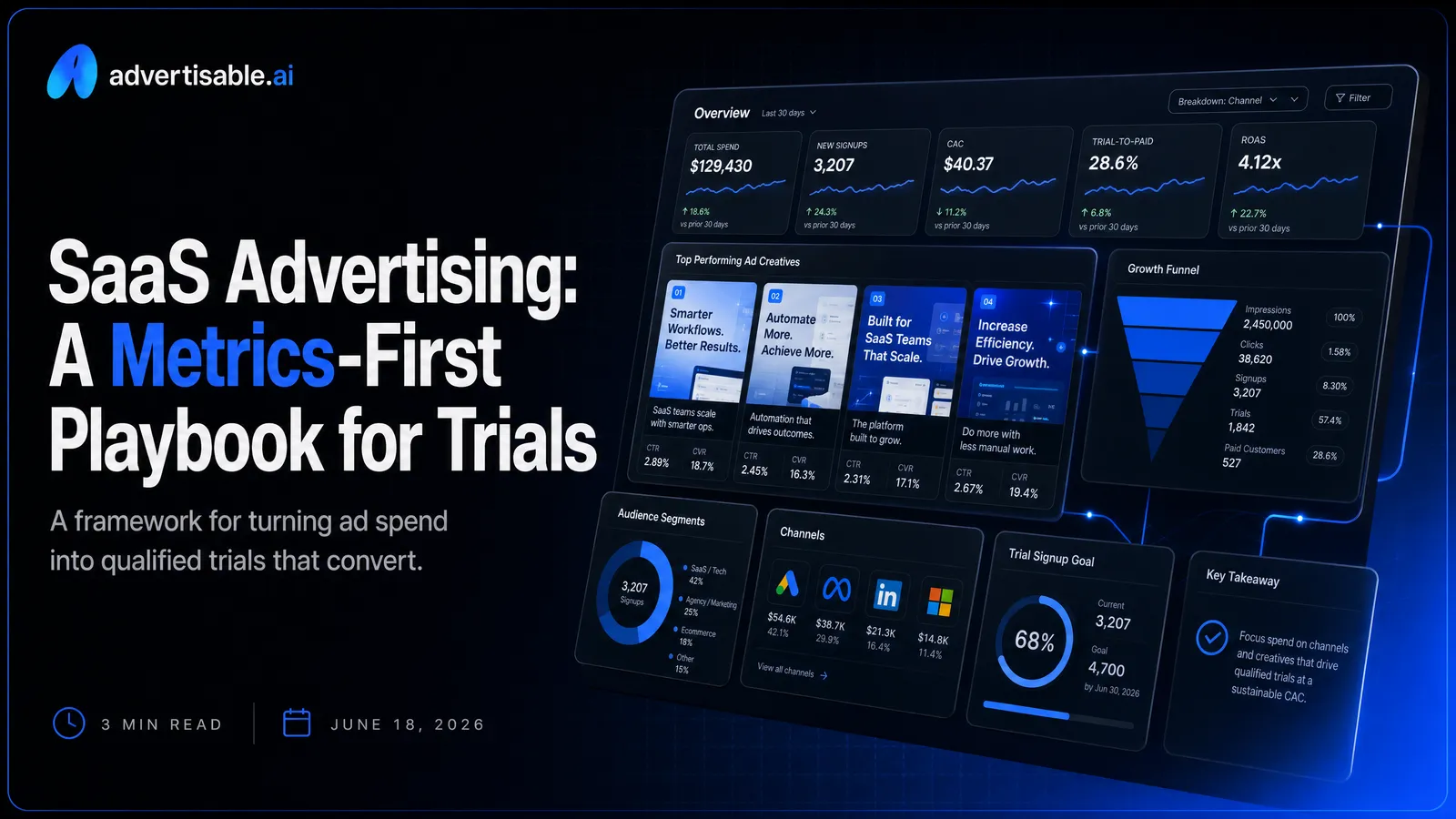
Run a trial-first SaaS advertising plan today: pick one high-intent capture channel plus one demand-creation channel, then optimize to cost-per-trial and trial-to-paid, not clicks.
Here is the playbook we use when you need direction fast without torching budget:
- Set your guardrails with LTV versus CAC, then use payback period as the constraint that tells you how aggressive you can be.
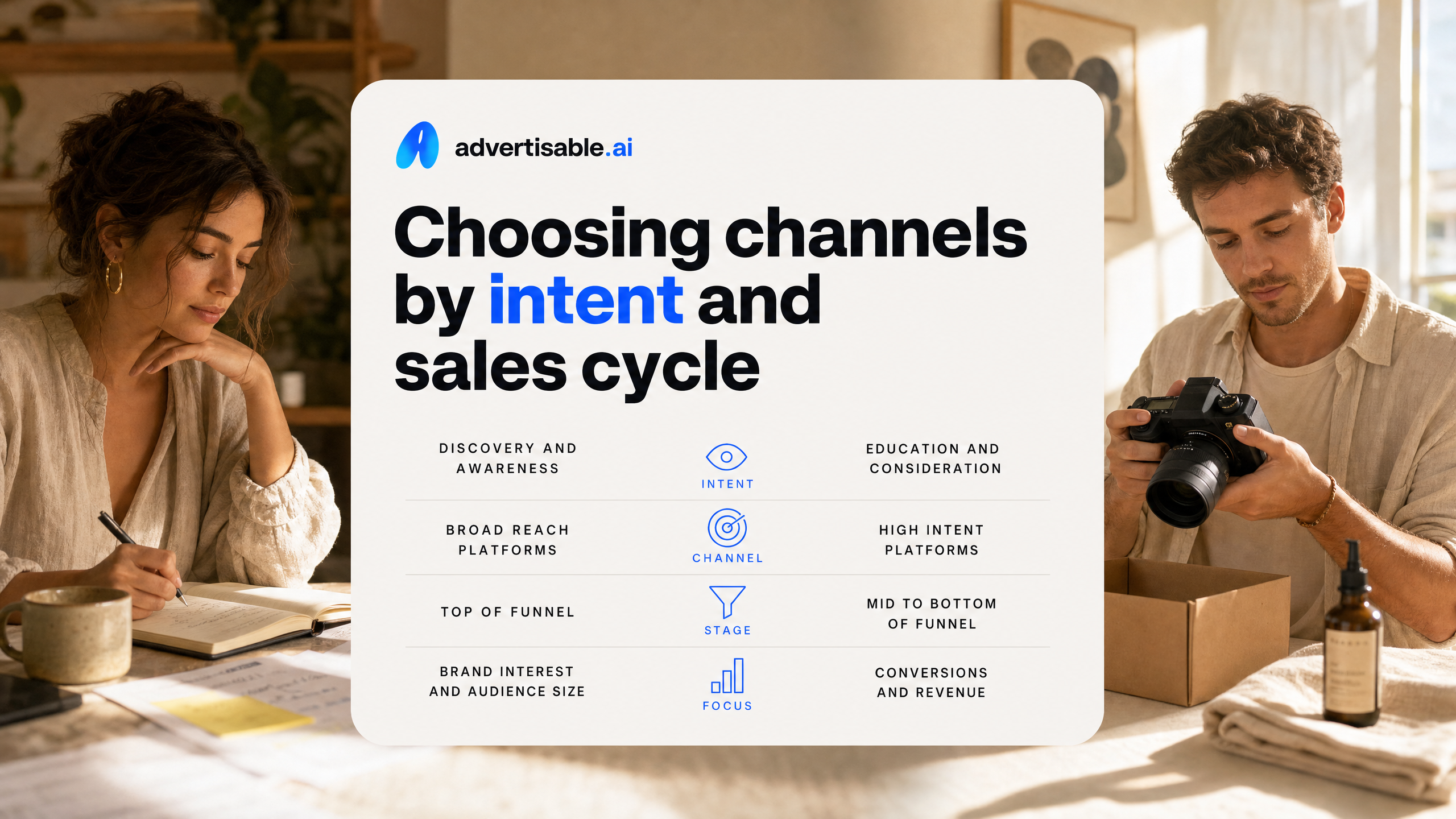
- Match channel to intent and sales cycle: search to capture existing demand, paid social to create it, retargeting to keep momentum during long consideration.
- Measure what actually moves revenue: cost-per-trial first, then trial-to-paid rate and payback period to spot where the funnel is really breaking.
- Fix the invisible-product creative problem with Founder-style explainers, problem-solution ads, demo-style UGC, and before-after workflows that explain what the software does fast.
We built Advertisable AI for this exact constraint: software is hard to show, and you still need enough creative volume to learn quickly. Our platform generates production-ready SaaS ads like UGC explainers and B-Roll Style Ads, with Brand DNA locking to keep everything on-brand and Frame-by-Frame Control so you can iterate scene-by-scene without redoing the whole ad.
Before you choose channels or scale spend, you need the right definition of SaaS advertising, what it is, what it is not, and why trials and recurring revenue change every decision downstream.
What SaaS advertising is and is not
You are selling a subscription relationship
SaaS advertising is not about winning a one-time purchase. You are starting a recurring relationship where the value shows up over months, not at checkout.
That changes how you judge performance. A campaign can look “fine” on clicks and signups and still be failing if the users you bring in never activate, never adopt the core workflow, and never renew.
In practice, SaaS advertising is doing three jobs at once: setting expectations, qualifying the right audience, and pre-selling the ongoing value so the customer actually sticks around.
- What it is: messaging that makes the software’s value legible fast, so the right people enter your pipeline and stay long enough to realize value
- What it is not: transaction-style creative that optimizes for impulse behavior and treats the first payment like the finish line
Your conversion event is the trial or demo
In most SaaS motions, the ad’s job is not “buy now.” The real conversion event is the trial start or the demo booked, because that is where intent becomes trackable behavior.
This is why ad creative for SaaS lives or dies on clarity. You need to show what the product does and who it is for quickly, or you will attract curious clickers who never cross the activation threshold.
Treat trials and demos as the first commit in the relationship. Your ads should make the next step feel obvious and low-friction: try it, see the workflow, and get to the moment of value.
- Trial-first: optimize to trial starts, then judge quality by what those users do inside the product
- Demo-first: optimize to booked demos, then judge quality by show rate and downstream conversion
The economics that change your ad decisions
LTV vs. CAC: do the math in dollars
You should not judge a SaaS ad by how expensive the lead feels. You should judge it by whether the lifetime value (LTV) of a customer can comfortably cover your customer acquisition cost (CAC).
Run it in plain numbers. If your average customer pays $99/month and stays 12 months, your gross LTV is about $1,188. If your blended CAC (ads plus sales time and tools you allocate) is $400, you have roughly $788 of room to cover onboarding, support, and product delivery, then still have profit.
Where teams get hurt is mixing definitions: counting CAC as “ad spend only,” or counting LTV as “first month revenue.” Keep the math consistent, and use contribution margin LTV when you can (LTV after variable costs), not top-line revenue.
- LTV (simple): average monthly revenue per customer x average months retained
- CAC (simple): total acquisition costs in a period / new customers in that period
- Reality check: a 3:1 LTV/CAC ratio is widely treated as the minimum viable threshold in B2B, per a B2B SaaS benchmark analysis
Payback period is your real guardrail
Even if LTV beats CAC, you can still kill your cash flow if payback takes too long. Payback period is how many months it takes to earn back CAC from gross margin, and it decides how aggressively you can scale.
Example: your CAC is $600 and your gross margin contribution is $120/month. Your payback is 5 months ($600 / $120). If your runway is 4 months, that “profitable” campaign is still dangerous.
This is why we treat payback as the day-to-day decision metric for SaaS ad spend. It forces you to balance growth with survivability and stops you from buying customers you cannot carry.
When payback is too slow, the fix is rarely “turn ads off.” More often, you tighten who you target and make trial value legible faster so the trial-to-paid path shortens.
- Payback period = CAC / monthly gross margin contribution per customer
- If payback stretches, your bids and budgets must reflect your cash timeline, not your optimism
- Healthy teams aim for CAC payback within 6 to 12 months, while elite performers reach 80 to 90 days (same B2B SaaS benchmark analysis)
Choosing channels by intent and sales cycle
Search for high-intent capture
Search is where you capture existing demand, not create it. When someone is already problem-aware and looking for a solution, search ads can be the cleanest path to a trial or demo because the intent is explicit.
Your job is to align keywords and landing intent to the trial moment, not to “traffic.” In SaaS advertising, the winners usually map to pain and use case language, then prove value fast with a demo-style UGC angle that makes the software legible in seconds.
- Prioritize bottom-funnel terms tied to evaluation behavior (pricing, alternatives, integrations, “software for [job]”)
- Write ads that promise a concrete outcome, then support it with proof cues (feature walkthrough, problem-solution framing)
- Keep conversion action consistent with your motion: trial-first product -> trial-focused search campaigns; sales-led product -> demo-focused search campaigns
Paid social for demand creation
Paid social is where you manufacture attention, then earn consideration over multiple touches. You are interrupting a feed, so your creative has to lead with value before branding and explain the “why this matters” in the first three seconds.
What we see work best for SaaS is creator-led ads and founder-style explainers that translate an intangible product into a single, obvious outcome. With Advertisable AI, you can generate multiple hook angles quickly, then keep the body consistent so your test reads are clean.
- Problem-solution ads that name the pain in plain language, then show the moment the product resolves it
- Demo-style UGC that walks through one job-to-be-done, not a tour of features
- Outcome-led statics that make value readable at scroll speed
Retargeting for long consideration
Retargeting is how you stay present when the buyer is interested but not ready. In SaaS, a prospect can hit your pricing page, disappear for weeks, then come back after a stakeholder conversation, so your retargeting needs structure, not “same ad to everyone.”
A practical starting point for B2B SaaS is the 70 percent prospecting and 30 percent retargeting split highlighted in long sales cycle research, then refine based on how long your evaluation window actually runs.
The most common failure we see is running cold prospecting creative to warm audiences. Your retargeting creative should assume familiarity and focus on proof, specifics, and objection handling.
- Segment by intent: content viewers vs site visitors vs pricing visitors vs trial starters
- Sequence creative: value reminder -> proof (walkthrough, comparison) -> offer and next step
- Cap frequency and rotate angles so you reinforce belief without burning out the audience
Measuring the right thing in SaaS ads
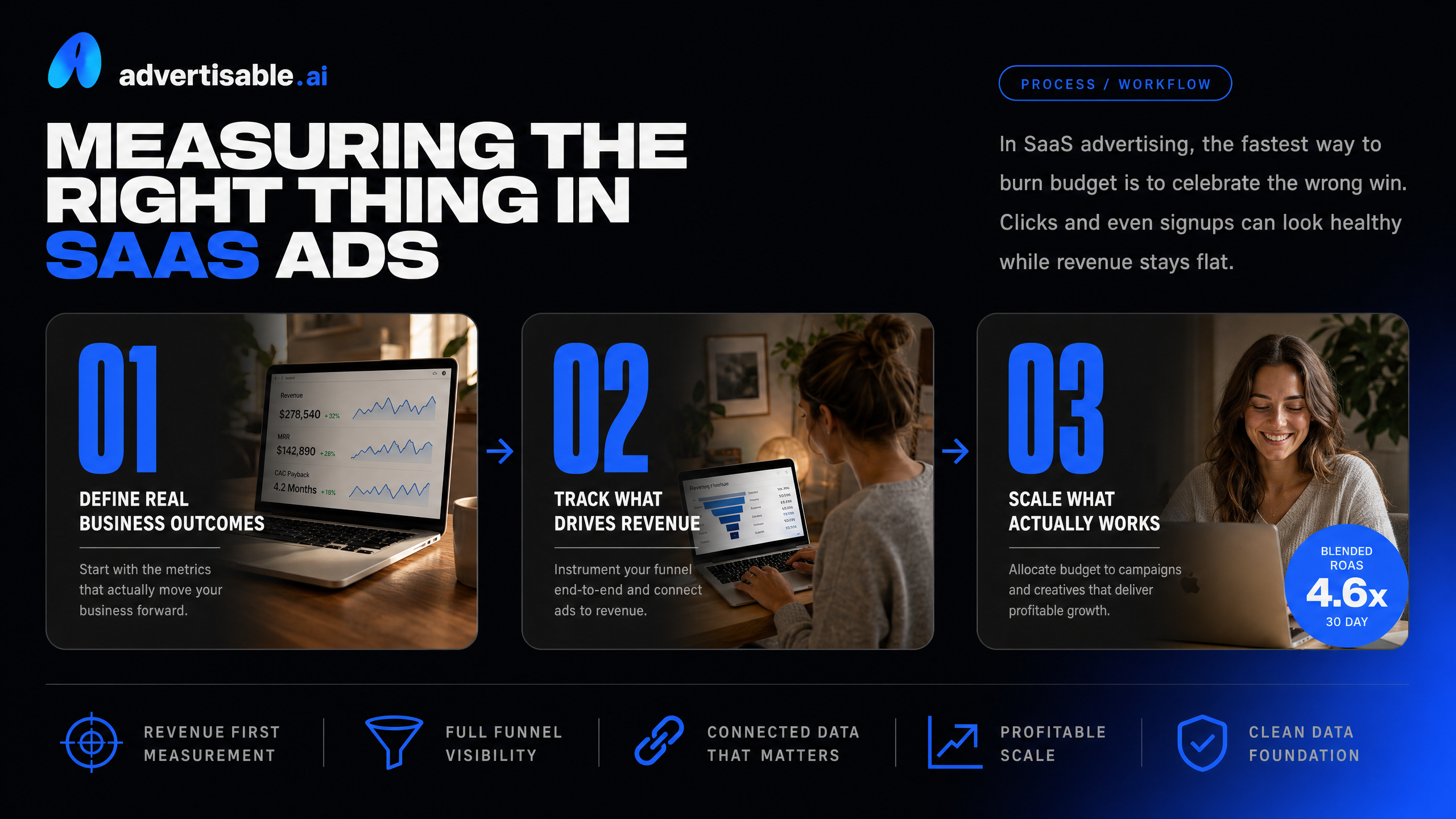
In SaaS advertising, the fastest way to burn budget is to celebrate the wrong win. Clicks and even signups can look healthy while revenue stays flat.
Why CPC can be a trap
A low cost-per-click can still mean your funnel is failing. You can buy attention cheaply and still attract the wrong people, the wrong expectations, or the wrong first-step experience.
We see this when teams optimize creative for curiosity clicks instead of value clarity. The ad promise pulls people in, but the landing experience or trial positioning cannot cash that promise, so the trial starts soft and never activates.
- CPC improves while cost-per-trial worsens (you are paying for traffic that does not raise its hand)
- Trials rise while trial quality drops (more “tire kickers,” fewer ICP fits)
- Click-through rate climbs but trial-to-paid stays flat (your message is compelling, your value is not landing)
Make cost-per-trial your primary efficiency metric
Cost-per-trial is the metric that forces alignment between ad intent and product intent. It tells you whether your creative and targeting are generating real evaluation behavior, not just engagement.
Treat it like your main budget dial, then run creative iterations that are designed to earn the trial. In our experience, creator-led ads and demo-style UGC work best when the hook lands the outcome in the first few seconds and the proof shows the product solving it.
- Define a “trial” event you actually trust (started trial plus first meaningful action, not just an email submit)
- Test hooks against one consistent body so you know what moved cost-per-trial
- Keep the promise tight: problem-solution language, then immediate proof
Trial-to-paid and payback period decide if you can scale
Cost-per-trial tells you efficiency, but trial-to-paid and payback period tell you viability. You are not buying a click, you are buying a path to recurring revenue.
Use trial conversion benchmarks to sanity-check performance: median B2B SaaS trial-to-paid conversion rates typically range between 18.5% and 25%, with the top 25% achieving 35% to 45%. If you are under 15%, treat that as a funnel problem to diagnose before you scale spend.
Then map payback period from actual paid conversions, not assumptions. If payback stretches too long, you do not need “more traffic,” you need better trial activation and clearer value delivery.
- Cost-per-trial (efficiency)
- Trial-to-paid rate (quality)
- CAC payback period (scalability constraint)
Creative that makes software legible fast
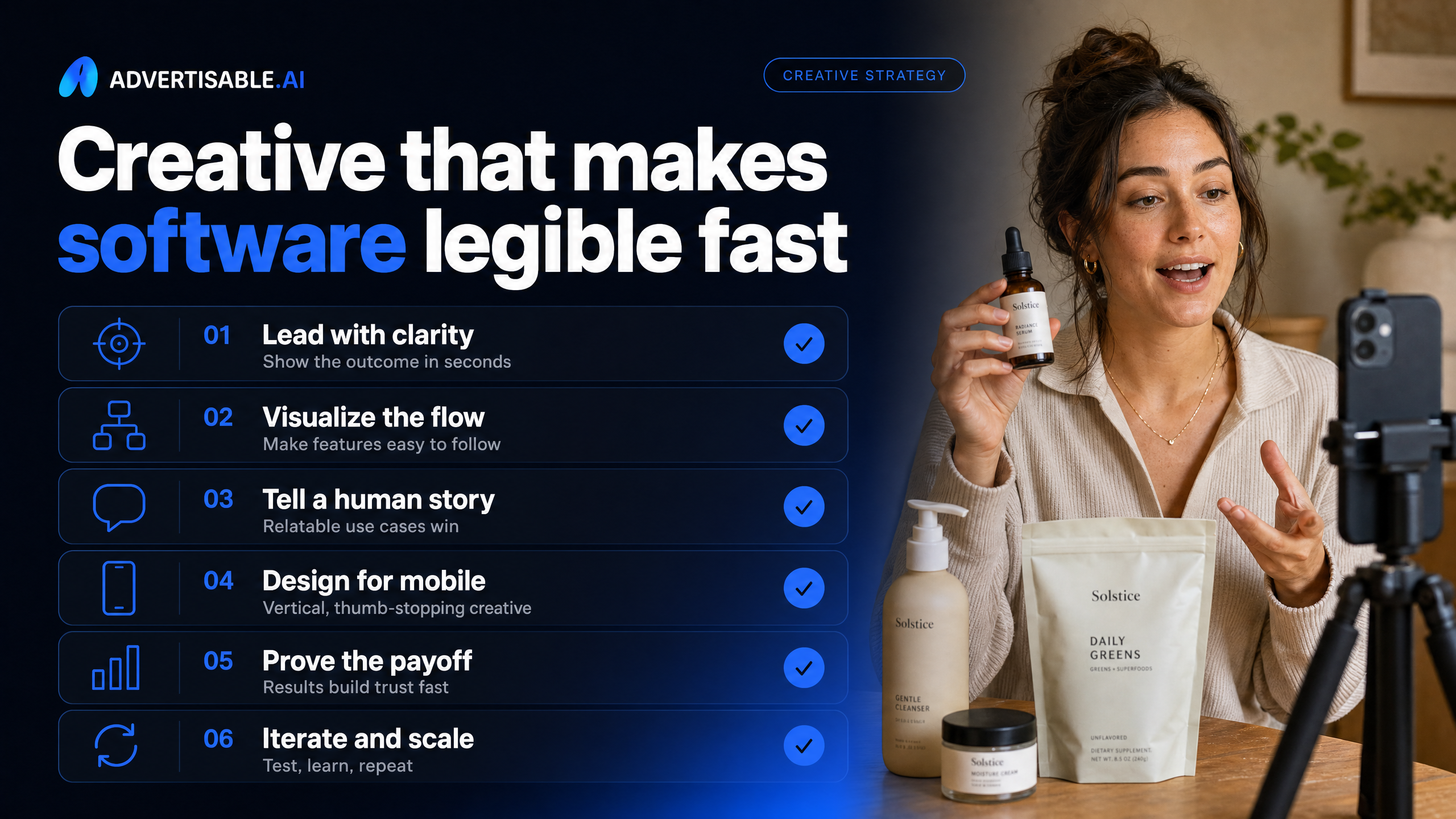
Why screen recordings don’t convert
Screen recordings usually fail in SaaS advertising because they make the viewer work. A cursor moving through menus does not communicate the outcome fast enough to earn the next second of attention.
In practice, screen recordings front-load UI and back-load meaning. You lead with navigation, not value, so the hook feels like a tutorial instead of a promise.
Use interface shots as proof, not as the headline. Your first beats should land the problem and the payoff in plain language, then show the exact moment the product resolves it.
- They start with “where to click” instead of “what you get”
- There is no human voice or social context, so it feels like internal training material
- Small UI elements are hard to read on mobile, especially in fast feeds
- They imply complexity: lots of steps, lots of setup, lots to learn
Founder-style UGC explainers
Founder-style UGC explainers convert because they translate software into a simple outcome, delivered by a person. You are not selling features, you are selling a future workflow that feels easier and more reliable.
What we see working is a tight problem-solution story where the “proof” is either a quick interface flash or a concrete before-after claim, not a product tour. This is also where brand consistency matters, because a creator-led ad with drifting facts or tone loses trust immediately.
If you are generating these at volume, lock your Brand DNA first, then test multiple hooks against one consistent body so you can attribute performance to messaging, not to a totally different video.
- Hook (0-3s): name the painful moment in the day
- Problem (3-10s): one sentence on the cost of staying stuck
- Proof (10-25s): the moment the software solves it
- Offer (last): the trial or next step, with minimal branding earlier
Demo B-roll and workflow before-after
Demo B-roll works when it shows the product “working” without asking the viewer to decode the UI. You are engineering value legibility: one workflow, one outcome, one visual change.
The clean pattern is before-after: start with the messy manual state, then cut to the organized automated state. You are not trying to cover every feature, you are trying to create belief that the trial will be worth the time.
In our experience, the fastest way to scale this is scene control: build one strong workflow core, then regenerate only the opening and the payoff beats until you find the combination that drives trials.
- Before: cluttered dashboard, scattered tabs, slow handoffs, unclear status
- After: one view that shows priority, ownership, and next action
- Proof shots: 1-2 tight interface moments that confirm it is real
- Pacing: keep cuts tight so the viewer never has to “read” the software
Testing enough creative without a studio
One body, five hook variants
For SaaS advertising, you get the cleanest read when you hold the “body” of the ad constant and only swap the first 2 to 3 seconds. That isolates what actually drives trial intent: the promise you lead with, not the edit, pacing, or visuals.
Your body is the repeatable spine: problem, proof, and a clear next step (trial or demo). Then you pressure-test five different hooks that each frame the same product value from a different angle, without turning the rest of the ad into a moving target.
- Hook 1: Problem callout (the moment the workflow breaks)
- Hook 2: Outcome promise (what is true in 30 minutes with your tool)
- Hook 3: Contrarian take (what most teams do that backfires)
- Hook 4: Objection flip (the reason trials stall, and the fix)
- Hook 5: Before-after comparison (same task, fewer steps)
Scene-level iteration for speed
Full re-renders slow your testing loop and blur causality. Scene-level iteration keeps you shipping by changing one scene at a time, usually the hook, while preserving everything else.
In practice, you storyboard the ad as discrete scenes: hook, problem, proof, and offer. If hook #2 underperforms, you regenerate only that opening scene and keep the proof and offer identical, so performance differences are actually interpretable.
What we see most often: teams waste days “improving” the whole ad when the body is already fine. The faster move is to keep the body stable until you have a hook that earns attention, then iterate the proof scene to increase believability.
- Regenerate hook scene first, not the entire video
- Keep on-screen promise and spoken line aligned in the first 3 seconds
- Change one variable per iteration (hook wording, creator, setting, or pacing)
Where advertisable.ai fits
advertisable.ai is built for this exact workflow: high-volume creative testing for an intangible product without a studio. You can generate a production-ready SaaS ad from a prompt or product URL, then iterate scene-by-scene instead of starting over each time.
The fit is strongest when you need creator-led ads and demo-style UGC at scale, but you still care about control and brand consistency. That is why our Storyboard Editor, Frame-by-Frame Control, A/B Hook Generator, and Brand DNA System are designed to work together: you lock what must stay true, and you test what actually moves trial conversion.
- Start by importing Brand DNA from your URL so colors, fonts, voice, and product facts stay consistent
- Build one strong body (problem, proof, offer) in the Storyboard Editor
- Generate five hook variants with the A/B Hook Generator
- Use Frame-by-Frame Control to swap only the hook scene as you learn
Turn SaaS Advertising Into Trial Conversion, Not Click Volume
If your SaaS ads are getting attention but trials do not turn into paid users, your bottleneck is usually creative clarity, not reach. You need value legibility in the first few seconds, then a message system you can iterate without restarting from scratch.
That is exactly where we built Advertisable AI. You can generate founder-style explainers and demo-style UGC from your product link, lock your messaging and visuals with our Brand DNA System, then use the Storyboard Editor and Frame-by-Frame Control to iterate scene-by-scene. Pair that with the A-B Hook Generator and you can test multiple angles against one core body, fast.
Start with the $5 trial, ship one explainer and one B-roll style ad, then optimize to cost-per-trial and trial-to-paid.
Frequently Asked Questions
Q: How do you advertise a product you can't physically hold or show?
A: You stop trying to “show” software like a physical product and focus on making the outcome instantly clear. Founder-style explainers and problem-solution ads work because they lead with the pain your buyer already feels, then show the moment your product resolves it. That structure gives your audience value legibility at scroll speed, which is what earns the click and the trial.
Once the promise lands, you can bring in interface moments as proof instead of relying on a feature rundown.
Q: Can the ads show my actual software interface?
A: Yes. Demo-style formats like B-roll style ads and feature walkthrough creative are designed to showcase your real interface in a way that feels native to the feed. The goal is to lead with the moment the software works, then support it with clear on-screen context so viewers understand what they are seeing.
When you combine that with a strong hook and problem framing, the interface becomes proof, not confusion.
Q: Will this help convert free trials?
A: Yes, because most trial drop-off starts before onboarding. If your ads win the click but fail to communicate the “why this matters” in the first few seconds, you attract trial users who never connect the product to a real outcome. Creator-led ads, founder-style explainers, and demo-style UGC fix that by clarifying the problem, the payoff, and the proof fast.
That typically improves trial intent and gives you a cleaner path to optimizing for trial-to-paid.