Is AI Killing Advertising Creativity? Not How You Think
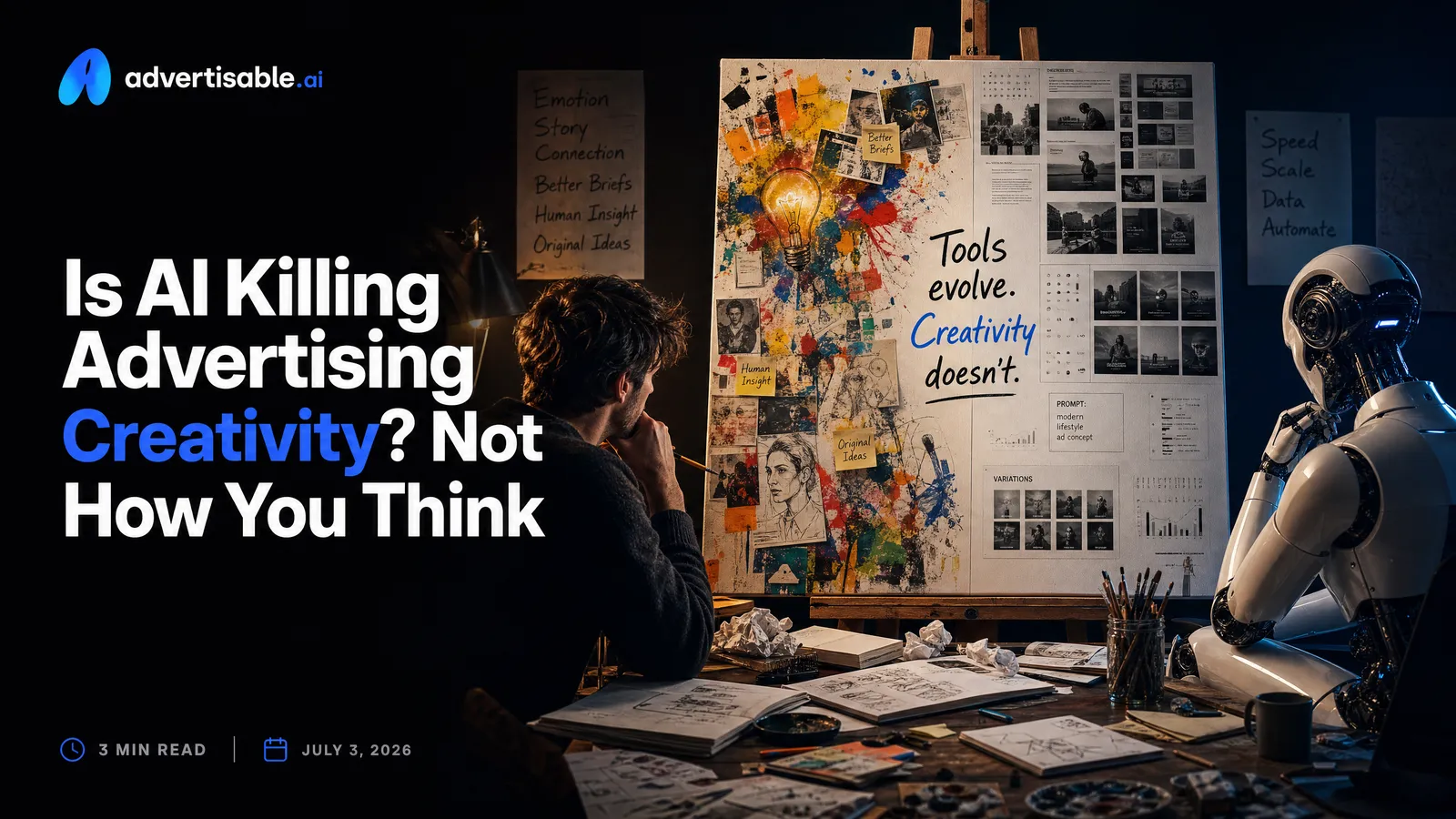
AI is not killing advertising creativity. It is changing how ads get produced, and it is making undirected creativity easier to spot and easier to replace.
Here’s what matters most right now:
- AI removes production bottlenecks, but it cannot choose a brand-defining point of view.
- The feed looks samey because default prompts lead to default decisions.
- Competence is now table stakes, so distinctiveness is what earns attention.
- Judgment is the scarce input, not output volume or tool access.
- Control over scenes and revisions beats one-shot generation every time.
- Brand consistency requires locked decisions, not endless rewrites and rerolls.
We built Advertisable AI for this exact shift: AI should handle repeatable execution, while you keep direction. With Brand DNA and a storyboard editor that gives you scene-level control and frame-by-frame control, you can iterate fast without drifting off-brand, and build variation packs without turning your creative into a template clone.
The fear is valid, because the feed really has changed. The reframe is where you get your leverage back: AI made competent ads abundant, so the only thing that compounds is the human part, the choices that make a brand unmistakable.
The fear is valid and the reframe matters
Your worry is rational: scroll any feed and you will see a wave of AI-made ads that feel same-y. The reframe is that creativity is not disappearing, but the value of “acceptable execution” is collapsing fast.
The feed looks flatter on purpose
The feed looks flatter because the incentives reward what is safe, fast, and broadly legible, not what is original.
Most AI workflows start from the same defaults: the same templates, pacing, UGC-style framing, and “proven” hooks. Over time, that pushes brands toward a shared visual and narrative middle, because it is easier to approve and easier to scale.
This is not an accident. It is the predictable outcome of optimizing for speed and volume under approvals pressure. research published in PMC shows how quickly iterative generation can converge, with 700 trajectories with diverse prompts converging to nearly identical visuals.
- Template gravity: libraries of “winning” formats nudge you into familiar structures
- Prompt mimicry: teams reuse what got approved last week, then iterate inside a narrow lane
- Safety bias: commercially safe aesthetics and claims survive review; sharper choices get sanded down
Competence got cheaper, not creativity
What got commoditized is competent execution: clean edits, readable motion, plausible voiceover, and platform-ready formatting. That used to take time and specialists; now it is near-instant.
Creativity is the part that still costs: a point of view, a real customer insight, and the taste to make tradeoffs on purpose. When you skip those decisions and ask a model to “make a great ad,” you are outsourcing the hardest part to averages.
In our experience, the teams that feel “AI killed our creativity” usually lost their pre-production discipline, not their talent. They moved faster, but they stopped choosing.
Distinctiveness becomes the only moat
When competent production is widely accessible, the only defensible advantage is distinctiveness: the set of choices that makes your brand recognizable before your logo shows.
Distinctiveness is not louder colors or more motion. It is consistency in what you believe, how you talk, and what you are willing to exclude, then expressing that in repeatable creative systems.
Look for moats you can actually sustain:
- A defined point of view that can generate multiple angles without sounding like everyone else
- Specific customer language you earned from real conversations, reviews, and objections
- Brand-locked constraints you do not violate, even when a trend would be easier
- A testing cadence that rewards learning, not just output volume
Why it looks like AI is killing creativity
The sameness you are seeing is real. It is not proof that creativity is gone, but it is proof that most AI-assisted output gets pulled toward the same defaults when nobody makes deliberate choices.
Default prompts produce default thinking
When you start with the same prompt patterns, you get the same strategic starting point, and the ad can only be as distinctive as that starting point.
In performance creative, the prompt often becomes the brief. If your brief is “make a UGC-style ad for X with a strong hook,” you have not made the hard decisions: the angle, the specific pain, the proof, the voice, the tradeoff you are willing to take to be memorable.
You see it in outputs that feel competent but interchangeable: a familiar problem statement, a predictable benefit stack, and a hook that could sell five other products without changing a word.
- Same input structure: feature list + “high-converting” + “for TikTok”
- Same creative logic: problem, agitation, solution, CTA in the same rhythm
- Same risk avoidance: no sharp opinion, no specific claim you have to defend
Tool templates converge on one look
Even with different brands, the templates push you toward the same visual grammar: the same pacing, transitions, type treatments, and “platform-native” framing.
This convergence is not just a taste issue. research published in PMC found 700 trajectories with diverse prompts converged to nearly identical visuals, collapsing into just 12 dominant motifs, which is a clean illustration of how quickly variety can shrink when systems optimize for high-probability outputs.
In ads, the practical effect is that your competitors and your team can end up shipping creatives that share the same silhouette, even if the product is different.
Good enough speed replaces craft
Speed changes standards. Once you can generate ten variations in minutes, “good enough” becomes the default decision, and craft gets treated like a luxury line item.
We see this most in revision behavior: instead of tightening one angle, teams regenerate the whole ad and hope one version feels right. That increases volume, but it weakens intention.
The craft that gets skipped is not polishing. It is the work that creates lift: selecting one point of view, designing constraints, and making scene-level choices that hold together under scrutiny.
- Hook specificity gets replaced with broad audience-pleasing language
- Story coherence gets replaced with a montage of benefits
- Brand voice gets replaced with whichever phrasing the model reaches first
Why this is a usage problem, not an AI limit
Skipped decisions create copycat outputs
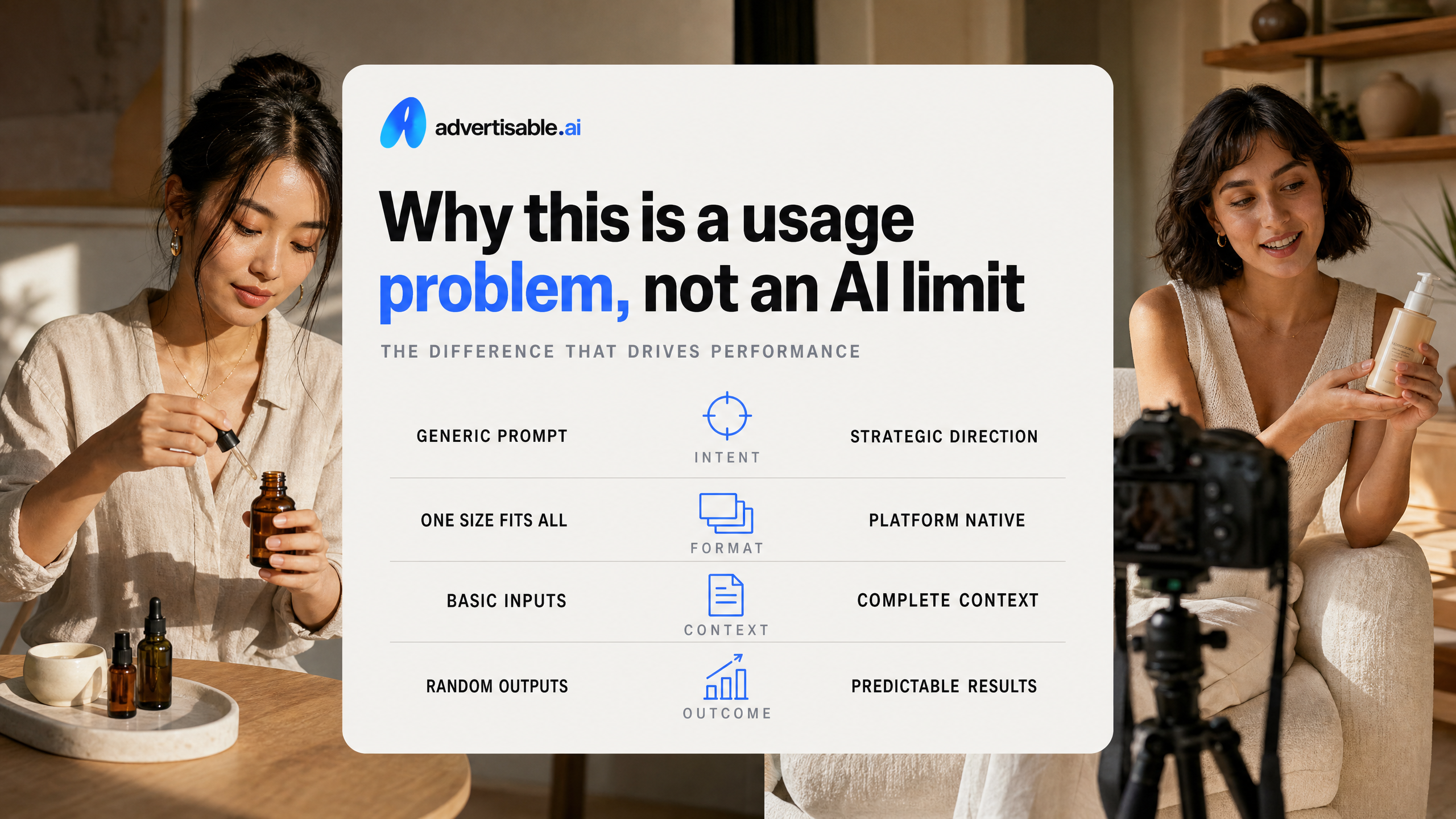
Most same-looking AI ads are the result of skipped creative decisions, not the model maxing out. When you do not pick a point of view, a real customer tension, and a specific promise, the tool fills the vacuum with familiar patterns that already “sound like an ad.”
In performance creative, the decisions people skip are rarely “big idea” decisions. They are the small, high-impact calls that shape everything downstream.
- Angle: which single belief you are trying to flip (not “improve your life”)
- Hook type: confession, contrarian claim, proof-first, or problem agitation
- Voice constraints: what you will never say, and what you always say
- Visual rules: how the product is framed, pace of cuts, and how “real” UGC should feel
- Offer framing: what makes this purchase rational today, not someday
When you leave these blank, you are not “saving time.” You are choosing the defaults that everyone else also chooses.
Same model, different discipline
The same model can produce forgettable creative or distinctive creative depending on your discipline. What changes is not the AI. What changes is your process for constraining, iterating, and reviewing.
In our experience, the teams that win treat AI like a production engine, not a creative director. They keep humans accountable for direction, then use tight iteration to turn one clear idea into many controlled variations.
This is why workflow features matter. When you can lock Brand DNA, and regenerate only the hook or a single scene inside a storyboard editor, you stay in decision-making mode instead of roulette mode.
- Define one creative hypothesis before generating anything
- Generate variation packs that change one variable at a time (usually the hook)
- Use scene-level control to iterate surgically without rewriting the whole ad
- Review like a buyer: clarity, credibility, and brand fit before volume
Judgment is the scarce input now
Output is abundant. Judgment is not. The bottleneck has moved from “can we make enough assets?” to “can we choose the few angles that deserve spend, and cut everything else fast?”
This is where creative leadership becomes more valuable, not less. You are paid for taste, prioritization, and restraint: knowing what to keep consistent, what to test, and what is off-brand even if it looks polished.
The teams scaling cleanly are building review habits around judgment: brand-locked consistency, controlled experiments, and fast approvals. The model generates. You decide what earns another iteration.
What AI-amplified creativity looks like in practice
Humans own POV and insight
Your unfair advantage is still human: point of view, judgment, and a real read on why someone would care. AI can remix patterns, but it cannot decide what your brand should stand for in one sentence, or what specific tension your customer feels right before they buy.
In practice, this means you show up with decisions, not prompts. You define the angle you are willing to repeat for 90 days, the tradeoff you want to own, and the one objection you are going to answer in a way only your brand can say.
When you do that, you are using AI for augmentation, not outsourcing, which lines up with MIT Sloan research separating automation (task transfer) from augmentation (productivity lift on human-led work).
- Your POV: the non-obvious stance your ads keep proving (what you believe that competitors avoid)
- Your insight: the trigger moment, objection, or context that makes the message feel earned
- Your taste: what you will not ship (visual cadence, claims, tone, and what “on-brand” actually means)
AI owns production and iteration
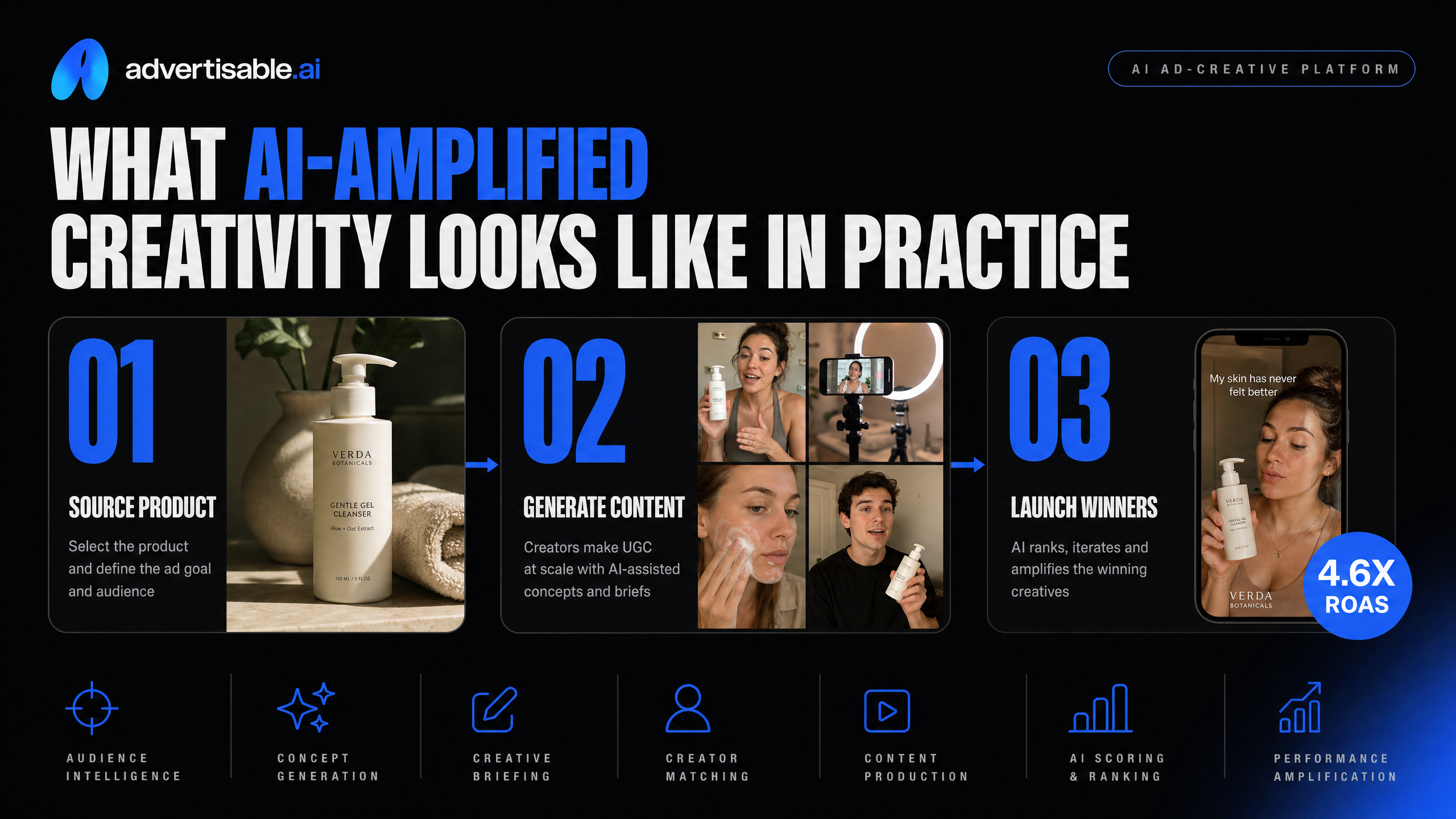
Once you lock the thinking, AI should carry the execution burden: generating formats, variations, and fast revisions without turning every change into a new project.
This is where performance teams actually win time back. You keep one core concept, then iterate at the scene level: swap the hook, tighten the first two seconds, adjust the offer framing, and export for multiple placements without rebuilding the entire asset.
In our workflow with Advertisable AI, Brand DNA handles consistency while the storyboard editor and scene-level control make iteration surgical instead of chaotic.
- Generate variation packs off one approved storyboard
- Regenerate only the hook scene to keep A/B tests clean
- Export production-ready assets in 9:16, 1:1, and landscape for faster deployment
Creativity moves up the stack
When production gets automated, creativity does not disappear. It relocates to higher-leverage decisions that compound across every variation you ship.
Your best creative work becomes: choosing the problem framing, designing the testing plan, setting guardrails for what “on-brand” means, and deciding which iterations deserve more budget.
You stop spending creative energy on making assets and start spending it on making bets. That is the difference between flooding the feed and building a repeatable creative system.
- From scripting scenes to architecting a message hierarchy (what must land in second 1, 3, and 7)
- From polishing one ad to running structured hook experiments with controlled variables
- From “making content” to building decision rules your team can reuse under pressure
How to use AI without flattening your creativity
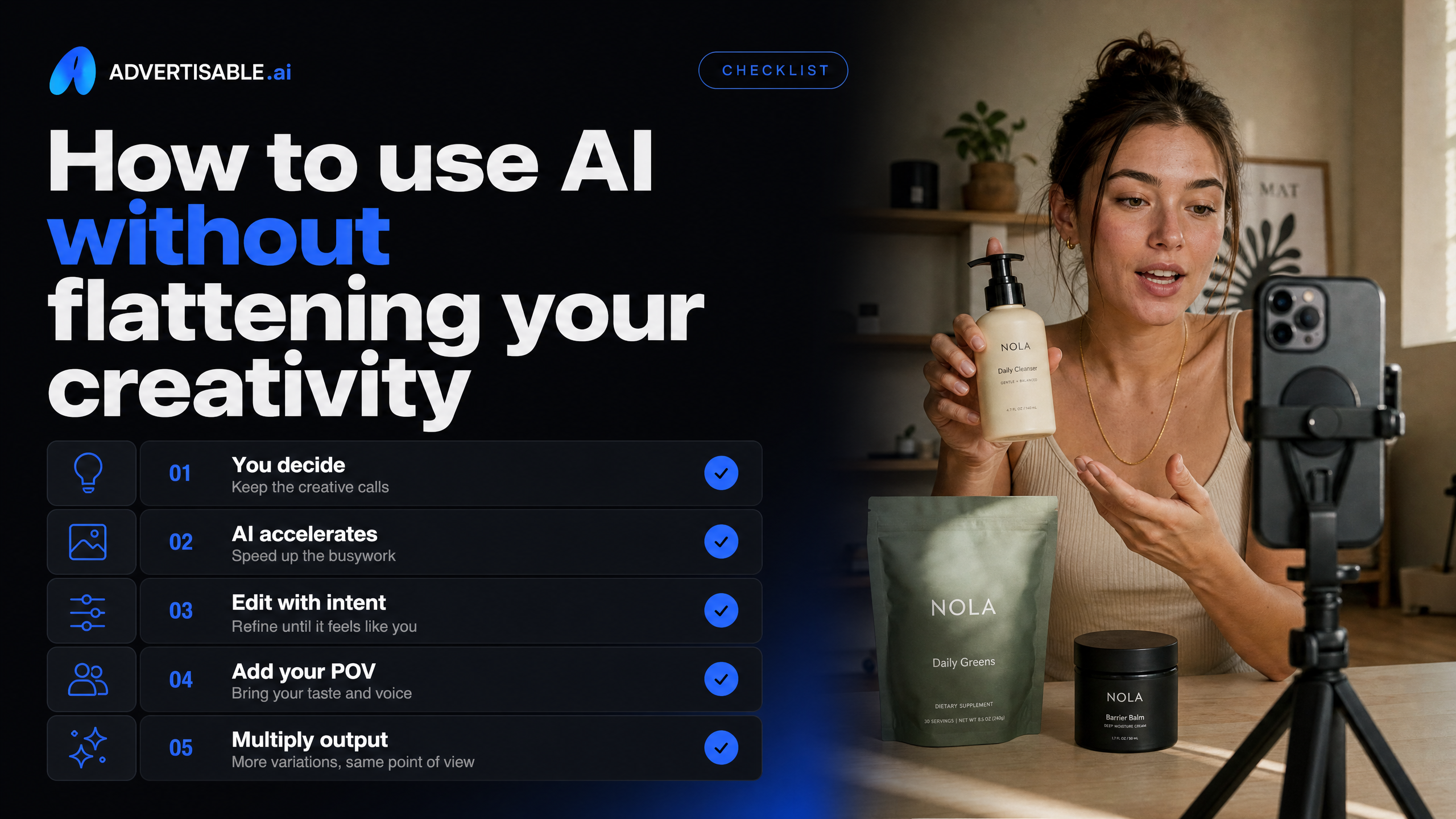
AI speeds up output. Your job is to keep the decisions that make the work recognizably yours, then use AI to multiply execution without drifting.
Start with a written brand POV
Your creativity gets flattened when the model becomes the creative director. The fix is a written brand POV that is clear enough to say “no” to 80% of plausible outputs.
Keep it short and specific. You are not writing a manifesto, you are writing constraints that force distinctive choices and keep every prompt anchored to your taste.
- One sentence you believe about the customer or category that competitors avoid
- Your signature tradeoff (what you will not do, even if it converts)
- Three proof points you earn the right to say (ingredients, process, results, or customer reality)
- A voice rule you can enforce in review (for example: blunt, warm, contrarian, clinical)
- Two visual non-negotiables you will recognize instantly
Run weekly hook tests by scene
Most performance lift comes from the hook, not from re-editing the whole ad. Test hooks weekly, but do it at the scene level so you isolate what actually changed.
In our experience, teams waste time regenerating full creatives when only the first 1 to 2 seconds need iteration. Keep the supporting scenes identical so you are running a clean A/B, not a new concept every time.
- Build one base ad with a complete storyboard
- Pick 3 to 5 hook angles to test (problem, contrarian insight, offer framing, proof-first)
- Regenerate only the hook scene using scene-level control
- Export as a variation pack with the same middle and end scenes
- Log hook, promise, and opening visual so you can learn across weeks
Approve storyboards before generating
You protect creativity in the storyboard review, not after 40 exports. Approve the narrative beats, claims, and on-screen text first, then generate production-ready variations from an approved plan.
This is where tools like Advertisable AI matter: a storyboard editor and frame-by-frame control let you lock decisions and iterate surgically instead of re-rolling the whole ad.
- Hook promise: what you are claiming in the first seconds, and what you must deliver
- Scene intent: what each scene must accomplish (not what it should look like)
- Brand compliance: words you will not use, claims you cannot support, visual boundaries
- Shot list: UGC-style moments, B-roll needs, and any must-have product visuals
- Approval owner: one person accountable for “yes” before generation
Using Advertisable to keep humans in control
Brand DNA locks brand-defining choices
The fastest way AI flattens creative is when your brand decisions get re-decided on every generation. Brand DNA is the guardrail: you lock what must stay true so speed does not turn into identity drift.
In our workflow, you set Brand DNA once from a product URL, review what the system extracted, then lock it for everything that follows. That means you are not re-litigating tone, visual identity, and messaging every time you need 20 new angles or a creative refresh.
- Lock the non-negotiables: voice, visual cues, and messaging boundaries that define your brand
- Update Brand DNA only when your real guidelines change, not because a single output looks off
- Still review before approval: Brand DNA reduces variance, it does not replace judgment
Frame-by-frame control keeps intent intact
One-shot generation is where intent goes to die. Frame-by-frame control keeps you in the driver seat because you can change the exact moment that matters without rewriting the whole ad.
Practically, that means using the storyboard editor for scene-level control: regenerate the hook, swap a single B-roll beat, or tighten a claim, while keeping the supporting scenes identical. You get cleaner A/B tests and far less revision churn because approvals focus on the delta, not an entirely new video.
- Regenerate only the hook scene to test angles without touching the rest of the storyboard
- Pin supporting scenes so performance changes map to the change you made
- Use frame-by-frame adjustments when pacing or emphasis is the variable you are testing
Build variation packs without drift
Variation packs are where scale usually breaks creativity: the fifth version looks right, the fiftieth starts to wander. Brand-locked generation plus scene-level edits let you ship volume while keeping a single creative thesis.
We recommend building variation packs off one approved base storyboard, then varying one dimension at a time so you can attribute results and protect the concept.
- Hold structure constant and rotate only hooks (problem, angle, offer angle)
- Export the same concept in 9:16, 1:1, and landscape without redesigning from scratch
- Keep naming and organization consistent so your approvals workflow does not collapse under volume
Get AI speed without losing the creative decisions
If your ads are starting to look like everyone else’s, the fix is not more output. It is tighter judgment, clearer brand choices, and a workflow that keeps humans in control.
That is exactly how we built Advertisable AI. You start from a product link to set Brand DNA, so your point of view and on brand decisions stay locked while you scale. Then you use the Storyboard editor with scene-level control to regenerate only the hook, only the opener, or only the offer frame, so testing stays clean and your intent stays intact.
Run the $5 trial, generate one production-ready variation pack, and prove to yourself you can move faster without flattening what makes your brand distinctive.
Frequently Asked Questions
Q: Is AI going to replace advertising?
A: AI will replace a lot of production work, but advertising still needs human judgment to decide what to say, why it matters, and what your brand stands for. The winners use AI to increase iteration speed while keeping strategy, taste, and final approval firmly human.
Q: How is this different from generic AI writing or design tools?
A: Generic tools generate content outputs. We are an ad studio built for production-ready ads, with Brand DNA to keep work brand-locked and a Storyboard editor that gives you scene-level control instead of one-shot generations.
Q: What happens to creative quality when generating hundreds of variations?
A: Quality holds when you lock the brand decisions first and only vary what you are actually testing, usually the hook or first scene. With Brand DNA and scene-level control, you can scale variation packs without drifting away from your approved story and look.
Q: Can I use this without leaving Claude?
A: Yes. With our MCP Server Integration, you can generate ads, adjust scenes, and export production-ready files directly in chat. You still keep a human review step before anything goes live.