Hook Rate for Video Ads: Define It, Calculate It, and Use It
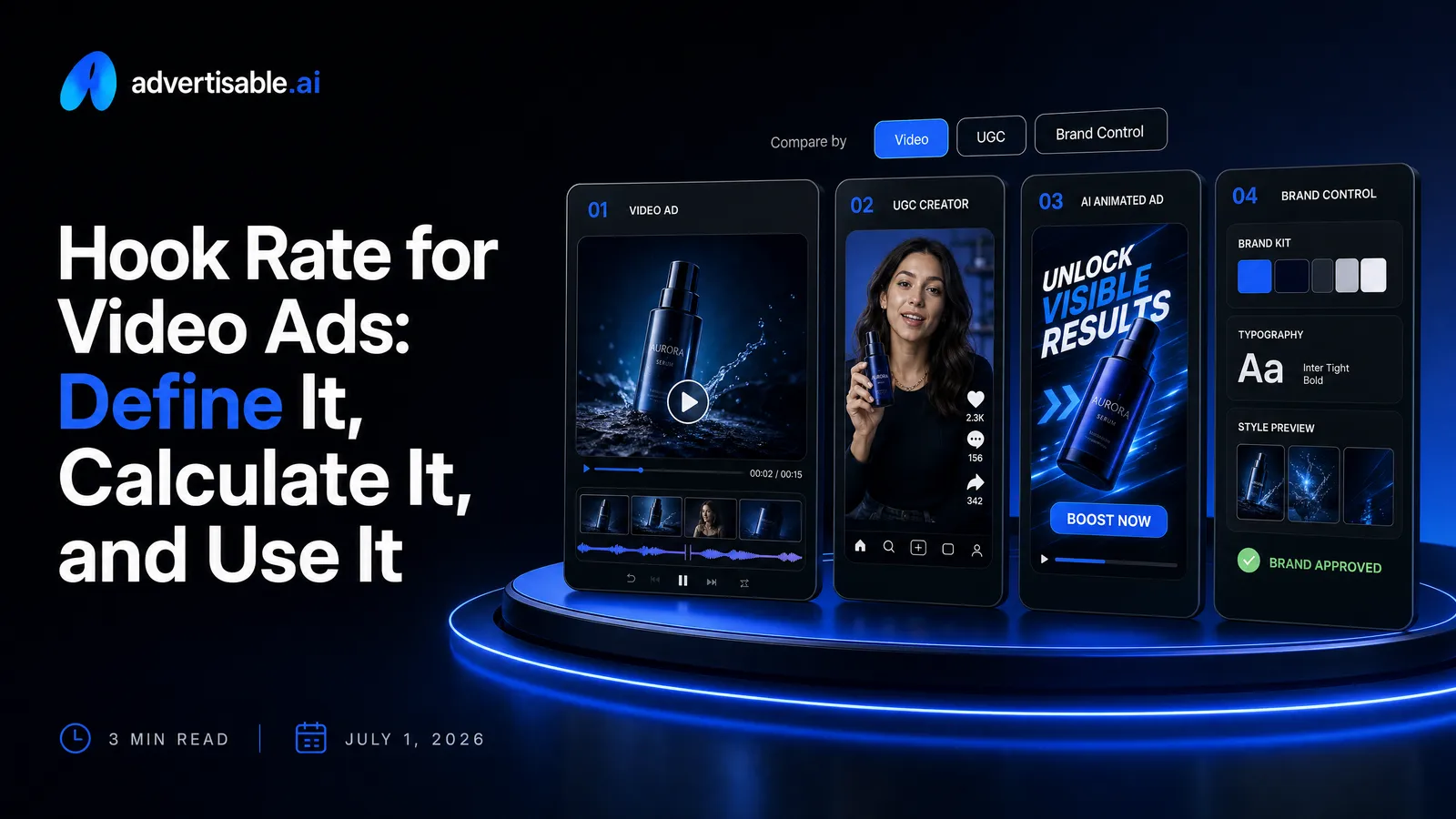
Hook rate is the percentage of impressions that turn into viewers who keep watching past the first few seconds. The simplest way to calculate it is views at your chosen early-view threshold divided by impressions, for example on Meta: 3-second video views ÷ impressions.
Here’s what matters most:
- Hook rate measures scroll-stop, not persuasion, so it must be read with hold rate.
- On Meta, hook rate is commonly treated as 3-second views divided by impressions.
- TikTok and YouTube thresholds differ, so equal percentages are not equal signals.
- Placement distribution can swing hook rate without any meaningful creative change.
- Make creative decisions only after a meaningful sample, not one day of noise.
- A falling hook rate usually means your opening stopped earning attention, not your offer broke.
- The fastest path to improvement is isolating the hook while keeping the body fixed.
We built Advertisable AI for this exact moment in your workflow: you need to turn a hook rate signal into shippable variation fast. Our storyboard editor and scene-level control let you regenerate only the opening without rebuilding the whole ad, and our one-variable testing batches are designed to keep your learnings clean instead of muddy.
Start by locking the definition, because the number only helps if you are calculating the same thing on every platform and every report. Let’s define hook rate precisely and use the simplest formula first, including how Meta’s 3-second view rate compares to TikTok and YouTube.
Hook rate definition and the simplest formula
What hook rate means
Hook rate is the percentage of ad impressions that turn into viewers who stay long enough to hit an early watch threshold (the first few seconds). It is a direct read on whether your opening earned attention, not whether your offer converted.
You use it as an early-screening metric because it isolates the scroll-stop moment. When your hook is unclear, slow, or visually confusing, people drop before the algorithm and your funnel get a fair shot.
The simplest Meta formula (3-second views)
On Meta, the simplest way to calculate hook rate is: 3-second video views divided by impressions. It tells you what share of people who were served the ad watched at least the first 3 seconds.
Keep the inputs consistent when you compare creatives. A hook rate pulled from one week of Reels-heavy delivery is not directly comparable to a week dominated by Feed placements, even if the creative is unchanged.
- Hook rate (Meta) = 3-second video views ÷ impressions
- Impressions = how many times the ad was served
- 3-second video views = how many plays crossed the 3-second mark
How TikTok and YouTube differ
TikTok and YouTube do not measure early attention in the exact same way, so the same percentage can mean different viewer behavior. The main difference is the view threshold and what counts as a view in that ecosystem.
At a practical level: treat each platform's early-view rate as its own metric with its own baseline. Compare within a platform first, then use cross-platform comparisons only as directional signals.
TikTok anchors its early-view metric to a 2-second threshold, while Meta uses 3-second views - so the same "hook rate" label measures slightly different viewer behavior on each platform, and the two numbers aren't directly comparable.
- TikTok: commonly anchored to 2-second video views (faster threshold, more sensitive to the first beat)
- YouTube: longer-form viewing norms and skippable formats can make early attention more tied to skip behavior than to a 2-3 second view count
- Reporting: each platform surfaces different default columns, so you may need to align on a comparable early-view threshold before you draw conclusions
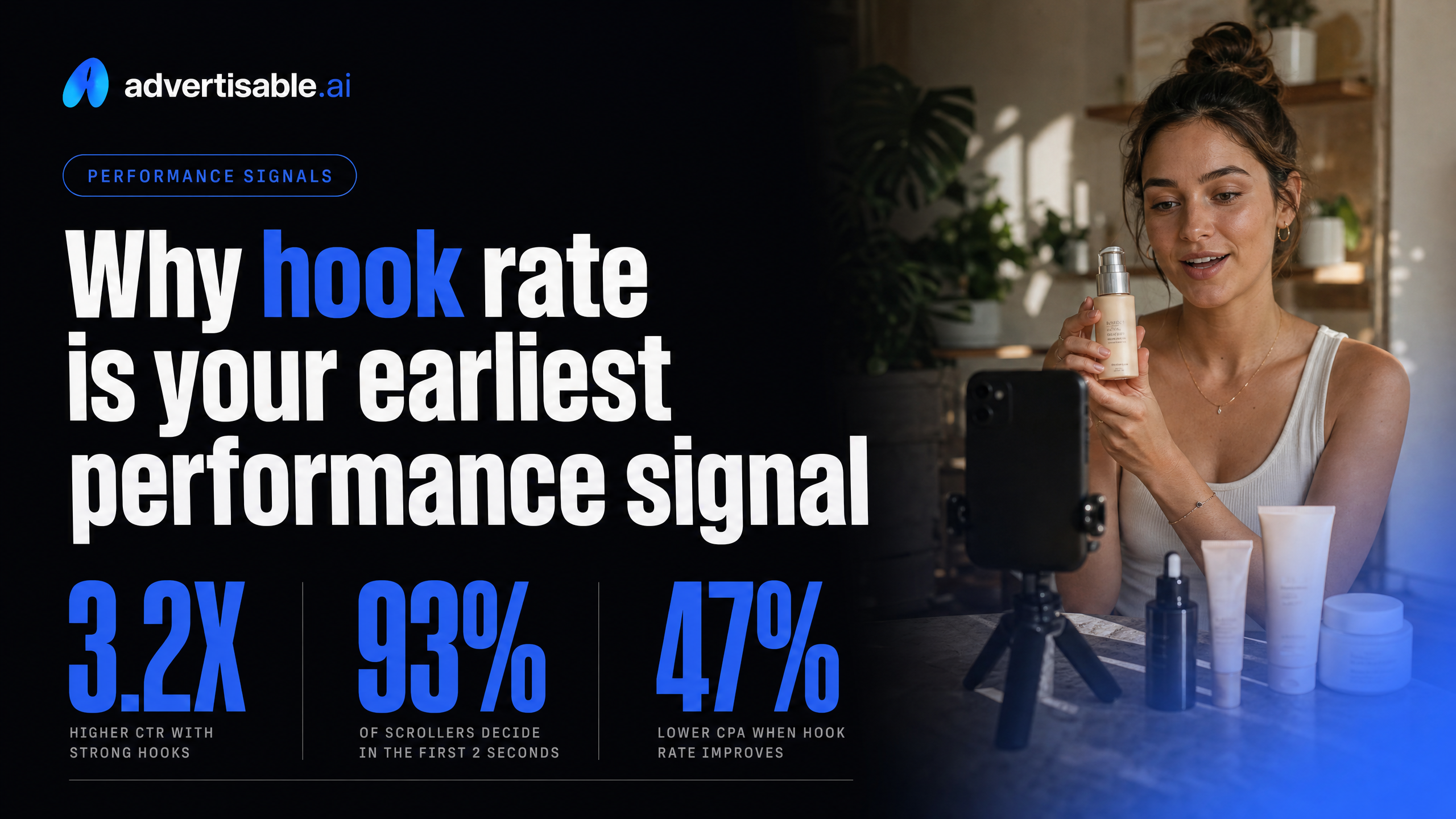
Why hook rate is your earliest performance signal
Attention comes first
Hook rate is predictive because attention is the first gate your ad has to pass. Nobody clicks, reads, or buys something they did not watch long enough to understand.
In practical terms, the opening 2 seconds decides whether you earn a real impression or just pay for a glance. When that opening is unclear, slow, or visually confusing, every downstream metric becomes noisy because you are measuring the behavior of people who never truly entered the message.
That is why we treat hook performance as the earliest read on creative-market fit: it tells you whether the ad is even being “allowed” to communicate before you judge the offer, landing page, or funnel.
- Low hook rate: the opening is failing to stop the scroll, regardless of how strong the rest of the ad is
- Stable hook rate: your ad is consistently earning attention, so later metrics are more likely to reflect the offer and audience fit
- Rising hook rate: a new angle or first frame is winning the attention auction, often before conversion data catches up
Spot winners before CPA confirms them
CPA is a lagging indicator. Hook rate moves earlier because it is driven by immediate viewing behavior, not by delayed conversion windows, attribution noise, or limited purchase volume.
When a new creative shows a clear lift in early attention against your own baseline, it is often a sign the platform will give it more distribution and more learning opportunities. That is how you find breakout winners while the CPA still looks “average” due to small sample sizes.
The opposite is also true: a creative can have a decent CPA for a few days on momentum, while its opening is already losing the scroll. By the time CPA worsens, you have usually burned time and budget.
Why you watch it daily, not weekly
You monitor hook rate daily because it is sensitive to creative fatigue and delivery shifts that take longer to show up in conversion metrics. A week is enough time to miss the early warning and keep spending behind an ad whose opening has stopped working.
Daily checks do not mean daily overreactions. You are looking for directional movement versus your account baseline, ideally within consistent placement mixes and comparable spend.
What we look for in practice is simple: does the opening still earn attention today, or did something change in the first seconds that will snowball into worse efficiency later?
- Daily hook-rate drift down while spend holds: fatigue is starting in the first frames
- Daily volatility without a clear trend: treat as noise until you have enough delivery to trust the signal
- Hook rate drops after a refresh to new placements/audiences: distribution changed, so interpret in that new context
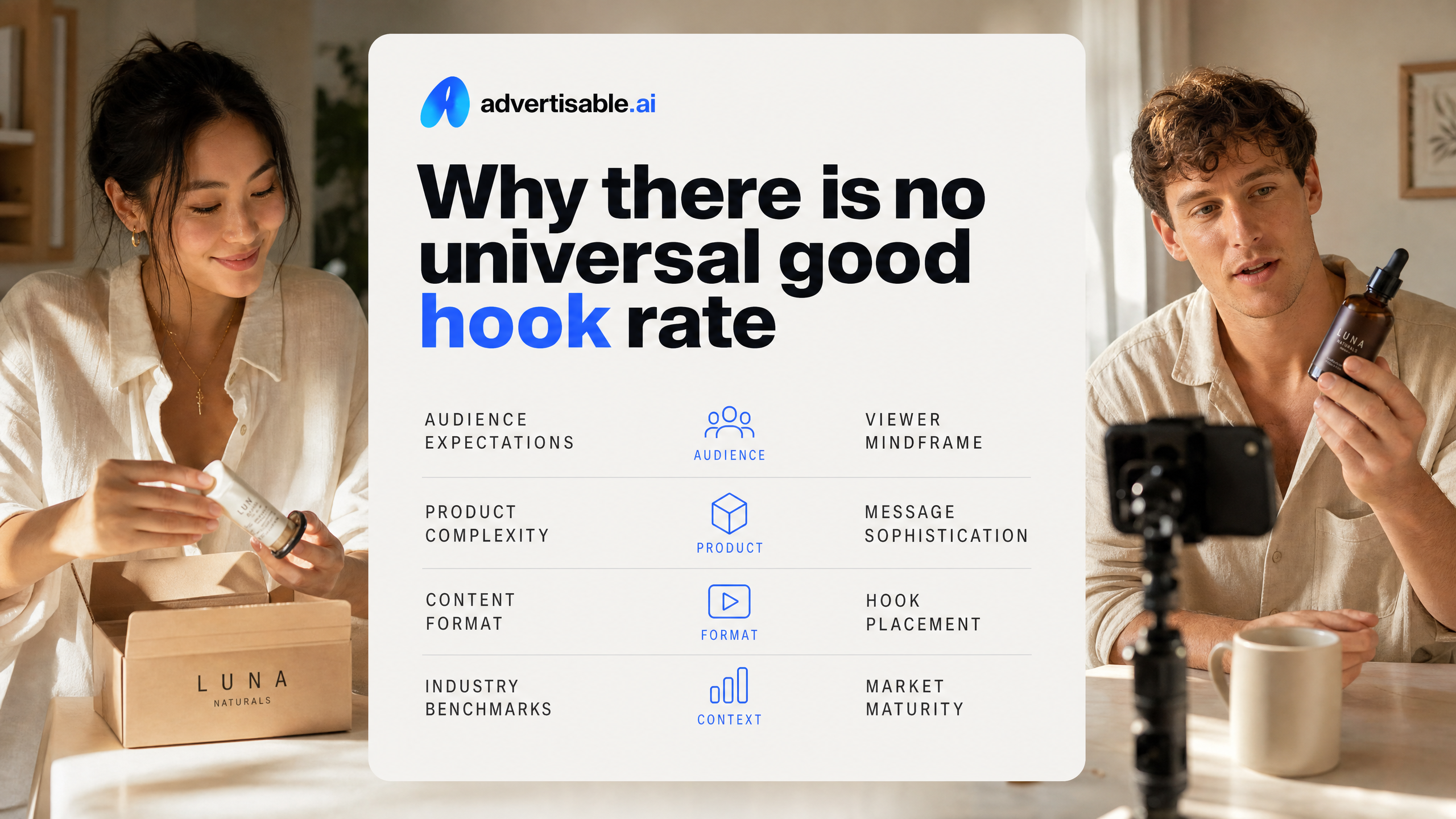
Why there is no universal good hook rate
Your placement mix can swing the number
A single “good” hook rate does not exist because you are rarely measuring one environment. You are measuring a blended average across placements that behave like different platforms.
In-feed, Reels, Stories, and Audience Network all produce different scroll speeds, sound-on rates, and intent. When the algorithm shifts delivery between placements, your aggregate hook rate can move even if the creative is unchanged. That is why chasing a benchmark without controlling for where the impressions came from is usually placement distribution noise, not a real creative change.
- When you compare week to week, hold placement constant (or at least report by placement) before you call a hook “better” or “worse.”
- When you test hooks, keep the same placement set for every ad in the batch so the mix cannot pick the winner for you.
Vertical and audience change attention
Hook rate is also elastic because different categories and audiences grant attention differently. A product with an obvious visual demo can earn early attention fast, while a higher-consideration offer often needs context before the viewer commits.
Even inside the same account, cold prospecting audiences behave differently than warm retargeting. Cold viewers decide in milliseconds whether you are relevant; warm viewers may tolerate a slower open because they already recognize the brand or problem.
Treat hook rate as a relative signal: you are looking for which opening earns more watch continuation for the same audience, not which ad hits a universal threshold.
Build a baseline inside your account
The only benchmark that consistently helps you is your own baseline, built under your own distribution, audiences, and creative style. That baseline becomes the reference point for deciding whether a change is meaningful.
Build it with a controlled batch: one audience, one placement set, fixed spend, and 10 to 20 hook variations where only the first 2 seconds change. In Advertisable AI, that is exactly what scene-level regeneration is for: swap the hook scene while keeping the rest of the storyboard intact, so your readout reflects the opening, not a full rebuild.
Track the median hook rate for that batch and use it as your internal “expected.” Winners are the hooks that beat that median repeatedly across new batches.
How to read a dropping hook rate without guessing
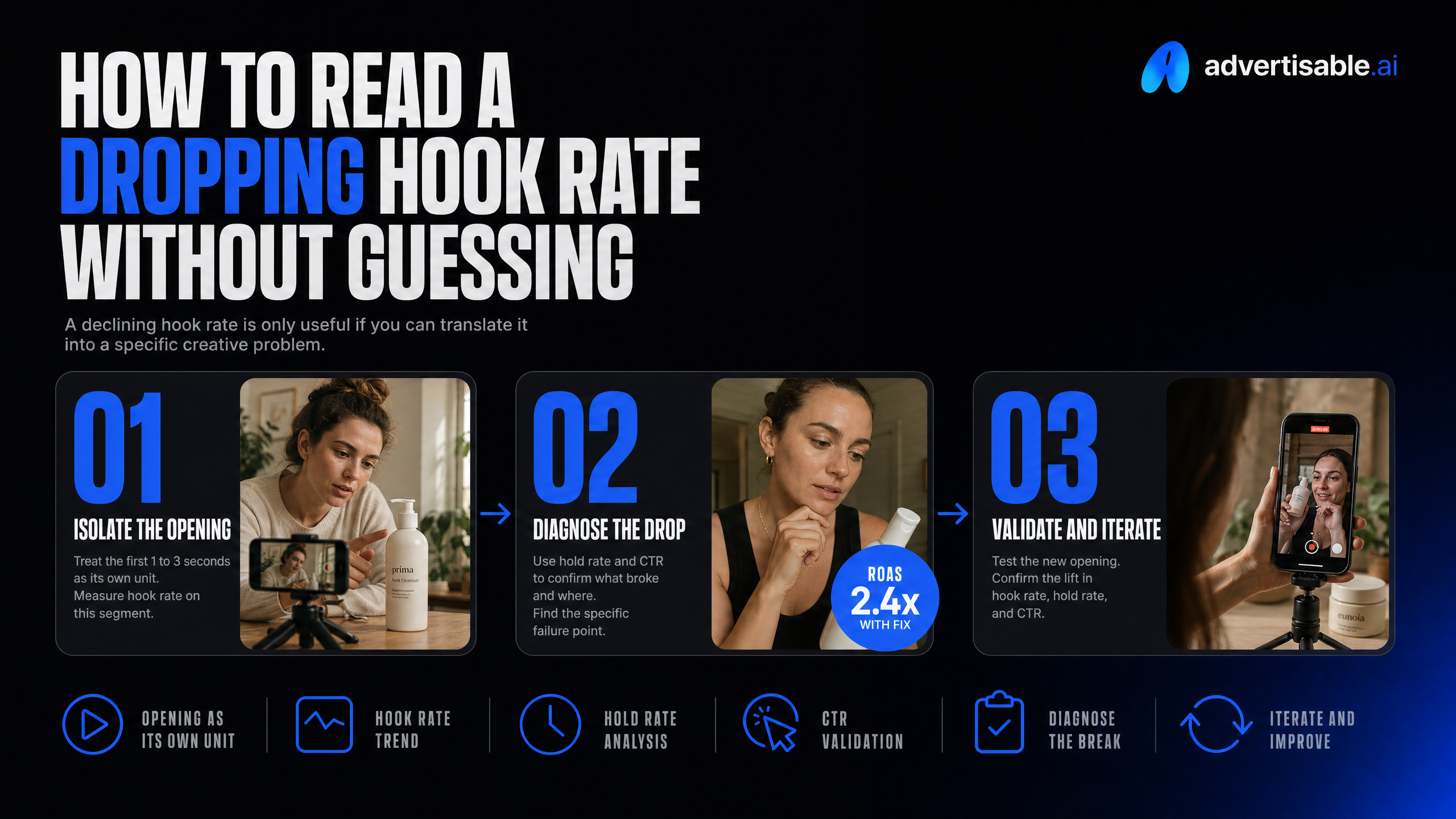
A declining hook rate is only useful if you can translate it into a specific creative problem. You do that by treating the opening as its own “unit,” then using hold rate and CTR to confirm what broke and what to change next.
A drop means the opening stopped earning
When your hook rate drops, your first seconds stopped winning the scroll. That is the clean read. It does not automatically mean your offer got worse, your targeting broke, or the algorithm “changed.”
In our experience, most teams misdiagnose this and start rewriting the entire ad or swapping audiences. The faster move is to assume the opening is no longer earning attention and then prove or disprove that with the next two metrics.
Treat it like a decaying asset: the hook used to buy you a few more seconds of viewing. Now it is buying fewer, so every downstream KPI becomes harder to achieve because fewer people even reach your product moment or proof element.
- Sanity check placement mix before you panic: a shift toward placements that naturally scroll faster can move the number even if the creative is unchanged.
- Compare to your own baseline for that same ad format and audience temperature, not someone else’s benchmark.
Use hold rate to locate the leak
Hold rate tells you where the viewer bails after they give you the initial seconds. That makes it the fastest way to locate the leak without rewatching 20 variations and guessing what “feels” wrong.
A practical read: if hook rate is down but hold rate is stable, the opening is the problem and the body is still doing its job once people get there. If hook rate is stable but hold rate falls, your opening is getting attention but the next beat is losing trust or clarity.
When hold rate collapses right after the hook, we usually see a mismatch between the promise and the proof. The hook sets an expectation, then seconds 3-7 fail to show the product, the mechanism, or the payoff quickly enough.
- Hook down, hold steady: refresh only the first 1-2 seconds.
- Hook steady, hold down: fix the handoff into the product moment (show what it is and what it does earlier).
- Hook up, hold down: the hook may be over-clicky for the audience; tighten the promise so the body can pay it off.
Pair with CTR to choose the fix
CTR is your tie-breaker because it tells you whether attention is turning into action. Used with hook rate and hold rate, it tells you which lever to pull: hook, early body, or offer framing.
Use these pairings to decide what to change next, while keeping everything else fixed so you can learn fast.
- Hook down + CTR down: you need new hook angles. Generate 10-20 one-variable hook options and keep the body identical so the readout is clean.
- Hook down + CTR flat: the opening is losing attention, but the call-to-action and offer still convert when people stick. Refresh the hook, do not rewrite the pitch.
- Hook flat + hold down + CTR down: fix the proof layer and product moment first.
The promise is getting the stop, but the ad is not earning belief.
Hook up + CTR down: your opening is attracting the wrong click intent. Make the first promise more specific to the actual offer or outcome.
When you can name the exact combo you are seeing, you stop “improving creative” and start making one precise change per test.
How to improve hook rate with isolation testing
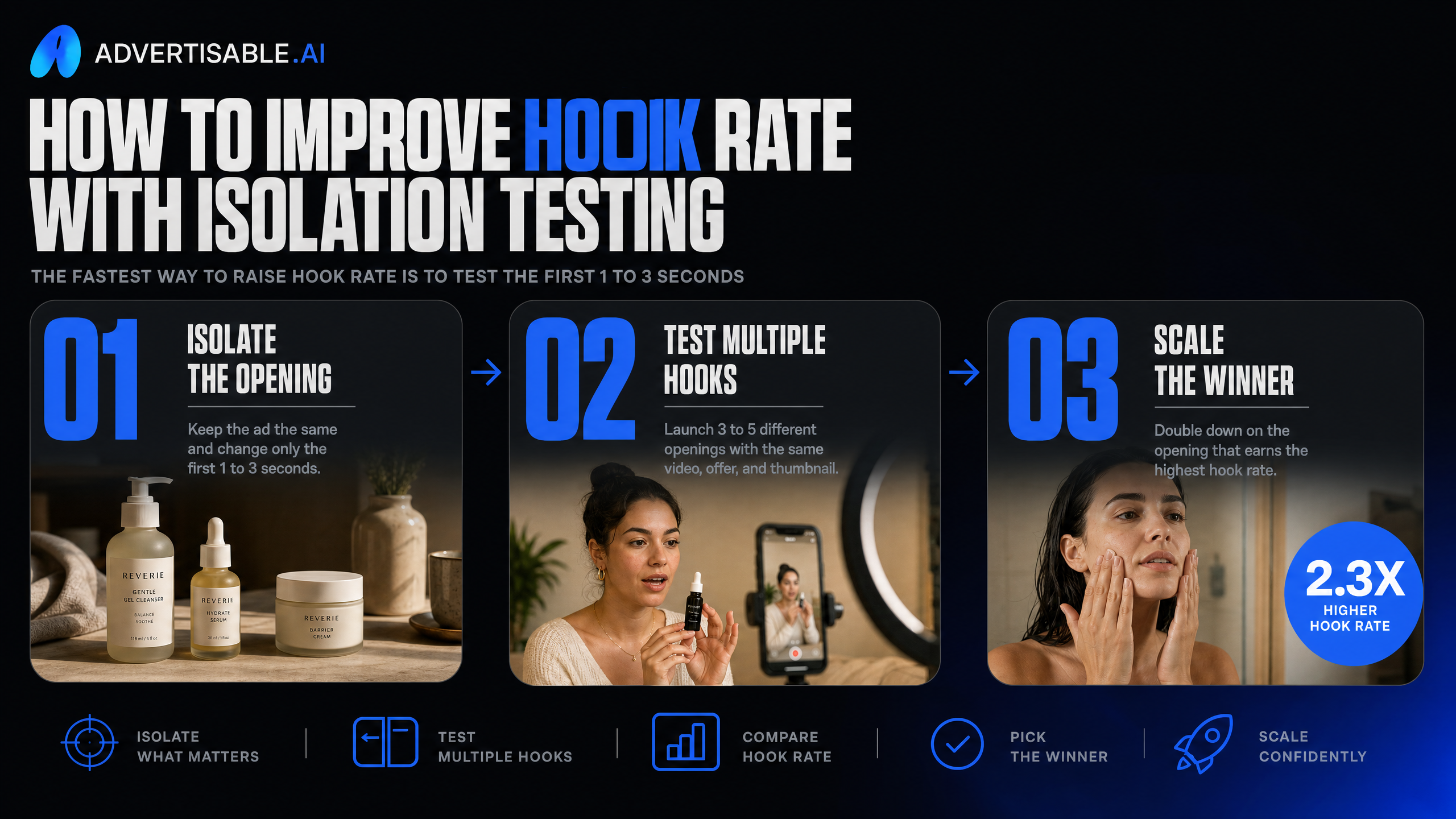
The fastest way to raise hook rate is to stop “improving the whole ad” and start isolating what actually controls the metric: the first 1 to 3 seconds. You treat the opening as the variable, keep everything else fixed, and let the data tell you which promise earns the stop.
The one-promise rule (in seconds)
Your hook needs one clear promise, expressed in the first 1 to 3 seconds, with zero competing ideas. The job is not to explain the product. The job is to earn permission to keep watching.
In our experience, hook rate drops when the opening tries to do three things at once: introduce the brand, tease features, and set a mood. Viewers do not “wait for clarity” on paid social.
A practical way to self-check: can you finish the hook sentence with “so you can…” and have only one ending? If you have two endings, you have two promises, and you are forcing the viewer to choose while they are already scrolling.
- One promise: “Stop wasting product with geometry drift” (single outcome)
- One proof cue: show the product moment immediately, not a montage
- One framing device: either a question, a claim, or a before-after, not all three
- One on-screen line: short enough to read while scrolling, with the key word first
Test many hooks against a fixed body
Isolation testing means you do not change the body while you test hooks. Same offer, same proof element, same call-to-action, same length and pacing. Only the first scene changes.
This turns your creative workflow into a clean experiment: if hook rate moves, you know it was the opening promise, not a new edit, a different proof layer, or a rewritten CTA.
Operationally, build one “proven body” and a library of interchangeable openings. With Advertisable AI, you can do this with a storyboard-first workflow and scene-level control so you swap just the hook scene without rebuilding the entire ad.
- Pick 1 fixed body (scenes 2+) that already sells the product clearly
- Generate 10 to 20 hook variations that each make a different single promise
- Keep targeting, placements, and spend consistent for the readout window
- Promote winners by rolling them into the next batch, then retire the rest
Refresh before fatigue is obvious
Do not wait for CPA to spike before you refresh openings. Hook performance often deteriorates first, and once it slides, your body never gets a fair chance to work because fewer people reach it.
Fatigue compounds when you keep spending behind the same opener, even if the rest of the ad is still strong. Your best move is to cycle new hooks onto the same proven body on a schedule, not as an emergency fix.
A simple rule we use: when the opener is no longer earning attention at your baseline, replace the hook scene first. You are protecting the learning you already paid for in the body and proof element.
- Pre-build a “next 10” hook backlog so you can ship refreshes quickly
- Rotate new openings before performance visibly collapses in reporting
- Archive hooks by promise and reuse the best ones across new bodies later
Use Advertisable AI to generate more hooks fast
Start with Brand DNA + ICP, not a blank prompt
Your hook volume only helps if the ideas are on-brand and aimed at the right buyer. Advertisable AI starts by extracting your Brand DNA and mapping it to your ICP from a product URL, so hook concepts inherit your visual proof layer instead of drifting off-message.
In practice, that means you stop writing prompts like “make 20 hooks” and start generating hooks that match your actual packaging, claims, and tone, with fewer surprises during review.
- Paste a product link (or upload brand assets) to pull colors, fonts, product specs, and voice cues into the Brand DNA layer
- Define your ICP inputs: who you sell to, their main objection, and the one promise you want to lead with
- Generate a batch of hook concepts that stay inside those guardrails, so you can test ideas without re-teaching the tool every time
Regenerate only the opening scene (keep everything else fixed)
Isolation testing breaks when you rebuild the whole ad. With scene-level regeneration, you can swap just the first two seconds while keeping the body, product moment, proof element, and CTA unchanged.
This is where the storyboard-first workflow matters: you approve a scene-by-scene blueprint, then iterate on the hook scene without touching the rest of the sequence. You spend credits on the variable you are testing, not on re-rendering scenes that were already shippable.
When a single scene shows geometry drift or color shift, fix that scene only. Do not regenerate the entire ad to repair one bad opening.
Use the 3-day trial to ship hook batches quickly
The fastest way to validate your hook hypotheses is a short, contained batch cycle. We built the $5, 3-day trial so you can generate 10 to 20 hook variations, launch them, and get a read without committing to a long contract.
A simple trial workflow:
- Day 1: Extract Brand DNA from your URL, create one storyboard, and render one “control” ad you would be comfortable running
- Day 2: Use the Variation Engine to produce a hook-only batch while keeping all other scenes locked
- Day 3: Export platform-specific variations and queue your next batch based on what the first readout tells you
Turn hook rate into a repeatable creative system
If your hook rate drops, your targeting did not suddenly break. Your opening stopped earning attention, and the fix is almost always more hook volume with cleaner isolation testing.
That is exactly where we built Advertisable AI to help. You can start from a product link, lock Brand DNA guardrails, and generate 10 to 20 one-variable hook variations against a fixed body. When you find a winner, you regenerate only the opening with scene-level control, not the entire ad.
Run a new hook batch every 48 to 72 hours, track movement against your own baseline, and scale what holds attention before CPA catches up. Start with a $5 trial and ship your next set of hooks this week.
Frequently Asked Questions
Q: What does hook rate mean?
A: Hook rate tells you what percent of impressions turn into viewers who keep watching past the first few seconds. It is your earliest read on whether the opening earned attention.
Q: What is a good hook rate?
A: There is no universal target because platform, placement mix, and audience change the number fast. The most useful benchmark is your own account baseline, then you look for meaningful movement up or down against it.
Q: What is hook rate and hold rate?
A: Hook rate measures whether people stay past the opening. Hold rate measures whether the people who made it past the opening keep watching deeper into the ad, which helps you pinpoint whether the leak is in seconds 1 to 3 or in the next beats.
Q: How many variations should I test per week?
A: A practical cadence is 10 to 20 one-variable variations per batch, then iterate based on results every 48 to 72 hours. If you have the workflow and QA discipline, you can scale that to 50 to 100 shippable variations per week across your account.