Ecommerce Advertising: How the Game Changed and What Actually Wins Now
A complete ecommerce advertising system is: pick the channels that match how your customer buys, run platform-native creative at a steady output cadence, allocate budget to buy enough data to learn, then optimize around creative refresh and fatigue, not “perfect” targeting.
Here’s what matters most right now:
- Meta and TikTok are the paid social core, and they reward testing speed.
- Google and YouTube add intent and discovery, but creative still shapes results.
- Prospecting needs constant hook testing; retargeting needs proof and clarity.
- Budget only works when it buys learning, not when it gets scattered everywhere.
- Underperformance is usually a creative or offer mismatch, not a targeting failure.
- Creative refresh is a weekly habit because fatigue is predictable at scale.
We built Advertisable AI for this exact reality: when targeting is automated, you need a creative pipeline that can keep up. Our UGC Ads, Product B-Roll, Static Ads, Recreate Video, and Animate are designed to help you ship production-ready variations quickly, while Brand DNA locking and frame-by-frame scene control keep output consistent and on-brand.
To make smart channel, budget, and optimization decisions, you have to start with the shift that changed everything: when platforms took over targeting, creative became the last controllable variable, and ad spend alone stopped being an advantage.
The Shift That Changed Ecommerce Advertising
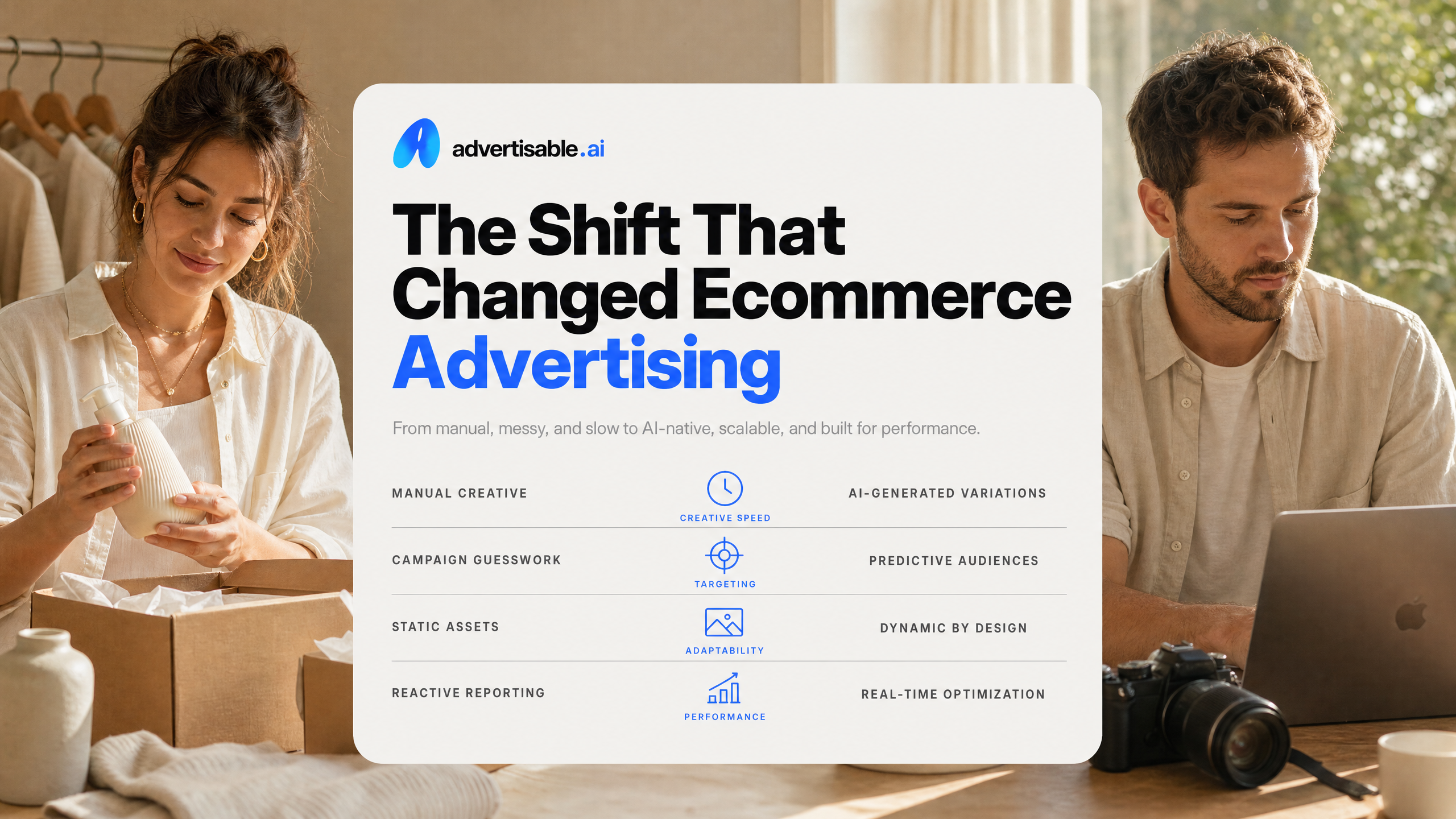
When Platforms Took Over Targeting
A big chunk of what used to be “media buying” is now delegated to the platform. Your targeting, placements, and even budget allocation increasingly get auto-optimized inside systems like Advantage+ and Performance Max.
In practice, that means you can still set guardrails (geo, exclusions, basic audiences), but you are no longer winning because you found a clever interest stack or a niche lookalike. The platform’s job is to find pockets of conversion behavior; your job is to feed it signals it can actually learn from.
- You give the algorithm: a conversion objective, a product, and constraints
- It decides: who sees it, where it shows, and how aggressively it bids in each auction
- The feedback loop is driven by: what people do after seeing your ad, not what you guessed about them upfront
Creative as the Last Controllable Variable
When targeting and bidding are automated, creative becomes the most direct lever you still control. It is the input that shapes attention, click intent, and purchase intent, and it is the only part of the system you can change without waiting for a platform to relearn your account.
This is why high-performing ecommerce accounts look less like “one perfect ad” and more like an operating cadence. You ship variations of hooks, problem-solution sequences, product b-roll, and testimonial ads, then keep what earns efficient conversions and replace what fatigues.
- Hook (first 3 seconds): what stops the scroll
- Problem statement: what makes the buyer feel seen
- Product demonstration: what creates belief
- Proof element: what reduces hesitation
- Offer or CTA: what forces the decision
Why Ad Spend Alone Stopped Being an Edge
More spend used to buy you a meaningful advantage because it bought you more targeting shots on goal. Now, spend mostly buys you faster exposure to the same reality: if the creative does not hold attention and convert, the algorithm just scales your inefficiency.
In our experience, the brands that feel like they are “missing a smarter channel” are usually missing a creative system. Bigger budgets still matter, but only after you can produce enough on-brand variations to keep learning while avoiding ad fatigue.
- Spending more does not fix weak message-market fit in the ad
- Spending more accelerates creative fatigue if you do not refresh
- Spending more widens the gap between brands that can iterate weekly and brands that cannot
Where Ecommerce Advertising Actually Happens
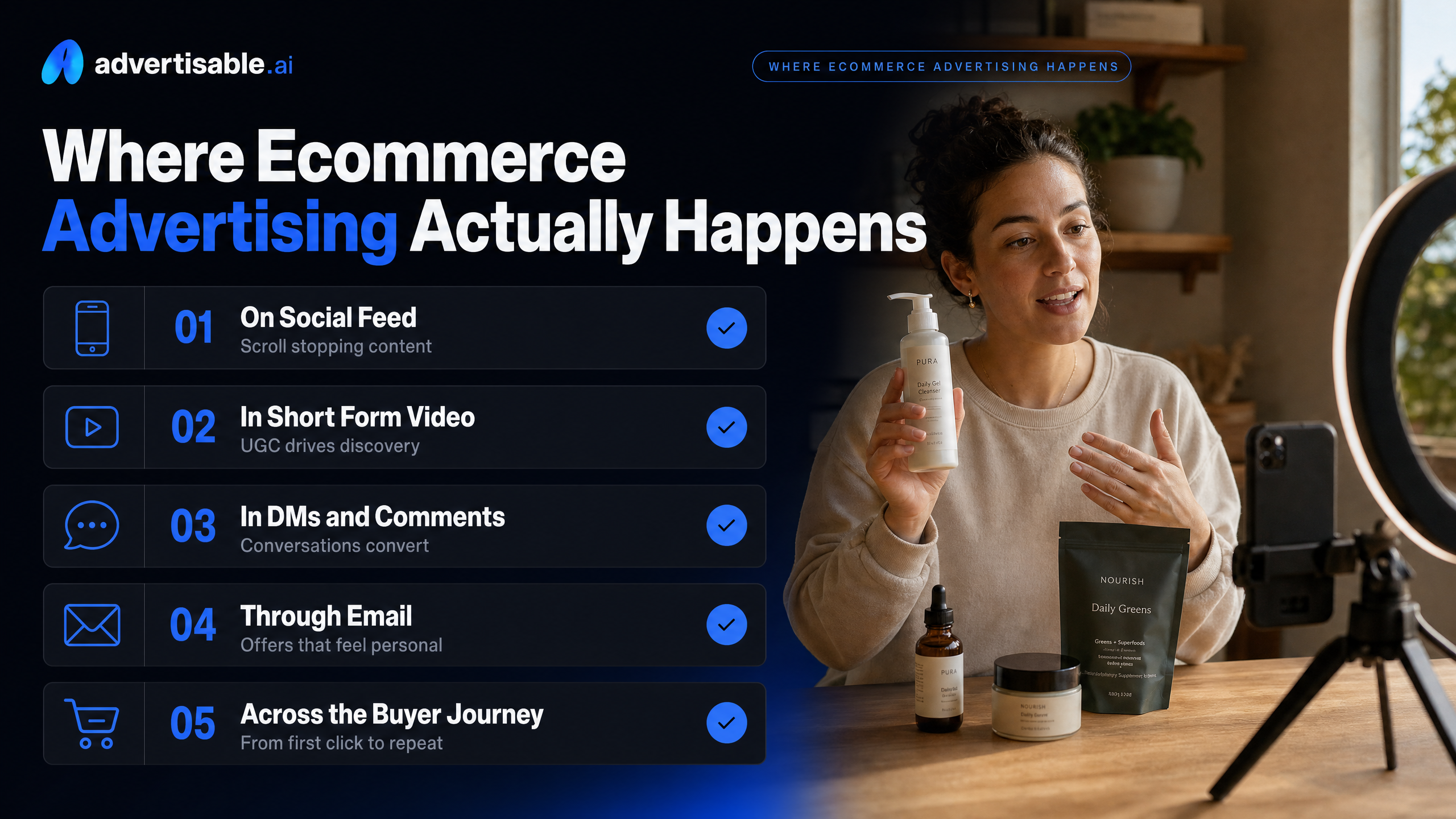
Meta and TikTok: the Paid Social Core
Most ecommerce advertising volume still runs through Meta and TikTok because they can create demand, not just capture it. You put a product in front of someone who was not actively shopping and the algorithm finds the pockets of buyers.
The important shift is that targeting advantages are smaller than they used to be. Broad audiences, automated placements, and campaign types like Advantage+ mean the platform is doing more of the delivery work, so your primary lever is the ad itself.
That is why competition has moved to creative throughput: how many credible UGC ads, product demos, and static variations you can ship without drifting off-brand. In practice, you win by refreshing hooks and angles fast enough to stay ahead of ad fatigue, not by micro-managing interests.
- Meta strengths: conversion-optimized delivery, fast feedback loops on variations, strong performance for direct response formats
- TikTok strengths: creator-style ads that feel native to feed, rapid creative turnover, strong upside when the hook lands
Google and YouTube: Intent and Discovery
Google is where you catch demand that already exists. When someone is searching, your job is less about inventing desire and more about matching the product, offer, and proof to what they want right now.
YouTube sits between social and search. It can work as discovery with short-form placements, and it can support intent when viewers are actively researching a category, but the creative still has to earn attention quickly.
Automation is doing more here too. With systems like Performance Max, the platform mixes placements and learns which creative and signals convert, which again pushes you toward a steady stream of new assets rather than one perfect ad.
- Use Google when the purchase is need-driven or comparison-driven and you can win with clear product facts and proof elements
- Use YouTube when you can tell a fast problem-solution sequence and show the product in use without a long explanation
Prospecting vs Retargeting Across Channels
Prospecting is for first-touch demand creation or demand capture from new customers. Retargeting is for converting people who already engaged: site visitors, video viewers, add-to-cart users, and past buyers depending on your setup.
Across Meta, TikTok, Google, and YouTube, the mechanics differ but the creative job is consistent: prospecting needs a ruthless hook plus a clear product demonstration, while retargeting needs proof and a reason to act now.
A common budget mistake is expecting retargeting to “fix” weak prospecting. Retargeting only scales when prospecting is feeding it enough qualified traffic, and automation will not rescue unclear messaging.
- Prospecting creative: hook-first UGC ads, unboxing ads, product b-roll that shows the outcome fast
- Retargeting creative: testimonial ads, before-after proof elements, offer frames that reduce hesitation
Why Creative Is Now the Bottleneck
How Creative Fatigue Kills Winners
On paid social, you do not usually lose because your targeting “broke.” You lose because the exact same ad gets shown to the same pocket of people until it stops getting attention, and performance slides.
Fatigue shows up as a familiar chain reaction: your hook stops earning the scroll-stop, the platform finds fewer converters at your target CPA, and delivery drifts to less responsive audiences to keep spending. The ad is not suddenly “bad,” it is just over-served.
The uncomfortable part is that a single winner can mask the problem for weeks, then fall off quickly. If your creative pipeline is thin, that drop forces reactive edits and panic testing instead of planned creative refresh.
- Early warning signals: rising CPA, falling click-through, frequency creeping up, comments turning from curiosity to “seen this already”
- What gets fatigued fastest: the first 1 to 3 seconds (the hook), then the opening problem statement, then the same proof element shown too many times
Variations Are a Testing Requirement
To keep performance stable, you need a steady flow of variations, not occasional “big new concepts.” The platform rewards breadth because it can match different angles to different micro-audiences.
What we see work in practice is structured variation: keep the body of the ad consistent long enough to learn, then swap the parts that drive the biggest swing in attention and intent. That is why teams test many hooks against one product demo body, instead of rebuilding from scratch every time.
- Hook swaps: 10 opening scenes with different promises, objections, or pattern interrupts
- Angle swaps: same footage, different framing (speed, comfort, durability, savings, simplicity)
- Proof swaps: testimonial-style line vs before-after vs product b-roll demonstration
- Format swaps: creator-style UGC ads vs product b-roll vs static ads for different placements
If you cannot produce variations quickly, you are forced into “one-ad betting,” and the account becomes fragile.
Throughput Is the Real Constraint
Most teams do not run out of ideas or budget first. They run out of production capacity: sourcing creators, shipping products, filming, editing, getting approvals, and exporting in the right sizes.
That is why “creative quality not good enough to compete at scale” is usually a workflow problem in disguise. When output cadence is slow, you accept compromises: rushed edits, inconsistent creator faces, off-brand visuals, or claims that drift from what you can safely say.
Throughput improves when you can lock brand rules and iterate at the scene level. In our platform, teams use Brand DNA plus a storyboard editor to regenerate a hook or proof scene without rebuilding the entire ad, which is exactly the kind of mechanical advantage you need when fatigue is routine.
The Volume vs Consistency Tension
Why Volume Usually Creates Brand Drift
High output usually breaks brand consistency because speed forces decisions down to whoever is shipping assets that day, not whoever owns the brand.
In ecommerce advertising, you are producing dozens of variations across UGC ads, product b-roll, statics, hooks, and aspect ratios. When your inputs are loose, every new variant becomes a new interpretation of your tone, claims, visuals, and “what this product actually does.” Drift is rarely one big mistake. It is a hundred small ones that compound across refresh cycles.
- Messaging drift: benefits get reworded until they sound like a different promise
- Visual drift: colors, fonts, and packaging details shift between exports
- Creator drift: faces and voices rotate, so recognition never compounds
- Compliance drift: claims get embellished as teams chase higher click-through
You can still hit volume like this, but you end up testing multiple “brands” at once, which muddies performance signals and makes scaling harder.
Why Tight Control Usually Slows Output
Traditional brand control depends on human review loops, and review loops do not scale linearly with creative demand.
A typical control-heavy workflow requires briefs, handoffs, revisions, approvals, and re-exports for every placement. That works when you ship a few hero ads per month. It collapses when you need weekly creative refresh to stay ahead of ad fatigue, because each new hook or angle becomes another ticket in the queue.
The friction is not just time. It is context loss: the brand knowledge often lives in one or two people, and they are not in the room when most variations get produced.
The Brands That Solve Both
Winning teams treat creative like a system: lock what must stay consistent, then vary what the algorithm needs for testing speed.
Practically, that means codifying brand rules (colors, fonts, product facts, voice) and standardizing a few repeatable ad structures like problem-solution sequence and testimonial ads. Then you generate volume by swapping hooks, angles, and proof elements without re-litigating the brand each time.
This is the exact gap tools like our Advertisable AI platform are built to cover: Brand DNA to prevent off-brand output, plus a storyboard editor so you can regenerate one scene instead of rebuilding the entire ad.
- Non-negotiables stay locked: brand lockup, visual system, approved claims
- Variables move fast: hook (first 3 seconds), creator delivery, offer framing, proof element
- Iteration happens at the scene level, so refresh is measured in minutes, not weeks
What a Scalable Creative Operation Looks Like
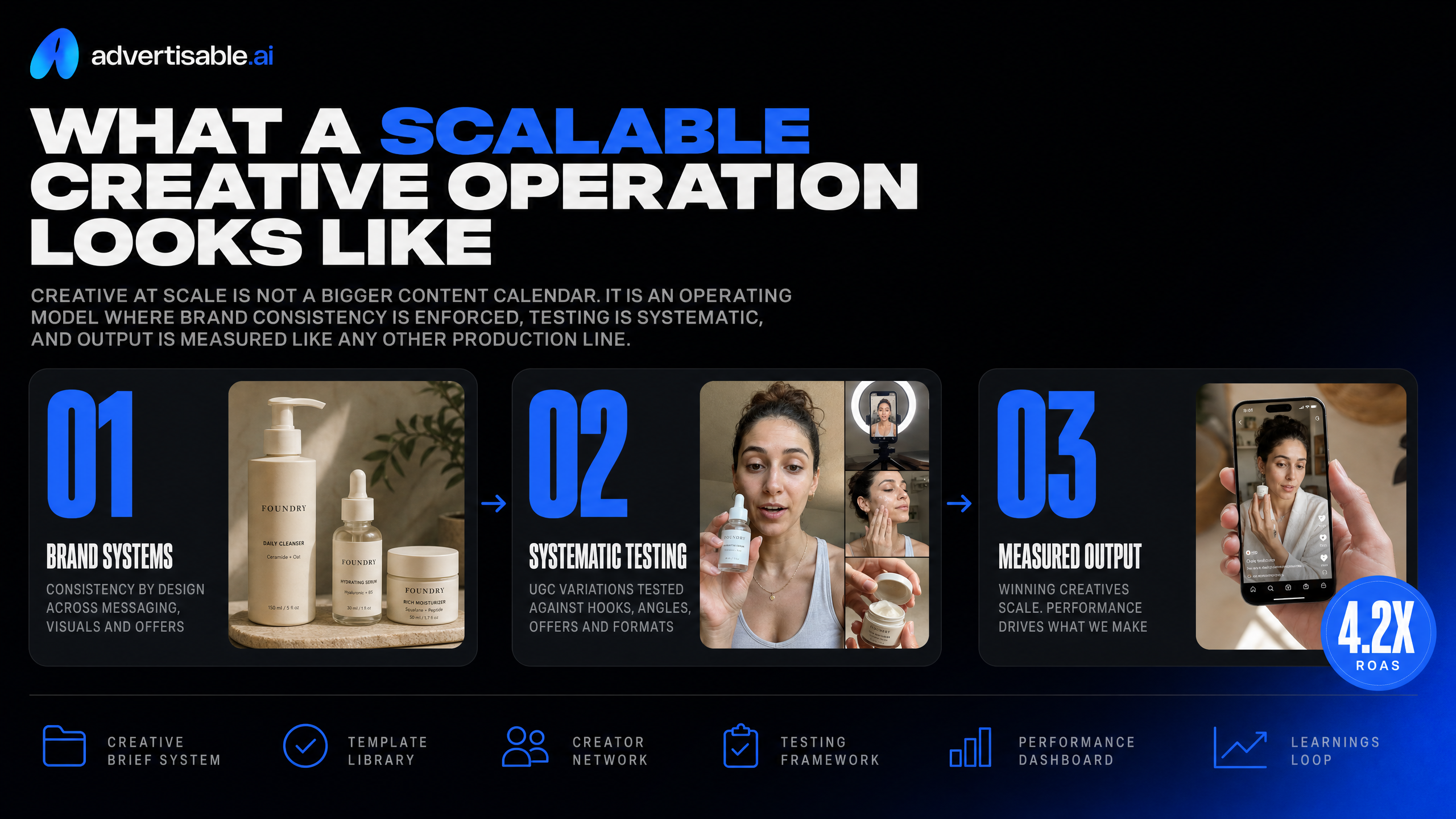
Creative at scale is not a bigger content calendar. It is an operating model where brand consistency is enforced, testing is systematic, and output is measured like any other production line.
Locked Brand Rules That Survive Volume
At high output, your brand breaks in predictable ways: colors drift, claims get stretched, and every new creator interprets “on-brand” differently. The fix is not more reviews. It is hard rules that travel with every asset, so volume does not equal variance.
In our experience, you want a single source of truth that is explicit enough to be executable and narrow enough to prevent improvisation. Think of it as constraints that still leave room for performance creativity.
- Non-negotiables: logo treatment, typography, color usage, and safe zones for text overlays
- Message guardrails: allowed claims, required disclaimers, banned phrases, and proof standards for testimonial ads
- Creator continuity rules: when to keep the same face/voice across variations and when to rotate intentionally
- Visual do-not-cross lines: prohibited backgrounds, competitor callouts, before-after policies, and packaging accuracy requirements
A Repeatable Hook and Angle Testing System
Scaling performance creative means separating what you are testing. You do not “test ads.” You test hooks, angles, and formats with as few moving parts as possible so you can learn fast.
A clean system is: lock one strong body (problem-solution plus product demonstration), then run hook sprints. Hook iteration is where you earn speed because the first 3 seconds decide whether the rest of the ad ever gets watched.
- Pick 1 offer and 1 demo sequence to hold constant for the sprint
- Write 10 hook variations that each express a distinct angle (pain, aspiration, objection handling, curiosity, urgency)
- Produce variants in the same formats you actually buy (9:16, 1:1, static), not just one “master”
- Promote winners by reusing the hook pattern, then rotate new angles before fatigue sets in
Measuring Cost Per Shippable Ad
Creative scale breaks when you only track media metrics and ignore production economics. The metric that keeps you honest is cost per shippable ad: what it takes in time and money to produce an asset you would confidently put spend behind.
Track it like a throughput KPI, not a one-off project cost. When you do, you can see whether your bottleneck is ideation, approvals, editing, or brand QA, and you can fix the actual constraint.
- Define “shippable” upfront (meets brand rules, accurate claims, correct specs, passes platform checks, exported in required sizes)
- Log real inputs per asset: brief time, revisions, edit time, stakeholder approvals, and rework rate
- Report weekly: shippable outputs created, average cycle time, and cost per shippable by format (UGC-style video, product b-roll, static)
- Use a kill rule: if an asset is not shippable after a set number of revisions, stop and diagnose the process, not the creative
How Advertisable Solves the Creative-at-Scale Problem
Brand DNA + ICP Analysis Keeps Output Consistent
Consistency breaks when you scale production faster than your team can enforce standards. Our Brand DNA and ICP analysis lock your visual rules and messaging so every asset stays aligned, even when you are generating dozens of variants.
You start from your product URL, and the system captures what needs to stay true: brand look and feel, product facts, and the voice your best customers actually respond to. That means fewer off-brand iterations and less time rewriting captions, claims, and overlays after the fact.
- Brand lockups: colors, fonts, and logo usage carried into every format
- Messaging guardrails: product facts and approved wording stay consistent
- ICP-aware angles: hooks and problem statements generated for your buyer, not a broad audience
Fast Variations With Scene-Level Regeneration
Volume is not “more ads.” It is more tests per week without resetting your whole production pipeline.
Advertisable is built for fast variation: generate batches of hooks, swap angles, and refresh creatives before fatigue sets in. When one part underperforms, you regenerate that scene instead of rebuilding the entire ad, which keeps testing tight and output high.
- Create 10 hook options against one product demo body to isolate what wins
- Regenerate a single scene (hook, proof element, or offer) without changing the rest
- Keep continuity by using the same creator across variations and funnel stages
Production-Ready Ads From a Product URL
The fastest way to ship is removing setup work. With Advertisable, you can generate studio-grade video, UGC ads, product b-roll, and statics directly from a product link, then push variations sized for Meta, TikTok, and YouTube.
If you want to feel the workflow before committing, start with the $5 trial and ship your first batch from a single URL.
Turn Creative Volume Into a Repeatable Advantage
Targeting and bidding are mostly automated now. What you still control is whether you can ship enough on-brand variations to stay ahead of ad fatigue without burning weeks on production.
That is exactly what we built Advertisable AI for. You start from a product link, lock your guidelines with Brand DNA, then generate performance-ready UGC ads, Product B-Roll, and Static Ads for Meta and TikTok. When a concept is close but not quite there, you regenerate one scene in the Storyboard Editor instead of rebuilding the entire ad.
If you want a clean next step, generate 10 hook variations for your best-selling product this week, test them, and scale the winners with a weekly creative refresh cadence.
Frequently Asked Questions
Q: What is eCommerce advertising?
A: Ecommerce advertising is the paid side of selling online, where you buy distribution on platforms like Meta, TikTok, Google, and YouTube to drive product discovery and purchases. In practice, performance is shaped less by clever targeting and more by whether your creative matches how people scroll and decide.
Q: Will AI-generated ads actually look professional and on-brand?
A: Yes, if you lock the rules upfront. With Advertisable AI, Brand DNA keeps your colors, fonts, product facts, and voice consistent, and scene-level control lets you fix a single shot or line without restarting the whole ad.
Q: How fast can I test new creative compared to hiring creators?
A: You can move in minutes instead of weeks. The practical advantage is testing speed: generate multiple hook variations against one product demonstration, ship the winners the same day, then refresh weekly as performance starts to fade.
Q: Do I need to ship my product to creators or to a studio?
A: No. You can generate Product B-Roll from your product data and run creator-style ads using AI avatars, so you are not blocked by shipping, scheduling, or shoot days.