Brand DNA: What It Is and How to Define It
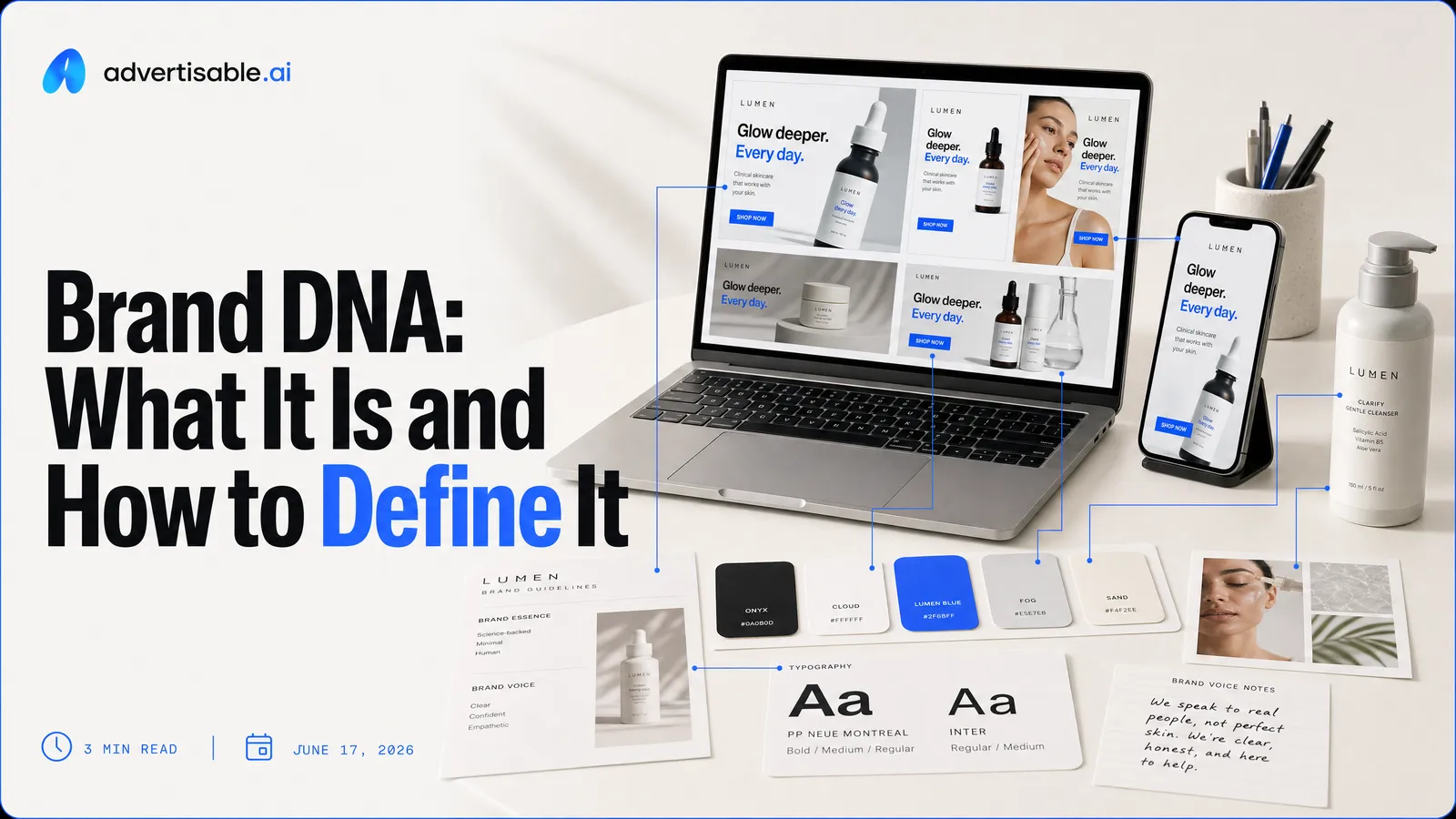
Brand DNA is the small set of core elements that stay constant across everything your brand makes, even as campaigns, offers, and channels change. It is what keeps a brand recognizably itself from one asset to the next. But most brands have a brand DNA defined somewhere and still watch their output drift, because the definition lives in a slide deck and gets ignored at the moment things actually get made. Brand DNA only does its job when it is enforced at the point of creation, not filed away as a reference nobody opens.
This guide turns "brand vibe" into rules your workflow can actually enforce. You will learn:
- What Brand DNA is and is not, and how it differs from brand guidelines.
- The components that make it up: verbal identity, visual identity, positioning, and personality, written as rules instead of adjectives.
- Why brand DNA breaks in the real world, especially once you are producing at volume.
- A one-session method to define yours by listing what can never change and turning opinions into hard constraints.
- Why scale requires enforcement at creation time, not after-the-fact brand policing.
Later, we will look at how this plays out in AI ad production, where you are generating hundreds of variations and brand DNA has to be enforced automatically rather than checked by hand. That is the problem Advertisable AI's Brand DNA feature is built for, and we will come back to it once the foundations are in place.
First, the boundary that everything else depends on: what brand DNA is, and what it is not.
What brand DNA is and is not
A snippet definition you can use
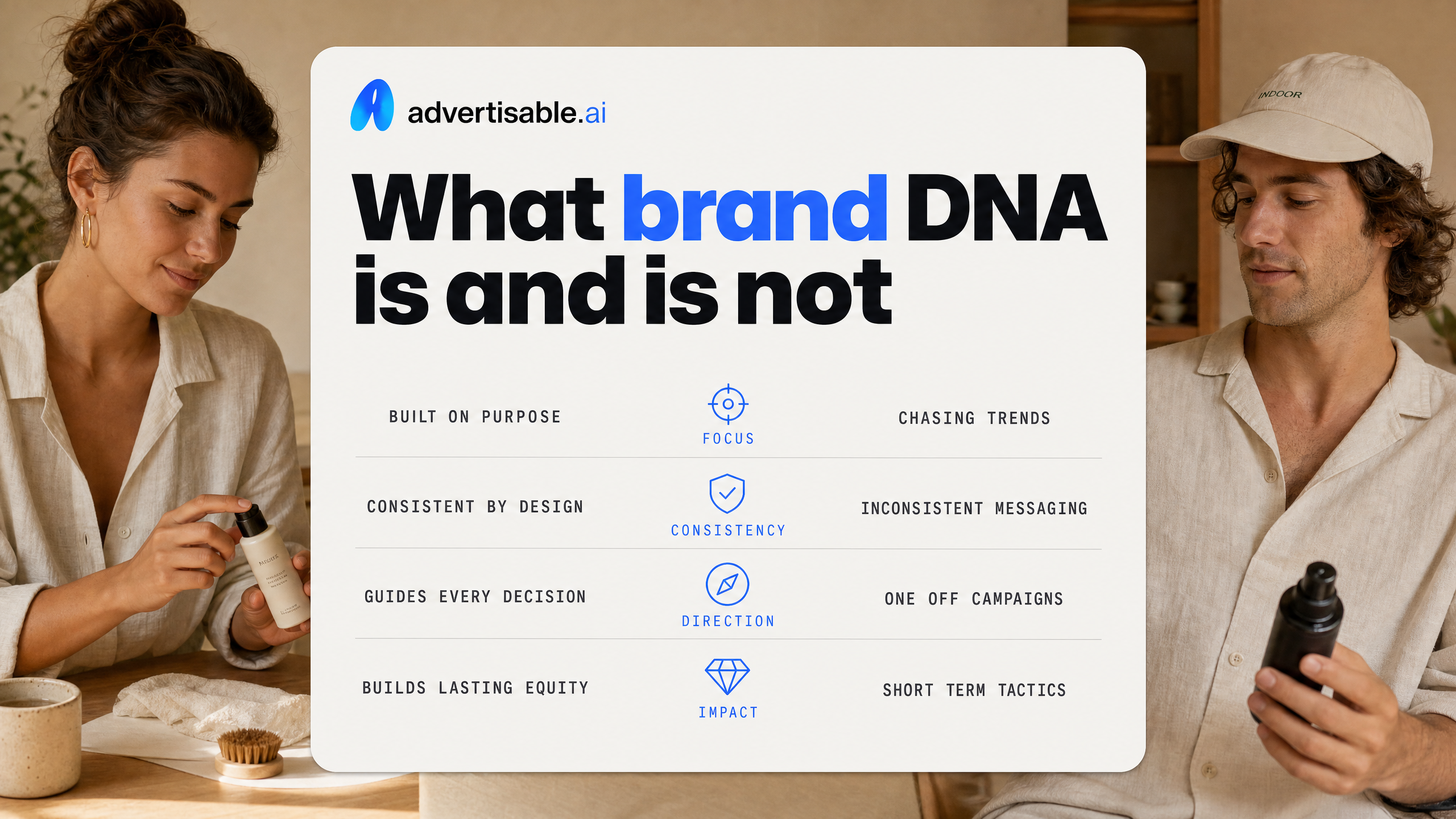
Brand DNA is the small set of creation-time rules that makes your brand recognizable and consistent across every asset you ship, even when the campaign, offer, or channel changes.
Done right, it is not a slide-deck concept. It is a decision system you can apply at speed: what must stay true in your visuals, voice, and product portrayal so every new creative still feels like it came from the same brand.
In performance creative, this matters because inconsistency is rarely subtle. You see it as product colors shifting, logos distorting, or the product “shape” drifting between scenes, which breaks trust fast and forces rework.
- What Brand DNA is: a short list of non-negotiables (constraints) that govern how you show up
- What Brand DNA is not: a moodboard, a set of adjectives, or a brand story nobody can enforce under deadline
Brand DNA vs. brand guidelines
Brand guidelines tell you what “correct” looks like. Brand DNA tells you what cannot be violated at the moment of creation.
Guidelines are usually comprehensive and descriptive: logos, typography, colors, do’s and don’ts, example layouts. Useful, but often too long and too passive for high-volume production.
Brand DNA is tighter and operational. It turns the brand into testable rules you can apply to every asset before it ships, especially when you are generating lots of variations quickly.
- Guidelines: reference documentation for humans to consult
- DNA: enforceable constraints you build into your workflow
- Guidelines: broad coverage (many elements, many edge cases)
- DNA: minimal set (only what drives recognition and prevents drift)
If your team can’t say “yes or no” in seconds, you are looking at guidelines, not DNA.
The non-negotiables that survive every campaign
Campaigns change by design. Your brand cannot. Brand DNA is the portion of your identity you keep constant while you rotate hooks, offers, angles, and formats.
In practice, the non-negotiables are not just "brand vibes." They include guardrails that prevent visible failure modes like geometry drift, color shift, and logo warping, because those break credibility before your message even lands.
- Visual identity rules: color tolerances, logo placement constraints, product depiction consistency (shape, proportions, finishes)
- Verbal identity rules: what you will and will not claim, your preferred phrasing, your tone boundaries
- Positioning rules: who the product is for, what problem you own, what you refuse to compete on
- Proof rules: what must be shown early to reduce uncertainty (your “visual proof layer”)
The components of brand DNA as rules
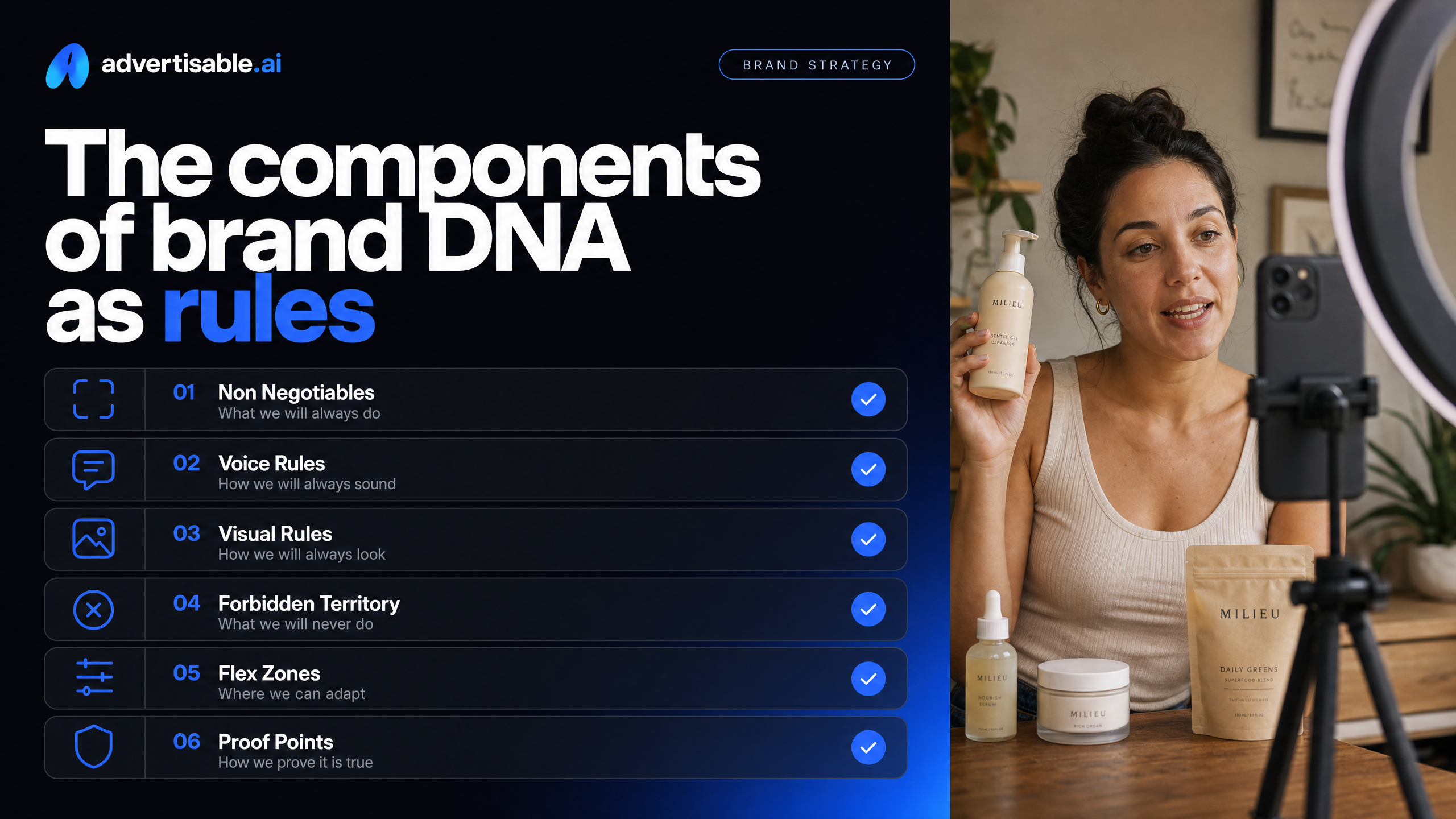
Brand DNA only works when it is written like enforceable rules, not descriptive adjectives. Think in constraints: what you will say, how it will look when rendered, and what you will never compromise on.
Verbal identity is message constraints
Your verbal identity is a set of message constraints that limits what your ads can claim, how they can claim it, and what they must avoid. This is how you stop copy drift when you are producing variations at volume.
In performance creative, the fastest way to lose consistency is letting every hook invent a new promise or a new “angle” that the brand would never sign off on. Treat voice as rules that can be checked at the point of writing, not debated in review.
Write your verbal identity so a teammate, or a system, can validate it in seconds.
- Claim boundaries: approved benefit statements, disallowed claims, and required qualifiers when needed
- Vocabulary rules: words you always use, words you never use, and product naming conventions
- Tone controls: allowed intensity (calm vs. punchy), humor rules, and what “confidence” sounds like in your category
- Proof language: what counts as evidence in your ads (demo, spec, testimonial, comparison) and what formats are off-limits
Visual identity is render constraints
Your visual identity is render constraints: rules that prevent the output from changing your product, logo, or brand look as you generate new variations. In AI-generated ads, this is where accuracy either holds or collapses.
The failure modes are predictable: geometry drift (shape changes), color shift (brand or product colors move), and logo warping (distortion). Visual constraints exist to block those outcomes before they ship.
Treat these as “pass or fail” checks, not style preferences.
- Color constraints: primary palette, allowed shades, and unacceptable shifts in product color
- Logo constraints: placement zones, minimum clear space, and distortion rules
- Product geometry constraints: silhouette consistency, key design features that cannot change, and angle limits
- Lighting and surface rules: acceptable reflections, background treatment, and realism thresholds for rendered product imagery
Values, positioning, and personality rules
Values, positioning, and personality are still rules, just higher-level ones. They decide what you prioritize, who you are for, and what you refuse to do even if it might win a short-term click.
Positioning rules keep every ad aligned to the same buyer logic, so your variations test creative, not your identity. Personality rules keep delivery consistent, so you do not sound like a different company every week.
When you operationalize these, you can ship faster without re-litigating “is this us?” on every storyboard.
- Value rules: non-negotiables that must show up in the work (for example, clarity over hype, proof over promises)
- Positioning rules: who you are for, who you are not for, and the single primary problem your ads are allowed to lead with
- Personality rules: how assertive you are allowed to be, how you handle skepticism, and what kind of humor or edge is permitted
- Decision rules: tie-breakers for approvals (if two options perform, you choose the one that better fits the values and positioning)
Why brand DNA fails in the real world
Defined, then filed away
Brand DNA fails because it gets treated like a one-time branding exercise instead of an operating constraint. You define it in a deck, everyone nods, and then the work goes back to shipping ads under pressure.
In performance teams, the moment that matters is creation time. That is when a designer, media buyer, or AI workflow needs guardrails they cannot miss, not a PDF they have to remember to open.
Volume makes this worse. Content production requirements have roughly doubled over the past two years in Adobe's research on scale, but most teams still run the same approval mechanics they used when output was a fraction of today’s pace. The result is predictable: drift is not a branding failure, it is a workflow failure.
Adjectives you cannot test
Most brand DNA docs are written as vibes: “bold,” “premium,” “conversational but authoritative.” Those words cannot be verified consistently across people, channels, or AI models, so they cannot be enforced.
In our experience with performance creative, what scales is rule-shaped DNA. You want statements that can pass or fail in a review, especially when you are generating dozens of AI-generated variations.
- Replace “premium” with constraints like: color palette boundaries, typography rules, and what product angles are allowed in the first 2 seconds
- Replace “playful” with language rules like: banned phrases, reading level, and whether you use humor at all
- Replace “consistent visuals” with measurable failure modes: prevent color shift, geometry drift, and logo warping
After-the-fact brand policing
Brand DNA breaks when you enforce it only at the end, through reviews that reject work after it is already produced. That turns brand into a tax: rework cycles, wasted time, and inconsistent decisions depending on who is reviewing that day.
Policing also fails at volume because you are checking outputs, not preventing mistakes. When one element misses, the common workaround is to redo the whole asset, which burns time and slows iteration.
The operational fix is to move enforcement upstream: bake the guardrails into the point of creation, then review before anything ships so problems are caught at the source instead of after. Fewer subjective debates, fewer full rebuilds, less drift.
How to define your brand DNA in one session
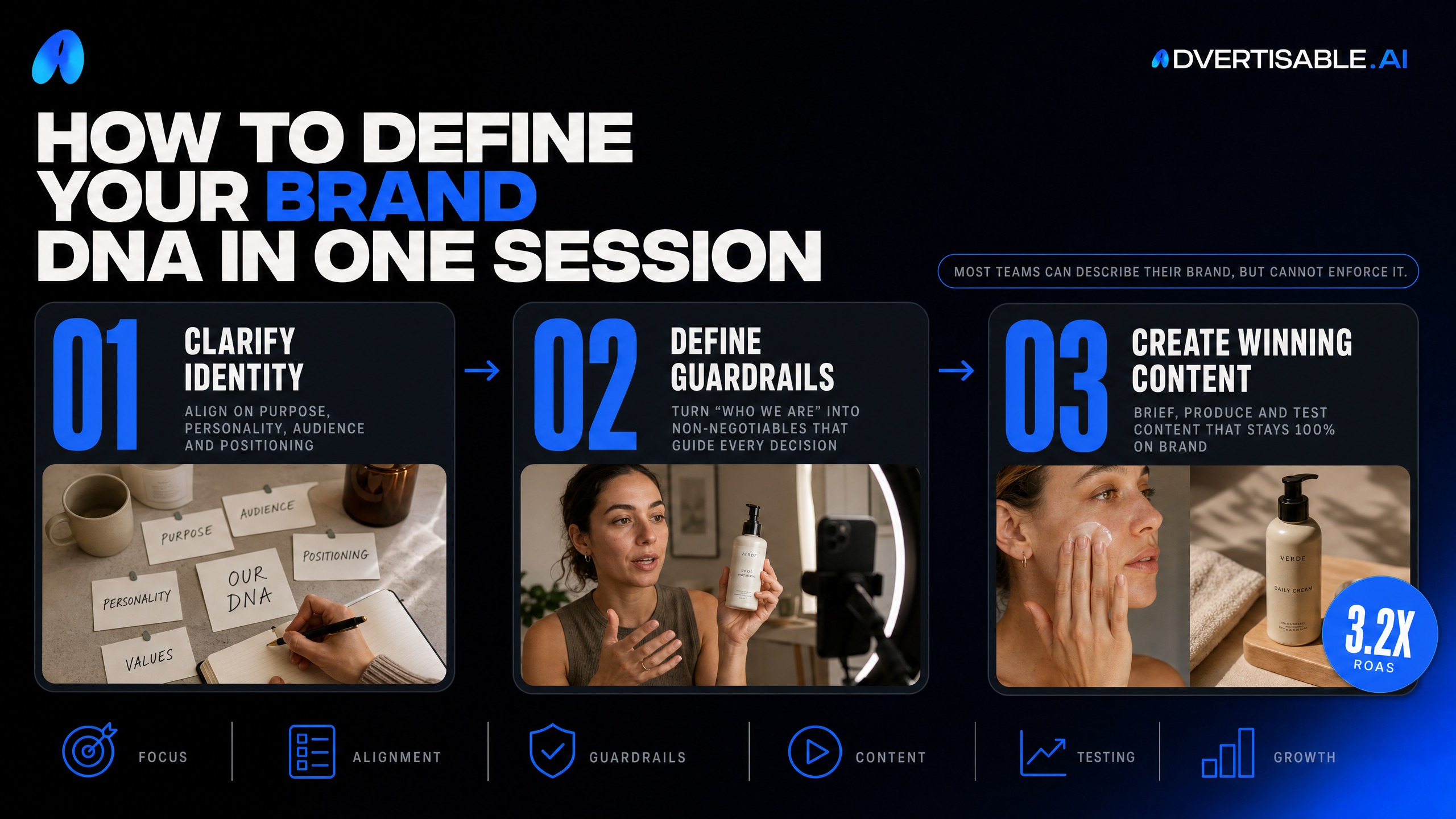
Most teams can describe their brand, but they cannot enforce it when the work is getting made. In one focused session, your goal is to turn “who we are” into a small set of non-negotiables that production cannot accidentally violate.
Write the “can never change” list
Your Brand DNA starts with what is not up for debate. This list is the part that stays constant even when campaigns, offers, and platforms change.
Keep it brutally small. You are not writing a manifesto. You are choosing the few elements that, when they drift, your output stops looking and feeling like it came from you.
In performance creative, this is also where you protect against visual failures that kill trust fast, like color shift, logo warping, or geometry drift in product shots. Your “never change” list is the baseline your QA uses before you spend time iterating variants.
- Visual constants: primary brand colors (with approved ranges), logo usage rules, product appearance rules (shape, proportions, key details that cannot change)
- Voice constants: your allowed tone (for example, direct and performance-first), your banned claims, and words you do not use
- Proof constants: the types of visual proof layers you always include early (product in-frame fast, clear use context, legible on-screen text style)
- Quality thresholds: what “production-ready ad” means for you (resolution, readability, clean compositing, no distortions)
If you cannot point to a concrete violation, it does not belong on this list.
Turn opinions into hard constraints
Adjectives do not scale. “Modern,” “premium,” or “bold” will get interpreted 10 different ways across a team and 100 different ways across AI-generated variations.
Convert every opinion into an observable rule you can approve or reject in seconds. The test is simple: could two reviewers independently make the same call without a meeting?
Use a quick translation pass in the same session: write the vibe, then force a constraint underneath it. The goal is a constraint you can check before the work ships, and fix in isolation if it misses, instead of reworking everything.
- Opinion: “Our product should look premium.” Constraint: “Use controlled, soft lighting; no harsh shadows; no cluttered backgrounds; product occupies at least 35% of frame in the first scene.”
- Opinion: “We are direct.” Constraint: “Hooks are 7-12 words, no metaphors, no hype claims; lead with the product moment in the first 2 seconds.”
- Opinion: “On-brand color.” Constraint: “No hue shifts on the product; reject any scene where the product color differs from the site images.”
- Opinion: “Clean logo.” Constraint: “Logo must be undistorted, fully legible, and never placed over high-motion textures.”
Brand DNA at scale needs creation-time enforcement
Drift is inevitable at volume
Once you produce creative at scale, brand drift is not a “maybe”, it is the default outcome. The only question is whether you catch it early or ship it and pay for it later.
In performance teams pushing dozens of variants, small interpretation gaps compound fast. One person reads “premium” and tightens lighting and pacing. Another reads “premium” and changes color treatment.
A third changes framing and the product stops looking like the product. Now you have inconsistency across the very assets you are trying to compare in-market.
What makes drift worse is process pressure. research on creative scaling highlights a reality most teams recognize: guidelines exist, but reviews get compressed, final checks happen after production is effectively committed, and “good enough” wins because nobody has time left to unwind decisions.
- Visual drift: color shift, geometry drift, and logo warping across variants
- Message drift: hooks and claims that sound like different brands depending on who wrote the prompt
- Channel drift: Meta, TikTok, and YouTube versions that no longer feel like the same campaign because each export path gets handled differently
Enforcement must happen at creation
If you only “police” brand DNA after assets exist, you are treating the symptom, not the cause. Enforcement has to be creation-time, where the system can prevent off-brand outputs before you spend budget, time, and review cycles.
Creation-time enforcement means turning your brand DNA from adjectives into constraints. In practice, that is where guardrails can block known failure modes like color shift, geometry drift, and logo warping while you are generating, not after the creative is already rendered and routed for approvals.
This is exactly why we built Advertisable AI around Brand DNA guardrails and a storyboard-first review checkpoint. You approve what “right” looks like at the scene level, then use scene-level regen to fix only the scenes that miss requirements instead of rebuilding an entire production-ready ad.
- Require storyboard approval before rendering any final output
- Lock product and brand constraints so every variation inherits the same non-negotiables
- Regenerate only the first two seconds or a single scene when it misses the bar, instead of restarting the whole asset
Lock your Brand DNA where creative actually gets made
If your brand DNA only lives in a PDF, your ads will keep drifting at the exact moment it matters: creation-time. You do not need more adjectives. You need non-negotiable constraints that prevent color shift, geometry drift, and logo warping across every variant you ship.
That is exactly how we built Advertisable AI. You start from a product URL, generate a Brand DNA Profile, and put Brand DNA guardrails in place before you render anything. Then you use storyboard-first review in the Storyboard Editor, and fix what is off with scene-level regeneration instead of rebuilding the whole ad.
Run the $5 trial, generate your first on-brand ads from a product link, and export production-ready variants for Meta, TikTok, and YouTube.
Frequently Asked Questions
Q: Is brand DNA the same as brand guidelines?
A: No. Brand guidelines are reference documentation: a comprehensive description of your logo, typography, colors, and do's and don'ts that someone consults when they need to check what "correct" looks like. Brand DNA is the smaller, enforceable core underneath that, the handful of non-negotiables that cannot be violated at the moment something gets made. Guidelines are broad and passive; brand DNA is minimal and operational. The quickest test: if your team can't give a yes-or-no answer in seconds, you're looking at guidelines, not DNA.
Q: What should brand DNA include?
A: Only the elements that, when they drift, stop your output from feeling like you, written as rules rather than adjectives. In practice that's four things: verbal identity (claim boundaries, vocabulary, tone), visual identity (color, logo, and product-depiction rules with real tolerances), positioning (who you're for and the one problem you lead with), and personality (how assertive you're allowed to be, how you handle skepticism). Keep it brutally small. If you can't point to a concrete violation a rule would catch, it doesn't belong in your brand DNA.
Q: How do you keep brand DNA consistent at scale?
A: Enforce it at creation, not after. Consistency breaks when DNA lives in a doc people forget under deadline and everyone reads "premium" differently. Convert adjectives into pass-or-fail constraints, then build them into the workflow where assets get made. At volume, manual review can't keep up, which is why creation-time enforcement (what tools like Advertisable AI are built for) is the only thing that holds.