AI Advertising Agencies: Scale Without Losing Judgment
If AI can generate ads on demand, why would a brand keep paying your agency? Every agency operator has felt that question land in the last year, and the honest answer is the reframe this whole page is built on: AI removes the production bottleneck, not the need for judgment. The agencies losing ground aren't the ones adopting AI, they're the ones still trading headcount for output while competitors ship more tested creative at better margins. Production is becoming a commodity. Strategy, taste, and client trust are not.
Here is how the agency model actually changes when production stops being your constraint:
- Your economics shift: output scales faster than labor, and margin improves, as long as you control revision churn and approvals.
- The work that stays human, the strategy, creative direction, media judgment, and accountability, becomes the thing clients actually pay for.
- Your day-to-day moves from making assets to running variation packs, cleaner tests, and faster cadence across every client.
- Multi-client consistency stops being a memory exercise and becomes something the system enforces.
We built Advertisable AI for the production layer of exactly this model. It turns a product link or prompt into production-ready video and image ads, with Brand DNA to keep each client brand-locked and a Storyboard Editor for scene-by-scene control across UGC-style ads, B-roll, statics, and animation, so your operators ship without waiting on edit queues and your team stays on the judgment work.
First, the shift underneath all of this: why AI advertising agencies are moving from production to judgment, and what that changes about what clients will pay for.
AI advertising agencies are shifting from production to judgment
The fear is real: if AI can generate ads on demand, why would a brand keep an agency? In practice, AI removes the production bottleneck, not the need for judgment. That shift is already changing what clients expect you to deliver, and what they will pay for.
What an AI advertising agency is now
An AI advertising agency is no longer defined by having “AI tools” in the stack. It is defined by how you use automation to increase creative volume while keeping decision quality, brand consistency, and performance accountability intact.
In a modern model, AI handles the repeatable execution layer: generating ad variations, reformatting for placements, and turning briefs into production-ready assets fast. Your team stays responsible for the parts that do not scale automatically: what to test, what to ship, what to cut, and what is on-brand and compliant.
The easiest way to see the difference is to look at what stays human in your own shop. If you cannot clearly describe your review gates and how you prevent off-brand outputs across dozens of variations, you are selling production dressed up as strategy.
- Automation is used to create many controlled variations, not one “finished” asset
- Brand rules are enforced so outputs stay consistent as volume increases
- Humans own the testing plan, prioritization, and final sign-off
Production gets fast, expectations rise
When production time collapses from weeks to hours, the client’s definition of “responsive” changes. You are no longer compared to other agencies. You are compared to software speed, and that raises the bar on iteration cadence.
This creates a new pressure point: approvals and decision-making become the constraint. That is why a Gartner survey notes that client approvals have become the new bottleneck as AI collapses production time but does nothing to collapse approval time.
Practically, you will be expected to deliver more options, tighter turnarounds, and cleaner experiments, because the cost of creating an extra variant is no longer a meaningful excuse.
- More concepts per week, not per month
- More revisions per round, with less tolerance for drift
- More structured testing, because “we tried a few ads” is not defensible anymore
Value concentrates in strategy and trust
As execution becomes abundant, value concentrates in the decisions that prevent wasted spend and brand damage. You win by being the partner who can be trusted to steer the system, not just operate it.
That trust is built through clarity: a test plan with clean reads, rules for what claims and visuals are allowed, and a consistent standard for what “ready to launch” means. When you can show how you make calls under uncertainty, clients stop shopping purely on output volume.
The agencies that scale without losing judgment are the ones that treat AI as a throughput multiplier, then professionalize the human layer: strategy, quality control, and accountability.
- Strategy: deciding the variation matrix and what to learn from each test
- Governance: brand-locked standards, compliance checks, and review gates
- Accountability: owning outcomes, not just delivering files
What AI changes in agency economics and margins
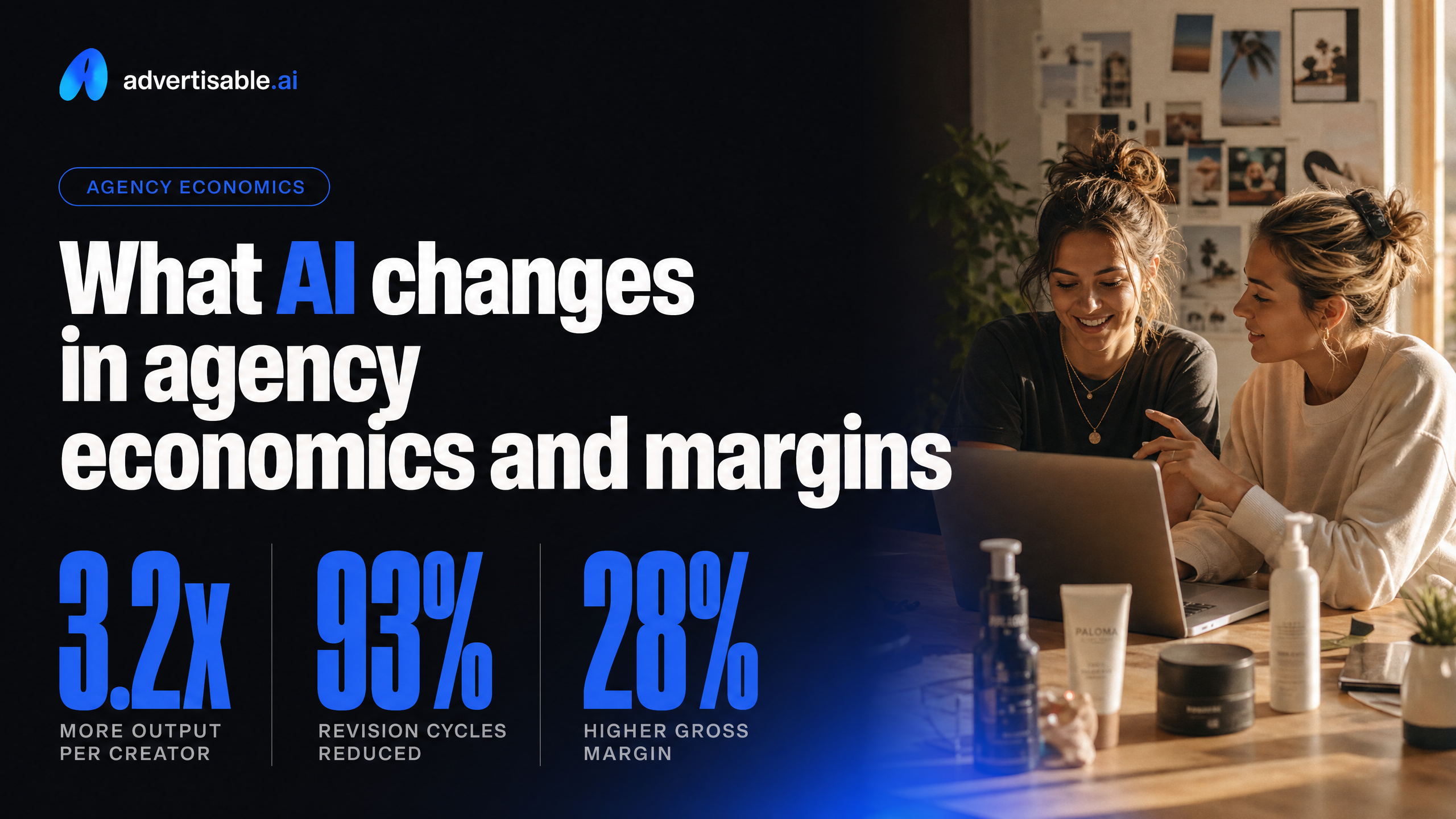
AI shifts your economics by removing the production bottleneck that used to force you to choose between hiring and saying no. Margins improve when output scales faster than labor, but only if you control revision churn and approvals.
The headcount-to-output ceiling breaks
In a traditional agency model, your output is capped by how many hands can physically produce assets. AI breaks that ceiling by turning more of the work into orchestration: prompts, guardrails, review, and performance learning.
Practically, you stop hiring to hit volume targets like “30 new assets per week per client.” Instead, you reuse the same strategic skeleton and generate a variation matrix quickly, then let media results decide what deserves deeper craft.
This only works if you lock brand consistency early. Without something like Brand DNA and scene-by-scene control, higher output just creates more off-brand review time, and you are back to trading headcount for throughput.
- Before: more clients or more variants meant more designers, editors, and producers
- After: more variants can mean more review and better testing cadence, not more production staff
- Your constraint moves from making assets to selecting, approving, and learning from them
Revision loops are the quiet margin killer
Most agencies do not lose margin on the first draft. They lose it on the fifth round of “tiny tweaks” that are not tiny when they stack across formats, placements, and stakeholders.
AI makes first drafts faster, but it can also increase stakeholder appetite for endless options. If you do not manage it, you create a new kind of scope creep: infinite variant requests with the same retainer.
You protect margin by tightening what constitutes a revision, and by making revisions cheap in the right way: regenerate only the scene that changed instead of rebuilding the whole asset.
- Separate “performance iterations” (new hooks, angles, offers) from “brand compliance fixes” (logos, colors, claims)
- Limit revision rounds per concept, but allow higher variant volume inside a defined testing grid
- Require clean reads: change one variable at a time so feedback is measurable, not subjective
Illustrative profit per client numbers
You do not need heroic pricing to improve profit per client. You need the cost to fulfill to fall faster than your deliverable volume rises, because labor is typically the largest line item and labor costs consume 50-70% of total revenue in industry benchmarking data.
Example A (traditional): $8,000/month retainer, $6,200/month fulfillment cost (producer, editor time, meetings, revisions) leaves $1,800 profit. If revisions spike, that profit can disappear without any visible “extra work” on the SOW.
Example B (AI-enabled): same $8,000/month retainer, fulfillment drops to $4,800 because production time compresses and revisions become scene-level regenerations. Profit becomes $3,200, and you can reinvest part of that into more testing volume without hiring.
- Traditional profit per client: $8,000 minus $6,200 equals $1,800
- AI-enabled profit per client: $8,000 minus $4,800 equals $3,200
What stays human and why clients still pay you
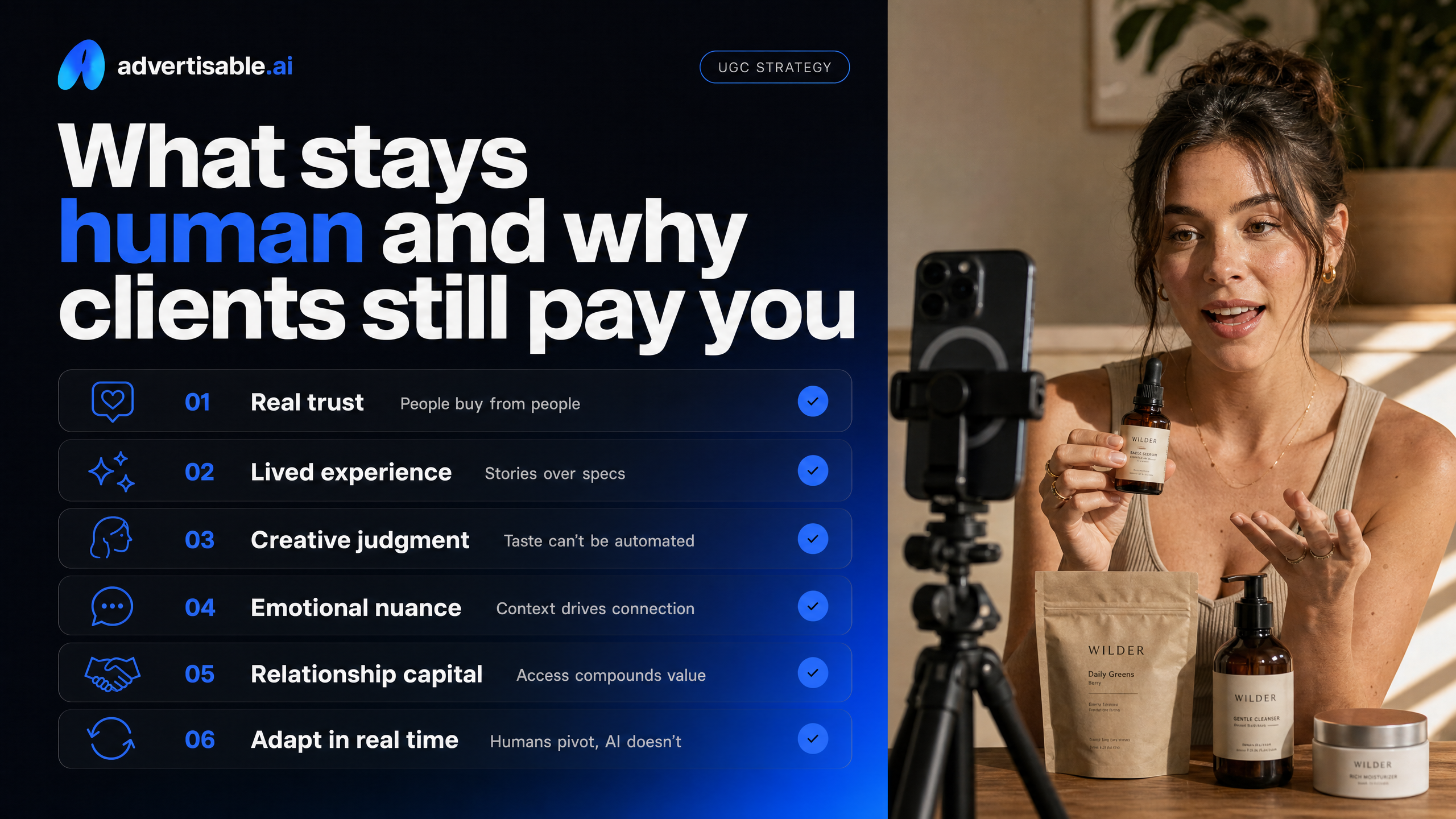
Strategy and positioning under constraints
Strategy stays human because it is the work of choosing what not to do when the constraints are real: budget, inventory, compliance, creative fatigue, and internal politics. AI can generate options, but it cannot own the trade-offs or the commercial risk.
Your value is clarifying the market story and then making it executable: who you are for, what you are uniquely credible at, and what angle you will prove in paid media first. In our experience, the fastest teams win by writing constraints into the brief (what claims you can and cannot make, what price points must work, what needs legal review) so every variation is on-mission instead of just different.
- Define the non-negotiables: claims, tone, visual rules, and what “success” means (CPA, MER, lead quality, or payback)
- Pick a single primary angle per test cycle (problem, outcome, mechanism, or objection) so your readouts stay clean
- Decide the testing scope upfront: which audiences, which placements, and what you will pause even if you “like” the creative
- Document what you will not compete on (price, feature parity, founder story) to prevent random creative drift
Creative direction and taste at scale
Creative direction is not production. It is taste, sequencing, and consistency, and clients pay for it because it keeps high volume from turning into brand chaos.
At scale, “taste” becomes a system: a repeatable way to evaluate hooks, pacing, proof, and casting choices across dozens of variants without diluting the brand. Tools can generate UGC-style ads, B-roll, statics, and animations quickly, but you still need a human to decide what feels on-brand, what is too risky, and what is worth iterating.
This is where brand-locked output matters. When we use Advertisable AI, we see teams move faster because Brand DNA and the Storyboard Editor reduce off-brand drift while giving you scene-by-scene control, so your creative lead spends time on decisions instead of rework.
Media buying judgment and client trust
Media buying judgment stays defensible because platforms optimize toward what you tell them to value, and clients hold you accountable for the outcome, not the automation. Nearly 60% of US ad buyers have used or plan to use AI-powered buying products according to an August 2024 EMARKETER survey, which means the tooling is widespread and the differentiator is oversight.
Trust is built in the calls you make when the dashboard is ambiguous: when to cut spend despite “good” CTR, when to protect a fragile CPA by narrowing tests, and when to scale a concept that is ugly but prints. Clients also pay for how you communicate risk: what you tested, what you learned, and what you will do next, without hiding behind platform recommendations.
The strongest operators separate automation from accountability. You let systems handle bids and delivery, while you own the test design, guardrails, and the narrative that keeps stakeholders confident.
How an AI-enabled agency runs day to day
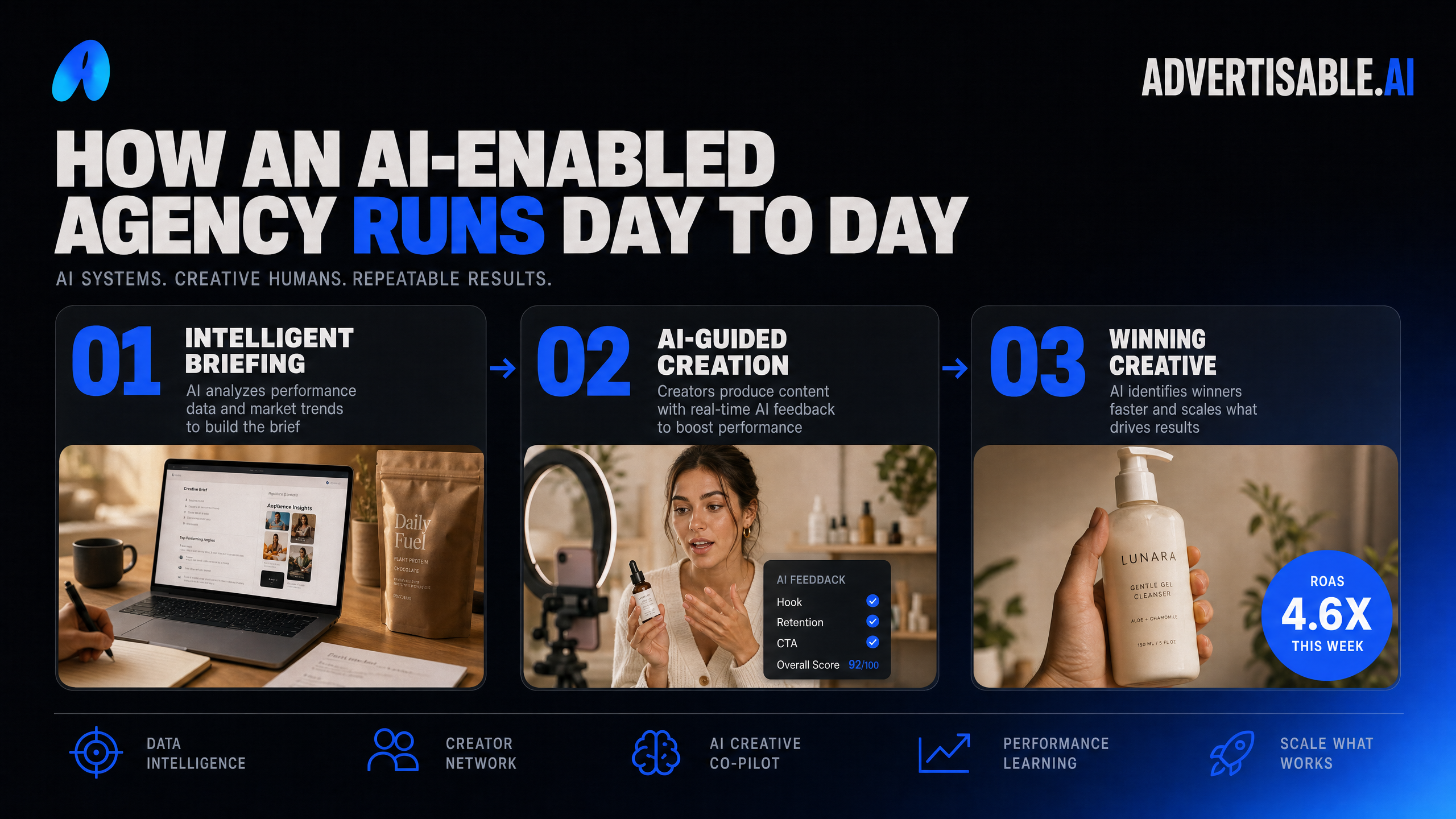
Variation packs are the default, not a bonus
In an AI-enabled agency, you do not buy “a video.” You buy a variation pack: a controlled set of versions built to test specific angles without reopening production every time.
The operational shift is simple. The team agrees on one base structure, then ships a planned variation matrix across hooks, formats, and cutdowns so your media buyer can launch parallel tests immediately.
What you should build is not more assets. Build a pack that is designed to isolate variables and is ready to upload to Meta, TikTok, and YouTube without extra formatting.
- One base concept with a fixed body (problem, proof, offer) and multiple hook options
- Multiple formats from the same creative intent (UGC-style ads, B-roll, statics, animation) so you can test placement-fit without rewriting the campaign
- Platform-ready aspect ratios (9:16, 1:1, 16:9) so distribution does not become the new bottleneck
Faster testing cadence, cleaner learnings
Speed matters, but the real win is cleaner learnings. When variations arrive together, you can run them in the same market conditions and stop confusing timing differences with creative performance.
We see agencies get better reads when they regenerate a single scene instead of rebuilding an entire ad. Hook testing is the obvious example: keep the body identical and swap only the hook, so performance differences map to one change.
AI collapses production time, but approvals can still slow you down. Your best safeguard is a pre-defined review workflow: what must be checked (claims, brand elements, CTAs) and what can be shipped within guardrails.
- Batch 5-10 hook variations in one push so tests run in parallel, not sequentially
- Use scene-by-scene control to change one variable at a time for clean reads
- Document “stop rules” (pause thresholds, time windows) so you do not keep spending on losers while waiting for the next build
Multi-client consistency and separation
The day-to-day reality of an agency is context switching across clients. An AI-enabled workflow only scales if every client stays brand-locked and separated, even when output volume spikes.
Operationally, that means each client has their own Brand DNA configuration: colors, fonts, logos, voice, and approved claims. Once locked, the system enforces it on every output so you are not relying on someone remembering guidelines at 11 p.m.
The question to answer for each client is how you prevent cross-contamination, not just how fast you generate. The difference between "more creative" and "more rework" is whether brand rules are enforced automatically per client and per asset.
- Dedicated Brand DNA per client, reused across campaigns instead of rebuilt per request
- Separate asset libraries and exports per account so files do not get mixed across brands
- Clear permissioning and review steps so only approved claim sets and creative directions ship
How advertisable.ai fits as your production layer
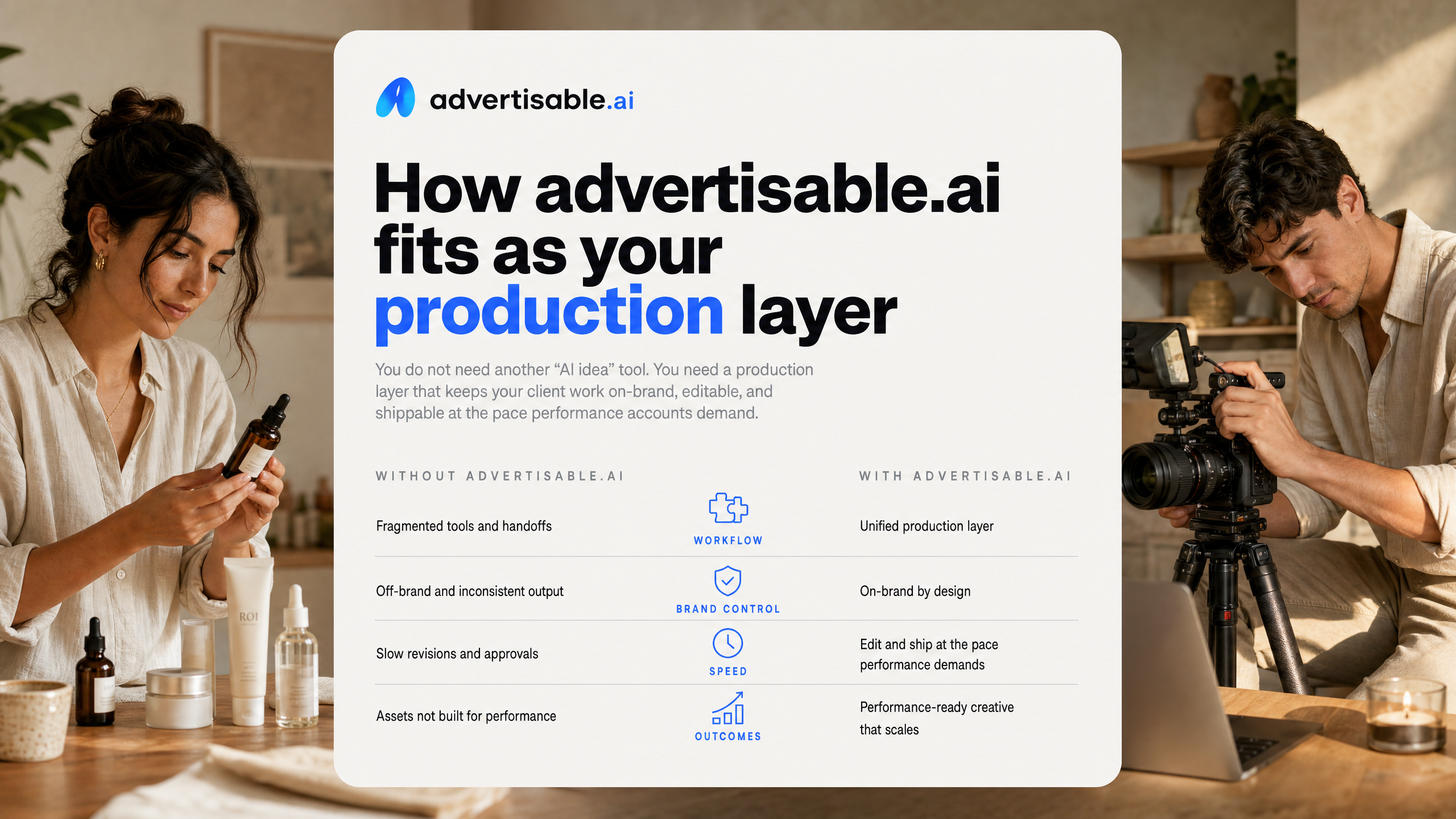
You do not need another “AI idea” tool. You need a production layer that keeps your client work on-brand, editable, and shippable at the pace performance accounts demand.
Per-client Brand DNA across accounts
The fastest way AI breaks an agency is brand drift: every new variation quietly changes tone, claims, and visual rules. Per-client Brand DNA is the guardrail that keeps outputs consistent while you scale volume across accounts.
In our workflow, you set Brand DNA once per client, then reuse it indefinitely. It locks the elements that should not change (colors, fonts, logos, voice, product specs, and approved claims) so every new asset starts “brand-correct” instead of needing a cleanup pass.
For agencies, the practical win is clean reads. When you test hooks or angles, you are not accidentally testing a new design system or a different claim, and you are not shipping revisions because an asset came out off-brief.
- Extract Brand DNA from a client product URL or website, then confirm the core assets (logo, color specs, fonts)
- Define product facts and allowable claims inside Brand DNA to reduce off-claim outputs
- Lock Brand DNA before you generate a variation pack, so your tests isolate the variable you intended
Scene control for rapid iteration
Iteration speed only matters if you can make targeted changes without rebuilding the whole ad. Scene-by-scene control lets you regenerate one scene, keep the rest constant, and ship the revision in minutes.
The Storyboard Editor maps the ad the way performance teams think: hook, problem, proof, offer. When the client says “the hook feels wrong” or the buyer says “keep the body, swap the opener,” you regenerate only that scene for a true A/B test instead of creating a new cut from scratch.
- Regenerate only the hook scene to run 5 to 10 hook tests against an identical body for clean reads
- Swap a single proof or product demo scene while keeping pacing, voice, and structure intact
- Use frame-by-frame regeneration for revisions when you need precision, not a brand-new concept
This is how you keep judgment and strategy human, while production work stops dictating your testing cadence.
Multi-format exports for every channel
Performance creative dies in the handoff when you have to rebuild the same idea for every placement. Multi-format exports keep one workflow, then render the assets you need for each channel and size.
With the Multi-Format Renderer in Advertisable AI, you can output UGC-style ads, B-roll, statics, and animations without switching tools or re-briefing. That matters when your media buyer wants a full rotation pack, not “one video and we will get to the rest later.”
- Aspect ratios: 9:16, 1:1, 16:9
- Platform-ready exports for Meta, TikTok, and YouTube
- One concept rendered across formats so your team can match creative to placement without re-production
Keep Your Judgment.
Bring Production In House.
If you are building an AI advertising agency model, your edge is not editing faster. It is shipping more tested angles while your strategy stays coherent and your client trust stays intact.
That is exactly where we fit. Advertisable AI is an AI Video Ad Generator built to remove the production bottleneck without turning your output into a roulette wheel. You lock each client into Brand DNA once, then use the Storyboard Editor for scene-by-scene control and frame-by-frame regeneration, so revisions and hook testing stay clean and brand-locked.
When you are ready to scale, the Multi-Format Renderer ships UGC-style ads, B-roll, statics, and animations in one workflow.
Start with the $5 trial. Generate 10 hook variations from a product link, export platform-ready cuts, and move your team back to judgment.
Frequently Asked Questions
Q: Can I keep each client's brand separate and enforced automatically?
A: Yes. You set up Brand DNA per client, and it enforces colors, fonts, logos, product specs, claims, and voice on every output. That means you can scale variation packs across accounts without accidental brand bleed or off-brand exports.
It is designed to keep your testing fast while your brand standards stay consistent.
Q: Does this replace my creative team?
A: No. It removes the production bottleneck that usually eats your team’s time, like repetitive versioning, revision loops, and formatting across placements. Your strategists, creative directors, and media buyers stay in control of the judgment calls that clients actually pay for.
You use the platform to turn their decisions into more production-ready ads, faster.
Q: How many variations can I produce per client?
A: Tens to hundreds, depending on your testing plan and credit usage. A common workflow is to generate 5 to 10 hook variations against one consistent body for clean reads, then expand winners into a broader variation matrix across formats. With scene regeneration, you can iterate on a single hook or proof point without rebuilding the entire ad each time.