AI Ads Without Losing Trust: A Quality-First Playbook
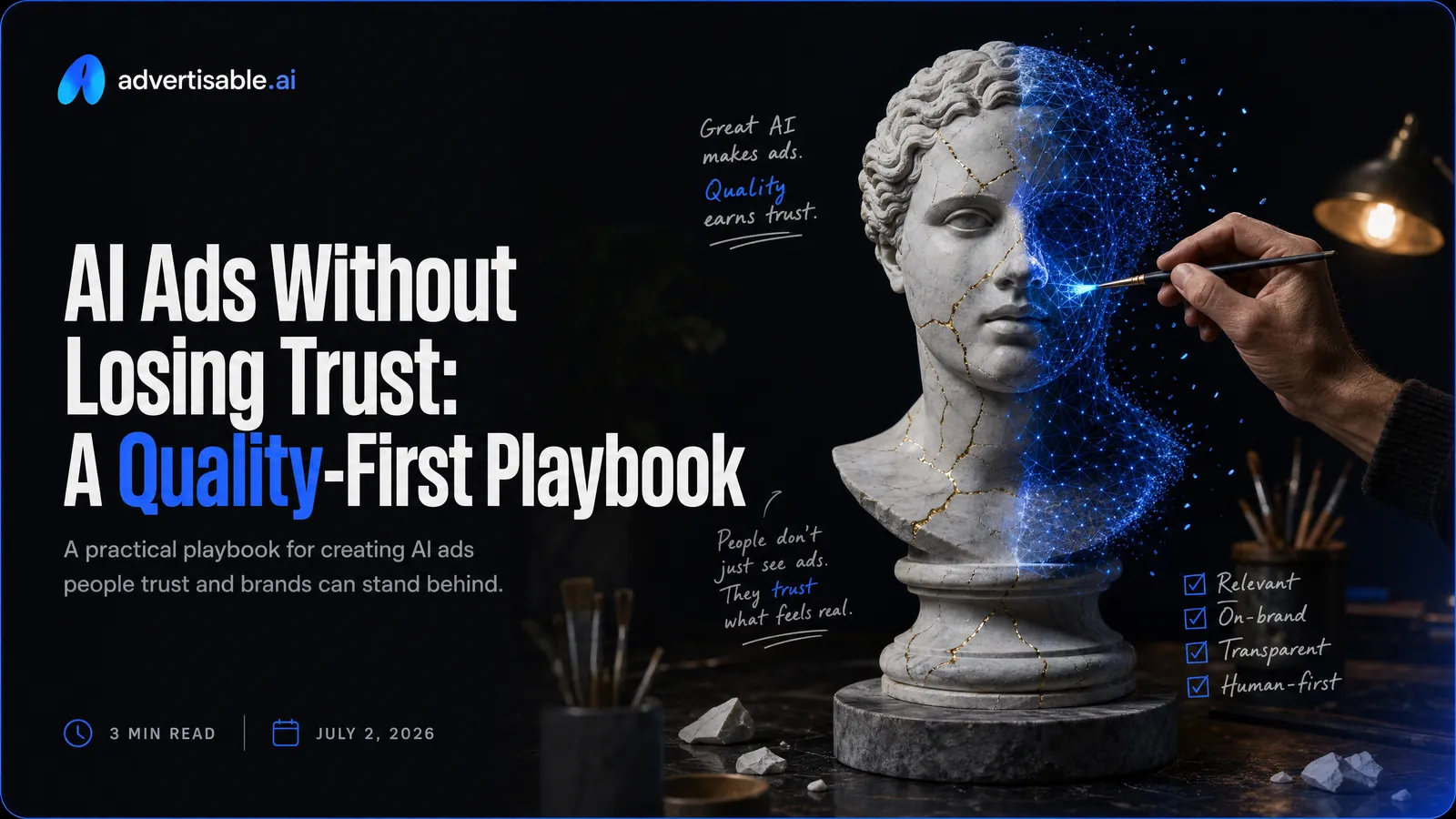
You can use AI-generated ads without hurting customer trust by keeping trust-sensitive elements brand-locked, human-reviewed, and claim-verified before anything ships. The risk is not “AI” itself.
Here’s what matters most right now:
- Trust drops when your ad feels evasive, not when your workflow uses AI.
- Sameness erodes belief over time, even if each individual ad looks polished.
- Unbackable claims create instant doubt, because one overreach makes buyers assume the rest is inflated.
- Vague benefits and fuzzy product details read like deception signals in-feed.
- Specificity wins: show the real product and the real context every time.
- Proof must be easy to verify, not hidden behind clever phrasing.
- Consistency builds recognition, and recognition is a trust shortcut at scale.
We built Advertisable AI for this exact problem: production-ready creatives with Brand DNA to keep outputs unmistakably yours, a Storyboard editor to review the story before rendering, and scene-by-scene control so you can regenerate what is wrong without rebuilding the entire asset. When you lock your brand rules and approved claims before you generate, AI becomes a quality lever instead of a risk multiplier.
The shift that makes everything else easier is simple: AI does not cost trust, bad AI does, and you can spot the difference by watching for the signals your ads are sending before anyone clicks.
The reframe: AI does not cost trust, bad AI does
You do not lose trust because an ad used AI. You lose trust when the output feels like it is dodging specifics, stretching claims, or hiding the real offer.
Trust breaks when ads feel evasive
Evasive ads trigger the same reaction whether they were made by a human team or an AI tool: “What are you not telling me?” That is the moment performance drops and comment sections heat up.
In our experience, evasiveness usually shows up as a missing who-what-where: no clear product view, no concrete promise, no real constraints. AI can make this worse because it is fast to generate endless variations that sound confident while saying very little.
- Vague benefits with no boundaries ("works for everyone", "best in the market")
- Proof-by-vibes: testimonials with no context, or “clinically proven” with no substantiating detail
- Polished visuals that avoid the product, the process, or the real terms of the offer
- Shifting language across variations, so the brand feels inconsistent week to week
Quality signals beat tool labels
Buyers rarely reward you for announcing the toolchain. They reward you for signals that the ad is truthful, grounded, and made with care.
That is why “AI-generated” versus “human-made” is the wrong axis. The real axis is verifiable versus fuzzy, and consistent versus drifting.
The principle is simple: verifiable claims are easier to trust than vague marketing language.
- Verifiable claims a buyer can check (exact features, ingredients, compatibility, timelines, terms)
- Proof that matches the claim (real product shots, real UI, real before-after with stated conditions)
- Consistency across creatives (same offer language, same constraints, same brand voice)
Your job is to stay specific
Your job is not to “make AI ads.” Your job is to ship ads that are unmistakably yours, with details that would be hard to fake.
Specificity is a discipline: decide what you can claim, what you cannot, and what must stay consistent across every iteration.
When you keep your inputs tight, AI becomes a multiplier for speed and testing. When you keep your inputs loose, AI multiplies ambiguity.
- Name the exact user and use case you are speaking to
- State one primary claim, plus the conditions where it holds true
- Show the product in the moment the claim matters
- Keep the offer terms identical across variations unless you are intentionally testing them
What actually erodes trust: three culprits that are not AI
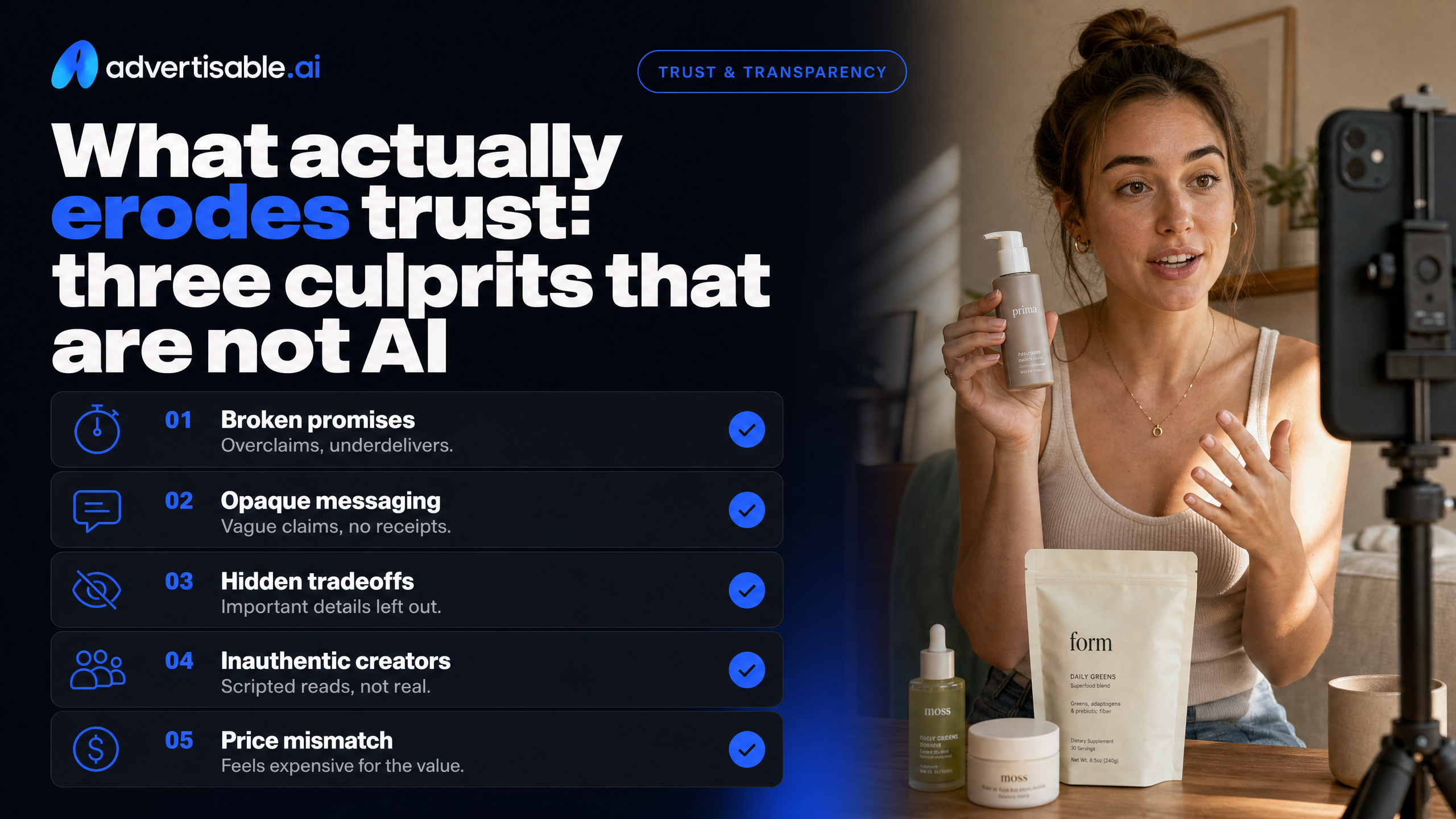
Sameness kills belief over time
The fastest way to lose trust is to look interchangeable. When your ads feel like they could belong to any brand in the category, people stop believing there is anything real behind them.
In performance accounts, sameness usually shows up as “template creative at scale”: the same hook structure, the same pacing, the same stock-feeling scenes, and the same copy patterns repeated across dozens of variants. You might get short-term volume, but the longer the audience sees it, the more it reads like mass production instead of a brand with a point of view.
Sameness is not an AI problem. It is a creative discipline problem, and it shows up whether you shoot everything in-house or generate it.
- Hooks that are structurally identical (just swapping a few words)
- Visuals that never show your actual product in use or in context
- UGC-style ads that all sound like the same script with a different face
- “Testing” that changes many variables at once, so everything converges into the same median ad
Unbackable claims create instant doubt
Trust breaks immediately when you make a claim a buyer cannot verify. The audience does not need to fact-check you line by line; they just need one overreach to assume the rest is inflated.
We see this most in categories where accuracy matters most: finance, health, and supplements. Iterative prompting can quietly introduce claim drift, where each "improvement" nudges the ad from a safe benefit into an unsupportable promise.
Your standard is simple: if you cannot substantiate it at the moment of dissemination, it does not belong in the creative.
- Absolute outcomes: “guaranteed results,” “works for everyone,” “instant cure”
- Unbounded speed claims: “in minutes,” “overnight,” “immediate” without proof
- Missing qualifiers: implying clinical-grade effects when you only have customer anecdotes
- Invented specificity: numbers, tests, or certifications you cannot produce on request
Vague ads trigger deception signals
Vagueness is not “safe.” It often reads as evasive, and evasive ads trigger the same skepticism people reserve for scams.
When you avoid specifics, your audience fills the gaps with worst-case assumptions: hidden fees, fine print, disappointing product reality, or a brand that will not stand behind what it is saying. Clear claims with clear boundaries outperform mystery language because they are checkable. A vague claim like "eco-friendly" tells a buyer almost nothing, while a specific one like "made with 75% recycled materials" gives them something concrete to evaluate - and specificity is what earns belief.
- Undefined benefits: “boost,” “optimize,” “supports” with no concrete meaning
- Unspecified proof: “clinically proven” without naming what was tested or where to verify
- Softened responsibility: “results may vary” used to excuse an aggressive headline
- Missing product reality: no price anchor, no what-you-get, no real use case shown
What builds trust in any ad: specificity, proof, consistency
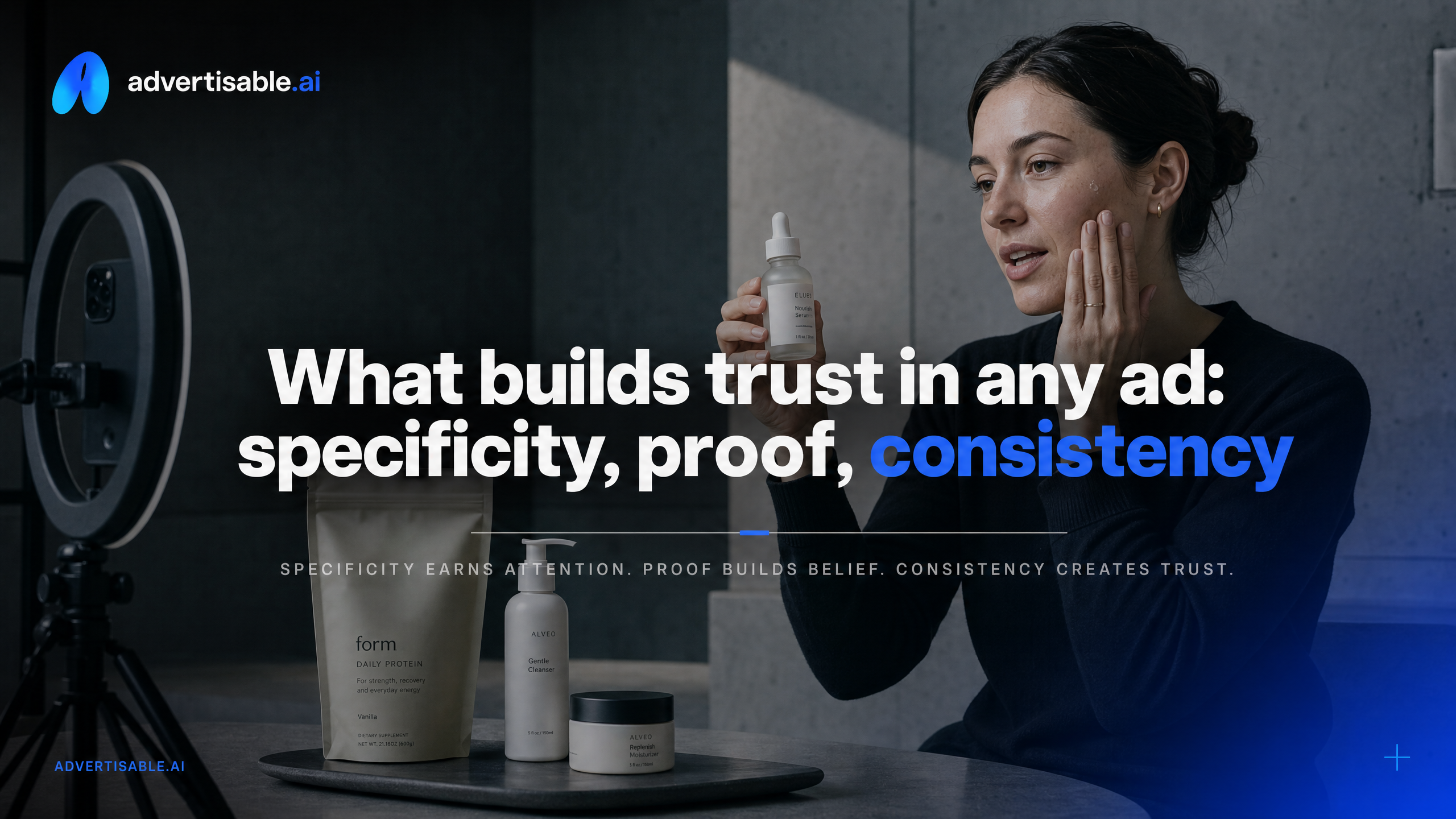
Trust is built the same way in every channel: you show you understand the buyer’s reality, you back your claims, and you show up the same way every time.
Specific context beats broad promises
Specifics outperform sweeping claims because they feel earned, not manufactured. “Works for everyone” reads like a template; “built for first-time moms who want a 10-minute setup” reads like you actually know who you’re serving.
In performance creative, context is the fastest shortcut to credibility: a real use case, a real constraint, and a clear point of view. That also keeps your AI-assisted variations from drifting into copy that could belong to any brand.
Make your specificity concrete in the ad itself:
- Name the buyer and moment: “post-workout,” “weeknight dinner,” “new apartment move-in”
- Name the constraint: time, space, skill level, budget ceiling, regulations, shipping cutoff
- Name the mechanism: what the product does that creates the outcome (not just the outcome)
- Name the boundary: who it is not for, or when it will not help
Proof must be easy to verify
Proof builds trust only when the buyer can check it without friction. If verification requires a call, a PDF request, or a vague “clinically proven” reference, it reads like you’re hiding the ball.
Use proof that is attached to the claim and visible where the claim appears: on-page specs, certifications, warranty terms, before-and-after methodology, or an on-screen demo of the result.
A quick standard we use: if a buyer cannot verify it in under two minutes, it is not proof, it is persuasion.
Consistency makes you recognisable
Consistency is how you earn familiarity at scale. When your visuals, voice, and claim style change every time, even strong ads feel like they came from different companies.
You want the audience to spot you before they read you. That means repeating a small set of recognisable inputs: the same vocabulary for benefits, the same visual system, and the same structure for how you introduce proof.
In our experience, this is where teams lose trust fastest when they produce high volumes: they generate endless variations, but they do not lock the parts that make the brand feel like itself.
Brand DNA locking is the simplest safeguard: it reduces off-brand drift so every new creative still feels like it came from the same source.
Where AI helps vs hurts trust: the same tool, opposite outcomes
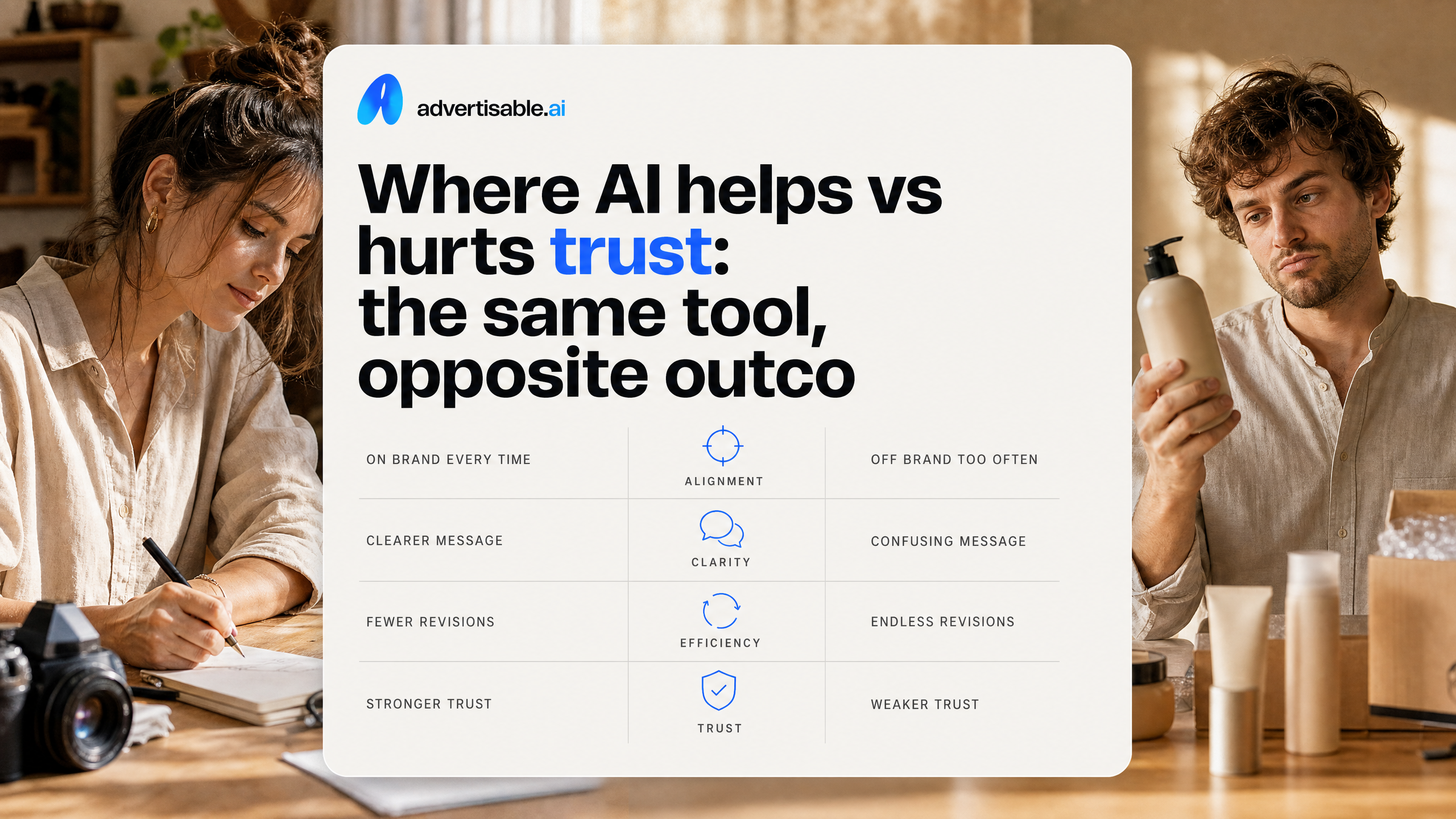
AI is neutral. Your workflow is not. The same model can either tighten your message and protect your brand, or produce a flood of near-misses that chip away at trust.
Cutting corners multiplies mistakes
AI hurts trust fastest when you use it to move faster than your ability to verify.
The failure mode is rarely one big, obvious lie. It is lots of small errors: the wrong product detail, an implied claim you cannot substantiate, a visual that does not match the SKU, a CTA that contradicts your offer terms. Each iteration compounds the last, because you are prompting on top of unapproved outputs.
Weak execution has a real cost: it increases the effort a viewer has to spend to understand the ad and pulls attention away from the message. In performance terms, that can look like more impressions with less belief.
- Generating first and approving later (claim drift accelerates during "one more tweak" cycles)
- Letting the model infer product facts instead of pulling them from your source of truth
- Testing dozens of variations that change multiple variables at once, so you cannot diagnose what broke trust
Raise quality by locking inputs
You get the trust upside when you lock what must not change, then let AI vary what can.
In practice, that means hard-coding your Brand DNA and approved claims before you generate anything, and using structured scenes instead of free-form prompting. When inputs are fixed, outputs become predictable, reviewable, and repeatable.
- Brand DNA lock: colors, fonts, logos, voice, product specs, and the exact list of approved claims
- Product URL import: pull real product details from the page instead of manual entry
- Storyboard editor: approve hook, proof, and offer structure before rendering
- Scene-by-scene regeneration: fix the one scene that drifted without re-rolling the whole ad
Use AI to free human review
The goal is not to remove humans. It is to move humans up the stack, from pixel-pushing to judgment calls.
When AI handles versioning and production, your reviewers can spend time where trust is actually won: validating claims, checking offer accuracy, and making sure the creative feels unmistakably like you.
- Reserve human time for claim substantiation checks and final brand fit, not rewriting captions for the tenth time
- Create a single approval gate before export so your team signs off once, not mid-iteration
- Regenerate only the hook or CTA when performance is soft, keeping the proven body and proof intact
How to use AI ads without losing trust: a practical workflow
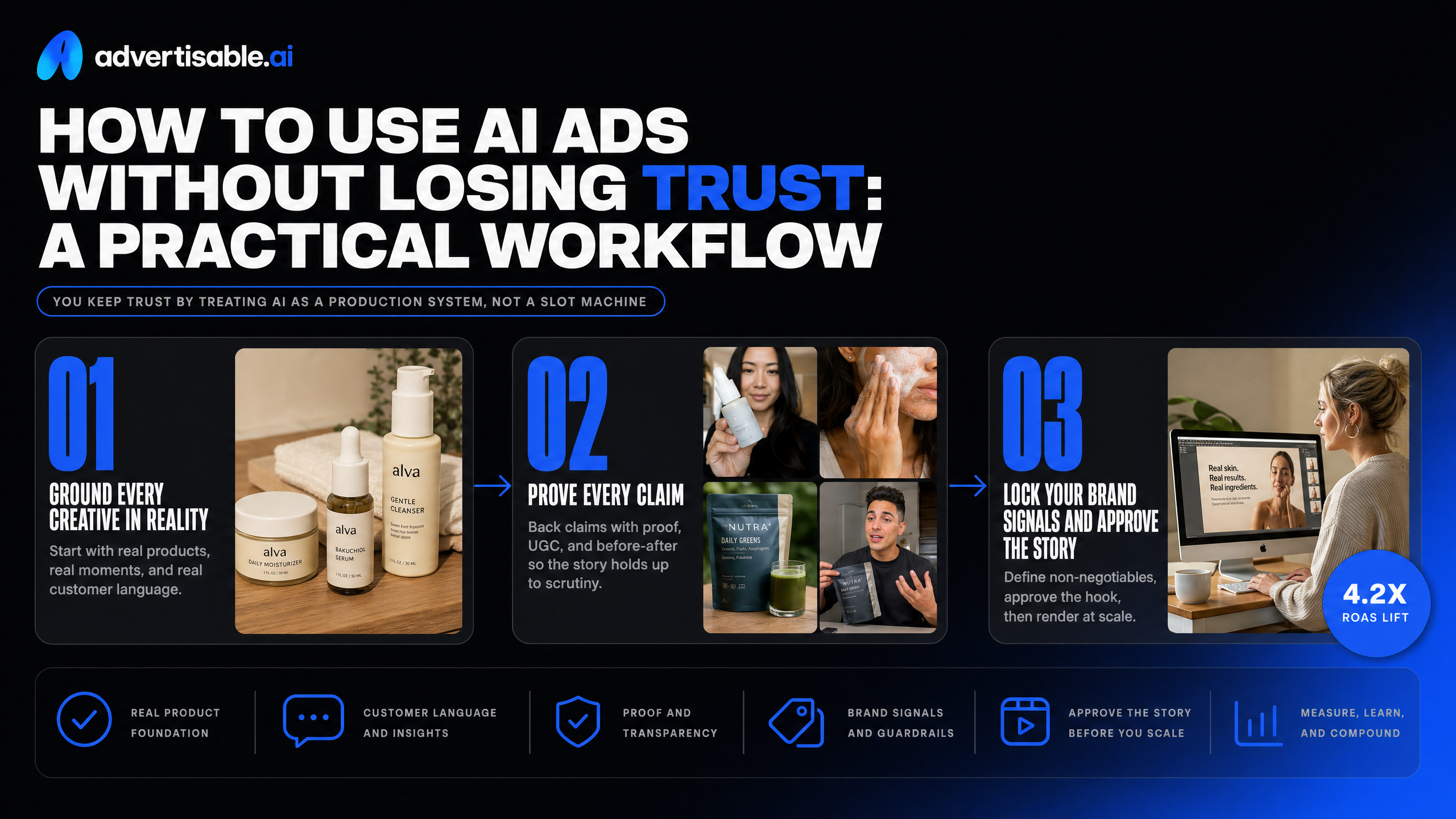
You keep trust by treating AI as a production system, not a slot machine. The workflow is simple: ground every creative in reality, prove every claim, lock your brand signals, then approve the story before you render.
Show the real product every time
Your fastest trust win is also the simplest: make the product unmistakable in the first seconds and throughout the ad. AI can help you produce more variations, but it cannot replace the credibility of real packaging, real UI, real textures, and real before-and-after context.
Operationally, treat your product as a required input, not an optional reference. Pull accurate details from your product page, and keep key frames anchored to what the customer will actually receive.
- Use your current packaging and labels, not a “close enough” interpretation
- Show the product in-hand or in-use, not floating beauty shots only
- Match the on-site product name, variant, and visuals exactly
- Keep the same hero angle across variations so you are testing messaging, not identity
Write only claims you can prove
Every AI-written benefit line is a claim you will need to back up until you can substantiate it. You do not earn trust by sounding confident; you earn it by making statements a buyer can check.
Build a short “approved claims” list and force every script to pull from it. This is how you prevent claim drift during iteration, where one prompt revision quietly escalates from a safe benefit to an unsupportable promise.
- Limit claims to what is supported by your product page, documentation, or third-party verification
- Avoid absolutes (best, guaranteed, cures) unless you can prove them at the moment the ad runs
- Separate what the product is from what it does (specs first, outcomes second)
- Require a substantiation note for each on-screen claim before export
Lock brand cues before scaling
Scaling is where trust breaks, because volume amplifies small inconsistencies. Lock your brand cues before you generate dozens of variations so every output stays unmistakably yours.
In our workflows, Brand DNA is the guardrail: colors, fonts, logos, voice, and approved claims are set once, then enforced across outputs so you can test hooks and angles without off-brand drift.
- Lock typography and color rules (including backgrounds and caption styling)
- Define voice constraints (what you say, and what you never say)
- Pin product facts and approved benefits so scripts cannot “improvise”
- Standardize recurring frames: opener, product proof moment, CTA end card
Review storyboards before rendering
Approve the story on paper before you spend time and credits rendering video. A storyboard review catches trust issues early: missing product shots, implied claims, or a narrative that feels evasive.
Use a simple pass-fail checklist at the scene level, then only regenerate the scenes that fail. With a Storyboard Editor and scene-by-scene control, you can fix the hook or the claim frame without rebuilding the entire ad.
- Hook: does it match what the product actually is and does?
- Product moment: is the real product clearly shown and correctly labeled?
- Proof: is the evidence explicit (demo, spec, policy, certification), not implied?
- CTA: does it align with the landing page offer and terms?
Point AI at trust with Advertisable AI: Brand DNA plus control
Trust stays intact when your creative system makes it hard to go off-brand, hard to ship a weak moment, and hard to let claims drift. That is the bar AI has to meet.
Brand DNA stops off-brand drift before it starts
Brand DNA prevents off-brand drift by locking the inputs AI should not improvise: your look, your voice, and the product facts you are willing to stand behind.
In practice, drift happens when you iterate fast and the tool starts “helping” with new phrasing, new visuals, or new claims that were never approved. Brand DNA flips that dynamic: you define the allowed palette, typography, logo usage, tone, and approved claims once, then generate against those rules so every output stays unmistakably yours.
Use product URL import to pull real product details directly from your site instead of retyping them across prompts. That single step removes a major source of accidental inconsistency.
- Lock visual rules: colors, fonts, logo placement, and layout conventions
- Lock messaging rules: voice, do-not-say lists, and only the claims you can substantiate
- Lock product truth: specs, benefits, and ingredients pulled from your product page, not memory
Frame-by-frame control fixes the one scene that is killing performance
Frame-by-frame control matters because most ads do not fail everywhere. They fail in one moment: the hook feels wrong, the product shot is unclear, or the CTA lands flat.
When you can regenerate a specific scene or element, you keep what is already working and change only what is not. That preserves continuity and saves time and credits versus full rerolls.
In our workflows, this usually shows up as tightening the first seconds, cleaning up a product moment, or swapping a closing line without touching the rest of the structure.
- Storyboard editor: adjust the hook, proof, offer, or CTA scene without rebuilding the full video
- Frame-by-frame control: regenerate only the weak scene while keeping the rest intact
- Frame-by-frame control: fix a specific visual element in a frame without resetting everything
Lock your claims before you scale
Off-brand and off-claim wording usually creeps in during revisions, not the first draft. Every new prompt is another chance for an unapproved line to slip in.
The fix is to approve your claims and brand rules up front, then only iterate inside those boundaries. Approve the storyboard and the claim set first, then let variation happen within what you have already signed off on.
- Lock Brand DNA and approved claims before generation
- Approve the storyboard before rendering begins
- Keep revisions inside the approved claim set
Get AI speed without the trust penalty
If your AI ads are starting to feel samey, overconfident, or vaguely evasive, the fix is not less AI. It is tighter inputs, clearer proof, and stronger control before anything ships.
That is exactly how we built Advertisable AI. You start from a product link, lock your Brand DNA so every output stays unmistakably you, then use the Storyboard editor and Frame-by-frame control to review the trust-sensitive parts before render. When one scene underperforms, you regenerate that scene instead of rebuilding the entire ad.
Run the $5 3-day trial and generate ten brand-locked variations.
Frequently Asked Questions
Q: Do people trust AI ads?
A: People do not react to the tool as much as they react to the signals in the ad. If your creative feels mass-produced, makes claims you cannot support, or looks like it is hiding the truth, trust drops fast. When your ad is specific, provable, and consistent, AI-assisted production can still earn belief.
Q: Can AI be 100% trusted?
A: No, not without a system around it. You treat AI output like a draft, then you verify product facts and claims, and you keep brand cues locked so the creative cannot drift. Trust comes from your process, not the model.
Q: How do you stop AI ads from drifting off-brand or off-claim?
A: Drift happens when iterative prompting slowly introduces new phrasing or claims you never approved. You prevent it by locking Brand DNA with your approved claims and product specs, and approving the storyboard before rendering, so variation stays inside boundaries you already set.
Q: What's the advantage of scene-by-scene regeneration vs. regenerating the whole ad?
A: Scene-by-scene control lets you fix the one part that is hurting performance, like the hook, proof moment, or CTA, without resetting everything else that is working. That saves credits and keeps your structure consistent, which makes testing cleaner and faster.