AI ad slop: Why AI ads look the same and how to stand out
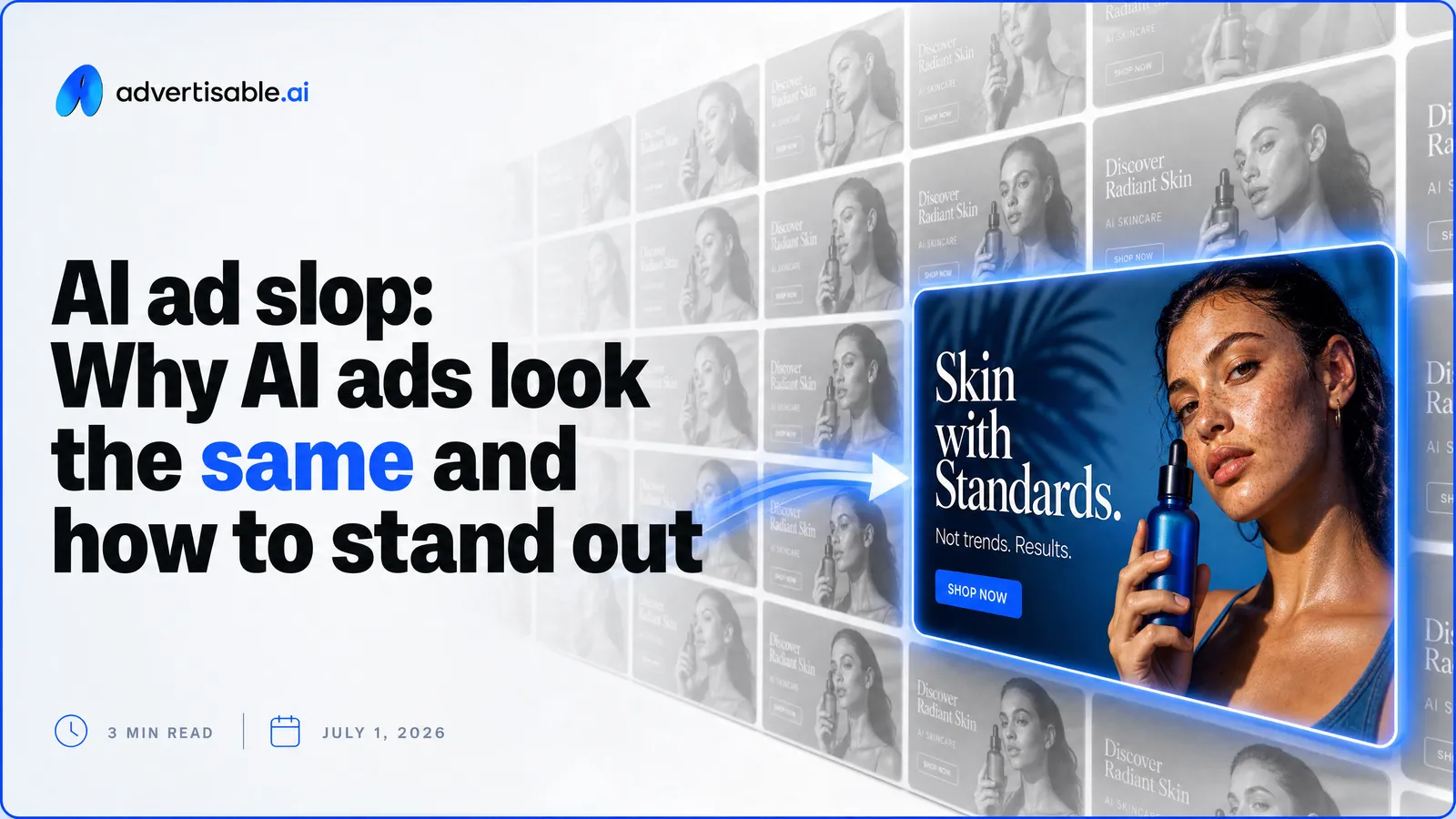
AI ad slop is what your team calls it when AI-generated ad creative starts blending together: the same hooks, the same pacing, the same templated visuals, and the same “made by a tool” feel.
Here’s what matters most right now:
- “AI ad slop” is sameness at scale, not simply “AI used in ads.”
- Shared models and defaults push everyone toward the same structures and visuals.
- Volume is no longer scarce, so more variations often add noise, not lift.
- Distinctive ads anchor to your real brand voice, proof, and product truth.
- Guardrails beat one-shot outputs when you care about QA time and consistency.
- Fixing one scene instead of rebuilding the whole ad saves time and keeps quality up.
We built Advertisable AI for this exact problem: you can generate production-ready statics and video ads while keeping control. Brand DNA keeps on-brand drift from creeping in, and Frame-by-frame control lets you adjust specific scenes instead of rebuilding the whole ad.
Before you can fix sameness, you need a clear definition of what “AI ad slop” actually looks like in the wild and why it is suddenly everywhere across paid social.
AI Ad Slop: What It Means and Why It's Everywhere
A Plain Definition You Can Use Internally
AI ad slop is the label teams use for AI-generated ad creatives that feel interchangeable: same hooks, same pacing, same visual language, and the same “a tool made this” fingerprint.
It is not “AI in ads” broadly. It is a specific failure mode of creative automation where defaults and templates take over, so the ad stops feeling like it came from a real brand with a real point of view.
Snippet you can drop into a brief: AI ad slop is high-volume AI creative that blends into the feed because it follows the same patterns and assets everyone else is using.
Why Sameness Floods Feeds Now
Sameness is flooding feeds because the constraints and incentives are aligned. Most teams are optimizing for speed, “good enough,” and fast iteration, and the tools are designed to deliver exactly that.
When you generate from a prompt or a product link without tight brand-consistency guardrails, the model reaches for the most statistically common ad shapes. You see the same direct-response openers, the same UGC-style framing cues, the same stock-like product beauty shots, and the same cadence built for short-form placements.
From a performance angle, this happens fast: once a few templates win cheaply, they get copied, remixed, and regenerated until the feed becomes a hall of mirrors.
Instant Scale, Identical Outputs
AI made scaling output trivial, but it also made duplication trivial. When every marketer can ship 50 variations before lunch, volume stops being a differentiator and starts being a distribution of near-identical ads.
The biggest driver is shared inputs: same models, similar prompts, the same creator-style conventions, and minimal scene-level control. Without deliberate constraints, variation engines often produce surface-level changes (new wording, new background, new angle) while keeping the underlying structure identical.
You feel it in your QA time: you are producing more files, but fewer truly distinct, on-brand ads that you would confidently spend behind.
- Instant generation reduces the cost of making “another version,” so teams rely on quantity instead of creative decisions.
- Default templates push everyone toward the same attention patterns (hook, problem, payoff) and the same visual grammar.
- Lack of brand guardrails creates on-brand drift across variations and scene drift inside videos, even when the prompt sounds specific.
How AI Tools Created Sameness at Scale
Shared Models, Shared Defaults
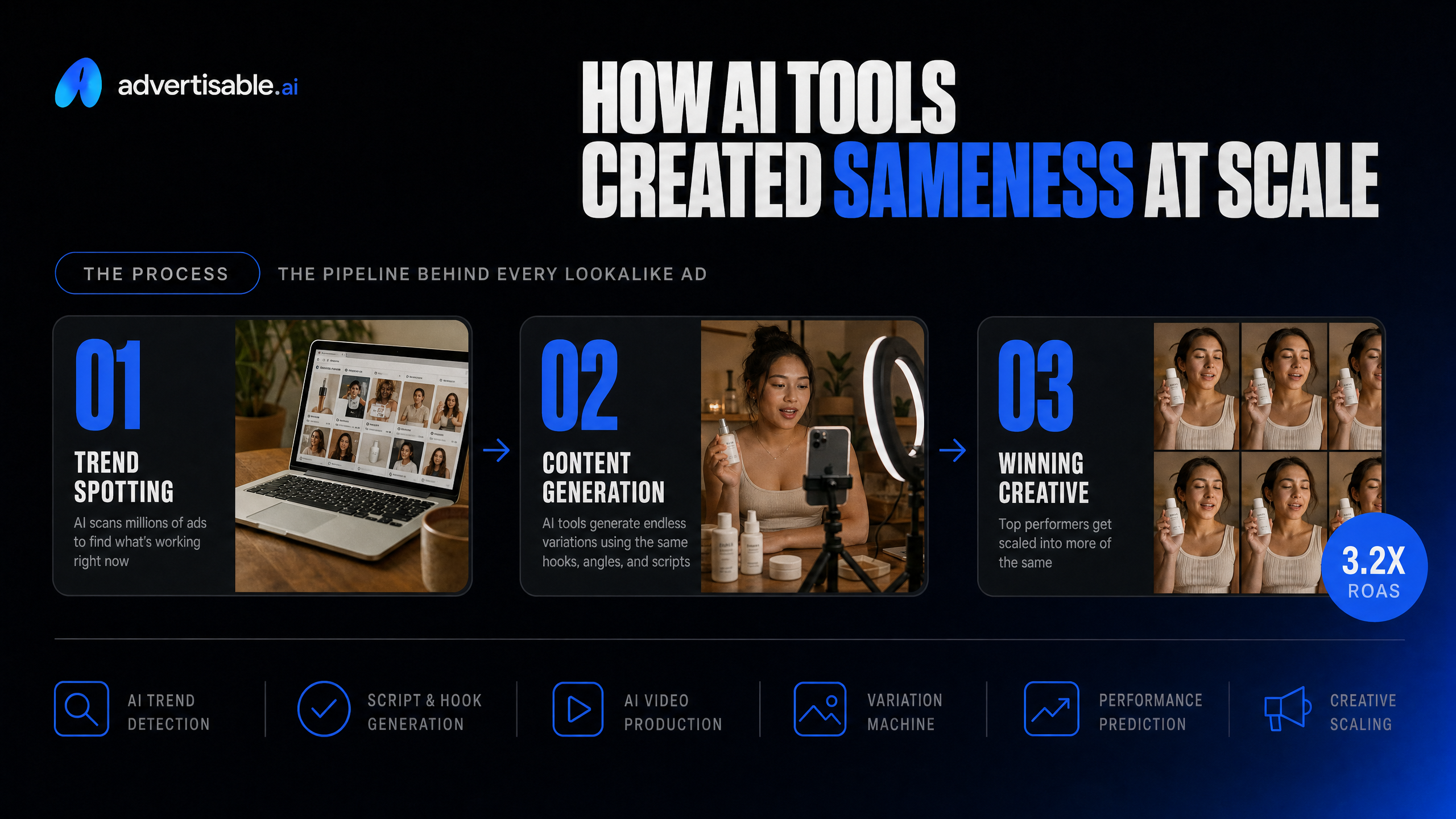
Most lookalike ads are not a mystery. You are seeing the fingerprints of the same underlying models, trained on similar data, shipped with the same creative presets and templates.
When large numbers of teams start from identical starting points, their outputs converge. The model steers you toward familiar structures because they are statistically safe, and the UI steers you toward defaults because they remove decisions.
In practice, sameness shows up as the same opening hook shape, the same pacing, the same caption styling, the same product framing, and the same “template logic” even when the brand is different.
- Default script structures that push identical beat patterns (problem, promise, proof, CTA)
- Preselected fonts, transitions, and motion styles that create the same visual cadence
- Shared “winning” prompt patterns copied across teams, agencies, and creators
- Auto-generated brand language that averages your tone into something safer and less specific
The ‘Good Enough Fast’ Output Problem
Speed is the feature, but “good enough fast” is the failure mode. When you optimize for output volume, you train your workflow to accept the first pass that clears a quick internal check, not the version that earns attention in-feed.
That is how you end up with ads that look polished yet feel interchangeable: the tool produces competent structure, but it does not carry your brand’s specific proof, constraints, or point of view unless you force it to.
The operational giveaway is QA time. Teams move from “review for brand and accuracy” to “scan for obvious issues,” and the work shifts from craft to triage.
- The first draft becomes the shipped draft, so weak claims, vague benefits, and fuzzy product detail survive
- Variation engines multiply the same core concept, so you get 30 versions of one idea instead of 6 distinct angles
- Without guardrails, on-brand drift increases as you generate across more offers, formats, and geos
If QA and revisions expand, the speed advantage disappears even though generation is instant.
The Stock Visuals Trap
Stock-like visuals are the fastest way to signal “made by a tool,” because the same asset libraries and synthetic scenes get reused across categories. Even when the creative is technically clean, the viewer reads it as familiar and scrolls.
This happens when the model fills gaps with universally plausible imagery: abstract gradients, interchangeable lifestyle shots, over-smoothed products, and settings that feel “close enough” but not true to your real world.
The fix is not "avoid AI," it is "stop letting AI invent your reality." Anchor the ad to real product truth and brand-specific assets, then use AI to scale within those constraints. That is why we built Advertisable AI around Brand DNA and Frame-by-frame control instead of one-shot generation.
Why Volume Alone No Longer Wins
Volume Is No Longer Rare
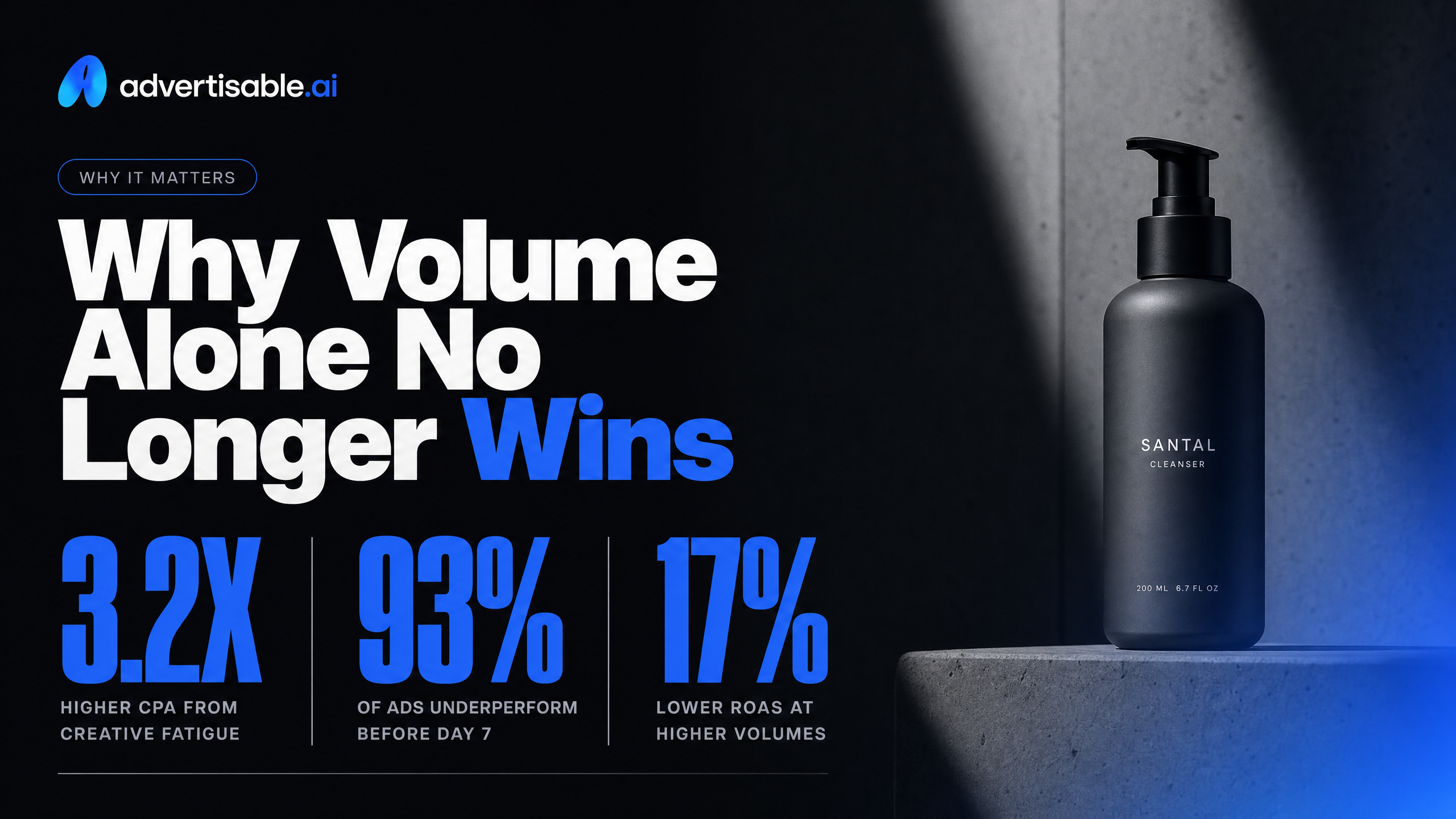
Publishing 50 variations used to signal a serious creative operation. Now it is table stakes, because AI made output fast and inexpensive for everyone.
The result is simple: your competitor can match your volume in a day, even with a smaller team. When supply explodes, the marginal value of the next ad drops, and your feed presence stops being a differentiator.
We see this show up in performance as well: teams push more assets, but ROAS still slides because the audience is not running out of ads to watch. They are running out of reasons to pay attention.
- The cost to generate variations collapsed, so volume stopped being a moat
- Platforms are saturated with similar structures: the same hooks, pacing, and templated visual language
- More output increases review and QA time, which quietly raises your true production cost
Noise Versus Distinctiveness
Volume without control mostly creates noise. You get dozens of ads that look plausibly fine, but they blend together and compete with each other for attention.
Distinctiveness is what cuts through: creative that is unmistakably yours at a glance and consistent across variations. That does not mean “more creative.” It means more anchored to your brand so the variation engine is exploring angles, not reinventing your identity.
- Noise looks like endless “new” versions that share the same structure and only swap surface details
- Distinctiveness looks like consistent brand assets, a clear point of view, and proof that feels specific to your product
- Noise increases on-brand drift as you scale, distinctiveness reduces it with brand-consistency guardrails
What Audiences Now Notice
Audiences have adapted. They scroll past anything that feels like it came from a default template, and they pause when something signals real intent and specificity.
In practice, they notice three things first: whether the product is shown clearly, whether the message sounds like your brand (not a model), and whether there is believable proof instead of abstract claims. This is why creative is the lever that increasingly decides performance - when targeting is automated, the ad itself is what audiences respond to or ignore.
That is why “more ads” can hurt you: you train the audience to recognize a pattern and ignore it, and you spend budget learning the same lesson repeatedly.
- Clear product visibility and believable demonstration
- A brand voice and visual system that stays consistent across placements
- Specific proof points that feel earned, not invented
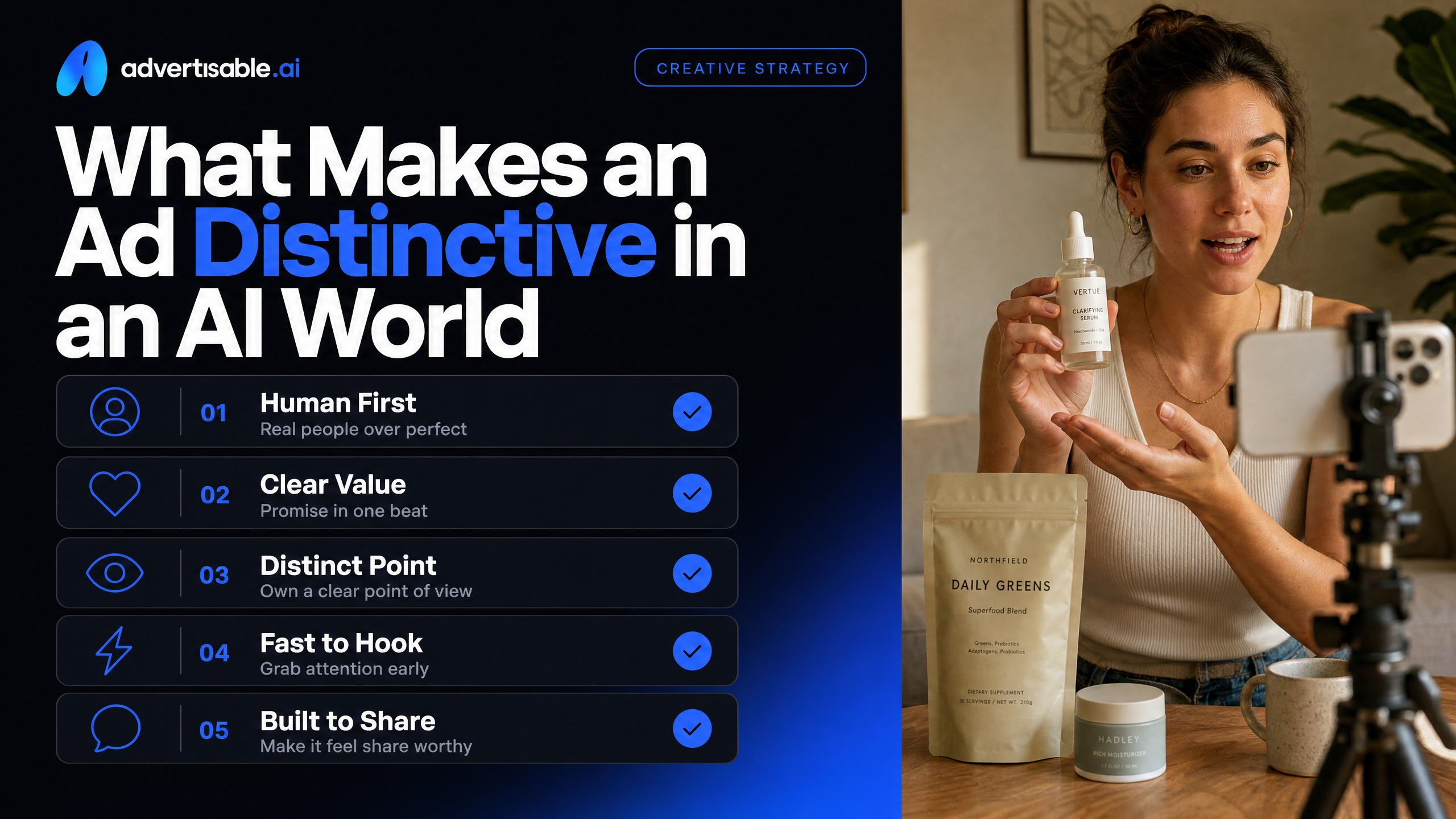
What Makes an Ad Distinctive in an AI World
Anchoring to Real Brand Identity
Distinctive ads start with identity, not prompts. When your creative begins from your actual brand rules, AI becomes a production layer, not the thing deciding your voice, look, and taste.
Identity is the set of cues that make someone recognize you in under a second: your visual system, your language patterns, what you emphasize, and what you refuse to say. AI cannot invent those cues for you because it does not know your history, your tradeoffs, or what your brand has earned the right to claim.
In practice, you need brand-consistency guardrails that constrain every variation, so speed does not turn into on-brand drift.
- Lock a small set of non-negotiables: fonts/colors, logo rules, framing style, and your 3-5 repeatable phrases (and a short list of banned phrases you never use).
- Define your offer posture: are you the rigorous proof brand, the contrarian category educator, or the simplicity brand that removes steps?
- Set “where we show up” rules: pacing, shot types, and how close the product gets to camera in the first 2 seconds.
- Enforce it before you generate at scale (this is what Brand DNA is for), instead of trying to fix identity after the variations ship.
Once identity is locked, you can generate 50 versions and they still feel like one brand, not 50 different tools.
Showing Your Actual Product
The fastest way to separate yourself from the feed is to show your real product, clearly, doing the job it claims to do. AI can fabricate beautiful scenes, but it cannot substitute for product truth without creating risk.
Product proof is not a claim. It is visibility: the exact SKU, the real packaging, the interface, the texture, the before and after state, the unboxing, the install, the workflow, the result. When you ship production-ready creative, “looks polished” is not enough; it needs accurate details, clear product visibility, and no QA surprises.
Operationally, this is where product URL input matters: pull the real product details, then use scene-level control to fix the one moment where the product is unclear, mislabeled, or visually wrong instead of regenerating the whole ad.
- Show the product within the first 3 seconds, not as a reveal at the end.
- Use one unmistakable “receipt” shot: packaging, UI screen, ingredients label, or in-hand scale cue.
- Avoid stand-ins that could be any brand in the category; specificity is the point.
- If one scene drifts, regenerate that scene only and keep the rest of the ad intact.
Leading With Genuine Point of View
A real point of view is the part AI cannot supply: what you believe about the category and what you are willing to say out loud. Most samey ads happen because the messaging is template-first, so the hook, structure, and conclusion all converge.
Point of view is not “be bold.” It is a defensible stance tied to your product and your customers: the problem you think the market misdiagnoses, the tradeoff you choose, the standard you hold. That stance gives you angles that do not sound like everyone else because they are not derived from the same prompt patterns.
Keep it tight: one POV per ad, one main tension, one resolution your product can honestly deliver. If you need help operationalizing this, we see teams move faster when they approve a storyboard first, then let the variation engine create multiple executions within that approved stance.
- Name the enemy precisely (a flawed assumption, a bad habit, or a confusing category norm), not a vague “pain point.”
- Commit to a tradeoff: what you do not optimize for, and why that matters to the buyer.
- Use language only your brand would use, then repeat it across variations so it becomes an asset, not a one-off line.
When identity, product truth, and POV are locked, AI speed stops creating sameness and starts creating consistent advantage.
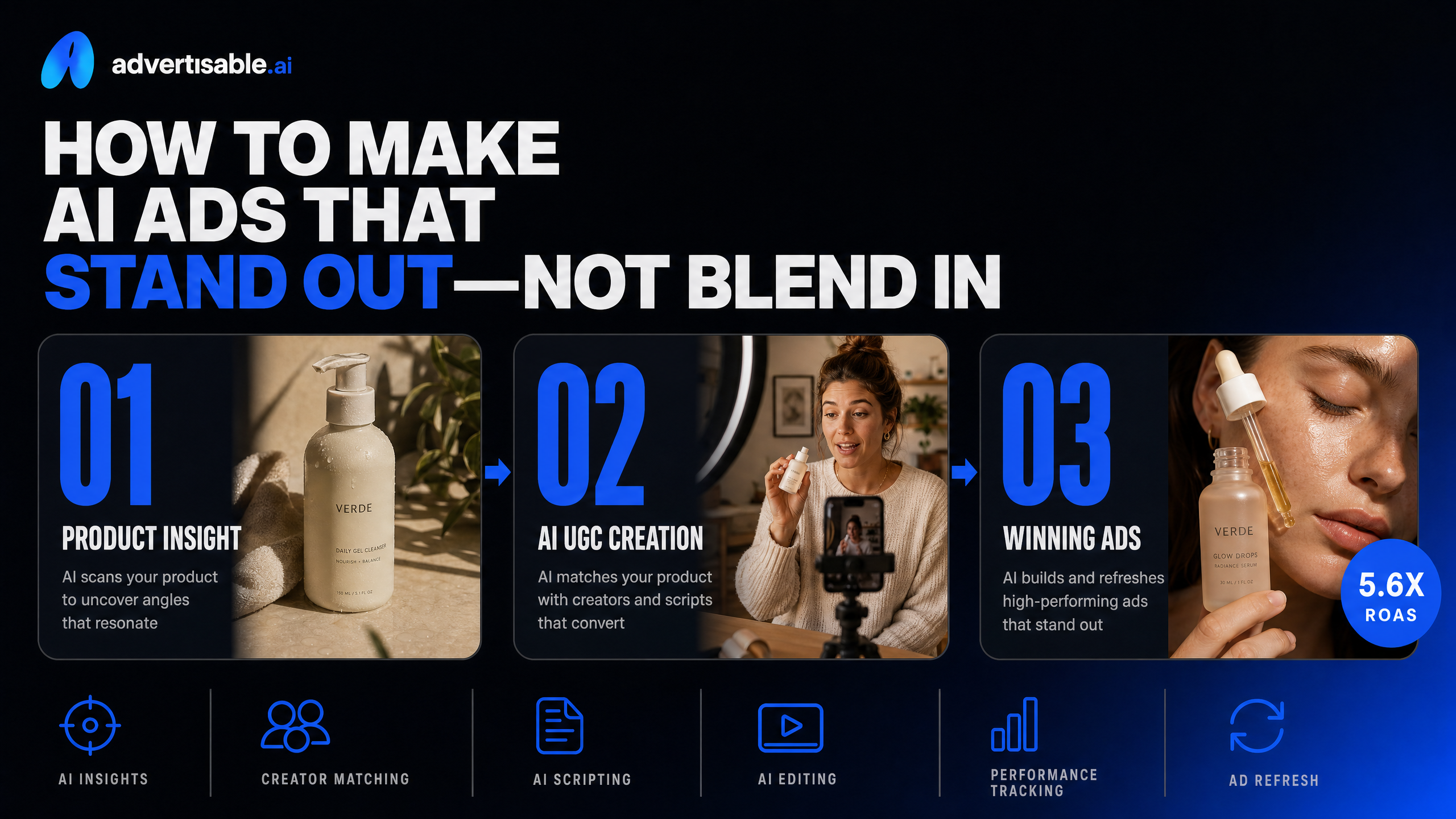
How to Make AI Ads That Stand Out—Not Blend In
Start With Brand Rules, Not Tool Defaults
Same-looking AI ads usually come from the same place: default settings making creative decisions for you. You stand out by forcing the model to operate inside your brand rules from the first draft, not “fixing it in post.”
In practice, that means you define what cannot change before you generate anything: your visual system, your voice, and your product truth. Then you make the AI fill in the blanks, instead of letting it pick a look, cadence, and hook style that happens to be common across the feed.
- Non-negotiables: logo use, color palette, typography rules, and composition do’s and don’ts
- Voice rules: sentence length, taboo words, level of punchiness, and how you handle claims
- Proof rules: what you can show (and cannot imply), plus what “production-ready” means for your QA bar
- Product rules: approved angles, packaging accuracy, and what must be visible on screen
Lock Identity Before You Create Variations
Variation only helps after your identity is locked. Otherwise, you are multiplying drift, not learning.
Treat identity as an approved spec: a consistent visual language plus a consistent point of view. The fastest way to lock it is to approve a storyboard and a small “golden set” of creatives that your team agrees is unmistakably you.
This is also where scene-level control matters. When one scene breaks the rules, you fix that scene, not your whole concept.
- Approve one core narrative structure (hook, problem, mechanism, proof, CTA) before scaling
- Create a reference pack: 3 to 5 on-brand winners you want the AI to emulate
- Define pass-fail checks for brand-consistency guardrails so reviews stay objective
Use AI for Volume, Inside Clear Brand Limits
AI is best used as a variation engine inside boundaries you already trust. Your goal is to ship more shippable variations per week, not more drafts that die in QA.
Put constraints around what can vary. Then scale volume where it actually drives performance testing: new hooks, new openings, new proof sequencing, new formats, and platform-specific cuts, while keeping Brand DNA stable.
This is exactly why we built Advertisable AI around Brand DNA and Frame-by-frame control: you get speed without sacrificing control.
- Lock constants: Brand DNA, product truth, approved claims, and formatting standards
- Vary only one dimension at a time (hook, offer framing, proof order, or visual motif)
- Regenerate the failing scene or frame, not the entire ad, to protect QA time and keep quality high
Anchoring AI Output to Your Brand With Advertisable
Brand DNA + ICP, Locked Before You Scale
Sameness happens when the model decides your voice, visuals, and customer story for you. In Advertisable, we start by extracting your Brand DNA and running ICP analysis from a product URL, then we lock those rules so every creative inherits the same identity.
That means your colors, tone, positioning, and the buyer context stay consistent across statics, video, and AI UGC, even when you are producing lots of variations.
- Brand DNA to set brand-consistency guardrails
- ICP cues that influence hooks, pacing, and objections addressed
- Fewer QA loops caused by on-brand drift between versions
Storyboard and Scene-Level Control
High-volume generation breaks down when one scene misses and you are forced to restart. Frame-by-frame control lets you fix the exact moment that drifted without rebuilding the whole ad.
- Approve structure before credits are spent on full production
- Regenerate only the weak scene (product clarity, claim language, or visual tone)
- Keep the rest of the winning sequence intact
Volume Without Sameness
Once Brand DNA and the storyboard are set, you can safely push volume because your identity stays constant while your angles change. That is how you test hard without flooding your feed with interchangeable creative.
- Generate many shippable variations from one locked identity
- Rotate net-new angles while preserving brand assets and voice
- Reduce rework time so more variations ship on the first pass
Get AI speed without losing your brand
If your feed tests are starting to blur together, the fix is not fewer ads or more ads. It is tighter control over what makes your creative unmistakably yours.
That is exactly why we built Advertisable AI. You can start from a product link, use Brand DNA to lock your identity, then approve a storyboard before you spend credits producing. When a scene misses, Frame-by-frame control lets you correct only what is off, so you protect QA time and keep quality predictable.
If you want volume that does not drift into sameness, start with one product URL and generate a first batch of production-ready variations you can actually ship.
Frequently Asked Questions
Q: What is an AI slop ad?
A: It is an AI-generated ad that feels templated and interchangeable, often repeating the same hooks, pacing, and stock-like visuals across brands. The signal to watch is not “AI” itself, but sameness at scale that lowers attention and trust.
Q: What is the AI slop problem?
A: When everyone can generate endless variations instantly, the market fills with lookalike creative and volume stops being an advantage. The practical impact is wasted spend on ads that fail to earn attention, plus extra QA time trying to fix on-brand drift after the fact.
Q: How is AI-powered ad creative different from AI targeting?
A: Targeting controls who sees your ads, while AI creative controls what they see. If performance drops because the ad looks samey or off-brand, that is a creative problem, not a targeting problem.
Q: What does 'production-ready' actually mean for AI-generated ads?
A: Production-ready means you can ship the ad on brand with clear product visibility and clean messaging, without getting stuck in revision loops. In practice, it is about reducing QA time and improving cost per shippable variation, not just making something that looks polished.