AI Ad Quality vs Quantity: How Many Variations to Test
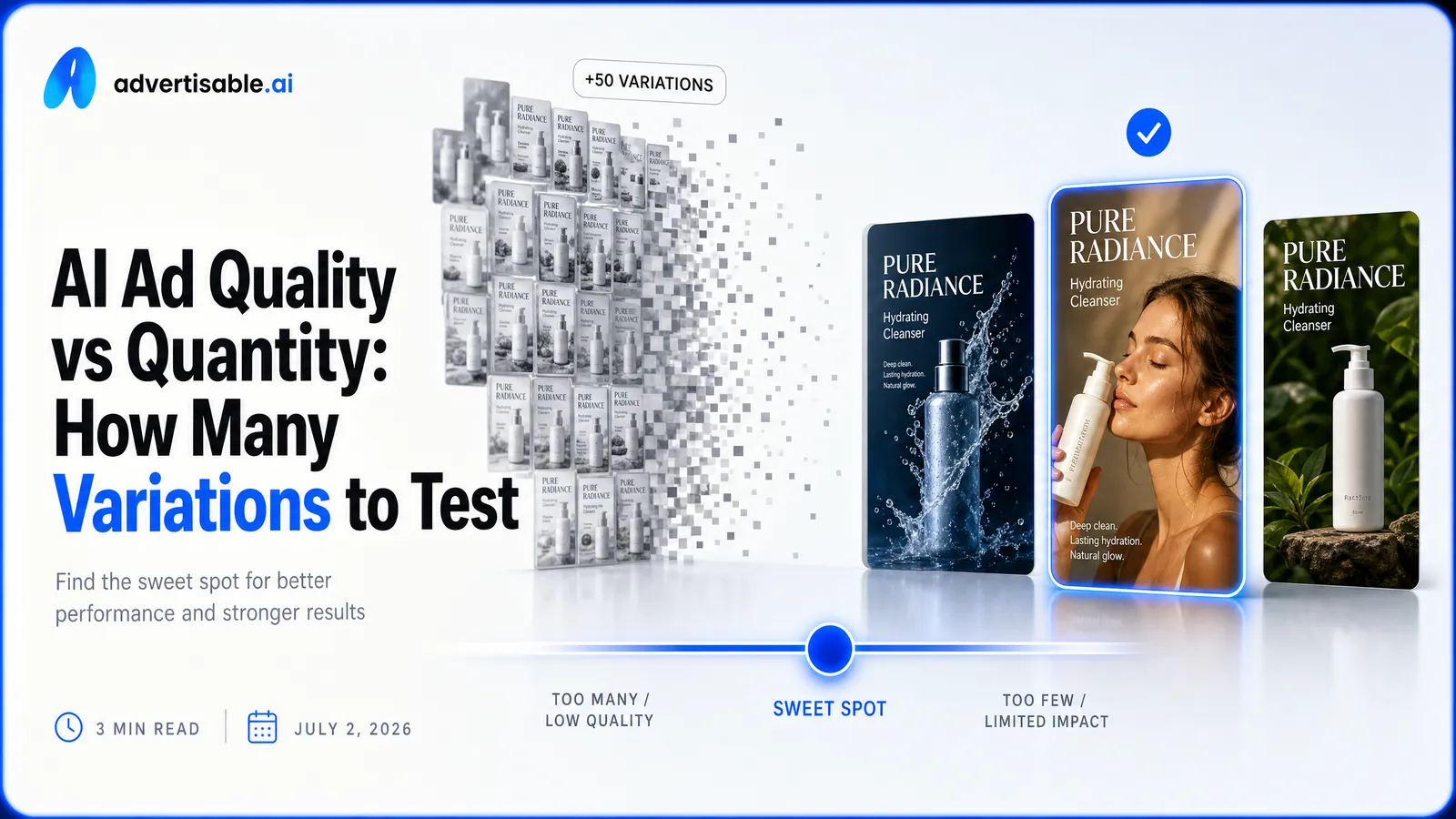
Prioritize neither in isolation. In AI ads, performance improves when you run enough distinct, on-brand variations to create clear learnings, without flooding your account with near-identical versions that burn time and budget. If your CTR and CPA stalled after scaling output, you are not alone.
Here’s what matters most:
- More ads only helps when each version creates a new performance signal.
- Fewer hero ads fails because you cannot predict the winning hook upfront.
- A variation counts only if it changes the hook, angle, or proof.
- One-variable tests keep results readable and prevent false conclusions.
- Start by counting real angles, then cap volume to what you can learn fast.
- Run 48-72 hour cycles so you optimize with data, not opinions.
We built Advertisable AI for this exact middle ground: speed with control. Our Video Ad Generator locks Brand DNA from your product URL, then lets you use a storyboard and scene regeneration to iterate the hook, offer, or CTA without rebuilding everything. That is how you ship 10-20 hook variations that stay consistent, on-brand, and useful for testing.
Once you see why quality versus quantity is a false choice, the “how many variations” question gets easier, because you start optimizing for distinct learnings, not raw output.
The reframe: quality vs quantity is a false choice
You do not win by choosing “more ads” or “better ads” in isolation. You win by producing enough real creative diversity to learn, while holding every variation to a consistent brand standard.
Volume is table stakes now
Volume is no longer a differentiator because AI made output fast and accessible. If you can generate 30 versions in a morning, your competitors can too, and the platforms are already flooded.
The trap is assuming more files equals more learning. In practice, high volume without meaningful differences creates noise: more ads to QA, more permutations to track, and less clarity about what actually moved CTR, CPA, or ROAS.
This is the new baseline: Forbes reporting on ad volume highlights that Adobe predicted that the number of ads will increase 5 times in the next 2 years alone. When supply explodes, “we made more” stops being a strategy and becomes the starting line.
- Volume only helps when it increases signal, not when it multiplies near-identical variations
- More output increases review and trafficking workload, even if generation feels “free” up front
- Creative fatigue does not care how fast you produced the ads, only whether the audience has seen the same idea too many times
Distinct and on-brand is the real axis
The real tradeoff is not quality versus quantity. It is distinct-and-on-brand versus mass-produced-and-indistinguishable.
A “new variation” only counts when it changes something that teaches you: a different hook, a different angle, a different proof element, a different offer framing. Swapping backgrounds, fonts, or minor phrasing tweaks usually does not create a new learning.
At the same time, distinct is not permission to drift. If your variations break your brand voice, misstate the product, or change the promise, you will waste spend and add rework time because you are testing a moving target.
You are aiming for enough variations to run a clean test, but tight enough constraints that every result is comparable and actionable.
Why just make more stopped working
Near-identical ads do not create signal
More ads only helps when the ads are meaningfully different. If you are mostly swapping backgrounds, pacing, or a couple words, you are not increasing learning. You are just adding noise to the test.
Platforms optimize based on patterns they can separate: a distinct hook, a distinct promise, a distinct proof, a distinct offer. Near-identical variants tend to compete with each other for the same audience, split spend, and leave you with results that look inconclusive because nothing truly changed.
In our experience, the fastest way to stall an account is to “ship 30 variations” that are really one idea repeated. You end up debating micro-metrics instead of getting a clear read on what angle actually moves CTR and CPA.
- A real variation changes what the viewer understands in the first 2 seconds (the hook), not just how it looks
- A real variation changes the reason to believe (proof element), not just the CTA button text
- A real variation changes the offer framing or objection handled, not the music track
When each version teaches you something different, you get signal you can scale instead of a pile of ads you cannot interpret.
More variants can increase rework cycles
Every extra variant has a rework cost. When you multiply output without control, you also multiply the number of things that can go off-brand, misstate the product, or miss the ad anatomy that holds performance together.
This is where teams quietly lose the time they thought AI would save: rewriting claims, fixing a muddled product moment, re-approving visuals, then rebuilding exports for each placement. The work shows up as coordination overhead, not creative insight.
Volume also increases the odds you change multiple variables at once, which forces a second pass to untangle what actually drove performance. The result is longer cycles, not faster learning.
A controlled workflow reduces this. For example, we built Advertisable AI around storyboards and scene regeneration so you can fix one scene (often the hook or offer) without touching the rest of the ad, keeping iteration tight instead of turning every tweak into a full redo.
Why just make fewer, better ads also fails
You cannot predict the winning hook
You cannot reliably predict the winning hook upfront, even if your team has great taste and a strong brand. What feels "best" in a review doc often loses to an angle you almost did not ship.
Hooks win or lose based on messy, real-world variables: audience sophistication, current competitors, placement context, and how quickly the product moment validates the promise. That is why treating creative as a small set of precious bets breaks down in paid social.
This is normal experimentation math, not a personal failure. Optimizely's experimentation data shows win rates are around 20% across experiments, and only 10% for experiments tied to revenue, so expecting three carefully crafted ads to consistently contain the winner is unrealistic.
- The hook that sounds most polished can underperform because it front-loads nuance instead of a single clear promise
- A “clever” opener can spike curiosity but miss the buyer intent your offer needs
- A direct pain-point callout can win even when the production is simpler, because it matches the viewer’s self-identification faster
Hero ads turn testing into guessing
Hero ads turn testing into guessing because they force you to change too many things at once, too slowly. When you only have one or two “masterpieces,” every edit becomes a debate and every result feels ambiguous.
In practice, hero-ad workflows create two problems: you do not have enough distinct shots on goal to find a winner, and you cannot isolate why something worked. Teams end up mixing hook, proof, offer, and CTA changes in the same revision, then arguing about what actually moved CTR or CPA.
A controlled approach is the opposite: keep the video body consistent and vary the opening on purpose. That is exactly why we built Advertisable AI’s Hook A/B Generator and scene regeneration, so you can swap the hook without rewriting the whole ad and still learn cleanly.
- One hero ad = one data point, which is rarely enough to separate signal from noise
- Creative review becomes political because every change is “high stakes”
- Results are hard to interpret because multiple variables shift between versions
The load-bearing rule: a variation only counts if it teaches you
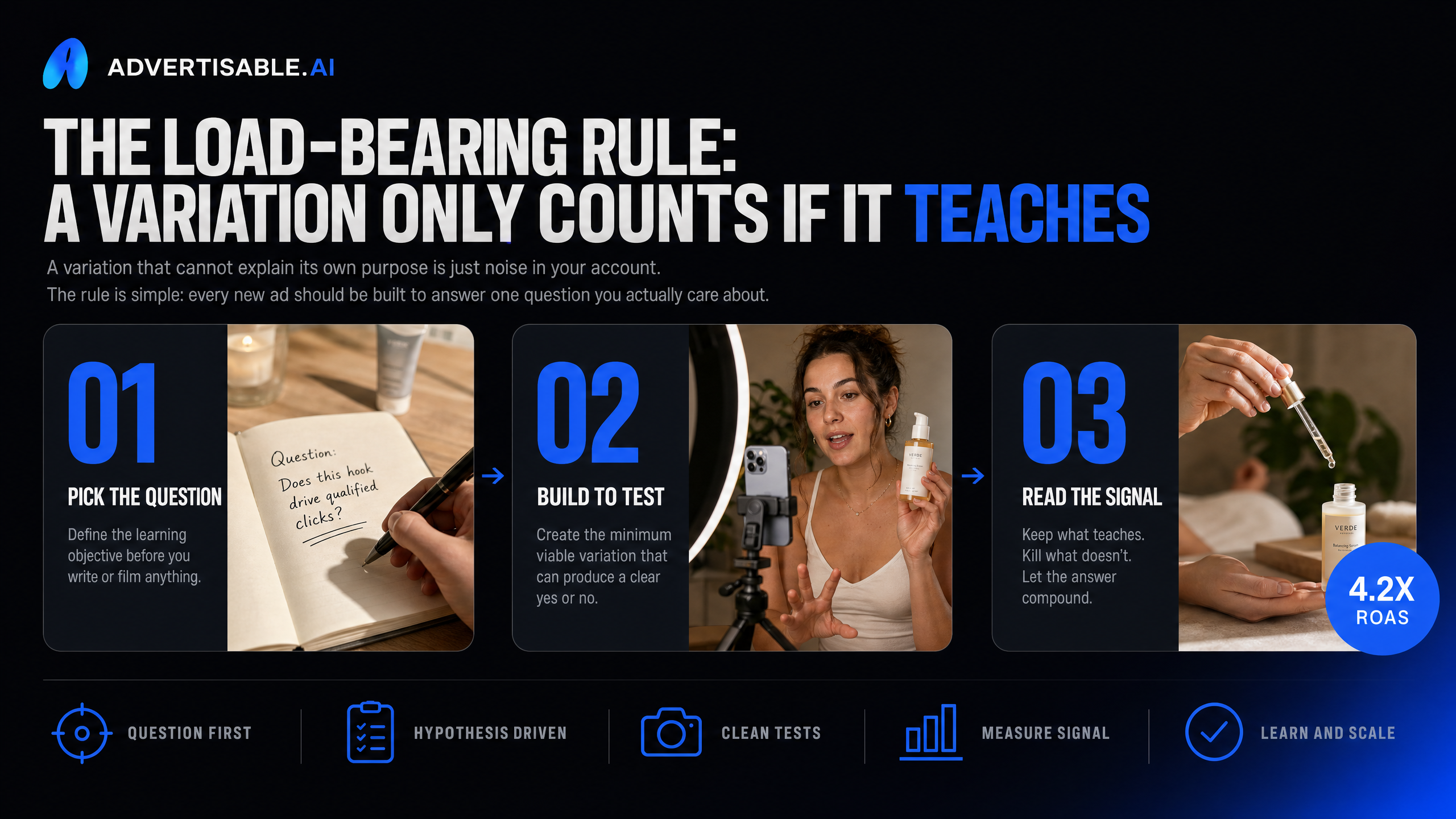
A “variation” that cannot explain its own purpose is just noise in your account. The rule is simple: every new ad should be built to answer one question you actually care about.
Change hooks, not just visuals
Swapping backgrounds, fonts, or b-roll rarely creates a new learning. If the opening promise stays the same, you are mostly testing taste, not performance.
Hooks are load-bearing because they control your first two seconds: thumb-stop, immediate relevance, and whether the viewer earns the right to see the rest. In our experience, teams get cleaner signal when they hold the video body constant and rotate hooks against it, so the account tells you which promise pulls.
- Audience callout hook: “For runners dealing with knee pain…”
- Outcome hook: “Cut prep time in half without changing your ingredients…”
- Objection hook: “No, this is not another subscription trap…”
- Mechanism hook: “Here’s what actually changes when you switch to X…”
Pick one hook family per test so you can scale the winning message across formats, creators, and placements without guessing why it worked.
Angles and proof create learnings
A real variation changes the angle and the proof, not the paint. Angle is the reason to care; proof is why you should believe it.
Without proof, you can get CTR and still lose on CPA because the click was curiosity, not conviction. Without a clear angle, you can show proof all day and still feel flat.
Treat proof as an interchangeable block you can swap in and out: demo moment, before-after, quantified claim you can stand behind, testimonial snippet, or comparison to the old way. When you change proof, you learn what your market trusts, not just what it notices.
- Angle: speed, then proof: time-lapse demo
- Angle: risk reversal, then proof: warranty or guarantee clarity
- Angle: quality, then proof: close-up of materials or process
- Angle: cost control, then proof: simple cost breakdown on-screen
One-variable tests protect clarity
If you change three things at once, you do not have a winner, you have a mystery. One-variable tests keep your learnings usable when you build the next batch.
The most common way teams waste a test is changing multiple variables at once - a new hook AND new proof AND a new CTA - then having no way to tell which change drove the result. That is exactly how you end up with lots of output and zero direction.
Use a fixed “ad anatomy” and rotate one piece at a time: hook or proof or CTA. Tools like our Hook A/B Generator and Scene Regeneration Engine are designed for this, because you can keep the body consistent while you swap only the scene you are testing.
- Lock the storyboard beats (hook, product moment, proof, CTA) before you generate variants
- Name the single variable in the file name (for example: Hook-Outcome vs Hook-Objection)
- Keep offer, CTA, and pacing identical while the test is running
Clarity compounds: one clean learning per cycle turns into a library of winning hooks and proof blocks you can recombine on purpose.
How many ads to test: enough for signal, capped by real angles
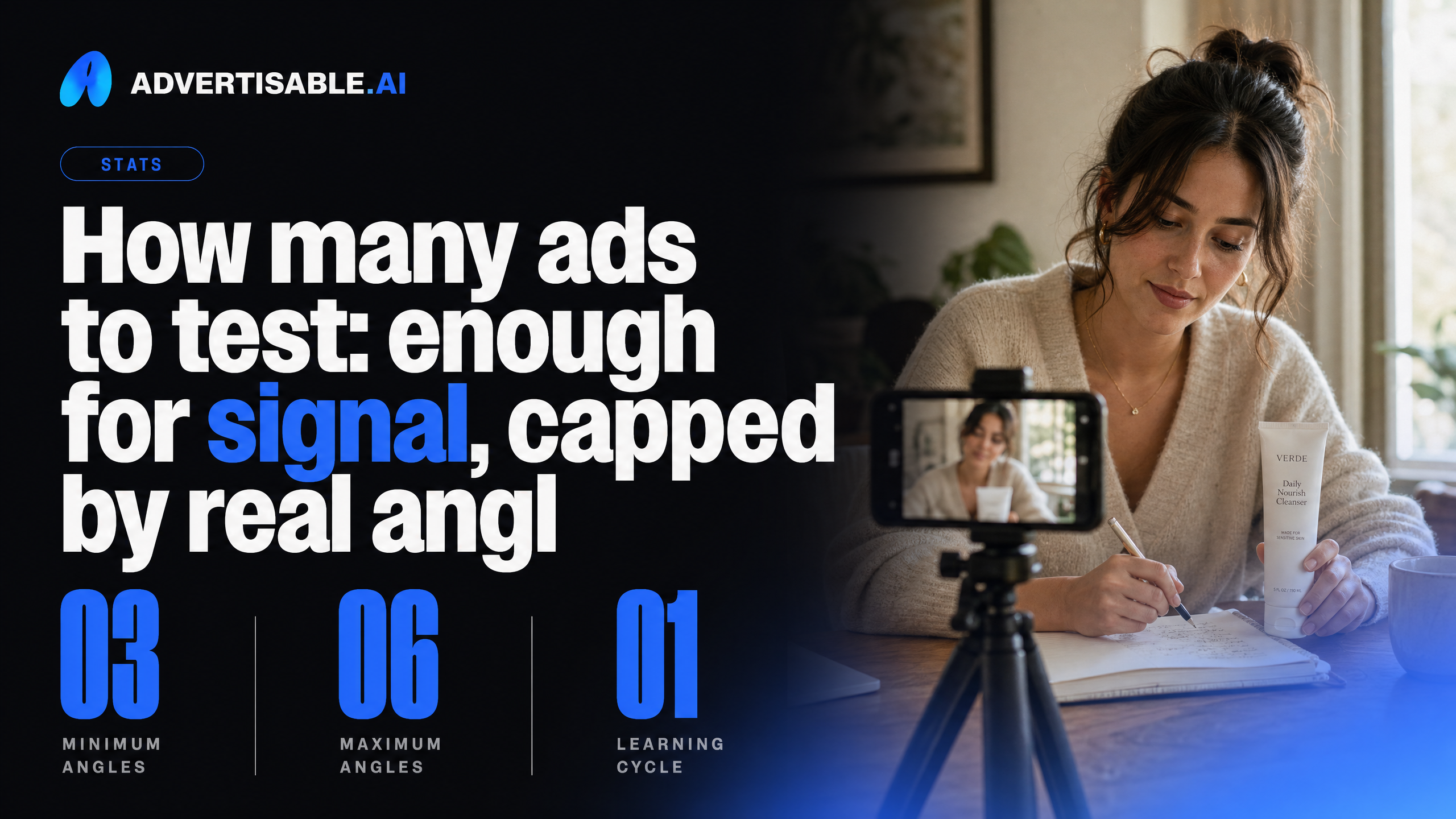
The right test count is not a magic number. It is the smallest set of truly different ideas that can produce a clean learning in a single cycle.
Count angles before you count ads
Start by inventorying angles, not output. If you only have three real angles, making 30 ads just creates noise because you are repeating the same idea with cosmetic changes.
An angle is the reason someone should care: a specific promise, pain point, objection, or proof. A new background, new avatar, or new music is not a new angle unless it changes what the viewer understands in the first 2 seconds.
- Write down 5-10 angles you can defend with accurate product details (outcome, use case, objection, proof, offer)
- For each angle, plan 2-3 hook variations so you can test the opening without rewriting the entire story
- Stop adding ads when you run out of distinct angles you would be comfortable repeating on your best placement
Hold brand standards constant
To get signal, keep brand standards fixed while you vary only the learning target. If every ad has different claims, tone, typography, and CTA, you cannot tell what caused performance to move.
In practice, you lock your Brand DNA, then keep the ad anatomy consistent: same product moment timing, same proof format, same CTA style. You are testing the angle or hook, not reinventing the entire creative each time.
This is where tools like Advertisable AI help: you can keep the video body consistent and generate hook variations without drifting off-brand.
- One claim set you have already approved (no new promises mid-test)
- One visual system (colors, fonts, logo placement, framing rules)
- One CTA structure (same words, same timing) across the whole batch
Ship 48-72 hour learning cycles
Run fast cycles so each batch earns its place. You want enough time for delivery and early conversion signals, but not so long that you keep spending on unclear concepts.
Use one-variable discipline inside each cycle: same core video body, rotate hooks or angles, then decide what you are promoting into the next batch. A practical rule many performance teams use is to give a creative enough delivery to show a clear early signal - often a couple of days or a set spend threshold - then pause the clear losers rather than waiting for a "perfect" read.
Treat each cycle like a handoff: the goal is not to declare a forever winner, it is to identify what to iterate next without restarting your creative system.
- Day 1: Launch a tight set of distinct angles with controlled hook variations
- Day 2-3: Pause clear losers, keep anything showing efficient clicks and early purchase intent
- Next cycle: Keep the winning angle, regenerate only the hook or proof scene, and ship again
Putting it into a controlled system with Advertisable AI
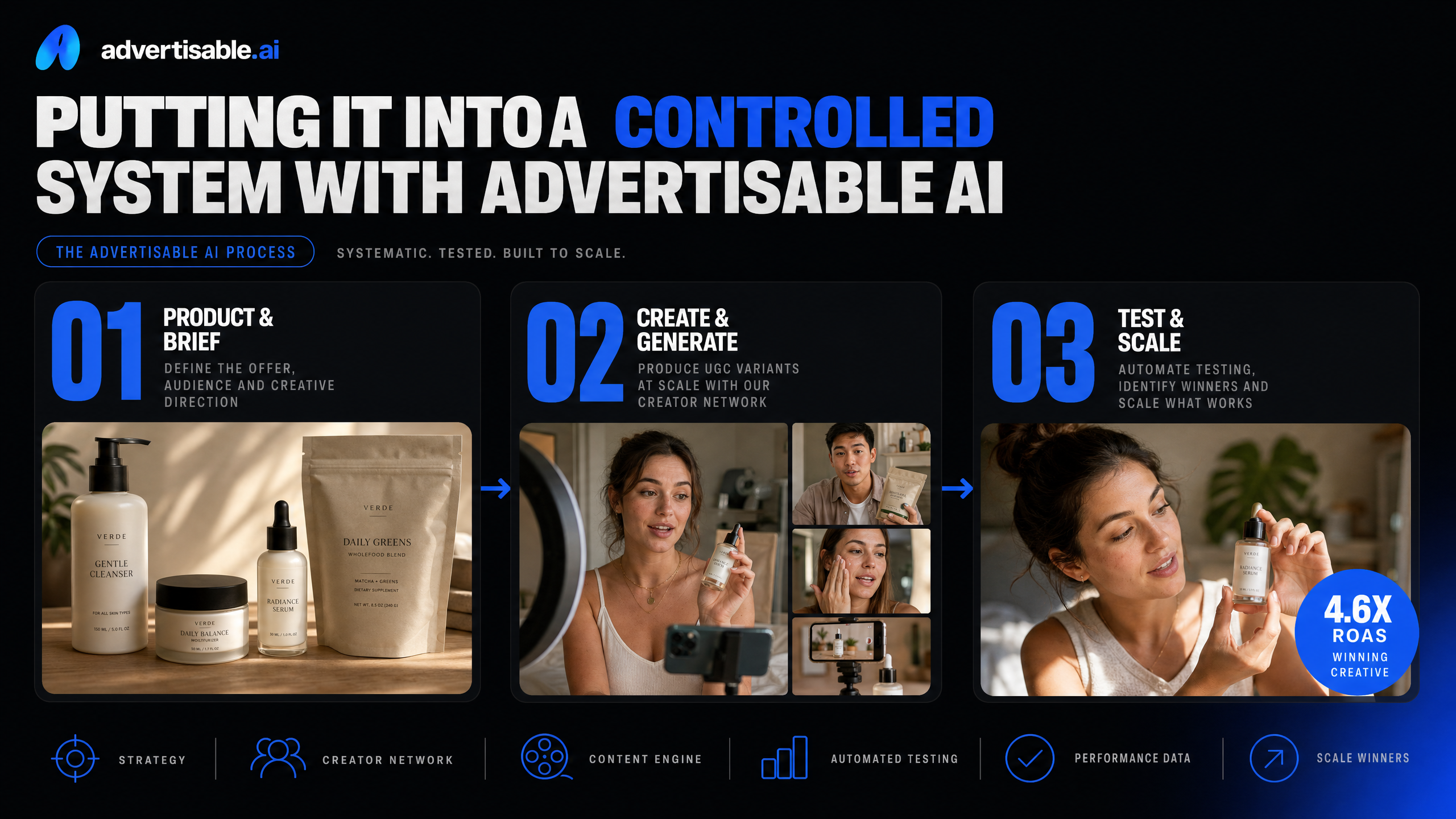
Brand DNA keeps every variation on-brand
Your testing only works if every variation still feels like you. Brand DNA is the control layer that prevents drift while you increase output.
In practice, the fastest way to waste spend is shipping “new” creative that quietly changes the wrong things: colors that do not match your identity, product details that are slightly off, or claims that your brand would not approve. That kind of variation does not teach you anything because you cannot trust what the market is reacting to.
With Advertisable AI, we start by extracting Brand DNA from a product URL, so each creative is anchored to the same brand assets, specs, and proof elements. You get variety where it matters, without turning your account into a brand consistency clean-up project.
- Locks visual consistency: logo use, colors, typography direction, and overall look so your ads read as one brand across placements
- Anchors to product truth: specs and key claims stay aligned with what you actually sell, reducing avoidable rework
- Keeps proof elements reusable: testimonials, reviews, and other proof formats stay consistent while you test different hooks
Frame-by-frame control creates true differences
High-volume output is not the goal. Distinct learnings are. Frame-by-frame control is what lets you change one variable on purpose and keep everything else stable.
Most teams think they are testing, but they are really remixing. A background swap plus new music plus a rewritten script does not tell you what moved CTR or CPA, because you changed three things at once.
A controlled system uses storyboard and scene-level decisions to create clean comparisons. You can keep the video body consistent and generate hook variations, or adjust a single scene without rebuilding the entire asset.
That is how you get real signal from your variation count: one intentional difference per version, with brand consistency held constant.
- Regenerate only the hook to test different opening angles against the same product moment and proof
- Edit one scene to fix clarity issues (offer, CTA, or on-screen text) without changing the rest of the narrative
- Approve the ad anatomy beat-by-beat in a storyboard before export, so the test is deliberate instead of accidental
Build a creative system that produces real signal, not noise
You do not need more ads. You need more distinct, on-brand variations that teach you something in a clean 48 to 72 hour test window. That is where most teams break down: the hooks blur together, the brand drifts, and rework eats the time you were trying to save.
With Advertisable AI, we help you turn a product URL into a controlled testing workflow. Brand DNA locks the standards. The Storyboard Editor lets you approve the ad anatomy beat by beat.
Then our Hook A-B Generator and Scene Regeneration Engine let you swap the hook, offer, or CTA without rebuilding everything.
Start with the $5 trial. Generate one storyboard, create 10 hook variations, export platform-ready sizes, and launch your next learning cycle.
Frequently Asked Questions
Q: Is it better to have quality or quantity?
A: It is a false choice. You need enough volume to learn, but only if each variation is genuinely distinct and stays on-brand, otherwise you just create spend and confusion without signal.
Q: What's the real cost: the plan price or rework time?
A: Rework time is usually the hidden cost that kills velocity. When you can fix only the scene that missed, you protect your testing cadence and keep your one-variable experiments clean.
Q: Why do my AI ads underperform compared to professional creatives?
A: Most underperformance comes from off-brand drift, unclear product moments, or testing variants that are too similar to teach you anything. Lock your Brand DNA, storyboard first, then test hook variations against a consistent video body so the data tells you what actually moved performance.
Q: How is this different from Creatify or other avatar tools?
A: We are built for controlled performance testing, not just output. Advertisable AI locks Brand DNA for consistency, supports storyboard approval, and lets you regenerate specific scenes so your variations are truly distinct without turning iteration into a rewrite loop.